Summons for Unlawful Detainer
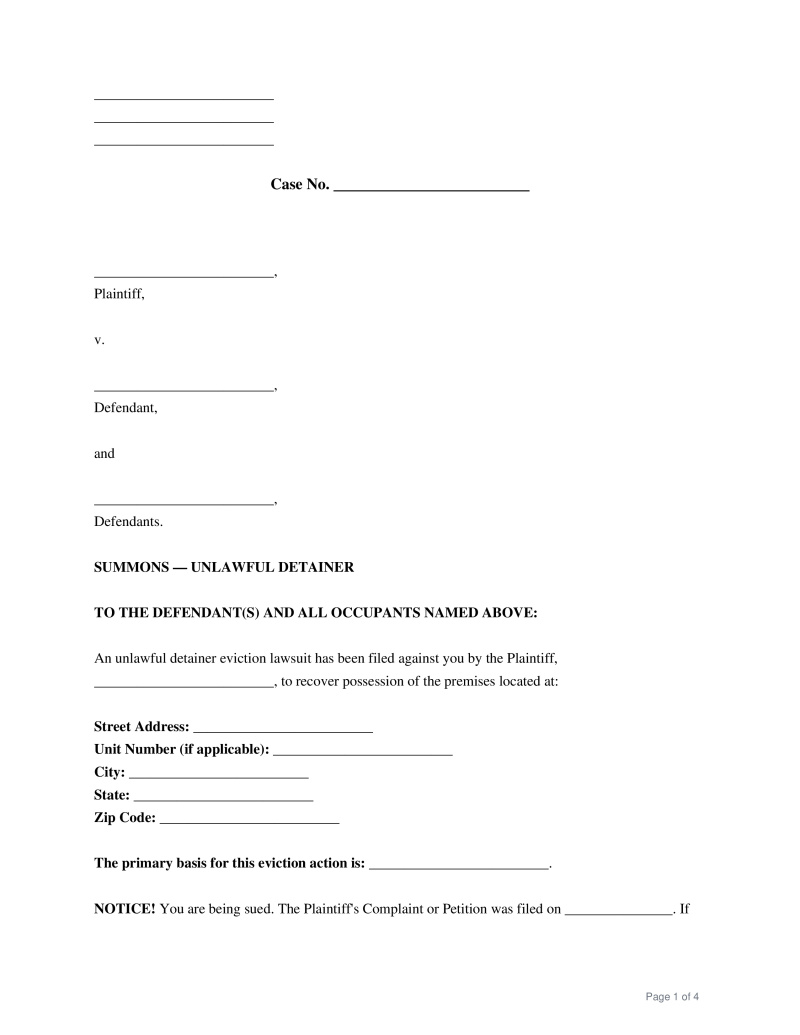
A Summons for Unlawful Detainer is a formal legal document issued by a court that officially notifies a tenant of an impending eviction lawsuit and directs them to respond within a specified period.
Summons Posture
Select the situation that best describes why this summons is being prepared.
Table of Contents
What is a Summons for Unlawful Detainer?
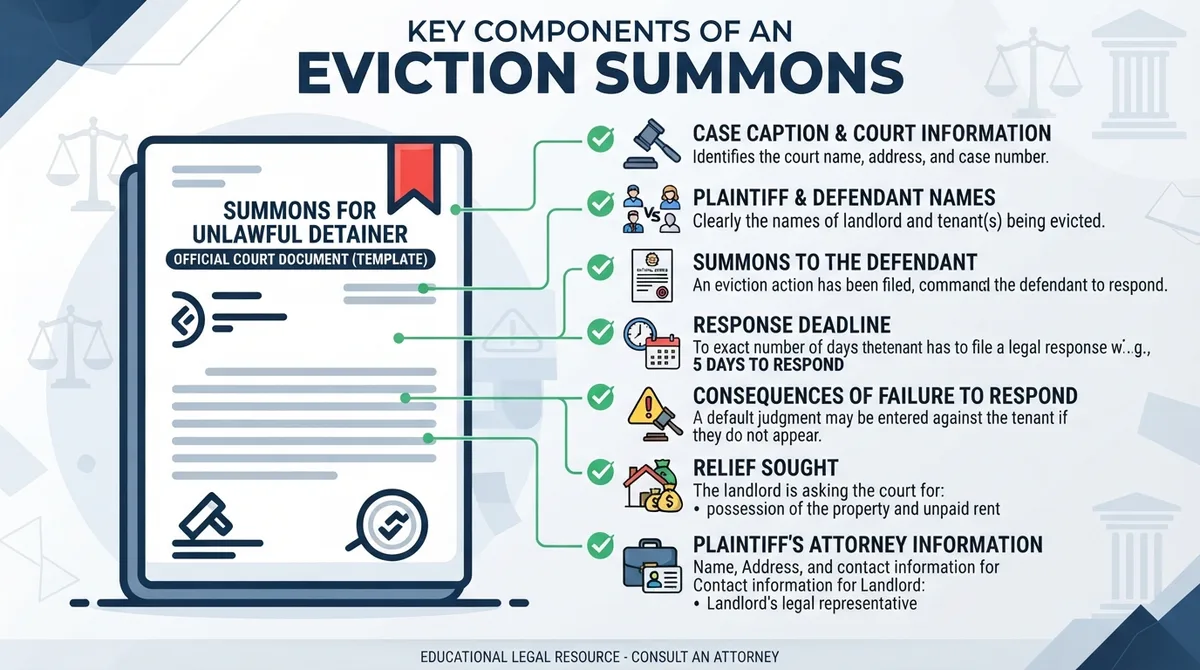
A Summons for Unlawful Detainer is a formal legal document issued by a court to notify a tenant that their landlord has initiated an eviction lawsuit. This document serves as official notice that legal action has commenced to regain possession of the rental property and obtain any unpaid rent or damages. It outlines the specific timeline in which the tenant must respond to the court and details the consequences of failing to do so. Landlords utilize this legal instrument as a mandatory step in the judicial eviction process to ensure the tenant's constitutional right to due process is respected.
Required Elements of a Summons
To be legally valid, a Summons for Unlawful Detainer must contain specific details that sufficiently inform the tenant of the legal proceedings:
- Party Identification - The full names of both the plaintiff landlord and the defendant tenant.
- Court Jurisdiction - The name and address of the specific court where the eviction lawsuit has been filed.
- Nature of Action - A clear statement explaining that the lawsuit is an unlawful detainer action seeking eviction.
- Relief Sought - The specific remedies the landlord is requesting, such as possession of the property, past-due rent, and legal fees.
- Response Deadline - The exact timeframe or return day by which the tenant must file a formal response or appear in court.
- Service Address - A physical street address where the tenant must deliver their written notice of appearance or answer.
- Contact Information - The telephone number, physical address, and facsimile number of the plaintiff or their legal representative.
State-Specific Legal Frameworks
State statutes dictate the exact formatting, language, and timelines required for eviction summonses:
- Washington State Summons Contents - Outlines the mandatory language, party details, return day, and physical address requirements for unlawful detainer summons forms (RCW 59.18.365).
- California Unlawful Detainer Summons - Establishes the official SUM-130 form used to notify tenants of eviction actions and the strict five-day response window (Cal. Code Civ. Proc. § 1167).
Consequences of Failing to Respond
Tenants who receive an eviction summons must act quickly to avoid severe legal and financial repercussions:
- Default Judgment - The court may automatically rule in favor of the landlord without a trial.
- Loss of Possession - The court will issue a writ authorizing law enforcement to remove the tenant from the property.
- Financial Liability - The tenant may be ordered to pay all unpaid rent, late fees, court costs, and landlord attorney fees.
- Negative Credit Impact - An eviction judgment becomes a matter of public record, significantly damaging the tenant's credit score and future rental prospects.
Types of Unlawful Detainer Actions
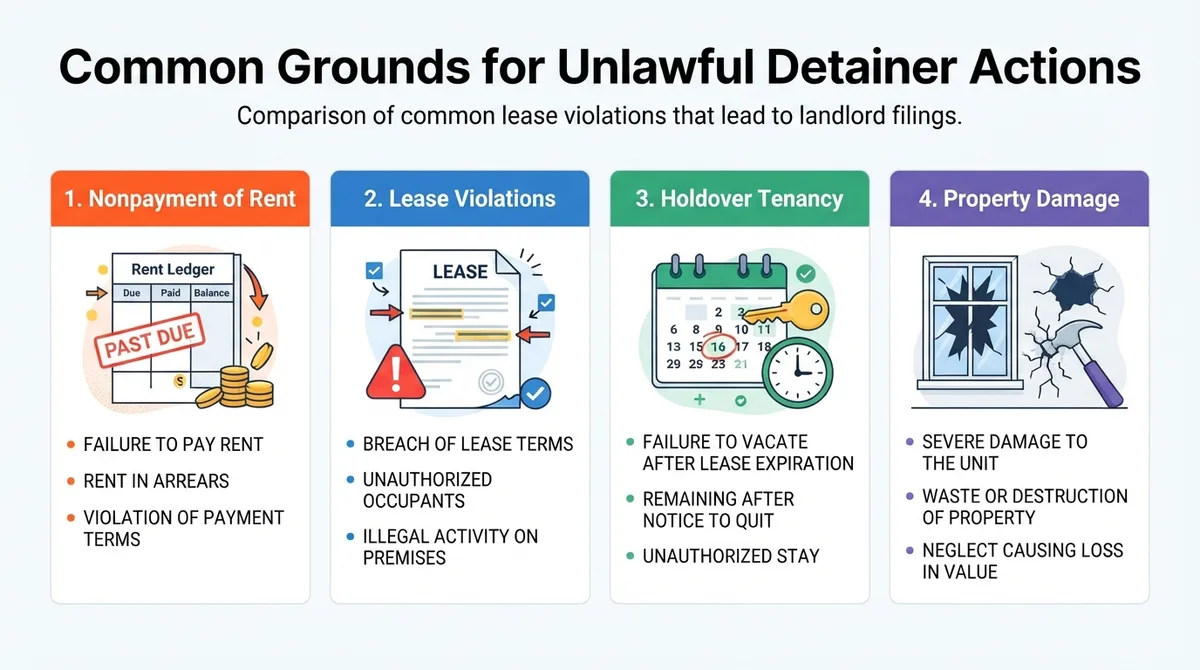
Eviction cases arise under several distinct circumstances, each requiring specific documentation:
- Nonpayment of Rent - An action initiated when a tenant fails to pay rent within the timeframe specified in a written notice.
- Lease Violation - A lawsuit filed after a tenant breaches a material term of the lease agreement and fails to cure the violation.
- Holdover Tenancy - An action brought against a tenant who remains in possession of the property after the lease term has expired without landlord consent.
- Nuisance or Illegal Activity - An expedited eviction process used when a tenant engages in illegal acts or causes severe damage to the property.
How to Respond to a Summons
Tenants must follow precise legal procedures when responding to an eviction notice to ensure their defense is heard:
- Read the Entire Document - Carefully review all dates, court locations, and allegations listed to understand the timeline and the landlord's claims.
- Draft a Written Answer - Prepare a formal response addressing each allegation in the complaint, admitting or denying each claim and stating any affirmative defenses.
- File the Answer with the Court - Submit the completed written response to the clerk of the court where the case was filed before the deadline expires.
- Serve the Plaintiff - Deliver a copy of the filed answer to the landlord or the landlord's legal counsel using the service address specified in the summons.
- Attend the Scheduled Hearing - Appear in court on the designated date to present evidence, call witnesses, and argue the case before a judge.
Frequently Asked Questions
Sources
- RCW 59.18.365: Unlawful Detainer Action—Summons—Form - Defines the required contents of a summons in unlawful detainer actions in Washington State.
- Summons—Eviction (Unlawful Detainer/Forcible Detainer/Forcible Entry) (SUM-130) - Provides the official form and instructions for the Summons in unlawful detainer actions in California.
Not the form you're looking for?
Try our legal document generator to create a custom document
Disclaimer: The templates available on this website are provided for general informational purposes only and do not constitute legal advice. They are not intended to be, and should not be interpreted as, compliant with any specific legal, regulatory, or privacy requirements. These templates are not a replacement for professional legal guidance and should not be relied upon for any particular matter or circumstance. Users are strongly encouraged to seek advice from a qualified attorney licensed in their jurisdiction before using, modifying, or relying on any template.
All templates are provided on an "as is," "with all faults," and "as available" basis. The provider disclaims any and all warranties of any kind, whether express, implied, statutory, or otherwise, including without limitation warranties of merchantability, fitness for a particular purpose, title, or non-infringement.
LegalTemplates.com makes no guarantees or representations regarding the accuracy, completeness, expected outcomes, or reliability of the materials contained in these templates or any materials referenced or linked from them.