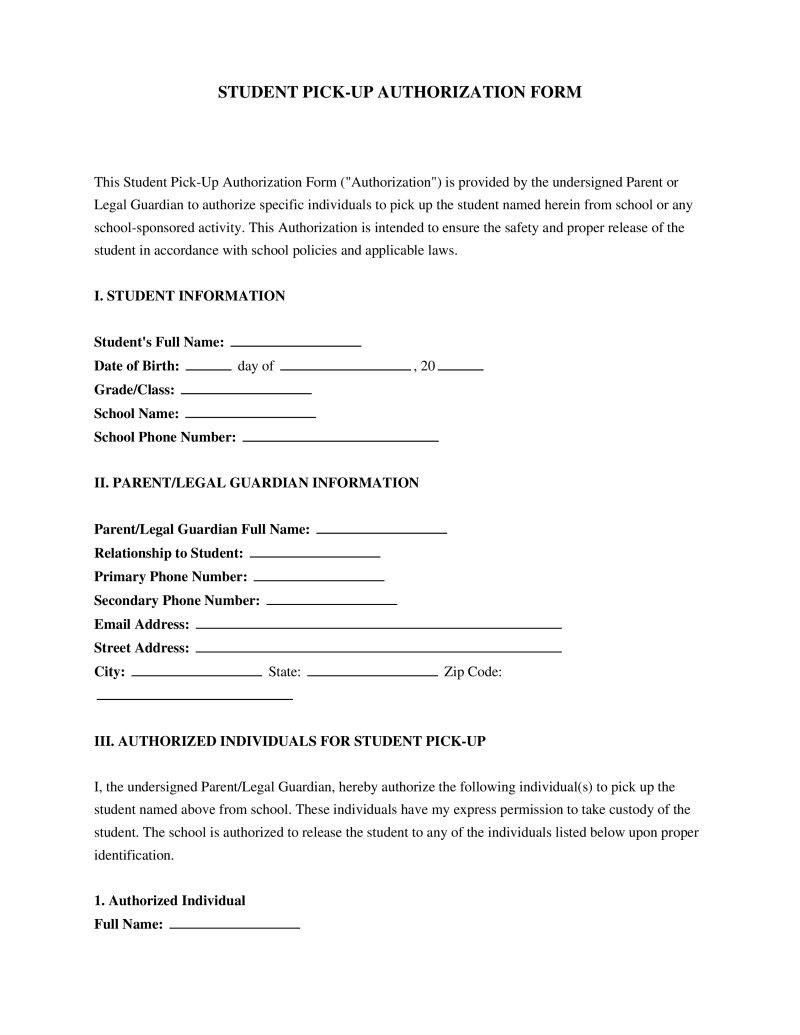
School Pickup Authorization Form
A School Pickup Authorization Form is a legal instrument by which a parent or guardian formally designates an authorized individual to collect a minor child from school or a designated care facility.
Authorization Type
Choose whether this authorization is for a one-time pickup or ongoing/recurring pickups.
Specify the date for the one-time pickup.
Choose all days that apply for ongoing pickups.
Provide additional details if pickup days are not listed.
Enter the start date for ongoing pickups.
Enter the end date for ongoing pickups, if any.
Table of Contents
What is a School Pickup Authorization Form?
A School Pickup Authorization Form is a formal legal document designed to grant permission for individuals other than a student's legal guardian or parent to pick up a child from school. This document is crucial for ensuring student safety and maintaining clear communication between educational institutions and families. It serves as a protective measure, explicitly detailing who is permitted to take a student from school premises, thereby preventing unauthorized individuals from doing so. Parents, legal guardians, and schools utilize this form to establish a clear record of approved individuals, minimizing potential security risks and streamlining daily dismissal procedures.
Legal Requirements and Validity
The legal validity and requirements for a School Pickup Authorization Form are primarily governed by state education codes, school district policies, and general principles of parental authority and child safety. While there isn't a single federal statute exclusively dictating this form, its enforceability relies on clear, unambiguous consent provided by the legal guardian. Schools typically establish their own specific procedures and form templates to ensure compliance with local regulations and best practices.
For a School Pickup Authorization Form to be considered legally valid and effective, several key elements are generally required:
- Written Consent - The authorization must be provided in writing, typically on a form supplied or approved by the school, to create a verifiable record.
- Parent/Guardian Signature - The form must be signed and dated by the student's legal parent or guardian, affirming their intent to grant permission.
- Clear Identification of Parties - The form must clearly identify the student, the authorizing parent/guardian, and all individuals being authorized to pick up the student.
- Specific Duration or Event - The authorization should specify the period for which it is valid (e.g., for the academic year, a specific date, or a particular event).
- Compliance with Court Orders - The authorization must not contradict any existing court orders regarding child custody, visitation, or restraining orders, which take precedence over parental consent.
- School Verification Procedures - Schools often require authorized individuals to present valid photo identification upon pickup to verify their identity against the information provided on the form.
- Timely Submission and Updates - The form must be submitted to the school in advance of any pickup, and parents are obligated to update the school promptly regarding any changes or revocations of authorization.
Applicable Federal and State Laws
While no single federal law specifically mandates the creation of a School Pickup Authorization Form, several federal and state statutes inform the practices surrounding its use, primarily concerning student privacy and safety. Educational institutions must navigate these laws to ensure their policies are compliant and protective of student welfare.
Several federal laws govern aspects related to student information and safety:
- Family Educational Rights and Privacy Act (FERPA) - This federal law protects the privacy of student education records. It requires schools to obtain written permission from the parent or eligible student before disclosing personally identifiable information from their education records (20 U.S.C. § 1232g). While not directly about pickup authorization, FERPA dictates how schools manage and protect student information, including who has access to a student and their records, thus influencing the need for formal authorization for release.
- Child Abuse Prevention and Treatment Act (CAPTA) - This act provides federal funding to states in support of child abuse and neglect programs. While not directly related to pickup forms, it underscores the importance of school policies that prioritize child safety and prevent situations where a child might be released into an unsafe environment (42 U.S.C. § 5101 et seq.).
State laws often provide more direct guidance or frameworks for school operations:
- State Education Codes - Most states have comprehensive education codes that outline the responsibilities of public and private schools regarding student attendance, safety, and custody. These codes frequently contain provisions related to student release policies, requiring schools to establish clear procedures for student dismissal and authorized pickups (e.g., California Education Code § 48200 et seq., New York Education Law § 3201 et seq.).
- Child Custody and Family Law Statutes - State family laws govern child custody and visitation orders. Schools are generally legally bound to adhere to these court orders, which can supersede parental authorizations if they conflict. If a court order specifies who has the right to pick up a child or prohibits certain individuals, the school must prioritize the court order (e.g., Texas Family Code § 153.001 et seq.).
Penalties for non-compliance with these laws or school policies can vary. For schools, failure to adhere to FERPA can result in the loss of federal funding. For individuals, attempting to pick up a child without authorization, especially in violation of a custody order, could lead to legal consequences, including charges of interference with child custody or kidnapping, depending on the severity and intent.
Rights and Obligations of Parties Involved
The effective implementation of a School Pickup Authorization Form relies on a clear understanding of the rights and obligations of all parties involved: the parents/legal guardians, the school, and the authorized individuals.
Parents/Legal Guardians:
- Right to Designate - Parents or legal guardians have the fundamental right to designate who is authorized to pick up their child from school, reflecting their custodial authority.
- Right to Revoke - They retain the right to revoke or modify any authorization at any time, typically requiring written notice to the school.
- Obligation to Provide Accurate Information - Parents are obligated to provide complete, accurate, and current information on the authorization form, including contact details and identification specifics for all authorized individuals.
- Obligation to Communicate Changes - They must promptly inform the school of any changes to custody arrangements, contact information, or the list of authorized individuals.
- Obligation to Inform Authorized Individuals - Parents should ensure that authorized individuals are aware of their responsibilities and the school's pickup procedures.
School:
- Obligation to Ensure Safety - The school's primary obligation is to ensure the safety and well-being of all students, which includes releasing them only to authorized individuals.
- Obligation to Adhere to Authorization - Schools are obligated to follow the instructions provided on a valid School Pickup Authorization Form, as long as it does not conflict with a court order.
- Obligation to Verify Identity - The school has a right and obligation to require and verify the identity of any individual attempting to pick up a student, often through photo identification.
- Obligation to Maintain Records - Schools must securely maintain all authorization forms and related documentation in compliance with privacy laws like FERPA.
- Right to Refuse Pickup - The school has the right to refuse to release a student if there is any doubt about the identity of the person, the validity of the authorization, or if a conflict with a custody order exists.
Authorized Individuals:
- Obligation to Present Identification - Authorized individuals are obligated to present valid government-issued photo identification upon request by school staff.
- Obligation to Follow School Procedures - They must comply with all school-specific pickup procedures, including designated pickup areas and times.
- No Inherent Right to Pick Up - An authorized individual has no inherent right to pick up a child; their ability to do so is solely derived from the parent's authorization and the school's acceptance of that authorization.
How to Complete a School Pickup Authorization Form
Completing a School Pickup Authorization Form accurately is vital to ensure the safety of students and the smooth operation of school dismissal procedures. The process typically involves several straightforward steps designed to gather all necessary information and confirm consent.
- Obtain the Official Form - Acquire the specific School Pickup Authorization Form directly from your child's school or school district website. Using the official form ensures all required fields pertinent to that institution's policies are included. Avoid using generic templates, as specific school requirements may differ.
- Provide Student and Parent Information - Fill in the student's full legal name, date of birth, grade, and any other identifying information requested. Subsequently, enter the full legal name, relationship to the student, and primary contact information (phone, email, address) for the parent or legal guardian completing the form. This section establishes the primary custodial authority.
- List Authorized Individuals - For each person you wish to authorize, provide their full legal name, relationship to the student (e.g., grandparent, aunt, family friend), and their primary contact phone number. It is highly advisable to also include a brief physical description or a copy of their photo ID if the form allows, as this aids school staff in identification. Ensure these individuals are reliable and aware they may be called upon.
- Specify Authorization Period and Conditions - Clearly indicate the duration for which the authorization is valid. This could be for the entire academic year, specific dates, or for particular events. Some forms may also allow for specifying conditions, such as "for emergencies only" or "after 3:00 PM." Review existing custody agreements to ensure the authorization does not conflict with any court orders.
- Sign and Date the Form - The parent or legal guardian must sign and date the form, certifying that the information provided is accurate and that they are granting permission for the listed individuals. Some schools may require a witness signature or notarization for enhanced legal validity, especially in complex custody situations. Always check the form's instructions for such requirements.
- Submit and Confirm Receipt - Return the completed and signed form to the designated school office or administrator. It is good practice to request a confirmation of receipt to ensure the form has been processed and is on file. Keep a copy of the completed form for your own records and inform all authorized individuals that their names are on file and they may be asked for identification.
Required Elements of a Valid School Pickup Authorization Form
For a School Pickup Authorization Form to be considered valid and actionable by an educational institution, it must contain specific information that clearly identifies all parties and the scope of the authorization. These elements are critical for legal compliance and ensuring student safety:
- Student's Full Legal Name and Identifying Information - Includes the student's complete name, date of birth, grade level, and any student ID numbers required by the school.
- Parent/Legal Guardian's Full Legal Name and Contact Information - The complete name, relationship to the student, primary phone number, and often an email address of the individual granting the authorization.
- Full Legal Name of Each Authorized Individual - The complete legal name of every person permitted to pick up the student, ensuring no ambiguity.
- Relationship of Authorized Individuals to the Student - A clear indication of how each authorized person is related to or connected with the student (e.g., grandparent, aunt, neighbor, family friend).
- Contact Information for Each Authorized Individual - A reliable phone number for each authorized person, allowing the school to contact them if necessary.
- Specific Dates or Duration of Authorization - The period for which the authorization is valid, such as the current academic year, specific dates for a trip, or an ongoing basis until revoked.
- Parent/Legal Guardian's Signature and Date - The legally binding signature of the parent or guardian, along with the date the form was signed, confirming their consent.
- Statement Regarding Photo Identification Requirement - Often includes a clause acknowledging that authorized individuals may be required to present valid government-issued photo identification upon pickup.
- Emergency Contact Information - While not strictly part of the pickup authorization, many forms integrate emergency contact details as a supplementary safety measure.
Frequently Asked Questions
Not the form you're looking for?
Try our legal document generator to create a custom document
Disclaimer: The templates available on this website are provided for general informational purposes only and do not constitute legal advice. They are not intended to be, and should not be interpreted as, compliant with any specific legal, regulatory, or privacy requirements. These templates are not a replacement for professional legal guidance and should not be relied upon for any particular matter or circumstance. Users are strongly encouraged to seek advice from a qualified attorney licensed in their jurisdiction before using, modifying, or relying on any template.
All templates are provided on an "as is," "with all faults," and "as available" basis. The provider disclaims any and all warranties of any kind, whether express, implied, statutory, or otherwise, including without limitation warranties of merchantability, fitness for a particular purpose, title, or non-infringement.
LegalTemplates.com makes no guarantees or representations regarding the accuracy, completeness, expected outcomes, or reliability of the materials contained in these templates or any materials referenced or linked from them.