Plea Agreement
A plea agreement is a legal contract between a prosecutor and a defendant where the defendant pleads guilty in exchange for a reduced charge or sentence.
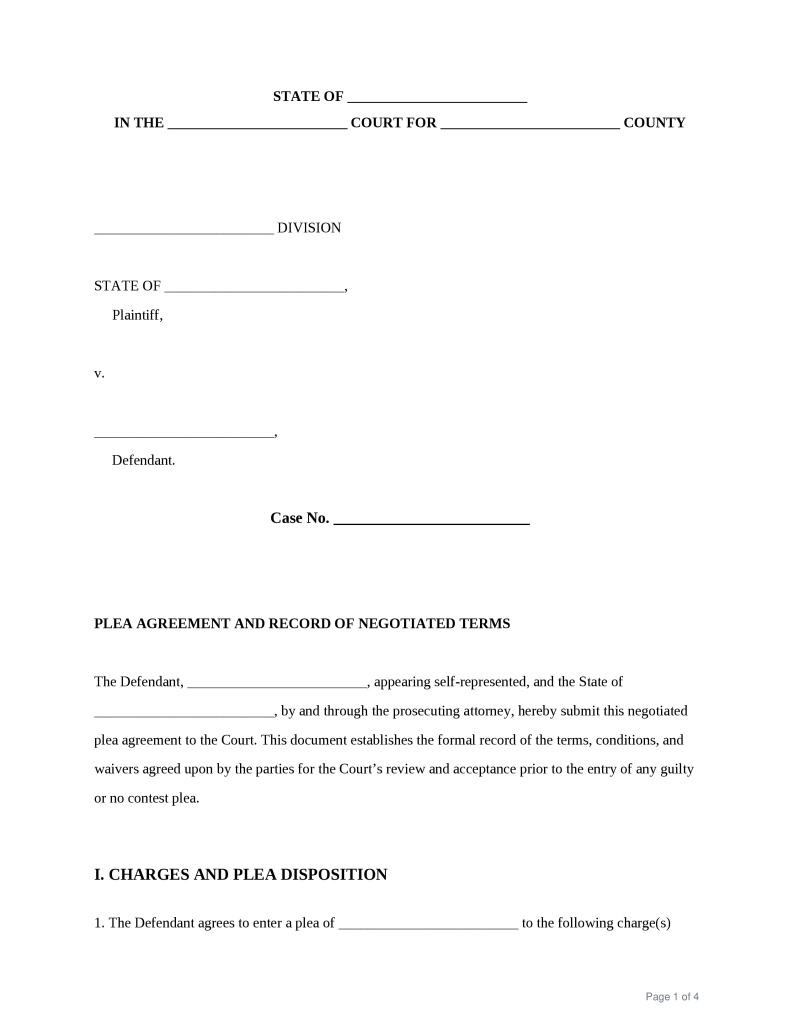
Plea Entry Type
Select the plea posture the court will be asked to accept. A conditional plea may preserve a specific issue for appeal if allowed by the jurisdiction and court order.
Identify the ruling, motion, or legal issue the Defendant is preserving, such as denial of a suppression motion.
Table of Contents
What is a Plea Agreement?
A plea agreement is a formal, legally binding contract between a criminal defendant and the prosecution in which the defendant agrees to plead guilty or nolo contendere to a specific charge in exchange for certain concessions. This legal instrument serves to resolve criminal charges without undergoing a full jury trial, conserving judicial resources and providing predictability for both parties. The document establishes the specific terms of the negotiated settlement, including recommended sentences, charge reductions, or the dismissal of other pending charges. It must be reviewed and approved by a presiding judge to ensure the defendant enters the agreement voluntarily and with a full understanding of the constitutional rights being waived.
Types of Plea Agreements
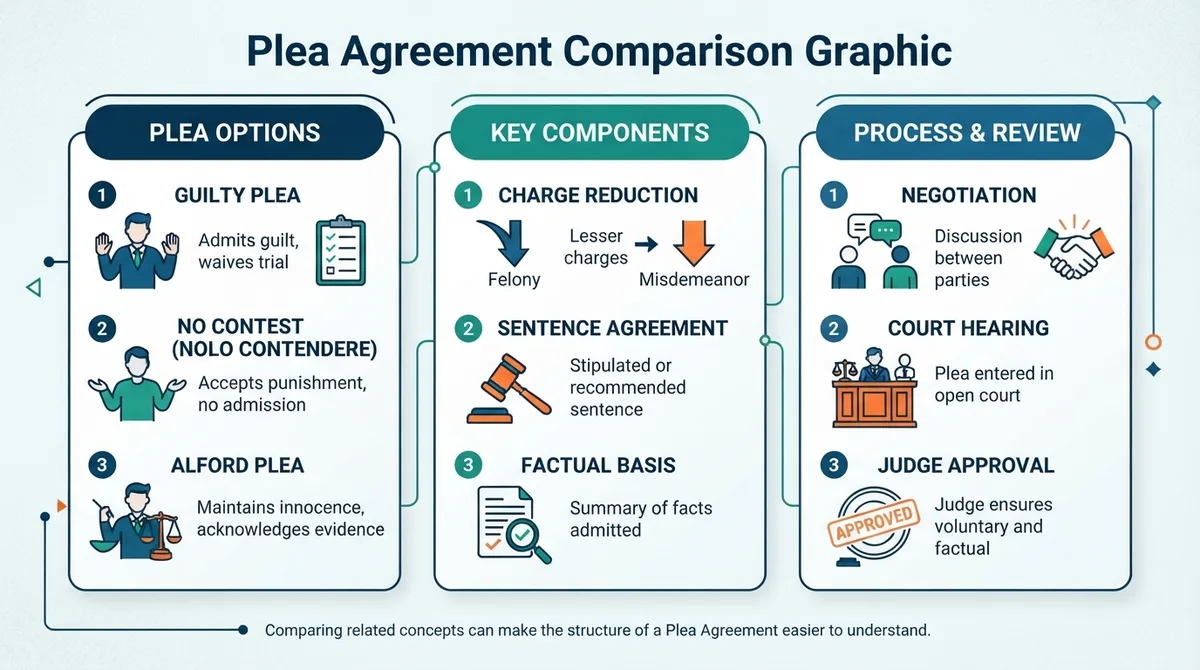
Criminal justice systems utilize different structures of negotiated agreements to resolve charges before trial, depending on the nature of the charges and the goals of the parties involved:
- Charge Bargaining - Negotiation where the prosecutor agrees to dismiss certain charges or file a less serious charge in exchange for a guilty plea.
- Sentence Bargaining - Agreement where the defendant pleads guilty to the original charge in exchange for a specific, lighter sentence or a prosecution promise to recommend leniency.
- Fact Bargaining - Agreement where both parties agree to stipulate to certain facts of the case, preventing other potentially aggravating facts from entering the official court record.
- Count Bargaining - Negotiation where a defendant facing multiple charges pleads guilty to a subset of those charges in exchange for the dismissal of the remaining counts.
Core Components of the Plea Agreement Form
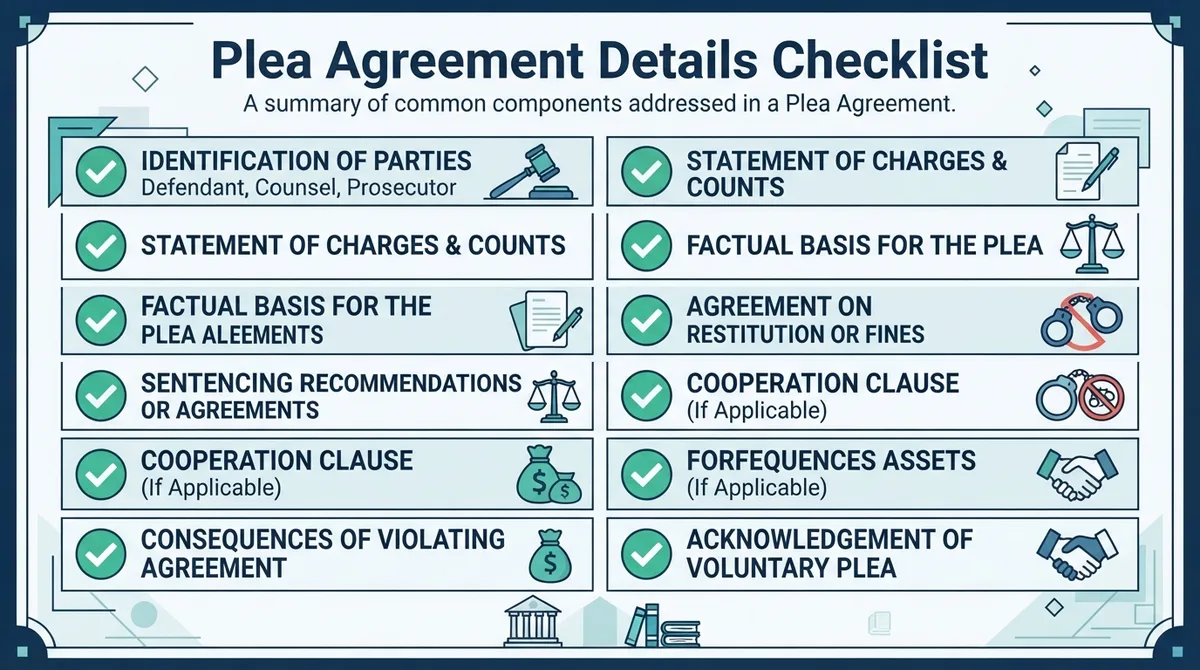
Official forms provided by courts and the Department of Justice outline the precise terms and conditions of the settlement to ensure transparency and legal validity. These standardized documents require detailed disclosures to protect the rights of the defendant and establish a clear record for the court:
- Factual Basis - A detailed statement of the specific conduct and facts the defendant admits to committing.
- Waiver of Rights - Explicit acknowledgment that the defendant is giving up the right to a jury trial, the right to confront witnesses, and the right to appeal the conviction.
- Sentencing Recommendations - The agreed-upon sentence or the range of sentences the prosecution will recommend to the court.
- Language Interpretation Provisions - Certified translation details and acknowledgment forms for defendants who require non-English documentation.
- Full Disclosure of Agreements - A statement asserting that no other promises, threats, or agreements exist outside the written document.
Immigration and Deportation Consequences
Plea agreements involving non-citizen defendants must address potential immigration consequences to comply with constitutional requirements and federal guidelines. Standardized templates from the Department of Justice provide specific language to address these situations:
- Direct Deportation Offense - Language specifying that the offense to which the defendant pleads guilty is the direct legal basis for mandatory deportation or removal.
- Unrelated Deportation Basis - Provisions clarifying that while the defendant is pleading guilty, the basis for deportation stems from factors or offenses unrelated to the immediate charge.
- Acknowledgment of Consequences - Clear statements indicating the defendant understands that pleading guilty may result in permanent exclusion from the United States.
- Defense Counsel Consultation - Documentation confirming that defense counsel has advised the non-citizen defendant of the specific immigration impacts of the plea.
Rights Waived in a Plea Agreement
Entering into a negotiated settlement requires a defendant to voluntarily relinquish several constitutional protections. These waivers must be clearly articulated in the written document and confirmed during the court hearing:
- Right to a Jury Trial - The constitutional guarantee to have a jury of peers determine guilt or innocence based on the evidence presented in court.
- Right to Confront Witnesses - The opportunity to cross-examine prosecution witnesses and challenge the evidence brought against the defendant.
- Privilege Against Self-Incrimination - The right to remain silent and not be compelled to testify or provide incriminating statements against oneself.
- Right to Compulsory Process - The power to use court subpoenas to compel the attendance of favorable witnesses at trial.
- Right to Appeal the Conviction - The ability to ask a higher court to review the legal decisions, trial procedures, or sentence imposed by the trial court.
Judicial Review and Approval Process
A plea agreement is not legally binding until the presiding judge conducts a formal inquiry and officially accepts the plea. The court follows a structured sequence of steps to evaluate the validity of the agreement:
- Submission of the Application - The defense and prosecution submit the completed application and signed agreement form to the court.
- The Rule 11 Colloquy - The judge questions the defendant under oath to ensure they understand the charges, the maximum penalties, and the rights they are waiving.
- Voluntariness Assessment - The court confirms the plea is voluntary and not the result of force, threats, or undisclosed promises.
- Factual Basis Determination - The judge reviews the evidence to ensure there is a sufficient factual foundation for the guilty plea.
- Final Acceptance or Rejection - The court formally accepts the plea and schedules the case for final sentencing or rejects the agreement.
Federal Jurisdictional Frameworks
The administration of plea agreements is governed by specific federal rules and local court procedures to maintain uniformity and fairness:
- Federal Rules of Criminal Procedure - Regulates the entire plea agreement process, including the prohibition on judicial participation in negotiations (Fed. R. Crim. P. 11).
- District Court Plea Applications - Local rules requiring specific standardized forms to document the defendant's understanding and voluntariness (District Court of the Virgin Islands Rules).
Sources
- Plea Application - Official plea application form for the District Court of the Virgin Islands.
- Translation of Plea Agreement Form - Official translation of the plea agreement form for the District Court of the Virgin Islands.
- Plea Agreement Form – Basis For Deportation Is An Offense To Which The Defendant Will Plead Guilty - Guidance on plea agreement language when deportation is based on the offense to which the defendant pleads guilty.
- Plea Agreement Form – Basis For Deportation Is Unrelated To Offense To Which The Defendant Will Plead Guilty - Guidance on plea agreement language when deportation is based on an offense unrelated to the one the defendant pleads guilty to.
Not the form you're looking for?
Try our legal document generator to create a custom document
Disclaimer: The templates available on this website are provided for general informational purposes only and do not constitute legal advice. They are not intended to be, and should not be interpreted as, compliant with any specific legal, regulatory, or privacy requirements. These templates are not a replacement for professional legal guidance and should not be relied upon for any particular matter or circumstance. Users are strongly encouraged to seek advice from a qualified attorney licensed in their jurisdiction before using, modifying, or relying on any template.
All templates are provided on an "as is," "with all faults," and "as available" basis. The provider disclaims any and all warranties of any kind, whether express, implied, statutory, or otherwise, including without limitation warranties of merchantability, fitness for a particular purpose, title, or non-infringement.
LegalTemplates.com makes no guarantees or representations regarding the accuracy, completeness, expected outcomes, or reliability of the materials contained in these templates or any materials referenced or linked from them.