Petition for Contempt
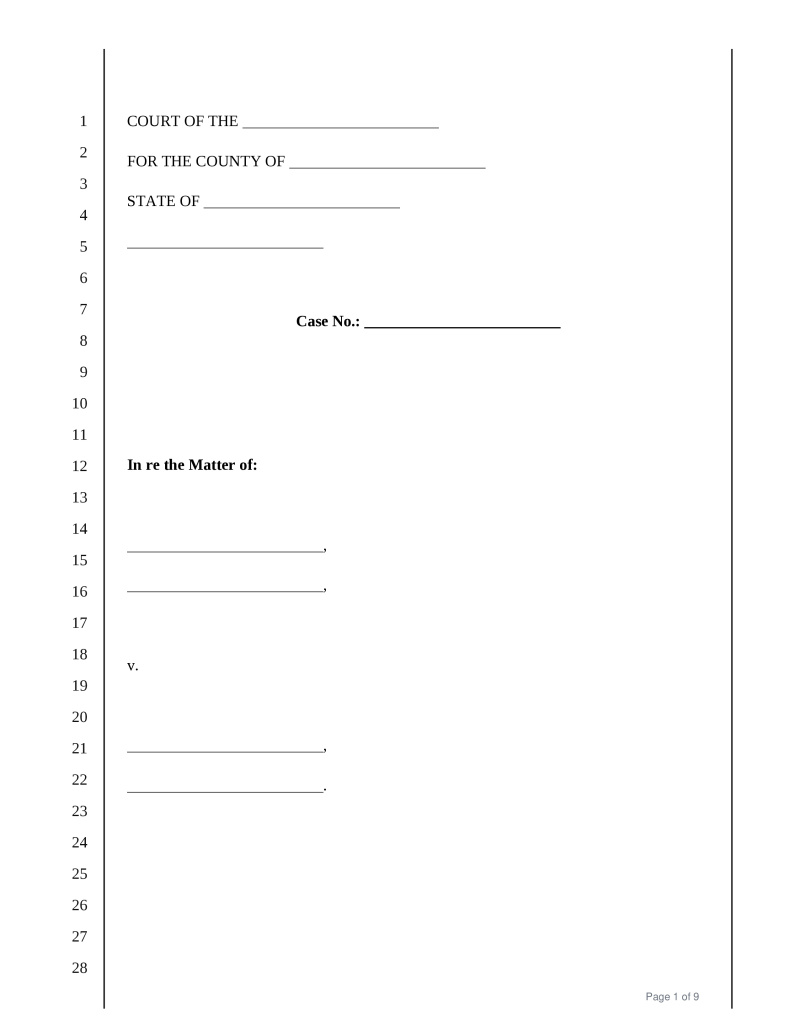
A Petition for Contempt is a formal legal pleading submitted to a court requesting that a party be held in contempt of court for failing to comply with an existing judicial order or decree.
Case Posture
Most contempt petitions are filed under the same case number as the order being enforced. Choose 'No' only if your court requires a new enforcement case to be opened.
Table of Contents
What is a Petition for Contempt?
A Petition for Contempt is a formal legal document filed with a court to request that a judge hold a party in contempt of court for violating a prior court order. This legal mechanism is primarily used to enforce existing judicial decrees, such as child support arrangements, custody agreements, injunctions, or bankruptcy discharge injunctions. The filing party asks the court to compel compliance by imposing sanctions, fines, or incarceration until the non-compliant party adheres to the original order.
Grounds for Requesting Contempt Sanctions
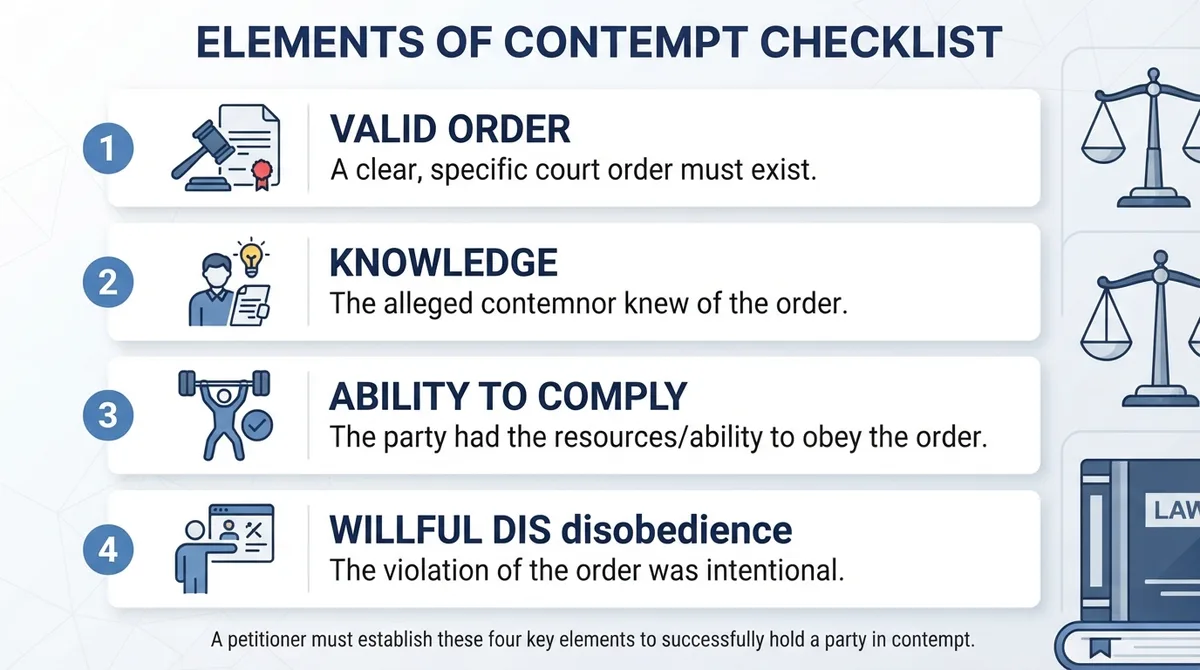
To successfully petition a court for contempt, the filing party must demonstrate specific factual elements showing that a violation occurred:
- Existence of a Valid Order - The court must have issued a clear, definite, and unambiguous order that was in effect at the time of the alleged violation.
- Knowledge of the Order - The responding party must have had actual knowledge of the court order, typically proven through proof of service or participation in the court proceedings.
- Ability to Comply - The responding party must have possessed the physical or financial ability to comply with the terms of the order at the time of the violation.
- Willful Disobedience - The failure to comply must have been intentional and voluntary rather than accidental or due to circumstances beyond the party's control.
Types of Contempt Filings and Orders
Courts utilize distinct procedural documents depending on the jurisdiction and the specific nature of the underlying case:
- Order to Show Cause Why a Party Should Not Be Held in Contempt - A procedural order issued by a court, commonly utilized in bankruptcy cases such as in the Southern District of California, which requires the accused party to appear and explain why they should not be penalized.
- Attachment for Contempt - A judicial writ, such as the form provided by the District of Columbia District Court for civil cases, directing law enforcement to bring a non-compliant party before the court.
- Motion for Civil Contempt - A standard petition filed by a private litigant seeking to compel another party's compliance with a civil court order through coercive sanctions.
Defenses to a Petition for Contempt
A party accused of violating a court order has several legal defenses available to challenge the petition during the hearing:
- Inability to Comply - The responding party can demonstrate that compliance was objectively impossible due to physical illness, financial destitution, or other uncontrollable circumstances.
- Ambiguity of the Order - The defense can argue that the original order was vague, confusing, or susceptible to multiple interpretations, making it unclear what actions were required.
- Lack of Notice - The accused party can show they were never properly served with the original order or did not have actual knowledge of its terms.
- Substantial Compliance - The responding party can present evidence that they made a good-faith effort to comply and achieved substantial compliance with the spirit of the order.
- Consent of the Other Party - The defense may argue that the petitioning party agreed to deviate from the court-ordered terms, although this defense is subject to strict judicial scrutiny.
Procedural Steps in Contempt Proceedings
Initiating and resolving a contempt action involves a structured legal process to ensure due process for the accused party:
- Drafting and Filing - The petitioner prepares the petition detailing the specific terms of the order that were violated and files it in the court that issued the original order.
- Service of Process - The petitioner serves the non-compliant party with the petition and any court-issued order to show cause to provide formal notice of the allegations.
- The Evidentiary Hearing - Both parties present evidence and testimony before a judge to determine whether a willful violation of the court order occurred.
- Issuance of a Ruling - The judge determines whether the responding party is in contempt and issues an order detailing the penalties or purge conditions required to clear the contempt.
Remedies and Sanctions for Contempt
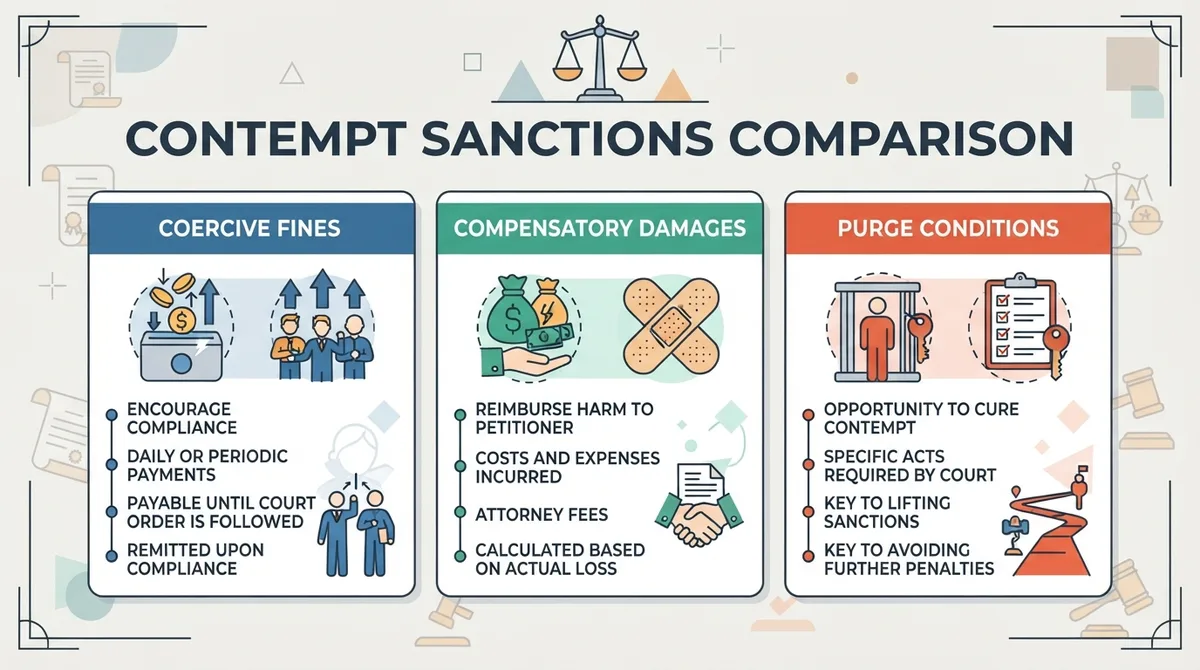
Courts possess broad authority to fashion remedies that encourage compliance or penalize disobedience depending on the classification of the contempt:
- Coercive Fines - Daily monetary penalties that accumulate until the non-compliant party performs the required action under the court order.
- Compensatory Damages - Financial awards paid directly to the injured party to cover losses or attorney fees resulting from the violation.
- Incarceration - Physical confinement of the non-compliant party, which is terminated once the individual complies with the court's directives.
- Purge Conditions - Specific, achievable actions defined by the court that allow the offending party to immediately resolve the contempt and avoid further penalties.
Frequently Asked Questions
Sources
- Order to Show Cause Why a Party Should Not Be Held in Contempt - Provides a form for initiating contempt proceedings in bankruptcy cases.
- Attachment For Contempt - Provides a form related to contempt proceedings in civil cases.
Not the form you're looking for?
Try our legal document generator to create a custom document
Disclaimer: The templates available on this website are provided for general informational purposes only and do not constitute legal advice. They are not intended to be, and should not be interpreted as, compliant with any specific legal, regulatory, or privacy requirements. These templates are not a replacement for professional legal guidance and should not be relied upon for any particular matter or circumstance. Users are strongly encouraged to seek advice from a qualified attorney licensed in their jurisdiction before using, modifying, or relying on any template.
All templates are provided on an "as is," "with all faults," and "as available" basis. The provider disclaims any and all warranties of any kind, whether express, implied, statutory, or otherwise, including without limitation warranties of merchantability, fitness for a particular purpose, title, or non-infringement.
LegalTemplates.com makes no guarantees or representations regarding the accuracy, completeness, expected outcomes, or reliability of the materials contained in these templates or any materials referenced or linked from them.