Legal Brief
A legal brief is a written legal argument presented to a court to persuade it to rule in favor of the submitting party's position.
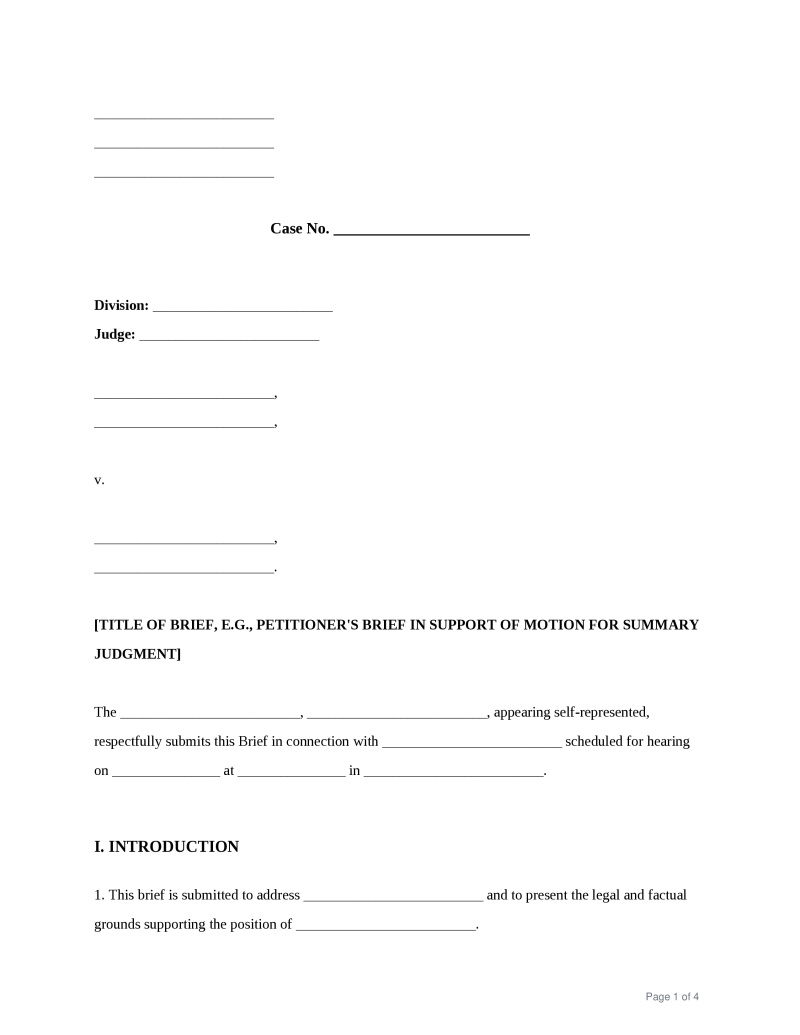
Brief Proceeding Context
Choose the setting that best fits the filing. This helps tailor questions about hearings, standards of review, record citations, and requested relief.
Use the court or tribunal's terminology if known.
Table of Contents
What is a Legal Brief?
A legal brief is a written document submitted to a court that explains a party's factual and legal arguments in support of a motion or an appeal. This formal document serves to persuade a judge or panel of judges that the submitting party's position is correct under the law. Attorneys and self-represented litigants draft these briefs during various stages of litigation to clarify complex legal issues and cite binding authority.
The Role of Legal Briefs in Litigation
Legal briefs serve as the primary vehicle for legal advocacy in both trial and appellate courts. Judges rely heavily on these written submissions to prepare for oral arguments and to draft their final opinions. A well-crafted brief clarifies the legal issues, presents the relevant facts in a structured manner, and applies binding legal precedent to the case at hand. This written advocacy often carries more weight than oral arguments, as judges have the opportunity to study the brief's citations and reasoning in detail.
Types of Legal Briefs
Courts receive different categories of briefs depending on the stage of the litigation and the role of the filing party:
- Opening Brief - The first brief filed in an appellate case by the appellant or petitioner to present their primary arguments.
- Answering Brief - The responsive brief filed by the appellee or respondent to address the points raised by the initiating party.
- Reply Brief - A document filed by the appellant to explain to the court why the opposing side's arguments are incorrect.
- Amicus Curiae Brief - A brief submitted by a friend of the court who is not a party to the case but has a strong interest in the legal outcome.
Standard Formatting and Presentation Rules
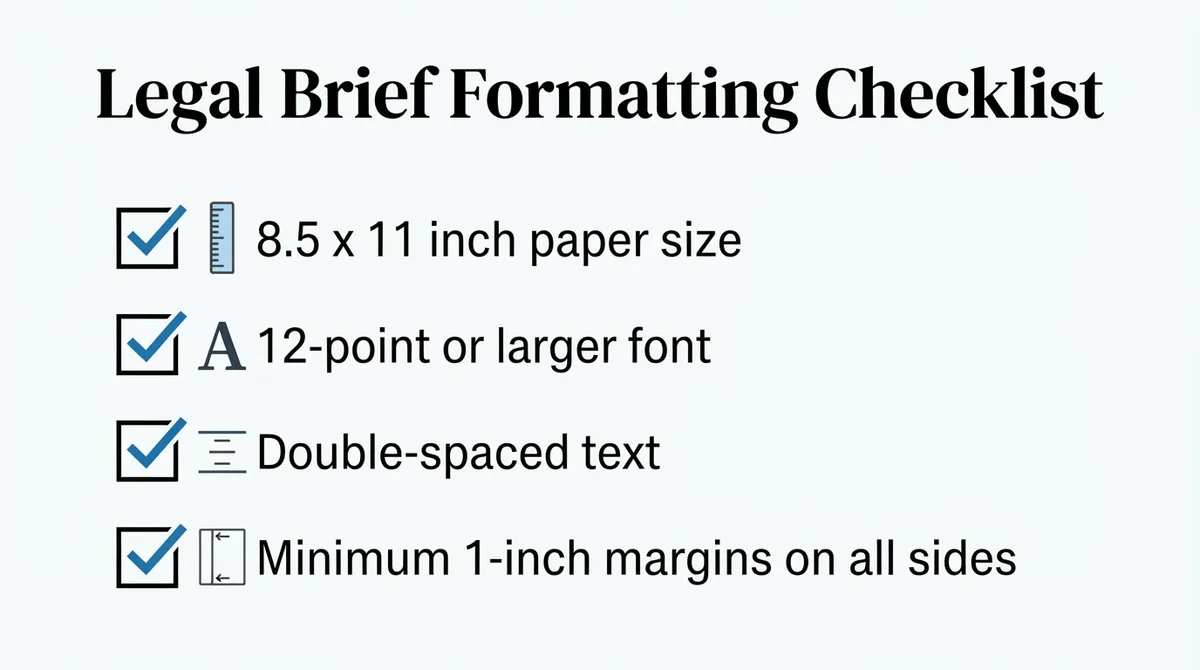
Federal and district courts enforce strict rules regarding the physical layout and presentation of legal briefs to ensure readability and standardization across filings. These technical rules govern everything from paper dimensions to the specific color of the physical covers used in appellate courts. Standardized formatting allows judges to focus on the legal arguments rather than navigating inconsistent document designs.
Specific physical requirements for filing a brief include:
- Paper Size and Legibility - Restricts the physical dimensions of filings to standard 8½-by-11 inch paper (U.S. Dist. Ct. N.D. Tex. Brief Rules).
- Font and Spacing - Mandates double-spaced text and minimum margin sizes of at least one inch on all four sides, utilizing a font size of 12-point or larger (U.S. Dist. Ct. N.D. Tex. Brief Rules).
- Reproduction Quality - Outlines the technical standards for text clarity, requiring a clear black image on light paper with only one side of the paper used, matching or exceeding laser printer output (4th Cir. R. 32).
Page Limits and Length Requirements
Courts impose strict length limitations on filings to promote concise legal writing and prevent unnecessary administrative burdens. Failure to adhere to these limits can result in the rejection of the filing or require special permission from the court to proceed.
Standard page limitations for court submissions include:
- Standard Brief Limit - Restricts primary briefs to a maximum length to prevent overly long arguments, excluding the table of contents and table of authorities (U.S. Dist. Ct. N.D. Tex. Brief Rules).
- Reply Brief Limit - Restricts the length of responsive filings to a maximum of 10 pages to ensure the arguments remain focused and concise (U.S. Dist. Ct. N.D. Tex. Brief Rules).
Appellate Cover Color Conventions
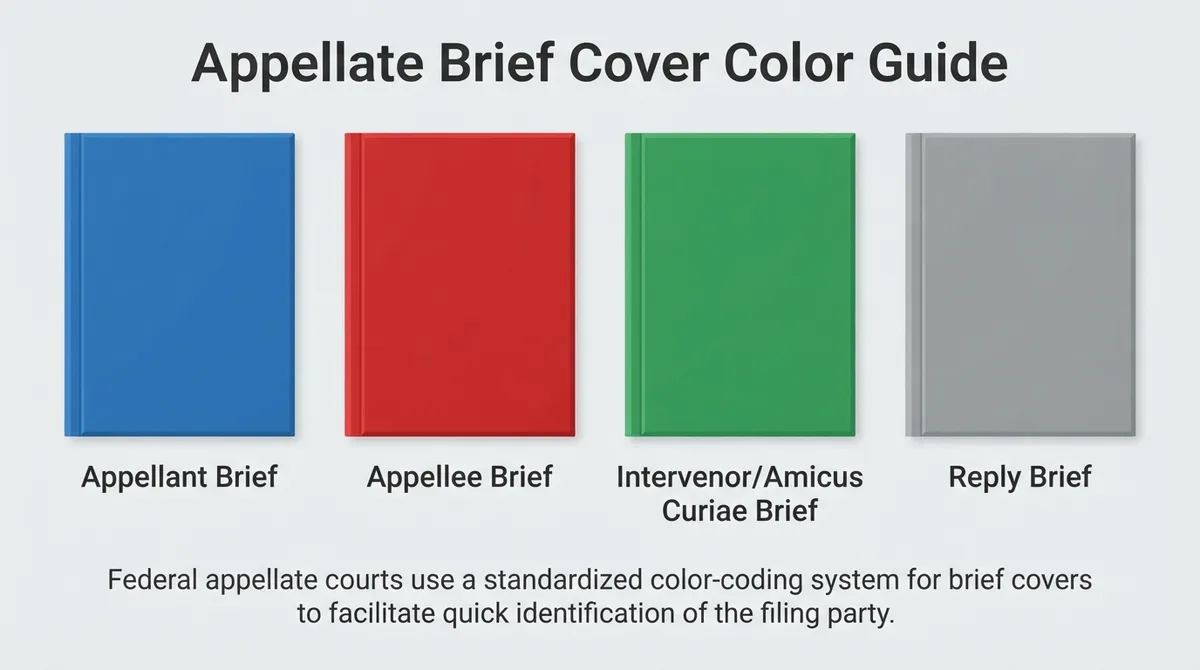
In federal appellate practice, court rules designate specific colors for the covers of physical briefs to allow judges and clerks to quickly identify the filing party. These color-coding standards are strictly enforced during the filing process.
The standard color assignments for appellate briefs include:
- Appellant Brief Cover - Designates the required blue color for the primary filing party's cover sheet (4th Cir. R. 32).
- Appellee Brief Cover - Designates the required red color for the responding party's cover sheet (4th Cir. R. 32).
- Intervenor or Amicus Curiae Brief Cover - Designates the required green color for third-party submissions (4th Cir. R. 32).
- Reply Brief Cover - Designates the required gray color for final responsive submissions (4th Cir. R. 32).
Essential Components of a Legal Brief
A well-structured brief contains several distinct sections designed to guide the court through the factual background and legal analysis of the case. Each section serves a specific purpose in building the party's arguments. Organized briefs allow the judiciary to locate key legal questions and supporting precedent efficiently.
The primary structural elements of a legal brief include:
- Table of Contents - Outlines the sections and headings within the brief alongside corresponding page numbers.
- Table of Authorities - Lists all cases, statutes, regulations, and other legal sources cited in the document in alphabetical order.
- Statement of Jurisdiction - Explains the legal basis and authority that allows the court to hear and decide the specific case.
- Statement of Facts - Presents a clear narrative of the factual background of the dispute, supported by direct citations to the trial record.
- Summary of Argument - Provides a brief, clear preview of the major points detailed in the subsequent analytical sections.
- Argument Section - Contains the core analytical portion where the party applies legal authority to the facts of the case to support their position.
Frequently Asked Questions
Sources
- Briefs | United States Court of Appeals for the Ninth Circuit - Provides detailed information on the types, contents, and formatting requirements for briefs filed in the Ninth Circuit Court of Appeals.
- Briefs. | Northern District of Texas | United States District Court - Outlines the general form, length, and requirements for briefs filed in the Northern District of Texas, including specific rules for amicus briefs and page limitations.
- Rule 32. Form of Briefs, Appendices, and Other Papers | United States Court of Appeals for the Fourth Circuit - Details the specific requirements for the form of briefs, appendices, and other papers filed in the Fourth Circuit Court of Appeals, including reproduction standards and cover specifications.
- Glossary of Legal Terms | United States Courts - Provides definitions of legal terms to help understand the federal court system, including the term 'brief'.
Not the form you're looking for?
Try our legal document generator to create a custom document
Disclaimer: The templates available on this website are provided for general informational purposes only and do not constitute legal advice. They are not intended to be, and should not be interpreted as, compliant with any specific legal, regulatory, or privacy requirements. These templates are not a replacement for professional legal guidance and should not be relied upon for any particular matter or circumstance. Users are strongly encouraged to seek advice from a qualified attorney licensed in their jurisdiction before using, modifying, or relying on any template.
All templates are provided on an "as is," "with all faults," and "as available" basis. The provider disclaims any and all warranties of any kind, whether express, implied, statutory, or otherwise, including without limitation warranties of merchantability, fitness for a particular purpose, title, or non-infringement.
LegalTemplates.com makes no guarantees or representations regarding the accuracy, completeness, expected outcomes, or reliability of the materials contained in these templates or any materials referenced or linked from them.