Index of Exhibits
An Index of Exhibits is a legal document that lists, organizes, and references the supporting evidence and documents presented during litigation, trial, or formal legal proceedings.
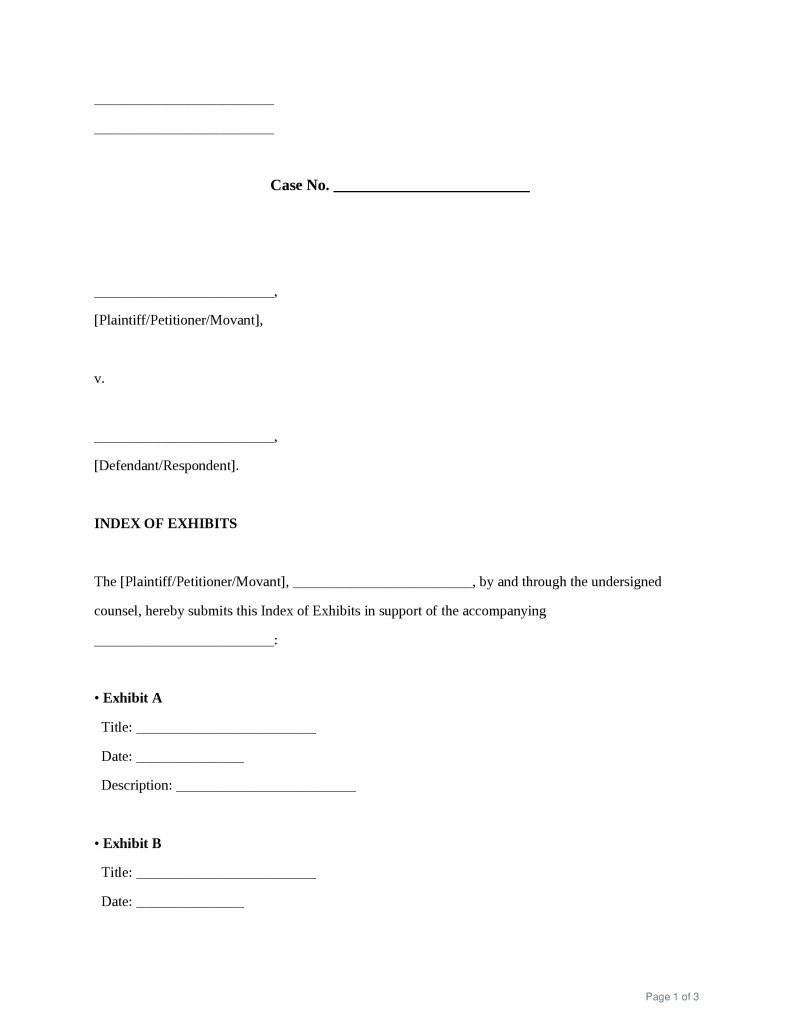
Exhibit Labeling Style
Courts and law offices commonly use letters for declarations and motions, numbers for trial exhibits, and party-prefixed labels when multiple sides are submitting exhibits.
Use the exact prefix, numbering, lettering, or tab convention you want shown in the index.
Table of Contents
What is an Index of Exhibits?
An Index of Exhibits is a structured directory that lists, categorizes, and describes the supporting documents, physical evidence, or demonstrative materials submitted in a legal proceeding or corporate transaction. This document serves as a navigational aid for judges, jurors, opposing counsel, and transaction parties, allowing them to locate specific pieces of evidence or documentation quickly within a larger filing. Legal professionals, administrative assistants, and corporate attorneys compile these indices to maintain organization during litigation, trials, depositions, and complex corporate transactions.
Purpose and Function in Legal Proceedings
An Index of Exhibits functions as a table of contents for evidentiary submissions, ensuring that all parties can reference materials efficiently. In complex litigation, filings can span thousands of pages, making a systematic directory essential for the administration of justice. Courts frequently require these indices to streamline hearings and trials, preventing delays associated with searching for unorganized documents. Beyond organizational utility, the index helps preserve the record for appeal by establishing a clear, chronological, or thematic log of every item presented to the decision-maker.
Common Contexts for Use
While most frequently associated with courtroom trials, an Index of Exhibits serves critical functions across various legal and business environments:
- Litigation and Trials - Organizes evidence submitted during motion practice, summary judgment filings, and trial presentation.
- Depositions - Tracks documents introduced during witness questioning to ensure accurate transcript references.
- Transactional Closings - Catalogs ancillary agreements, certificates, and schedules attached to a primary corporate acquisition or financing agreement.
- Administrative Hearings - Assists agency officers in reviewing evidence submitted for regulatory compliance, zoning boards, or employment disputes.
- Appellate Briefs - Directs appellate judges to specific portions of the lower court record or trial transcript.
Types of Exhibits Indexed
Legal proceedings and transactions involve various forms of evidence and documentation, each requiring distinct categorization within the index. The primary types of exhibits indexed include:
- Documentary Exhibits - Written materials such as contracts, correspondence, emails, financial statements, and medical records that substantiate factual claims.
- Demonstrative Exhibits - Visual aids including charts, diagrams, maps, and timelines created specifically to help the trier of fact understand complex information.
- Physical Exhibits - Tangible objects, equipment, or forensic items presented in court, which are typically represented in the written index by a photograph or description.
- Electronic Exhibits - Digital files, audio recordings, video footage, and social media data requiring specific software or hardware for presentation.
Key Elements of an Index of Exhibits
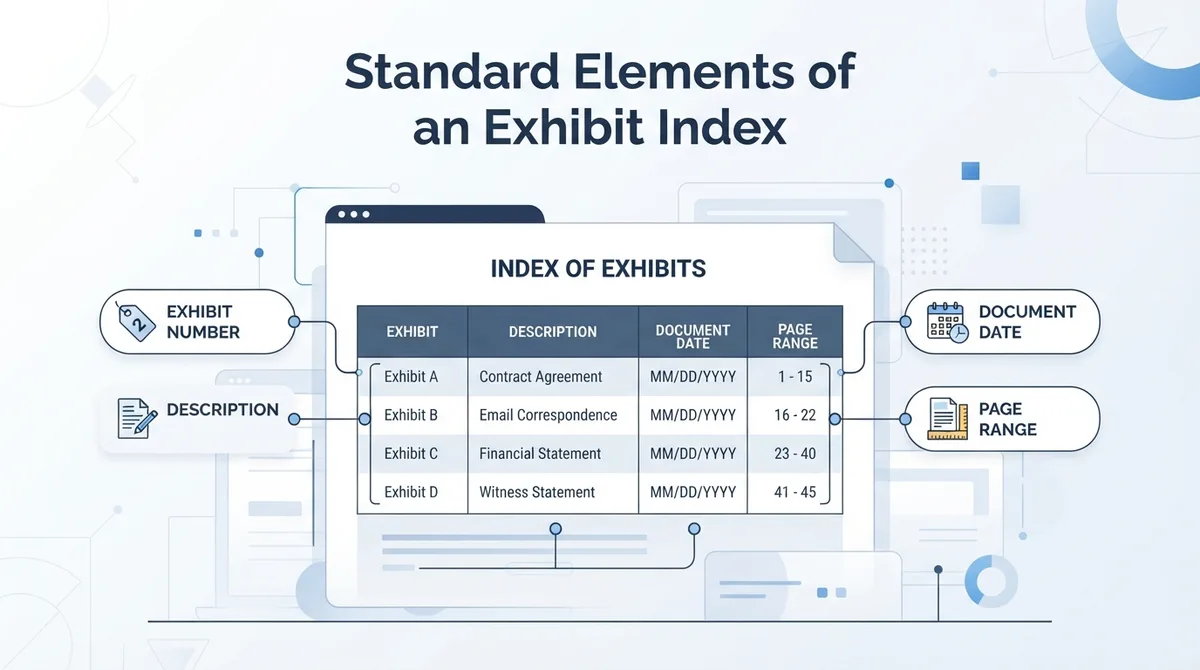
To ensure clarity and compliance with standard legal practices, an Index of Exhibits typically contains several standard fields:
- Exhibit Number or Letter - The unique alphanumeric identifier assigned to each item, often utilizing numbers for plaintiffs and letters for defendants.
- Description of Exhibit - A concise, objective title or summary that identifies the document, such as its author, recipient, and subject matter.
- Date of Document - The original date the exhibit was created or executed, aiding in chronological sequencing.
- Page Range - The specific page numbers within the larger filing where the exhibit begins and ends, often utilizing Bates numbering.
- Admission Status - Columns reserved for tracking whether the item was offered, objected to, or admitted into evidence during a trial.
How to Prepare an Index of Exhibits
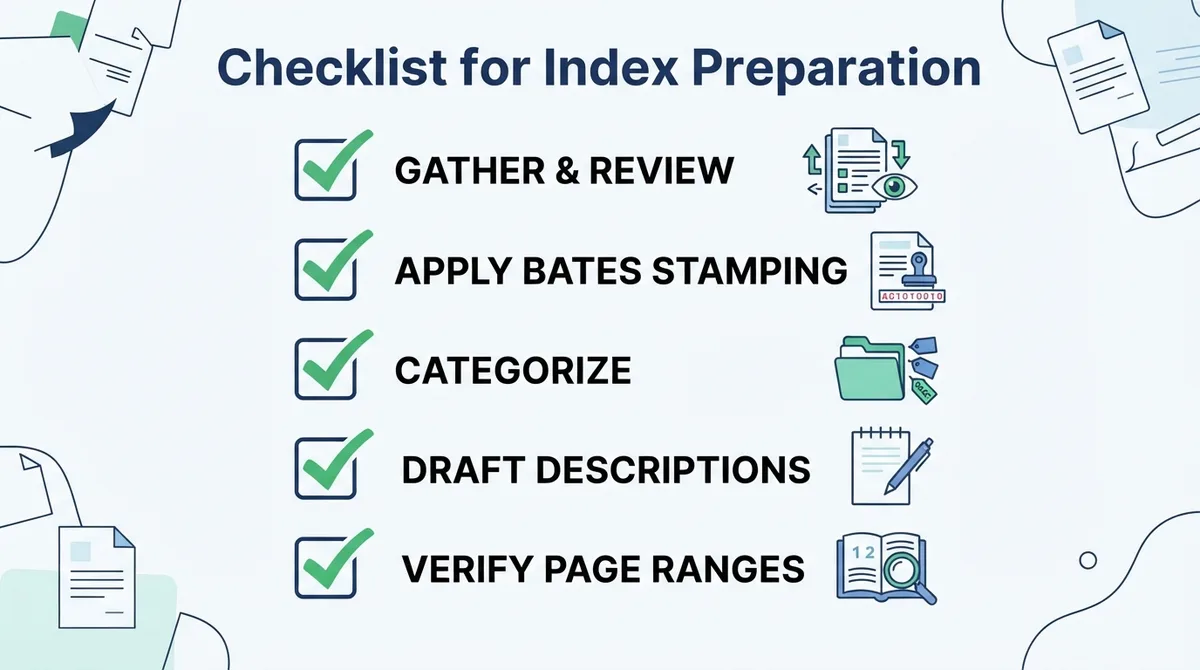
Creating an accurate directory requires meticulous attention to detail and coordination among the legal team. Support staff typically follow a standardized sequence to prepare the document:
- Gather and Review - Collect all source documents, physical items, and digital files intended for submission to ensure completeness.
- Apply Bates Stamping - Assign unique, sequential page numbers to every page of the documentary evidence to establish a consistent reference system.
- Categorize and Sequence - Group the items logically, typically in chronological order or by the witness who will introduce them.
- Draft Descriptions - Write brief, objective titles for each item, avoiding argumentative language or subjective commentary.
- Verify Page Ranges - Double-check that the page numbers listed in the index align perfectly with the actual pages of the compiled file.
Formatting and Court Rules
Courts and administrative bodies maintain specific guidelines regarding the preparation of evidentiary indices. The Federal Rules of Civil Procedure and local district court rules outline the precise formatting, marking, and filing methods required for exhibit lists:
- Bates Numbering Requirements - Many jurisdictions mandate that all pages listed in an Index of Exhibits contain sequential, computerized page stamps to prevent document tampering (Fed. R. Civ. P. 26).
- Pre-Marking Mandates - Local rules often require parties to meet, confer, and pre-mark all exhibits prior to the commencement of trial to avoid administrative delays.
- Redaction Rules - Federal and state guidelines require the removal of sensitive personal information, such as Social Security numbers and financial account details, from indexed exhibits before filing (Fed. R. Civ. P. 5.2).
Frequently Asked Questions
Not the form you're looking for?
Try our legal document generator to create a custom document
Disclaimer: The templates available on this website are provided for general informational purposes only and do not constitute legal advice. They are not intended to be, and should not be interpreted as, compliant with any specific legal, regulatory, or privacy requirements. These templates are not a replacement for professional legal guidance and should not be relied upon for any particular matter or circumstance. Users are strongly encouraged to seek advice from a qualified attorney licensed in their jurisdiction before using, modifying, or relying on any template.
All templates are provided on an "as is," "with all faults," and "as available" basis. The provider disclaims any and all warranties of any kind, whether express, implied, statutory, or otherwise, including without limitation warranties of merchantability, fitness for a particular purpose, title, or non-infringement.
LegalTemplates.com makes no guarantees or representations regarding the accuracy, completeness, expected outcomes, or reliability of the materials contained in these templates or any materials referenced or linked from them.