
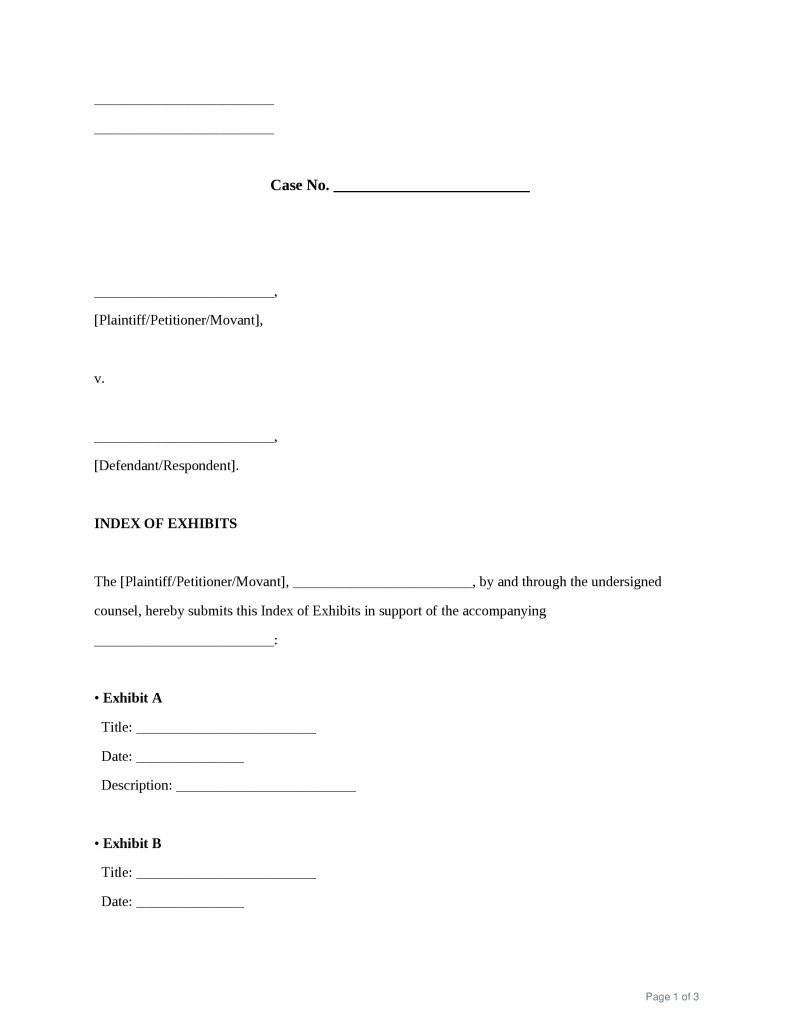
Exhibit
Create Exhibit
Exhibit
An exhibit is a legal document or supplementary material appended to a primary contract, agreement, or court pleading to provide essential supporting evidence, detailed schedules, or clarifying information.
Answer the question(s) below to create your Exhibit
Exhibit Context
Select the setting where the exhibit will be referenced. This helps tailor filing, authentication, and reference details.
Use this if the exhibit will be used in a setting not listed above.
Table of Contents
What is an Exhibit?
An exhibit is a document, object, photograph, copy, or other material item introduced as evidence during a trial, hearing, or legal proceeding. Legal professionals and self-represented litigants use these items to support witness testimony, demonstrate key facts, and clarify complex issues for the judge or jury. Once submitted to the court, an exhibit becomes a permanent part of the official record of the case, allowing the trier of fact to review the material when making a final determination. The proper identification, preparation, and presentation of these materials are essential components of trial advocacy.
Types of Exhibits
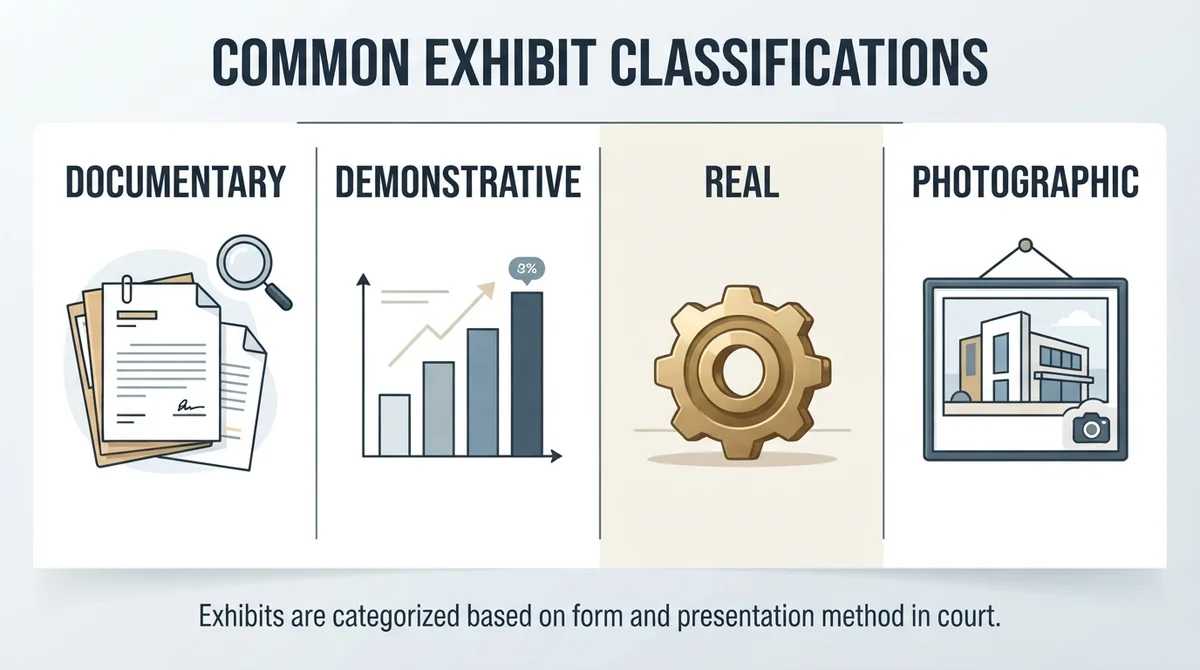
Litigants rely on various classifications of exhibits depending on the nature of the evidence and the facts they need to establish in court:
- Documentary Exhibits - Written materials such as contracts, emails, medical records, financial statements, or correspondence presented to prove specific facts.
- Demonstrative Exhibits - Visual aids created specifically for the courtroom, including charts, diagrams, maps, timelines, and scale models designed to help the jury understand complex information.
- Real Evidence - Tangible physical objects directly involved in the underlying dispute, such as a defective product part, a weapon, or physical property.
- Photographic and Digital Exhibits - Photographs, video recordings, audio files, or digital animations that depict a scene, event, or condition relevant to the case.
The Process of Introducing Exhibits
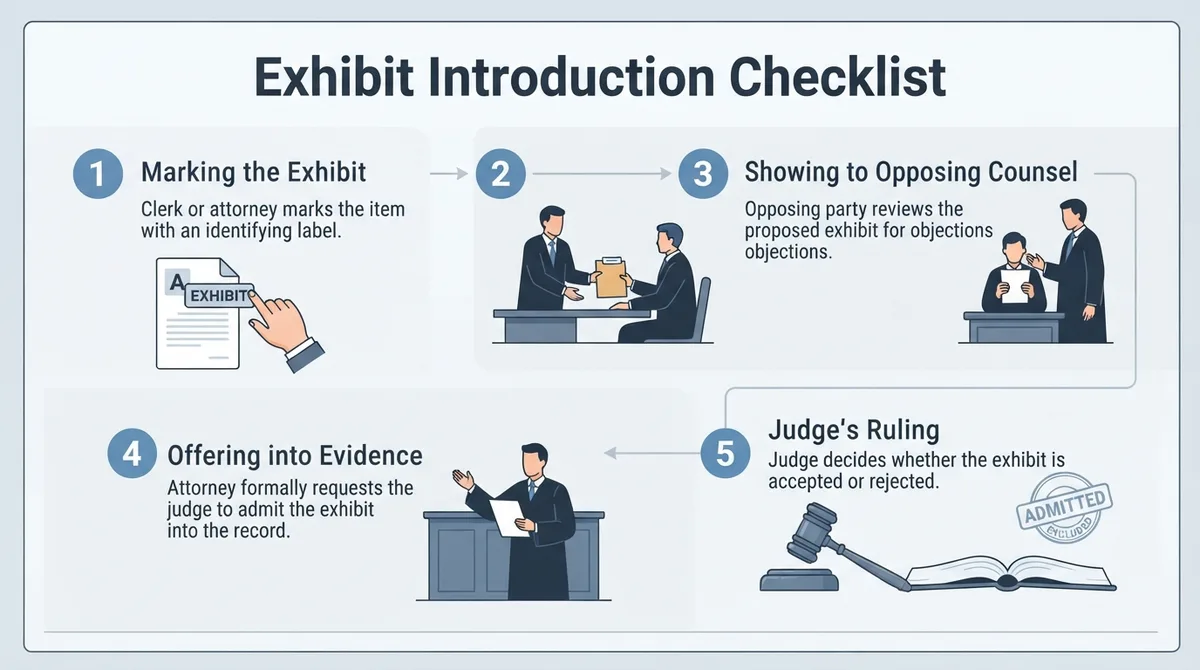
To enter an exhibit into evidence during a trial or hearing, litigants must follow a specific sequence of procedural steps:
- Marking the Exhibit - Assigning a unique identifier, such as a letter or number, to the item before or at the start of the proceeding for tracking purposes.
- Showing to Opposing Counsel - Presenting the marked item to the opposing party to allow them to inspect the material before it is shown to a witness.
- Identifying the Exhibit through a Witness - Asking a witness with personal knowledge of the item to identify what it is and confirm its authenticity.
- Offering the Exhibit into Evidence - Formally requesting that the judge admit the item into the official record of the case.
- Ruling on Admissibility - Addressing any objections raised by the opposing party before the judge decides whether to admit or exclude the item.
Admissibility and Legal Requirements
Courts enforce strict evidentiary rules to determine whether an exhibit can be admitted into evidence. The primary requirements for admissibility include:
- Relevance - The item must have a direct tendency to make a fact of consequence more or less probable than it would be without the evidence.
- Authentication - The proposing party must produce sufficient evidence or witness testimony to prove that the item is what the party claims it is.
- Hearsay Exceptions - Written documents containing out-of-court statements must qualify under an established exception to the hearsay rule to be admitted for their truth.
- Best Evidence Rule - Parties must generally produce the original document rather than a copy when attempting to prove the contents of a writing, recording, or photograph, subject to specific legal exceptions.
Differences Between Exhibits and Other Legal Documents
Exhibits serve a distinct purpose compared to other documents filed during litigation:
- Pleadings - Formal written statements of a party's claims or defenses, such as complaints and answers, which set the framework of the lawsuit but do not constitute evidence.
- Affidavits - Written statements sworn under oath that may reference exhibits, whereas the exhibit itself is the external material document or object attached to support those statements.
- Briefs - Written legal arguments submitted to the court to persuade the judge on legal points, which rely on admitted exhibits to support their factual assertions.
Common Mistakes in Managing Exhibits
Improper handling of exhibits can compromise a case or lead to the exclusion of critical evidence. Common errors include:
- Failure to Authenticate - Attempting to introduce a document without a witness who can verify its origin, creation, or custody.
- Improper Labeling - Mixing up numerical or alphabetical sequences, causing confusion in the court transcript and during witness questioning.
- Redaction Failures - Neglecting to remove sensitive personal identifying information, such as Social Security numbers or financial account details, before submitting the item to the public record.
- Lack of Clean Copies - Failing to provide identical, legible copies of documentary exhibits for the judge, opposing counsel, the witness, and the court reporter.
Frequently Asked Questions
An exhibit is used to provide tangible proof that supports or clarifies testimony in a legal proceeding. It helps the trier of fact understand the details of the case by offering concrete evidence.
No, a document must meet court rules of evidence, including relevance and authenticity, to be admitted. The judge decides whether the document is legally admissible after hearing any objections.
Plaintiff exhibits are introduced by the party bringing the lawsuit, often marked with numbers. Defendant exhibits are introduced by the defending party, often marked with letters to prevent confusion.
Exhibits are generally kept by the court clerk as part of the official record for a specified period, especially during appeals. Parties may eventually petition the court to retrieve their original items once the case is fully resolved.
Yes, marking an exhibit merely identifies it for the record and does not guarantee its admission. The judge may exclude the marked item if it fails to meet evidentiary standards or if the opposing party raises a valid objection.
A photograph is generally classified as a demonstrative or photographic exhibit. It requires a witness to testify that it accurately depicts the scene or object at the relevant time.
Sources
- Glossary of Legal Terms - Provides a definition of 'exhibit' as a document or other item introduced as evidence during a trial or hearing.
- Glossary of Legal Terms - Defines 'exhibit' as a document, object, photograph, copy, or thing that is submitted to the court as evidence.
- Glossary of Legal Terms - Describes an exhibit as a document or material produced and identified in court for the purpose of introducing it as evidence in the case.
- Glossary of Legal Terms - Defines 'exhibit' as a document or other item introduced as evidence during a trial or hearing.
- Glossary of Legal Terms - Describes an exhibit as a document, object, photograph, copy, or thing that is submitted to the court as evidence.
Related Documents
Forms commonly used with Exhibit.
Not the form you're looking for?
Try our legal document generator to create a custom document
Disclaimer: The templates available on this website are provided for general informational purposes only and do not constitute legal advice. They are not intended to be, and should not be interpreted as, compliant with any specific legal, regulatory, or privacy requirements. These templates are not a replacement for professional legal guidance and should not be relied upon for any particular matter or circumstance. Users are strongly encouraged to seek advice from a qualified attorney licensed in their jurisdiction before using, modifying, or relying on any template.
All templates are provided on an "as is," "with all faults," and "as available" basis. The provider disclaims any and all warranties of any kind, whether express, implied, statutory, or otherwise, including without limitation warranties of merchantability, fitness for a particular purpose, title, or non-infringement.
LegalTemplates.com makes no guarantees or representations regarding the accuracy, completeness, expected outcomes, or reliability of the materials contained in these templates or any materials referenced or linked from them.