Executor of Estate Create Executor of Estate
Executor of Estate Preview
View Document
Download PDF

Executor of Estate

An Executor of Estate document is a legal instrument that designates a personal representative to manage, distribute, and settle a deceased person's estate in accordance with probate law.
Sep 01, 2026
Answer the question(s) below to create your Executor of Estate

Probate Case Status

Choose "Existing probate case" only if the court has already assigned a case, cause, estate, or docket number.

Start

Table of Contents

What is a Executor of Estate?

An executor of estate is an individual or institution appointed to manage and distribute a deceased person's property and assets in accordance with their last will and testament. The primary purpose of this role is to ensure the decedent's final wishes are carried out, outstanding debts and taxes are paid, and the remaining estate is distributed to the designated beneficiaries. This position carries a fiduciary duty, requiring the appointed party to act with the utmost honesty, loyalty, and care on behalf of the estate.

Primary Duties and Responsibilities

The administration of a decedent's estate involves several legal and financial obligations:

  • Locating the Will - Finding the original testamentary documents and filing them with the local probate court to initiate the administration process.
  • Asset Inventory - Identifying, securing, and valuing all assets belonging to the deceased, including real estate, bank accounts, investments, and personal property.
  • Paying Creditors - Notifying potential creditors of the death and settling valid outstanding debts using funds from the estate.
  • Filing Tax Returns - Preparing and filing the final federal and state income tax returns for the deceased, as well as any estate tax returns.
  • Distributing Property - Transferring the remaining assets to the beneficiaries named in the will after all debts, taxes, and administrative expenses are paid.

Types of Executors

Different arrangements exist for managing estate administration depending on the complexity of the assets and the preferences of the testator:

  • Individual Executor - A single person, often a family member, trusted friend, or professional advisor, chosen to manage the estate independently.
  • Co-Executor - Two or more parties appointed to work together to administer the estate, requiring joint decision-making and shared responsibility.
  • Corporate Executor - A professional entity, such as a bank or trust company, hired to manage complex estates for a fee.
  • Successor Executor - A backup individual or institution designated to step in if the primary executor is unable or unwilling to serve.

The Estate Administration Process

Administering an estate requires following a structured legal process:

  1. Petitioning the Court - The designated party files a petition for probate to receive official letters testamentary, which grant the legal authority to act.
  2. Notifying Interested Parties - Formal notices are sent to beneficiaries, heirs, and creditors regarding the probate proceedings.
  3. Managing Estate Assets - Bank accounts are consolidated into an estate account to pay ongoing expenses and manage incoming funds.
  4. Settling Claims and Taxes - Valid creditor claims are paid, and final tax clearances are obtained from state and federal authorities.
  5. Closing the Estate - A final accounting of all transactions is submitted to the court for approval prior to the final distribution of assets.

Legal Requirements and Qualifications
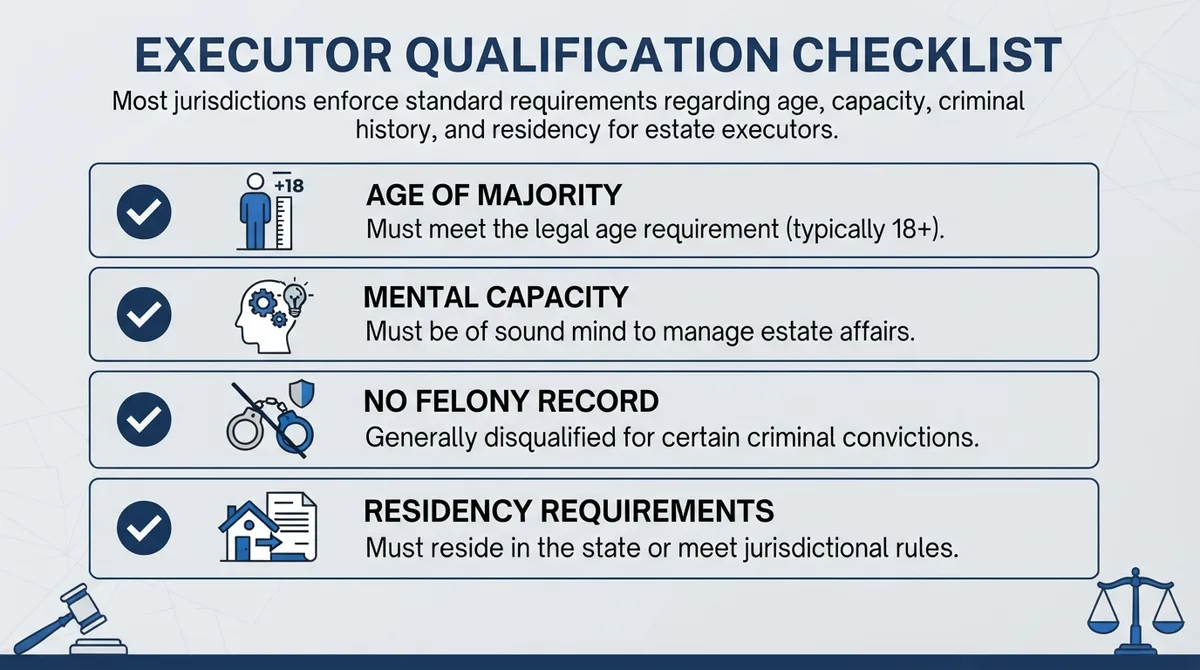
Infographic checklist of the legal qualifications required to serve as an Executor of Estate.
Most jurisdictions enforce standard requirements regarding age, capacity, criminal history, and residency for estate executors.

Most jurisdictions impose basic legal qualifications for anyone serving in this fiduciary role:

  • Age of Majority - The individual must be at least 18 years old at the time of appointment.
  • Mental Capacity - The representative must possess the cognitive ability to make sound financial and legal decisions.
  • Criminal Record Restrictions - Many states prohibit individuals with felony convictions from serving as fiduciaries.
  • Residency Requirements - Out-of-state representatives may face additional bonding requirements or be required to appoint an in-state agent for service of process.

Distinction Between Executors and Trustees
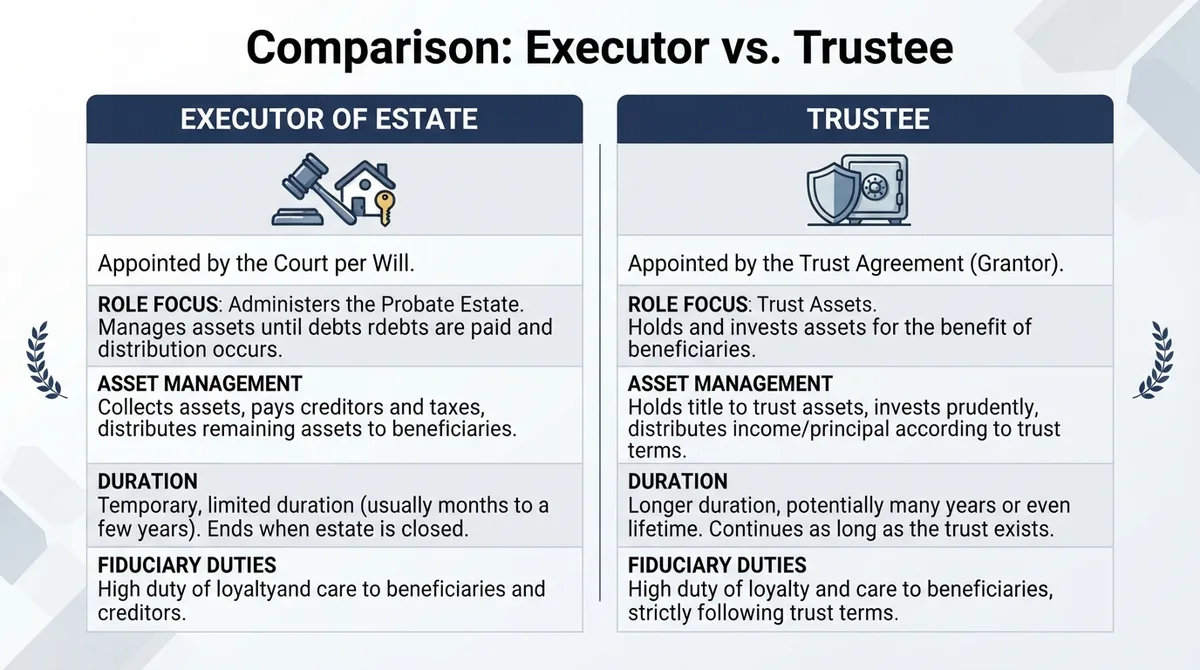
Comparison chart showing the differences between an Executor of Estate and a Trustee in terms of authority, duration, and asset management.
While both roles carry fiduciary duties, executors manage probate estates temporarily whereas trustees oversee trust assets over longer durations.

While both roles involve fiduciary duties, their scope and duration differ:

  • Duration of Authority - An executor of estate serves a temporary role focused on winding down the estate, while a trustee manages trust assets over a potentially long period.
  • Source of Authority - The executor derives authority from a will and court appointment, whereas a trustee derives authority directly from a trust agreement.
  • Asset Ownership - An executor manages assets that pass through probate, while a trustee manages assets already transferred into the trust.

Fiduciary Liability and Common Risks

Serving in this capacity carries significant personal liability. The representative must manage estate assets prudently to avoid financial loss or legal challenges. Common pitfalls include:

  • Co-mingling Funds - Mixing personal funds with estate assets, which violates fiduciary duties and can lead to immediate removal.
  • Improper Distribution - Distributing assets to beneficiaries before paying outstanding taxes or valid creditor claims.
  • Failure to Secure Assets - Allowing property to be damaged, lost, or depreciated due to neglect or lack of supervision.
  • Inadequate Record-Keeping - Failing to maintain detailed receipts, bank statements, and transaction histories for court accounting.

Frequently Asked Questions

Yes, it is common for a testator to name a major beneficiary, such as a spouse or child, as the executor. This arrangement is legally permissible as long as the individual fulfills their fiduciary duties impartially.
No, a person named in a will has the right to decline the appointment. If they refuse, the court will appoint an alternative representative or the designated successor executor.
Yes, executors are generally entitled to compensation for their time and effort. The payment amount is typically set by state law or specified directly within the will.
Yes, interested parties can petition the probate court to remove an executor for misconduct, negligence, or a conflict of interest. The court will hold a hearing to evaluate the evidence before making a decision.
If there is no will or no named executor, the probate court will appoint an administrator to handle the estate. This administrator performs the same duties as an executor but must follow state intestacy laws for asset distribution.

Executor of Estate Sample

0% Complete 0/0 Fields

STATE OF
IN THE FOR

In the Matter of the Estate of:
,
Deceased.

Case No.

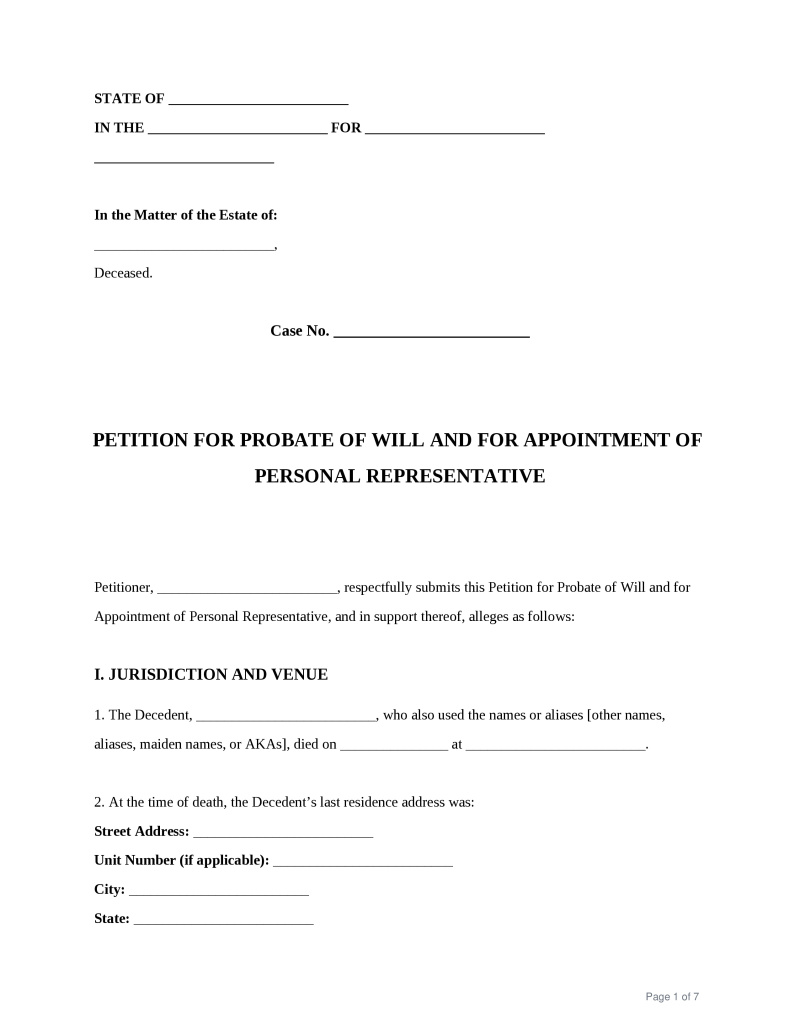
PETITION FOR PROBATE OF WILL AND FOR APPOINTMENT OF PERSONAL REPRESENTATIVE

Petitioner, , respectfully submits this Petition for Probate of Will and for Appointment of Personal Representative, and in support thereof, alleges as follows:

I. JURISDICTION AND VENUE

1. The Decedent, _______________, who also used the names or aliases , died on at .

2. At the time of death, the Decedent’s last residence address was:
Street Address:
Unit Number (if applicable):
City:
State:
Zip Code:

3. Venue is proper in this county because the Decedent was domiciled in this county at the time of death, or owned property located within this county at the time of death.

II. DECEDENT'S FAMILY AND INTERESTED PERSONS

4. At the time of death, the Decedent’s marital or domestic partnership status was . The surviving spouse or partner is:
Name:
Mailing Address:
Street Address:
Unit Number (if applicable):
City:
State:
Zip Code:

5. The names, relationships, and mailing addresses of the Decedent's heirs-at-law, so far as known or ascertainable by diligent inquiry, are as follows:

Heir 1:
Heir Name:
Relationship to Decedent:
Mailing Address:
Street Address:
Unit Number (if applicable):
City:
State:
Zip Code:

6. The names, relationships, and mailing addresses of the beneficiaries named in the Decedent's Will, if applicable, are as follows:

Beneficiary 1:
Beneficiary Name:
Interest in Estate:
Mailing Address:
Street Address:
Unit Number (if applicable):
City:
State:
Zip Code:

7. The following interested persons are minors, incapacitated, missing, deceased, or specially situated:

III. TESTACY AND THE WILL

8. The Decedent died leaving a Last Will and Testament dated , and codicils dated . The original Will is currently located at .

9.

IV. PROPOSED PERSONAL REPRESENTATIVE

10. Petitioner, _______________, whose relationship to the Decedent is , is qualified to serve as the Personal Representative of the Estate. Petitioner's contact information is:
Mailing Address:
Street Address:
Unit Number (if applicable):
City:
State:
Zip Code:
Phone:
Email:

11.

12. The first alternate or successor personal representative, if any, is:
Name:
Relationship to Decedent:
Mailing Address:
Street Address:
Unit Number (if applicable):
City:
State:
Zip Code:

V. ESTATE ASSETS, DEBTS, AND ADMINISTRATION

13. The estimated value of the probate estate is as follows:
• Estimated value of probate personal property: $
• Estimated value of probate real property: $
• Expected annual income of the estate: $
• Real Property Address:
• Legal Description / Parcel Number:
• Occupancy Status of Real Property:
• Other Asset Categories:

14. The estimated total amount of known estate debts is $. Other known debts or claims include:

15. The known nonprobate, trust, joint, or beneficiary-designated assets of the Decedent are:

16. The following tax issues affect the estate:

17. Petitioner requests authority to administer the estate.

18.

19. Petitioner requests that bond be set in the amount of $, or that bond be waived based on the following grounds:

20. The facts supporting the appointment of the proposed executor or personal representative are:

21. Petitioner is aware of the following disputes, contests, or objections regarding this estate:

VI. RELIEF REQUESTED

WHEREFORE, Petitioner requests that this Court:
1. Enter an Order admitting the Decedent’s Last Will and Testament dated _______________ to probate;
2. Appoint _______________ as Personal Representative of the Estate;
3. Issue Letters Testamentary or Letters of Administration to the appointed representative;
4. Determine bond as requested herein; and
5. Grant such other and further relief as the Court deems just and proper.

Respectfully submitted,

Signature: _________________________
Printed Name: _______________
Role / Capacity: Petitioner
Address: _______________
Phone: _______________
Email: _______________

VERIFICATION

I, _______________, declare under penalty of perjury under the laws of the State of that I am the Petitioner in the foregoing matter, that I have read the foregoing Petition, and that the facts stated therein are true and correct to the best of my knowledge, information, and belief.

Date:

Signature: _________________________
Printed Name: _______________
Petitioner

NOTICE OF HEARING

A hearing on this Petition is scheduled as follows:
Date:
Time:
Location / Courtroom:

CERTIFICATE OF SERVICE

I hereby certify that on , a true and correct copy of the foregoing Petition and Notice of Hearing was served upon all interested parties listed below by :

Recipient 1:
Recipient:
Address:
Service Method:

Signature: _________________________
Printed Name: _______________
Role / Capacity: Petitioner

Not the form you're looking for?

Try our legal document generator to create a custom document

Disclaimer: The templates available on this website are provided for general informational purposes only and do not constitute legal advice. They are not intended to be, and should not be interpreted as, compliant with any specific legal, regulatory, or privacy requirements. These templates are not a replacement for professional legal guidance and should not be relied upon for any particular matter or circumstance. Users are strongly encouraged to seek advice from a qualified attorney licensed in their jurisdiction before using, modifying, or relying on any template.

All templates are provided on an "as is," "with all faults," and "as available" basis. The provider disclaims any and all warranties of any kind, whether express, implied, statutory, or otherwise, including without limitation warranties of merchantability, fitness for a particular purpose, title, or non-infringement.

LegalTemplates.com makes no guarantees or representations regarding the accuracy, completeness, expected outcomes, or reliability of the materials contained in these templates or any materials referenced or linked from them.

We Value Your Privacy

We use cookies to enhance your browsing experience, analyze site traffic, and personalize content. We do not sell your personal data. By clicking "Accept All," you consent to our use of cookies. For more information, please read our Privacy Policy.