Declaration for Court Case
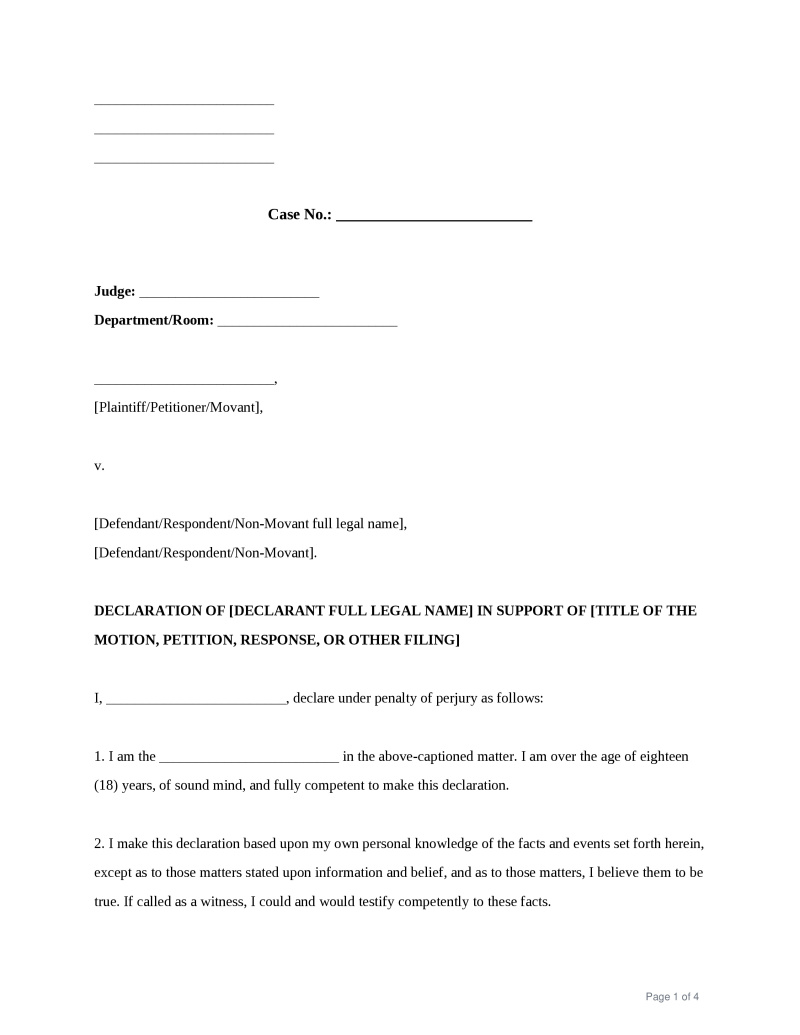
A declaration for a court case is a written statement of facts signed under penalty of perjury that is submitted to a court to support or oppose a specific motion or legal position.
Case Posture
Choose existing case if a case, cause, or docket number has already been assigned.
Table of Contents
What is a Declaration for Court Case?
A Declaration for Court Case is a formal, written statement made under penalty of perjury that presents factual evidence to a court in various legal proceedings. This document allows individuals, including parties to the lawsuit and third-party witnesses, to submit testimony to a judge without the necessity of physical attendance in a courtroom. Courts rely on these written submissions to resolve motion hearings, family law disputes, and minor infractions. The document serves as a primary method for establishing key facts and must adhere strictly to procedural standards to be considered admissible.
Types of Declarations for Court Cases
Courts utilize different categories of declarations depending on the nature of the legal proceeding and the role of the person submitting the document:
- Supporting Declaration - A written statement submitted by the initiating party to provide factual evidence in support of a motion or request for a specific court order.
- Responsive Declaration - A document filed by the opposing party to address, contest, or clarify allegations made in the initial motion.
- Witness Declaration - A statement drafted by a non-party individual who possesses firsthand knowledge of events relevant to the legal dispute.
- Traffic Court Declaration - A specialized form used by defendants to contest traffic citations through a written trial process rather than an in-person hearing.
Legal Requirements and Admissibility
To be admissible in legal proceedings, a Declaration for Court Case must adhere to strict procedural rules established by court systems:
- Family Law Declaration Guidelines - Establishes requirements and a 10-page limit for declarations supporting or responding to a request for court orders in family law matters (California Rules of Court, Rule 5.111).
- Personal Knowledge Standard - Mandates that the declarant must base all statements on personal knowledge and explicitly explain how they acquired that knowledge (California Rules of Court, Rule 5.111).
- Penalty of Perjury Clause - Requires the document to contain a statement declaring that the contents are true and correct under the penalty of perjury under the laws of the jurisdiction.
- Factual Focus - Directs that the content must focus on observable facts rather than legal arguments, opinions, or hearsay.
Traffic Court Trial by Written Declaration
In many jurisdictions, drivers can challenge traffic citations without appearing in court by using a specific written process:
- Trial by Written Declaration Option - Grants defendants the right to challenge traffic infractions in writing instead of attending an in-person trial (California Vehicle Code Section 40902).
- Traffic Court Trial Guidelines - Sets procedural rules for contesting traffic citations through written statements (California Rules of Court, Rule 4.210).
- Extension of Appearance Date - Mandates that the court clerk extend the defendant's appearance date by 25 calendar days upon receiving a written request for a trial by written declaration (California Rules of Court, Rule 4.210).
- Evidence Submission Guidelines - Allows the defendant to submit their written statement along with any supporting physical evidence, such as photographs or diagrams, to the court.
Differences Between Declarations and Affidavits
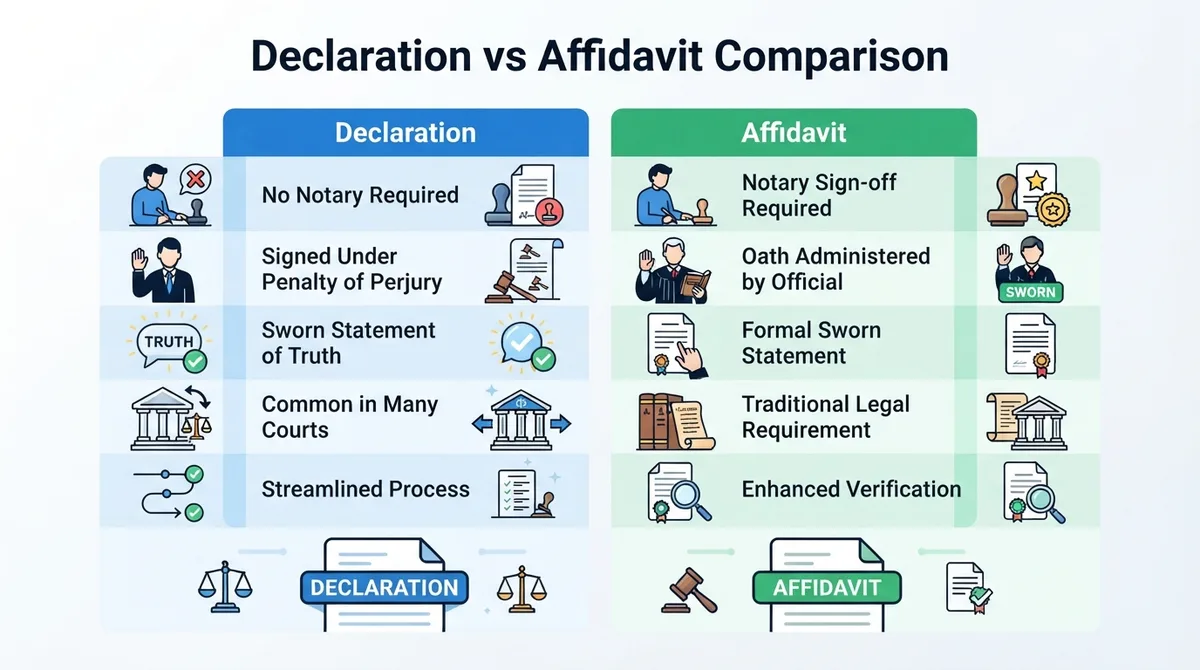
While declarations and affidavits serve similar evidentiary purposes in court cases, they differ in execution:
- Notarization Requirement - Affidavits require the presence of a notary public or another authorized official to administer an oath, whereas declarations do not.
- Perjury Declaration - Declarations rely on a penalty of perjury statement signed by the declarant to establish truthfulness under applicable laws.
- Jurisdictional Acceptance - Federal courts and many state courts accept declarations in place of affidavits, but some local courts still mandate notarized affidavits for specific filings.
Essential Elements of a Court Declaration
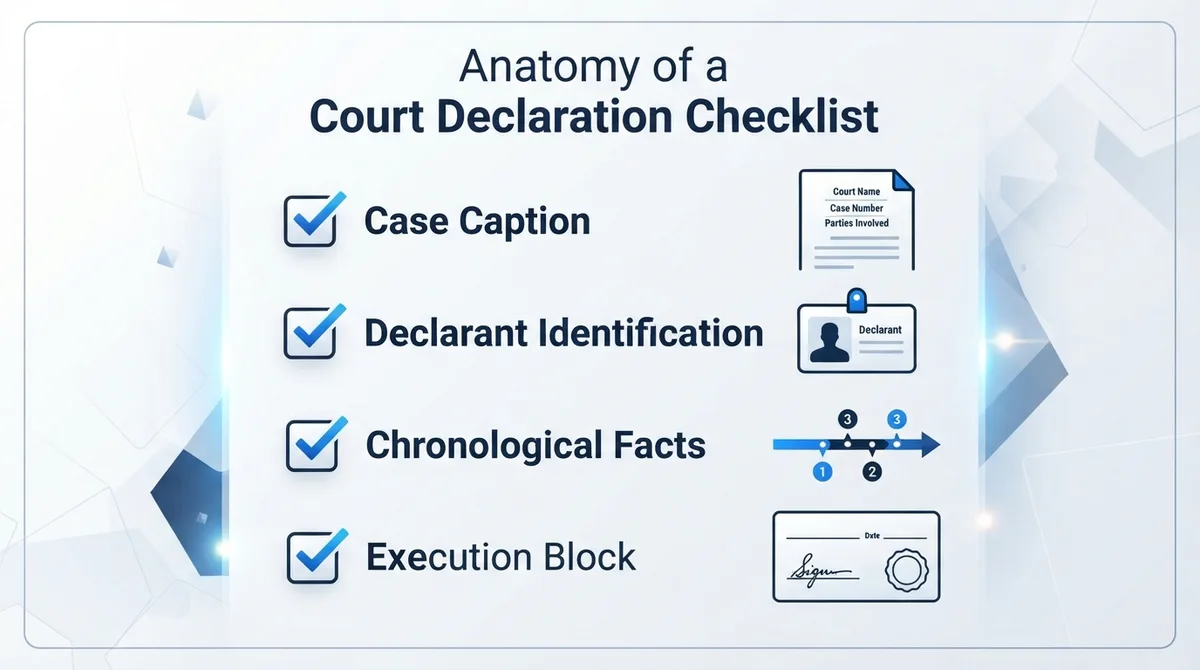
A properly drafted declaration must contain specific structural elements to be recognized by the court:
- Case Caption - The heading at the top of the document that lists the court name, case title, and case number.
- Declarant Identification - An introductory paragraph stating the declarant's name and relationship to the case.
- Chronological Statement of Facts - A series of numbered paragraphs detailing the relevant events in a clear, sequential order.
- Execution Block - The concluding section containing the date, the location of signing, and the physical or authorized electronic signature of the declarant.
Frequently Asked Questions
Sources
- Rule 5.111. Declarations supporting and responding to a request for court order - Provides guidelines on declarations supporting and responding to court orders in California family law cases.
- Rule 4.210. Traffic court-trial by written declaration - Establishes procedural requirements for trials by written declaration in traffic court under Vehicle Code section 40902.
- Trial by Written Declaration | Superior Court of California | County of San Mateo - Explains the process of contesting a traffic citation through a trial by written declaration in San Mateo County, California.
Not the form you're looking for?
Try our legal document generator to create a custom document
Disclaimer: The templates available on this website are provided for general informational purposes only and do not constitute legal advice. They are not intended to be, and should not be interpreted as, compliant with any specific legal, regulatory, or privacy requirements. These templates are not a replacement for professional legal guidance and should not be relied upon for any particular matter or circumstance. Users are strongly encouraged to seek advice from a qualified attorney licensed in their jurisdiction before using, modifying, or relying on any template.
All templates are provided on an "as is," "with all faults," and "as available" basis. The provider disclaims any and all warranties of any kind, whether express, implied, statutory, or otherwise, including without limitation warranties of merchantability, fitness for a particular purpose, title, or non-infringement.
LegalTemplates.com makes no guarantees or representations regarding the accuracy, completeness, expected outcomes, or reliability of the materials contained in these templates or any materials referenced or linked from them.