Protective Order
A protective order is a court-issued legal document that prohibits a specified individual from engaging in certain behaviors, such as contacting or approaching another person, to prevent harassment, abuse, or violence.
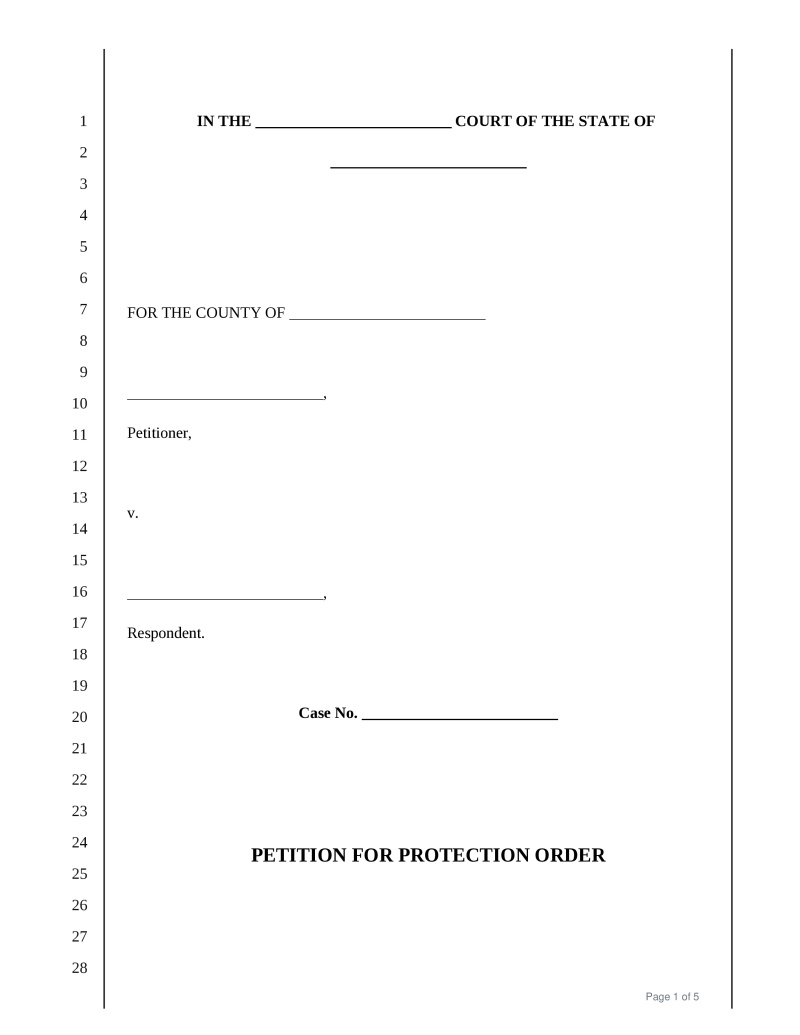
Temporary Order Requested
Many courts allow an emergency, ex parte, or temporary order if immediate safety protection is needed before the Respondent is heard.
Table of Contents
What is a Protective Order?
A protective order is a legally binding court order designed to protect an individual from harassment, abuse, stalking, or domestic violence by restricting the behavior of another person. Issued by a judge, this document establishes clear boundaries, prohibiting the restrained party from contacting or coming within a specified distance of the protected party. Individuals seek these orders through civil or criminal courts to secure immediate legal protection and establish consequences for unauthorized contact. Violation of this order constitutes a criminal offense in most jurisdictions, allowing law enforcement to make an immediate arrest.
Types of Protective Orders
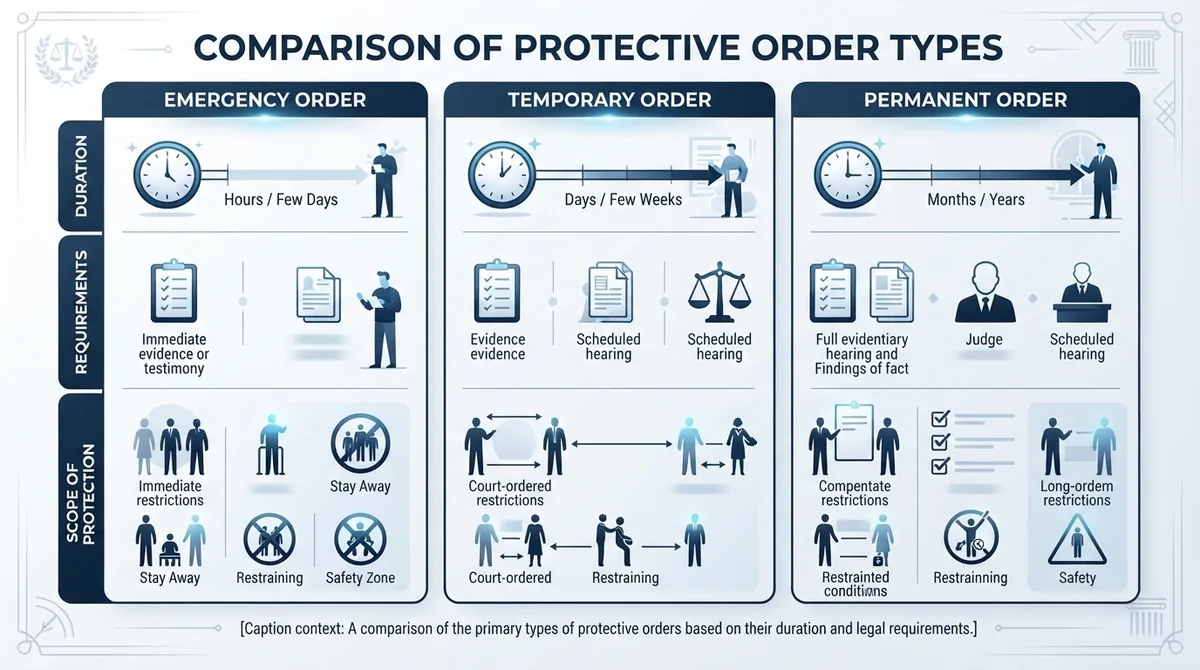
Courts issue different categories of protective orders depending on the urgency of the situation and the relationship between the parties:
- Emergency Protective Order - A short-term order issued by law enforcement or a judge immediately following an incident of domestic violence to provide temporary safety (often lasting three to seven days).
- Temporary Protective Order - A short-term directive issued without the responding party present, designed to offer protection until a full court hearing can be scheduled (typically lasting fifteen to thirty days).
- Permanent Protective Order - A long-term order granted after a formal court hearing where both parties present evidence, remaining in effect for a specified period of years or indefinitely.
Common Uses and Situations
Individuals seek judicial protection under several distinct circumstances. These legal instruments address safety concerns arising from various interpersonal conflicts:
- Domestic Abuse - Protection from physical violence, threats, or emotional abuse committed by a spouse, former spouse, intimate partner, or family member.
- Stalking and Harassment - Relief from repeated, unwanted attention, monitoring, or communication that causes reasonable fear or emotional distress.
- Sexual Assault - Restrictions placed on individuals accused or convicted of non-consensual sexual acts to prevent contact with the victim.
- Elder or Vulnerable Adult Abuse - Safeguards for older adults or disabled individuals facing physical, financial, or emotional exploitation by caregivers or family members.
Standard Provisions and Restrictions
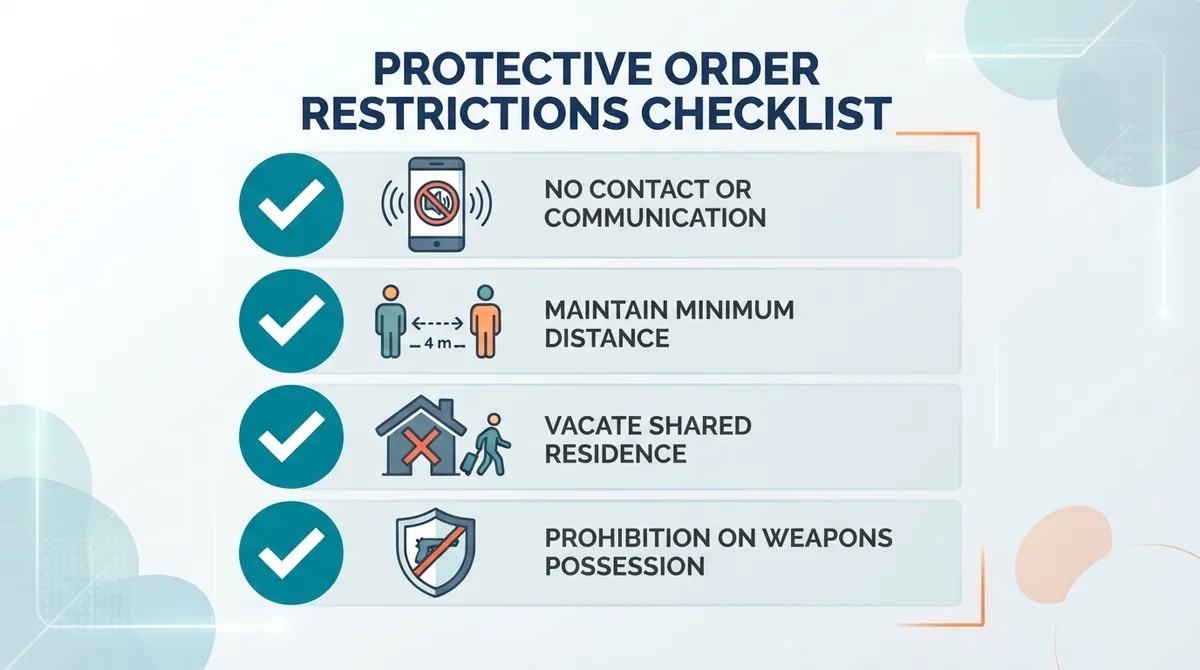
A protective order contains specific mandates tailored to the circumstances of the case. The court typically imposes several standard restrictions on the restrained party:
- No-Contact Provision - Prohibits all forms of communication, including phone calls, text messages, emails, social media interaction, and third-party messages.
- Stay-Away Provision - Mandates the restrained party maintain a specific physical distance from the protected party, their residence, workplace, and school.
- Move-Out Provision - Orders the restrained party to immediately vacate a shared residence, regardless of whose name is on the lease or deed.
- Firearms Restriction - Requires the restrained party to surrender any firearms in their possession and prohibits the purchase of new weapons during the duration of the order.
- Temporary Custody and Support - Establishes temporary arrangements for child custody, visitation, and financial support to ensure stability during the legal process.
Legal Framework and Enforcement
The legal basis for protective orders rests on state and federal statutes. These laws define the scope of protection and the consequences of non-compliance:
- Violence Against Women Act - Mandates nationwide enforcement of valid protective orders across state lines and tribal boundaries (18 U.S.C. § 2265).
- Gun Control Act of 1968 - Restricts individuals subject to certain active domestic violence protective orders from possessing firearms or ammunition (18 U.S.C. § 922(g)(8)).
- State Domestic Violence Statutes - Establish the specific petition processes, filing fees, and hearing timelines within individual state court systems.
The Petition and Hearing Process
Obtaining a final protective order involves a structured legal process. Petitions must navigate specific procedural steps to secure long-term protection:
- Filing the Petition - The petitioner submits a written request detailing the incidents of abuse or harassment to the local court clerk.
- Review for Temporary Relief - A judge reviews the petition immediately to determine if an emergency or temporary order is warranted prior to the full hearing.
- Serving the Respondent - Law enforcement or a professional process server delivers the petition and temporary order to the respondent, providing official notice of the allegations and the hearing date.
- The Formal Hearing - Both parties appear before a judge to present evidence, testimony, and witness statements regarding the allegations.
- Issuance of the Order - The judge evaluates the evidence and decides whether to grant a multi-year or permanent protective order.
Frequently Asked Questions
Not the form you're looking for?
Try our legal document generator to create a custom document
Disclaimer: The templates available on this website are provided for general informational purposes only and do not constitute legal advice. They are not intended to be, and should not be interpreted as, compliant with any specific legal, regulatory, or privacy requirements. These templates are not a replacement for professional legal guidance and should not be relied upon for any particular matter or circumstance. Users are strongly encouraged to seek advice from a qualified attorney licensed in their jurisdiction before using, modifying, or relying on any template.
All templates are provided on an "as is," "with all faults," and "as available" basis. The provider disclaims any and all warranties of any kind, whether express, implied, statutory, or otherwise, including without limitation warranties of merchantability, fitness for a particular purpose, title, or non-infringement.
LegalTemplates.com makes no guarantees or representations regarding the accuracy, completeness, expected outcomes, or reliability of the materials contained in these templates or any materials referenced or linked from them.