Notary Acknowledgement
A Notary Acknowledgement is a formal declaration before an authorized public official, such as a notary public, by a person signing a document, confirming that the signature is authentic and made voluntarily.
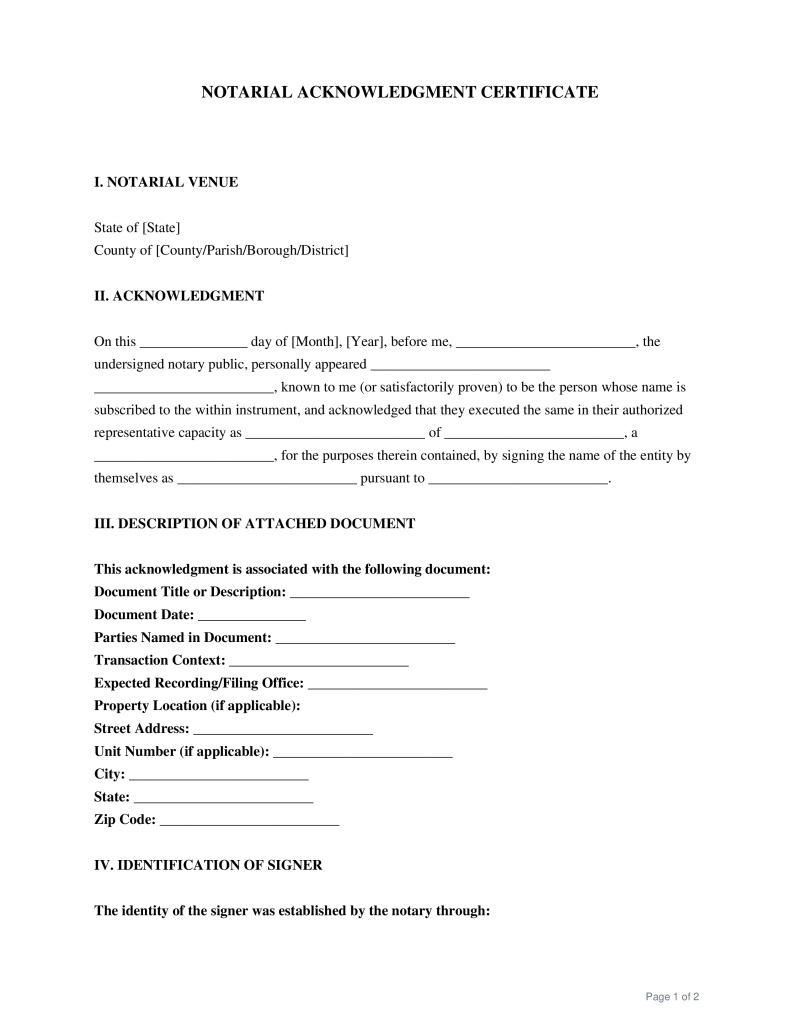
Acknowledgment Capacity
Choose whether the acknowledgment is for a person signing for themselves, a person signing on behalf of an entity or another person, or both. Representative capacity wording is commonly used for officers, managers, trustees, attorneys-in-fact, partners, guardians, executors, and similar authorized signers.
Table of Contents
What is a Notary Acknowledgement?
A Notary Acknowledgement is a formal notarial act where an individual declares before an authorized notary public that they have voluntarily signed a document for its stated purpose. This process confirms the identity of the signer and establishes the authenticity of the signature on the record. It is widely used by individuals, businesses, and legal professionals to execute contracts, deeds, powers of attorney, and other formal instruments. The primary objective is to prevent fraud and ensure the legal validity of the executed document.
Purpose and Legal Significance
The primary function of this notarial act is to ensure the integrity of legal transactions and protect the parties involved. Verifying the identity of the signer helps prevent fraudulent activities that could result in severe legal and financial consequences.
A properly executed certificate provides several legal protections:
- Prevention of Impersonation - Verifying the identity of the signer protects parties from financial loss due to forgery.
- Verification of Voluntariness - The signer declares that they executed the document of their own free will for its intended purpose.
- Presumption of Validity - Courts generally presume that an acknowledged document is authentic, shifting the burden of proof to anyone challenging its validity.
- Recording Eligibility - Many government offices, such as county recorders, require an acknowledgment before a deed or property easement can be officially recorded.
Types of Notary Acknowledgements
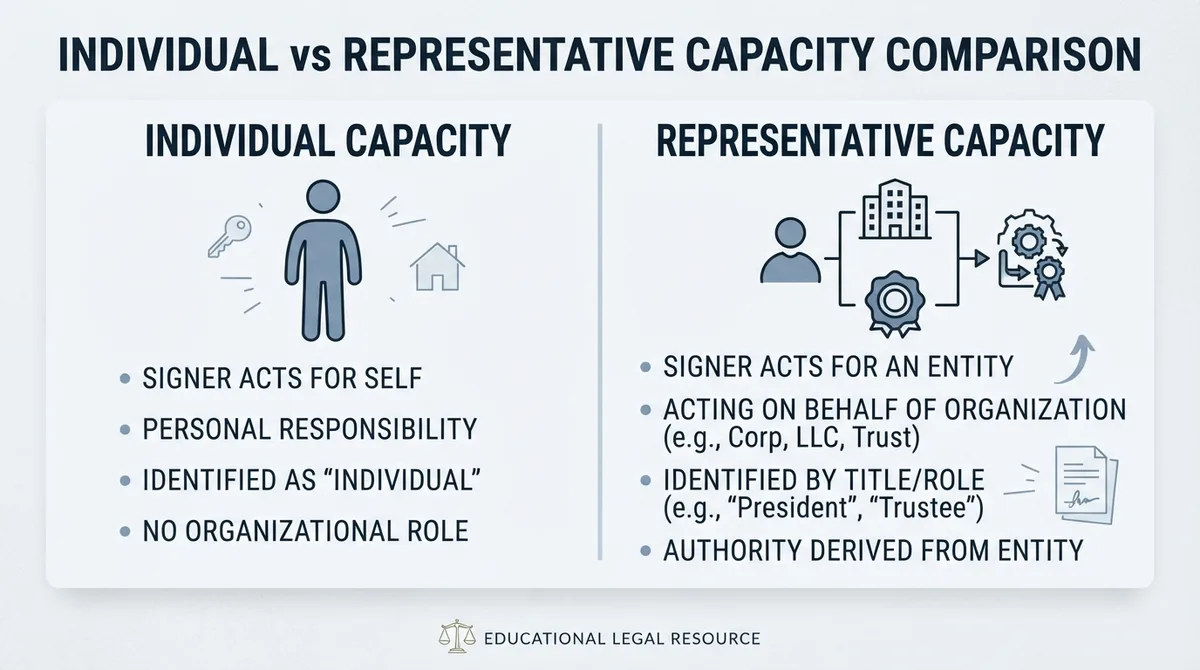
Notarial acts of this nature are generally categorized based on the capacity in which the signing party is executing the document. State guidelines dictate specific certificate wording for each category to reflect the signer's legal authority.
- Individual Capacity - A category where the signer acts on their own behalf, acknowledging that they personally signed the document for its intended purposes.
- Representative Capacity - A category where the signer acts on behalf of another entity, such as a corporation, partnership, trust, or estate, acknowledging their authority to sign.
Key Requirements for Performing an Acknowledgement
To execute this act legally, a notary public must follow a structured verification process. These steps ensure that the document meets the statutory standards required by state law.
- Personal Appearance - The signer must physically appear before the notary public at the time the acknowledgment is made.
- Positive Identification - The notary must verify the identity of the signer using satisfactory evidence, such as a government-issued photo ID, or personal knowledge.
- Signature Verification - The notary must verify that the signature on the record belongs to the individual appearing before them.
- Prior Execution Permitted - The document does not need to be signed in the presence of the notary public, provided the signer acknowledges the signature as their own.
- Voluntary Intention - The notary must determine that the signer understands the document and is executing it voluntarily without duress.
Essential Elements of an Acknowledgement Certificate
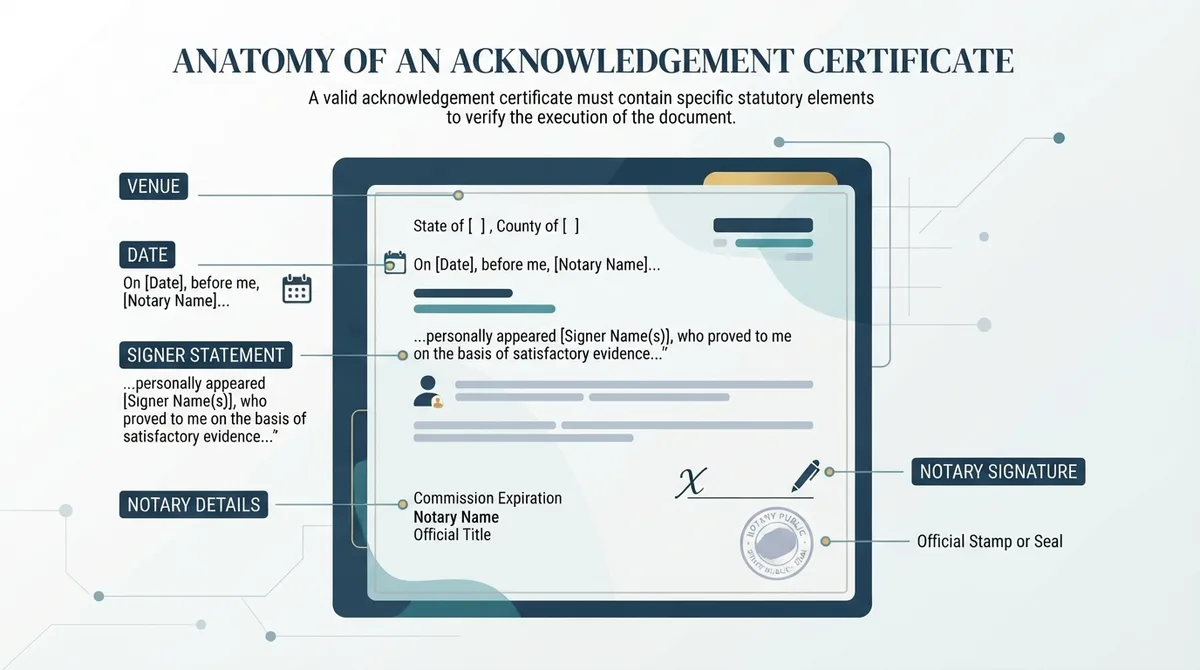
An acknowledgment certificate is a written statement signed and sealed by the notary public, proving that the notarial act took place. While exact wording varies by state, certain components must be present to ensure validity.
The standard components of a valid certificate include:
- Venue - The specific state and county where the notarial act is physically performed.
- Date of Act - The date the acknowledgment is taken, which may legally occur before or after the date the instrument was executed.
- Signer Statement - A statement indicating that the signer personally appeared and acknowledged the signature.
- Official Signature and Seal - The signature of the notary public and their official notary seal or stamp.
- Legible Notary Name - The printed or typed name of the notary public, which is recommended to appear below the signature line.
State Statutes and Legal Frameworks
States establish their own regulations and adopt uniform acts to standardize how notaries perform their duties. These laws outline the specific responsibilities, certificate forms, and identification standards required within each jurisdiction.
- Pennsylvania Revised Uniform Law on Notarial Acts - Authorizes notaries public to perform specific notarial acts, including taking acknowledgments, and outlines verification duties (5 Pa.C.S. § 301 et seq.).
- Washington Notarial Acts Act - Governs the duties, requirements, and certificate forms for taking acknowledgments within the state (RCW 42.45 et seq.).
- Massachusetts Executive Order on Notarial Acts - Regulates the standards of conduct and certificate requirements for notaries performing acknowledgments (Executive Order No. 450).
Frequently Asked Questions
Sources
- Taking an acknowledgement - Provides guidance on the notarial act of taking an acknowledgment in Washington State, including definitions and sample certificates.
- Notary Public: South Dakota Secretary of State - Offers an illustration of an acknowledgment and emphasizes the importance of identifying the person making the acknowledgment to prevent financial loss due to impersonation or forgery.
- Powers of a Notary Public | Department of State | Commonwealth of Pennsylvania - Details the notarial acts authorized under the Revised Uniform Law on Notarial Acts (RULONA), including taking acknowledgments, and outlines the requirements for performing such acts.
- Notary services - Explains the notarial act of acknowledgment, including the requirements for the notary and the signer, and provides a sample acknowledgment certificate.
- Acknowledgments: Requirements | Mass.gov - Provides guidelines on the requirements for acknowledgments in Massachusetts, including sample forms and the necessary components of a valid acknowledgment certificate.
Not the form you're looking for?
Try our legal document generator to create a custom document
Disclaimer: The templates available on this website are provided for general informational purposes only and do not constitute legal advice. They are not intended to be, and should not be interpreted as, compliant with any specific legal, regulatory, or privacy requirements. These templates are not a replacement for professional legal guidance and should not be relied upon for any particular matter or circumstance. Users are strongly encouraged to seek advice from a qualified attorney licensed in their jurisdiction before using, modifying, or relying on any template.
All templates are provided on an "as is," "with all faults," and "as available" basis. The provider disclaims any and all warranties of any kind, whether express, implied, statutory, or otherwise, including without limitation warranties of merchantability, fitness for a particular purpose, title, or non-infringement.
LegalTemplates.com makes no guarantees or representations regarding the accuracy, completeness, expected outcomes, or reliability of the materials contained in these templates or any materials referenced or linked from them.