Motion for Continuance
A Motion for Continuance is a formal legal request submitted to a court by a party to a lawsuit seeking to postpone or reschedule a scheduled trial, hearing, or other legal proceeding to a later date.
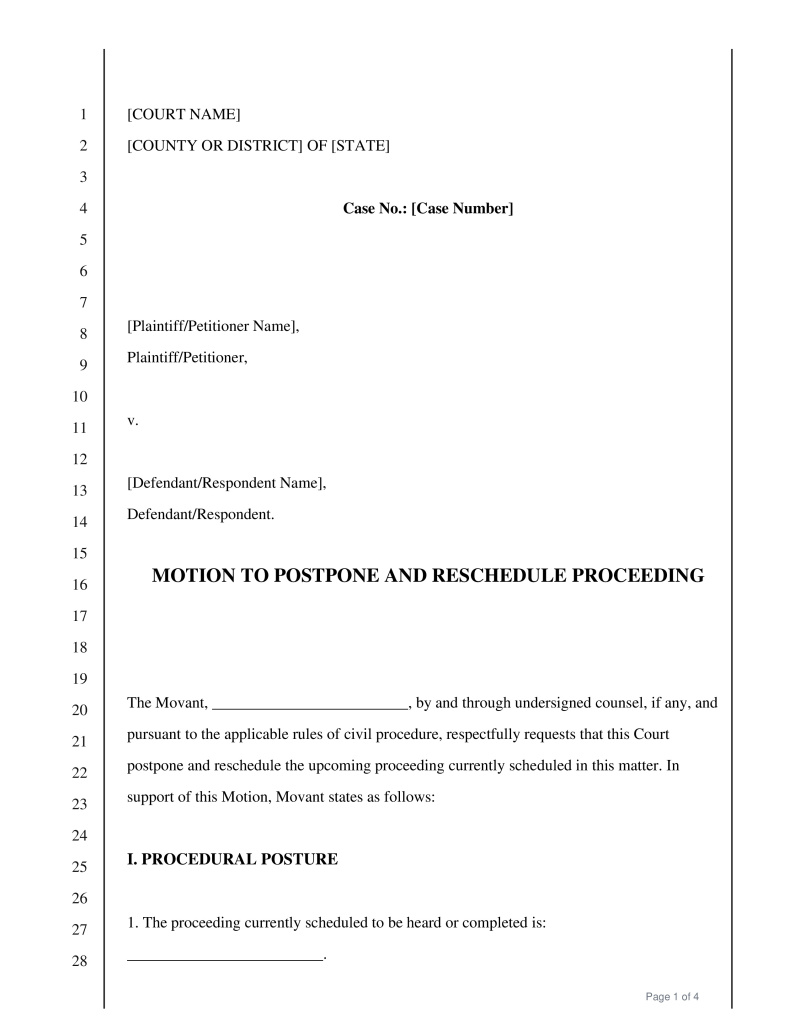
Continuance Target Type
Select the scheduled event or deadline that the motion should address.
Use the name or description that appears on the court notice, order, or docket.
Table of Contents
What is a Motion for Continuance?
A Motion for Continuance is a formal legal request submitted to a court asking to postpone a scheduled trial, hearing, or other legal proceeding to a later date. This procedural tool is utilized by plaintiffs, defendants, or prosecutors in both civil and criminal cases when unexpected circumstances prevent them from being prepared or present. The primary purpose of the motion is to ensure fairness and preserve due process rights by allowing parties adequate time to prepare their cases.
Types of Motions for Continuance
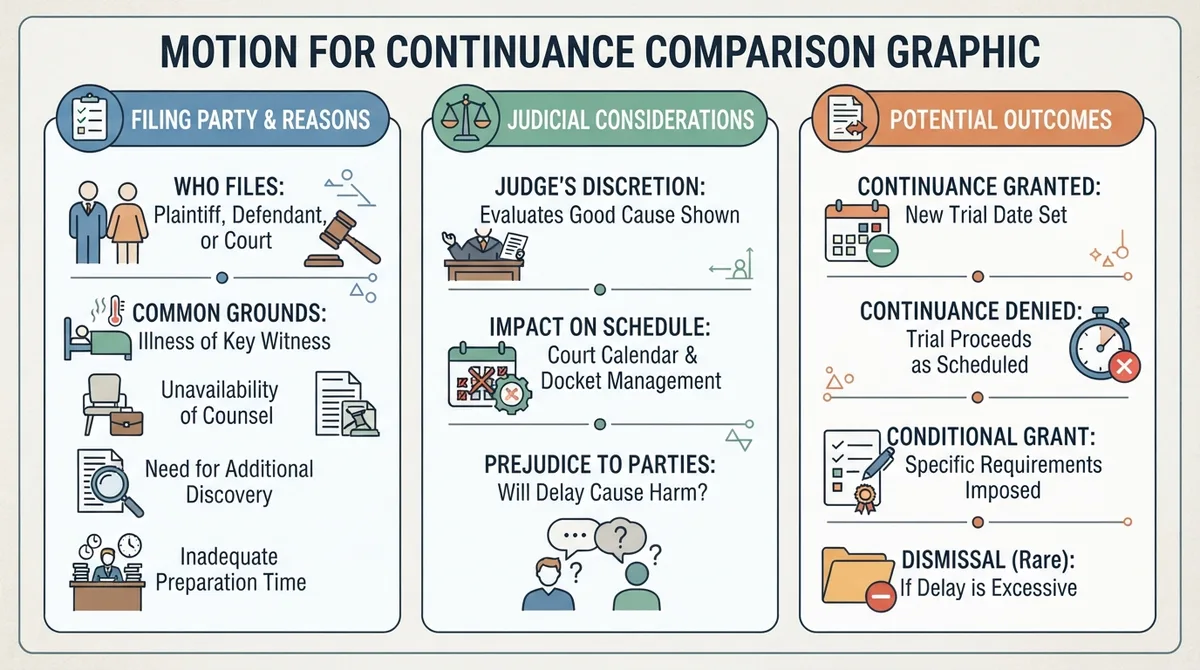
Parties in a legal proceeding may file different variations of this motion depending on the level of agreement between the sides and the urgency of the situation:
- Joint Motion for Continuance - A request submitted cooperatively by both the plaintiff and the defendant agreeing that a postponement is necessary.
- Uncontested Motion for Continuance - A request filed by one party where the opposing party has been contacted and does not object to the postponement.
- Contested Motion for Continuance - A request filed by one party that the opposing party actively opposes, requiring the judge to resolve the dispute.
- Emergency Motion for Continuance - A last-minute request filed due to sudden, unforeseen events such as a medical emergency or natural disaster.
Common Grounds for Requesting a Postponement
Courts do not grant delays automatically and require a showing of good cause before altering the schedule of a case. Common justifications include:
- Attorney Illness or Unavailability - Sudden medical emergencies, severe illness, or conflicting trial schedules of the lead attorney.
- Unavailability of a Key Witness - The unexpected absence, illness, or inability to locate a material witness whose testimony is essential to the case.
- Incomplete Discovery - Situations where parties need more time to gather evidence, conduct depositions, or receive expert reports through no fault of their own.
- Recent Change of Counsel - The hiring of a new attorney who requires reasonable time to review the case file and prepare an adequate defense.
- Amended Pleadings - Significant changes to the initial complaint or answer that introduce new legal claims or factual allegations requiring additional preparation.
Key Elements of a Motion for Continuance
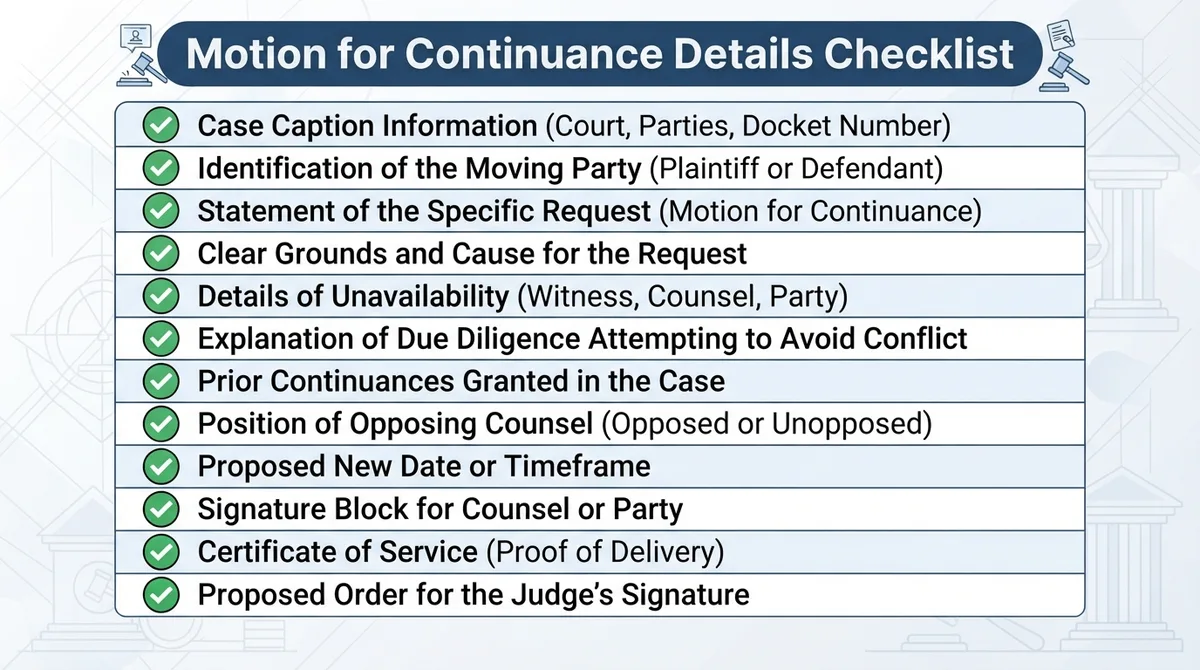
To be considered by a judge, the written request must contain specific details and follow local court rules:
- Case Caption - The official heading containing the court name, party names, case number, and division.
- Statement of Facts - A clear explanation detailing the specific reasons why the current date cannot be met.
- Good Cause Showing - A legal argument demonstrating that the request is made in good faith and not solely for the purpose of delaying the proceedings.
- Certificate of Conference - A statement verifying that the moving party contacted the opposing counsel to discuss the requested delay.
- Verification or Affidavit - A sworn statement, often required in many jurisdictions, supporting the factual claims made in the motion.
- Proposed Order - A separate draft document for the judge to sign, granting the request and outlining the new schedule.
Judicial Discretion and Standards of Review
Judges possess broad discretion when deciding whether to grant or deny a postponement. The court must balance the moving party's need for additional time against the interest of the opposing party in securing a prompt resolution. When reviewing a motion, judges typically evaluate several factors to ensure justice is served.
The court assesses whether the moving party exercised due diligence in preparing for the case prior to requesting the delay. Judges also examine the potential prejudice or harm the opposing party might suffer if the trial is postponed. If a party has repeatedly requested delays, the court is far more likely to deny the request to prevent abuse of the legal system. In criminal cases, judges must also weigh the defendant's constitutional right to a speedy trial against the reasons presented for the delay.
Procedural Requirements and Filing Timelines
Filing a request for a delay requires adherence to strict procedural rules established by local and state courts:
- Written Submission Requirement - Requests must generally be submitted in writing, though oral motions may be permitted in open court under emergency circumstances.
- Filing Deadlines - Motions should be filed as soon as the conflict is identified, often requiring submission a specific number of days before the scheduled hearing.
- Notice to Opposing Parties - The moving party must serve a copy of the motion to all other parties involved in the lawsuit.
- Filing Fees - Some jurisdictions require the payment of a motion filing fee unless a waiver is granted.
Legal Frameworks Governing Continuances
Procedural rules at both the state and federal levels dictate how courts handle requests for postponements:
- Federal Rules of Civil Procedure - Governs the scheduling and management of pretrial conferences and trials in federal civil cases (Fed. R. Civ. P. 16).
- Federal Speedy Trial Act - Establishes strict time limits for criminal trials while defining excludable delays, including those resulting from granted continuances (18 U.S.C. § 3161).
- California Rules of Court - Outlines the firm policy disfavoring continuances in civil cases except upon a showing of good cause (Cal. Rules of Court, Rule 3.1332).
- Texas Rules of Civil Procedure - Mandates that no continuance shall be granted except for sufficient cause supported by affidavit (Tex. R. Civ. P. 251).
Not the form you're looking for?
Try our legal document generator to create a custom document
Disclaimer: The templates available on this website are provided for general informational purposes only and do not constitute legal advice. They are not intended to be, and should not be interpreted as, compliant with any specific legal, regulatory, or privacy requirements. These templates are not a replacement for professional legal guidance and should not be relied upon for any particular matter or circumstance. Users are strongly encouraged to seek advice from a qualified attorney licensed in their jurisdiction before using, modifying, or relying on any template.
All templates are provided on an "as is," "with all faults," and "as available" basis. The provider disclaims any and all warranties of any kind, whether express, implied, statutory, or otherwise, including without limitation warranties of merchantability, fitness for a particular purpose, title, or non-infringement.
LegalTemplates.com makes no guarantees or representations regarding the accuracy, completeness, expected outcomes, or reliability of the materials contained in these templates or any materials referenced or linked from them.