Motion for Contempt
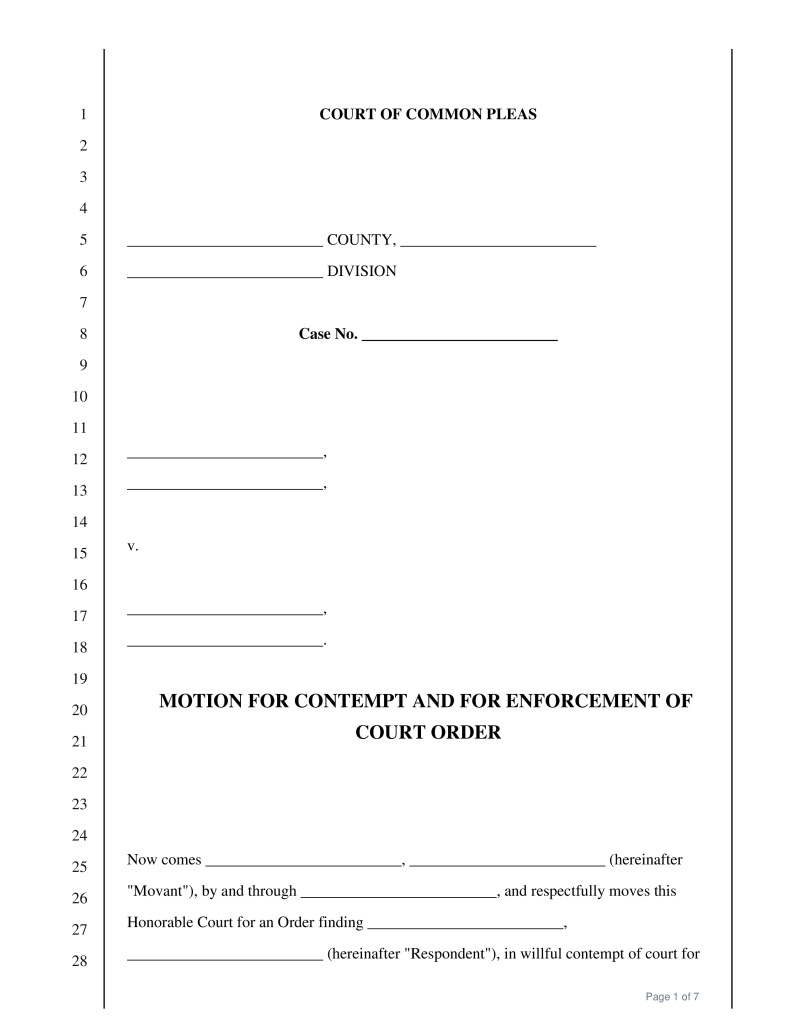
A Motion for Contempt is a formal legal pleading filed with a court to request sanctions or enforcement measures against a party who has willfully violated a prior judicial decree, order, or judgment.
Violated Order Type
Choose the primary order involved. You can describe additional violations later.
Briefly identify the order category.
Table of Contents
What is a Motion for Contempt?
A Motion for Contempt is a formal legal request submitted to a court asking a judge to enforce an existing order and penalize a party who has failed to comply with its directives. This legal mechanism serves as a primary tool for parties seeking to compel obedience to judicial decrees, such as injunctions, support orders, or bankruptcy discharge injunctions. The party filing the motion, known as the movant, bears the burden of proving that the opposing party knowingly violated a clear and unambiguous court order.
Common Uses of a Motion for Contempt
Courts utilize contempt proceedings across various legal fields to maintain authority and ensure compliance with judicial determinations:
- Bankruptcy Discharge Violations - Creditors attempting to collect debts that have been legally discharged in bankruptcy proceedings violate the automatic stay or discharge injunction, prompting debtors to seek relief (11 U.S.C. § 524).
- Domestic Relations Orders - Parents or former spouses frequently file these motions when an obligor fails to pay court-ordered child support, alimony, or violates custody schedules.
- Civil Injunction Enforcement - Litigants use these motions to enforce restraining orders, non-compete agreements, or environmental remediation mandates.
- Discovery Non-Compliance - Parties in ongoing litigation file motions when an opposing party refuses to comply with subpoenas or court-ordered discovery requests.
Types of Contempt
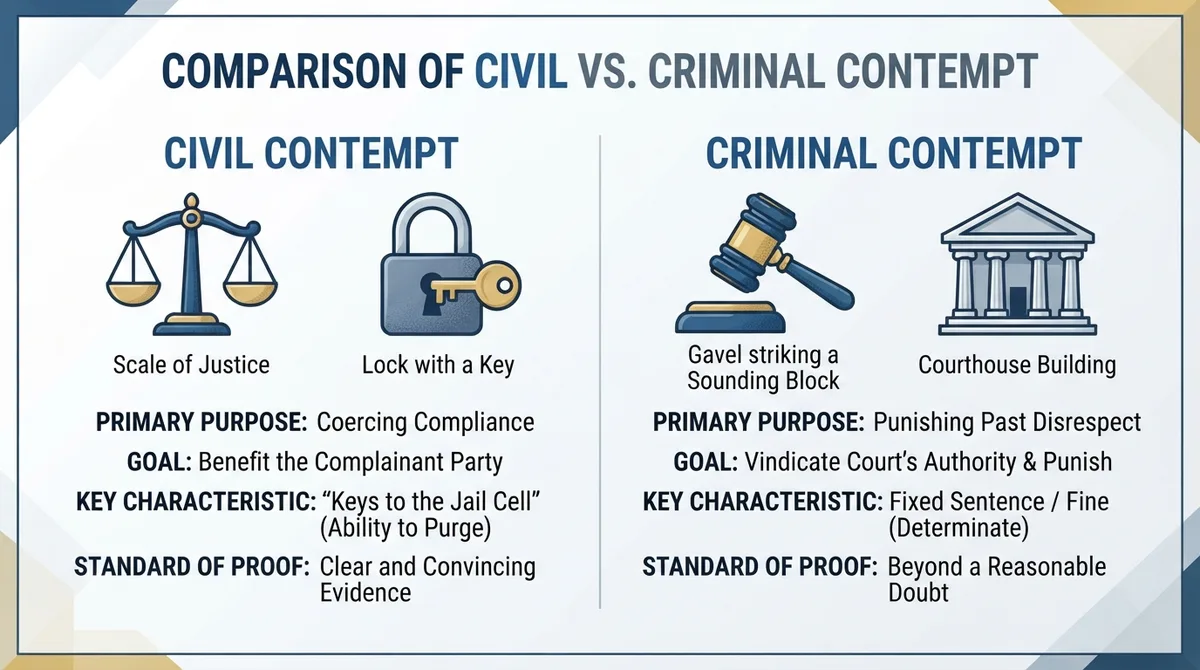
Courts categorize contempt into distinct types based on the nature of the violation and the purpose of the proposed sanction:
- Civil Contempt - Remedial measures designed to coerce compliance with a court order for the benefit of the complainant.
- Criminal Contempt - Punitive measures intended to vindicate the authority of the court by punishing past acts of disobedience.
- Direct Contempt - Disobedient or disrespectful behavior that occurs directly in the presence of the court, allowing for immediate summary punishment.
- Indirect Contempt - Disobedience that occurs outside the immediate presence of the court, requiring a formal motion, notice, and a hearing to establish.
Required Elements of the Motion
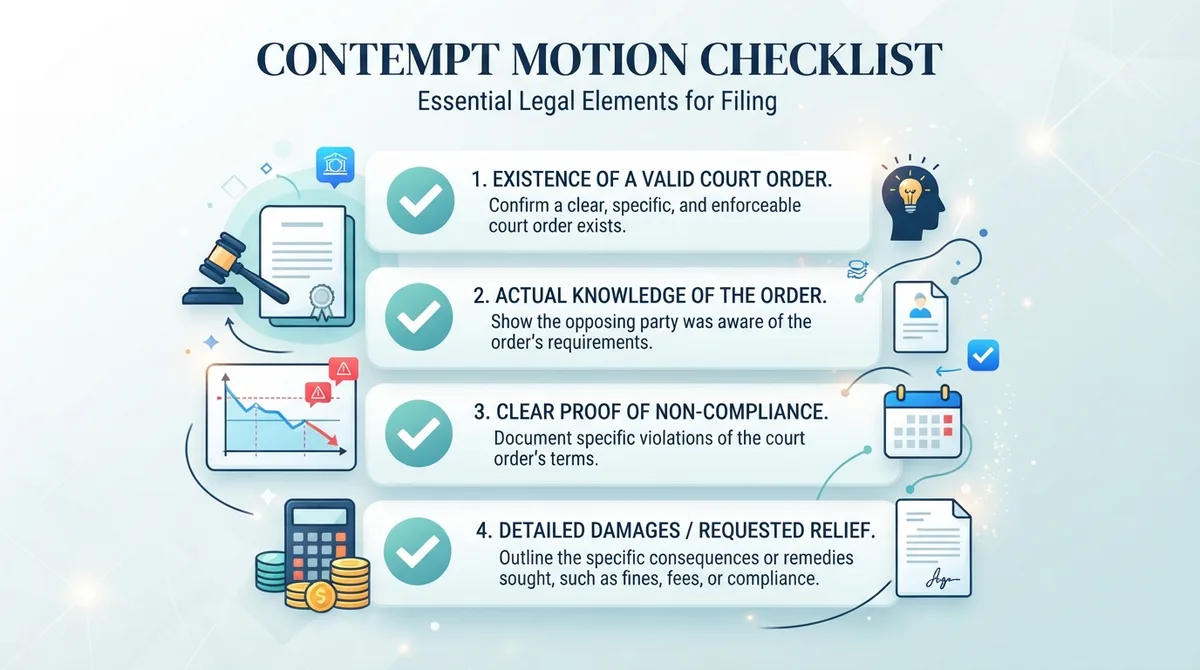
To succeed on a motion, the filing party must draft a comprehensive document detailing the specific nature of the violation. Specific local court rules outline the necessary allegations for filing:
- Factual Allegations - Detailed allegations of the facts supporting the motion, specifying the exact order violated, the date of the order, and the specific actions constituting non-compliance (District of Oregon LBR 9020-1).
- Requested Relief - Clear statements detailing the specific damages, attorney fees, and other corrective relief that the movant requests from the court (District of Oregon LBR 9020-1).
- Proof of Notice - Evidence demonstrating that the non-complying party had actual knowledge of the court order prior to the violation.
Filing Procedures in Federal Bankruptcy Courts
Filing procedures vary by jurisdiction, but federal bankruptcy courts utilize standardized electronic filing systems for processing these motions:
- District of Nebraska Filing - Filers must select Bankruptcy, navigate to Motions/Applications, enter the case number, choose Contempt from the event list, and attach the PDF file (District of Nebraska Bankruptcy Court Instructions).
- Central District of California Filing - Filers must select Bankruptcy, navigate to Motions/Applications, enter the case number, choose Contempt (motion) from the event list, and attach the PDF file (Central District of California Bankruptcy Court Manual).
- Southern District of Indiana Filing - Filers must select Bankruptcy, navigate to Motions, Applications & Briefs, enter the case number, and choose Contempt (including Violation of Discharge Injunction), Motion for from the menu (Southern District of Indiana Bankruptcy Court Guidelines).
- District of New Jersey Filing - Filers must select Bankruptcy, navigate to Motions/Applications, enter the case number, select Contempt from the drop-down menu, and upload the supporting PDF document (District of New Jersey Bankruptcy Court Procedures).
Standard of Proof in Contempt Proceedings
The legal standard required to establish contempt depends heavily on the nature of the proceedings:
- Clear and Convincing Evidence Standard - Civil contempt requires the moving party to prove by clear and convincing evidence that a specific, unambiguous court order was violated.
- Beyond a Reasonable Doubt Standard - Criminal contempt requires the government or prosecuting party to prove the violation beyond a reasonable doubt due to the punitive nature of the sanctions.
- Knowledge and Intent Requirement - The moving party must demonstrate that the alleged violator had actual knowledge of the order, though civil contempt does not always require proof of willful intent to violate.
Potential Sanctions and Remedies
When a court grants a contempt motion, it can impose various remedies depending on whether the contempt is civil or criminal in nature:
- Coercive Fines - Daily monetary penalties that accumulate until the non-compliant party performs the required action.
- Compensatory Damages - Financial awards paid directly to the moving party to cover losses resulting from the violation, including attorney fees and court costs.
- Incarceration - Physical confinement of the non-compliant party until they comply with the court order, commonly referred to as holding the keys to their own jail cell.
Frequently Asked Questions
Sources
- Motion for Contempt | District of Nebraska | United States Bankruptcy Court - Provides instructions for filing a Motion for Contempt in the District of Nebraska Bankruptcy Court, including selecting the appropriate event in CM/ECF and attaching the necessary documents.
- Motion for Contempt | Central District of California | United States Bankruptcy Court - Outlines the procedure for filing a Motion for Contempt in the Central District of California Bankruptcy Court, including selecting the appropriate event in CM/ECF and attaching the necessary documents.
- Motion for Order of Contempt | Southern District of Indiana | United States Bankruptcy Court - Provides guidance on filing a Motion for Order of Contempt in the Southern District of Indiana Bankruptcy Court, including the appropriate event in CM/ECF and necessary attachments.
- Motion for Contempt | District of New Jersey | United States Bankruptcy Court - Details the steps for filing a Motion for Contempt in the District of New Jersey Bankruptcy Court, including selecting the appropriate event in CM/ECF and attaching the necessary documents.
- Rule 9020-1. Contempt. | United States Bankruptcy Court for the District of Oregon - Defines the requirements for a Motion for an Order of Contempt in the District of Oregon Bankruptcy Court, including necessary allegations and requested relief.
Not the form you're looking for?
Try our legal document generator to create a custom document
Disclaimer: The templates available on this website are provided for general informational purposes only and do not constitute legal advice. They are not intended to be, and should not be interpreted as, compliant with any specific legal, regulatory, or privacy requirements. These templates are not a replacement for professional legal guidance and should not be relied upon for any particular matter or circumstance. Users are strongly encouraged to seek advice from a qualified attorney licensed in their jurisdiction before using, modifying, or relying on any template.
All templates are provided on an "as is," "with all faults," and "as available" basis. The provider disclaims any and all warranties of any kind, whether express, implied, statutory, or otherwise, including without limitation warranties of merchantability, fitness for a particular purpose, title, or non-infringement.
LegalTemplates.com makes no guarantees or representations regarding the accuracy, completeness, expected outcomes, or reliability of the materials contained in these templates or any materials referenced or linked from them.