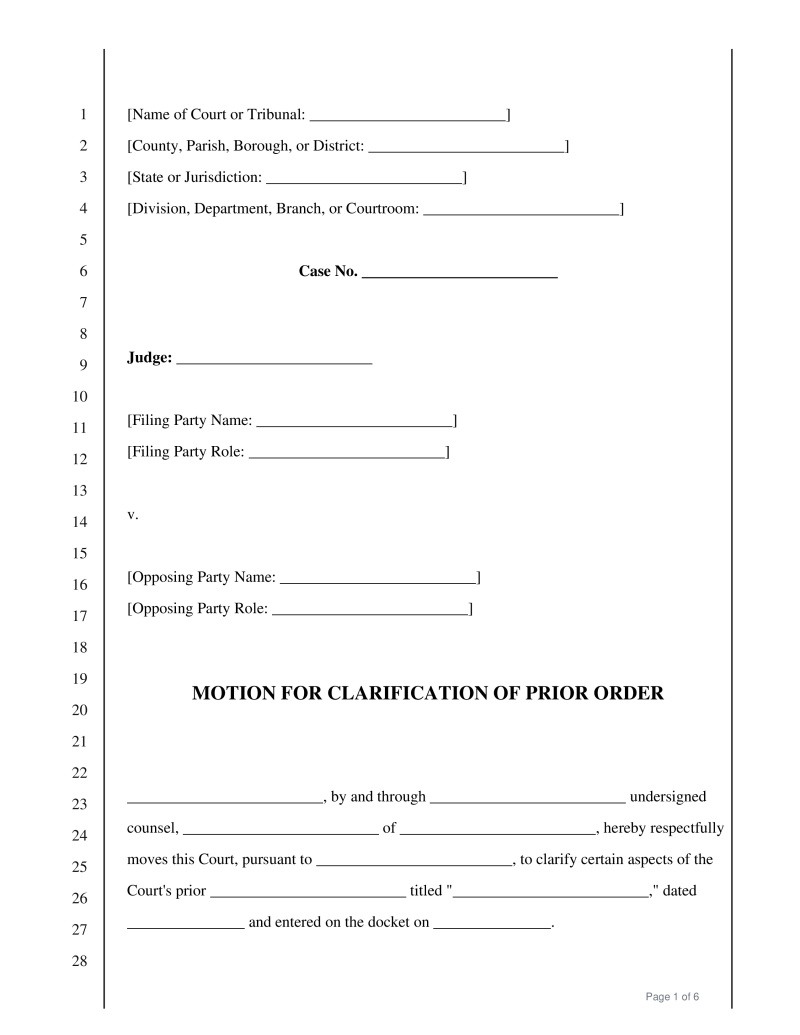
Motion for Clarification
A Motion for Clarification is a formal written request submitted to a court asking a judge to resolve ambiguities, uncertainties, or omissions in a previously issued order, ruling, or judgment.
Filing Party Role
Select the procedural role of the party asking the court or tribunal for clarification.
Use the role shown in the case caption or tribunal record.
Table of Contents
What is a Motion for Clarification?
A Motion for Clarification is a formal procedural request submitted to a court asking a judge to explain or resolve an ambiguity in a previously issued order, judgment, or decree. Parties in civil, criminal, or administrative proceedings file this motion when the court's directive is unclear, conflicting, or susceptible to multiple interpretations. The primary objective is to obtain a precise explanation of the court's intent so that the parties can comply with the ruling without risking non-compliance or contempt. This motion does not seek to change the substance of the ruling, but rather to illuminate the exact obligations and rights established by the court.
Purpose and Legal Grounds
Courts possess inherent authority to clarify their own orders to ensure proper administration of justice and compliance. While federal courts and state jurisdictions generally recognize and allow these motions, they are disfavored and rarely granted. Litigants frequently confuse clarification with reconsideration, which leads to courts scrutinizing these filings to ensure they are not disguised attempts to re-argue the merits of a case. The moving party must demonstrate that the language of the order is genuinely ambiguous and that clarification is necessary for execution or compliance.
Specific federal appellate guidelines reflect this restrictive approach:
- Disfavored Remedy Status - Establishes that requests for clarification, reconsideration, or modification of an order deciding a motion are disfavored and rarely granted (Fed. R. App. P. 9th Cir. Advisory Committee Notes).
- Rarely Granted - Judicial bodies rarely grant these motions because orders are presumed to be clear and final unless a manifest ambiguity is demonstrated (Fed. R. App. P. 9th Cir. Advisory Committee Notes).
- Inherent Judicial Power - Trial courts maintain the authority to clarify ambiguous rulings to prevent confusion and ensure the accurate execution of judicial mandates.
Procedural Rules and Requirements
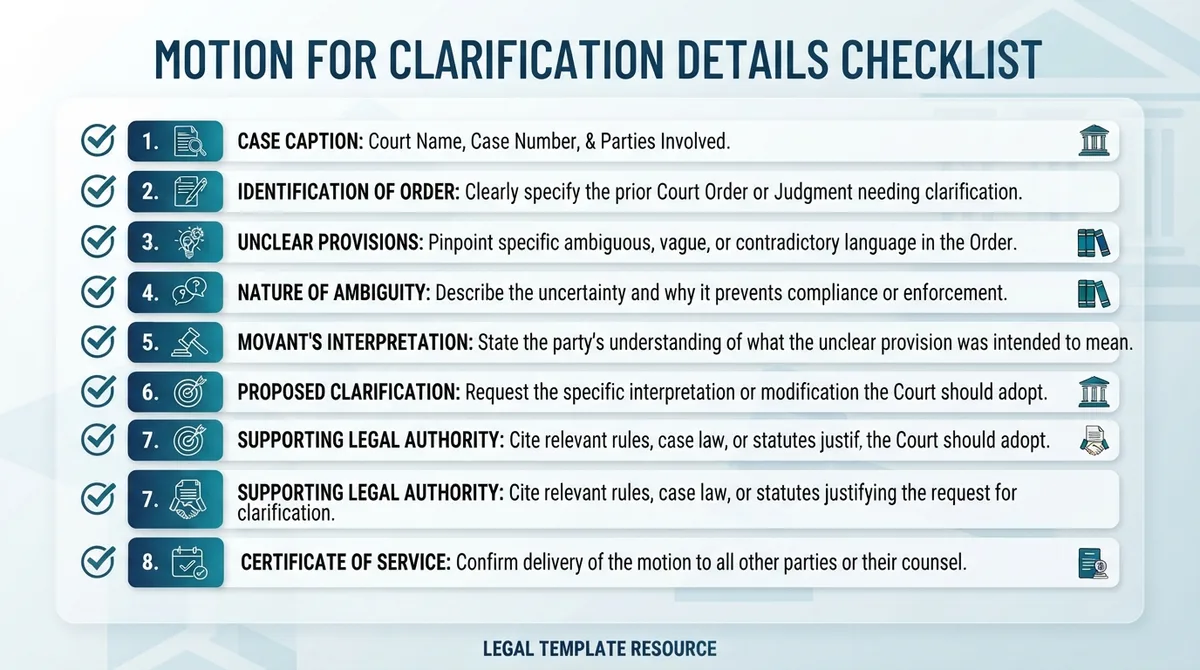
Filing a Motion for Clarification requires adherence to specific local and federal rules of civil procedure. Jurisdictions establish precise guidelines regarding the format, length, and supporting documentation required for these motions. Failure to follow these local rules can result in the immediate denial of the motion without a review of the underlying ambiguity.
The United States District Court for the Southern District of West Virginia illustrates standard procedural requirements:
- Local Motion Practice Rules - Mandates that motions for clarification must be accompanied by a supporting memorandum of law detailing the legal and factual basis for the request (LR Civ P 7.1).
- Page Limitation - Restricts supporting memorandums to a maximum length of 20 pages to ensure concise arguments (LR Civ P 7.1).
- Timeliness - Requires parties to file the motion within a reasonable timeframe after the entry of the ambiguous order to avoid delaying the proceedings.
- Specification of Ambiguity - Mandates that the moving party identify the exact language, paragraph, or directive in the court order that requires explanation.
Types of Clarification Requests
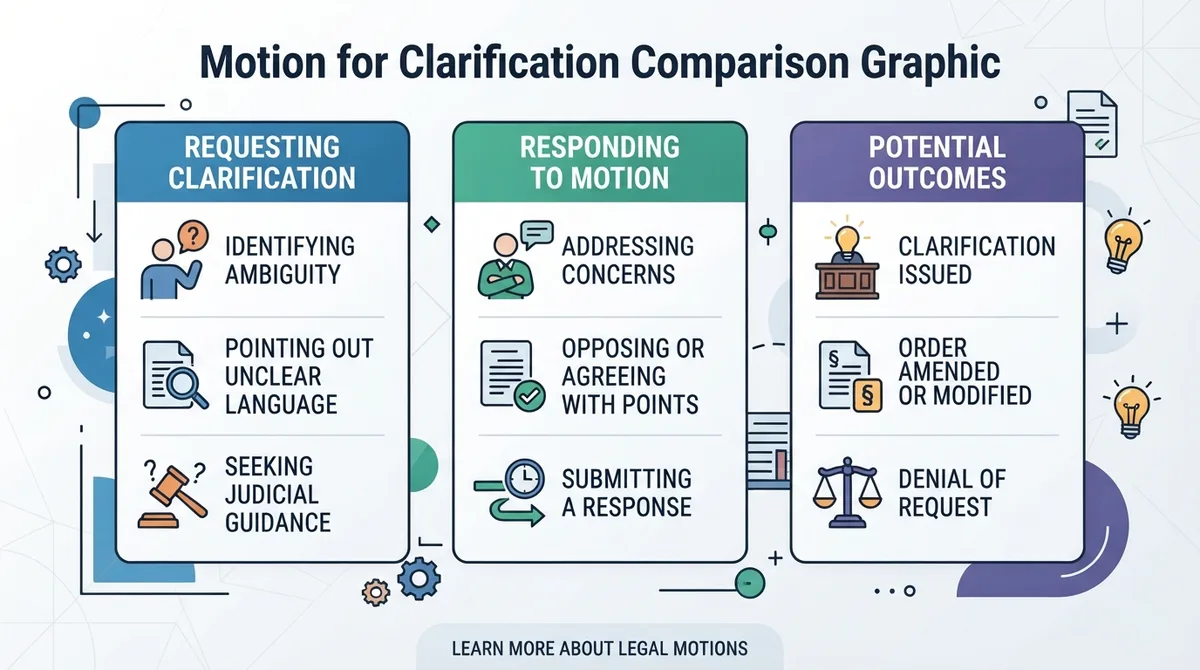
Parties may seek clarification for various aspects of a court order depending on the nature of the ambiguity:
- Inconsistent Directives - Requests addressing orders that contain conflicting instructions within the same document, making simultaneous compliance impossible.
- Ambiguous Timeframes - Requests seeking to define unclear deadlines, start dates, or compliance schedules established by the court.
- Scope of Injunctive Relief - Requests seeking to clarify the precise geographical boundaries or specific actions prohibited or permitted under an injunction.
- Financial Obligation Calculations - Requests seeking clarification on the exact methodology, principal amounts, or interest rates applicable to a monetary judgment.
Application in Specific Legal Contexts
The utility of a Motion for Clarification spans multiple legal disciplines, including bankruptcy, family law, and complex civil litigation. In bankruptcy proceedings, clarity is essential because multiple creditors and debtors must coordinate actions under strict court supervision. Ambiguous orders in these settings can lead to unintended violations of the automatic stay or incorrect distributions of estate assets.
The following examples illustrate the application of these motions in practice:
- Bankruptcy Clarification Practice - Illustrates a formal response to a motion to clarify regarding the interpretation of debtor and creditor obligations (Barnett’s Response to Pitre’s Motion to Clarify, Adv. Dkt. 117, Bankr. S.D. Miss.).
- Domestic Relations Orders - Resolves ambiguities in child custody schedules, visitation rights, or the division of marital assets to prevent ongoing parental conflict.
- Administrative Agency Mandates - Assists parties subject to administrative consent decrees in understanding complex regulatory requirements without triggering compliance penalties.
Key Differences from Reconsideration and Appeal
Understanding the distinctions between clarification, reconsideration, and appeal is critical for proper legal strategy. Filing the wrong motion can result in forfeiture of rights or denial of the requested relief. Each procedural action serves a distinct function in the litigation lifecycle.
The differences are defined by the objective and scope of each filing:
- Motion for Clarification - Seeks an explanation of what the court's existing order means without asking the court to change its decision or alter legal rights.
- Motion for Reconsideration - Asks the court to review its decision, correct errors of law or fact, or consider newly discovered evidence, directly challenging the correctness of the ruling.
- Notice of Appeal - Initiates a process where a higher court reviews the lower court's decision for legal or procedural errors, aiming to overturn the judgment entirely.
Sources
- LR Civ P 7.1 | Southern District of West Virginia | United States District Court - Provides local rules on motion practice, including requirements for motions for clarification.
- Federal Rules of Appellate Procedure, Ninth Circuit Rules, Circuit Advisory Committee Notes - Advisory notes on motions for clarification, reconsideration, or modification of orders.
- Motion for Clarification (“Barnett’s Response to Pitre’s Motion to Clarify”) (Adv. Dkt. 117) filed by Kevin Barnett - An example of a motion for clarification filed in a bankruptcy case.
Not the form you're looking for?
Try our legal document generator to create a custom document
Disclaimer: The templates available on this website are provided for general informational purposes only and do not constitute legal advice. They are not intended to be, and should not be interpreted as, compliant with any specific legal, regulatory, or privacy requirements. These templates are not a replacement for professional legal guidance and should not be relied upon for any particular matter or circumstance. Users are strongly encouraged to seek advice from a qualified attorney licensed in their jurisdiction before using, modifying, or relying on any template.
All templates are provided on an "as is," "with all faults," and "as available" basis. The provider disclaims any and all warranties of any kind, whether express, implied, statutory, or otherwise, including without limitation warranties of merchantability, fitness for a particular purpose, title, or non-infringement.
LegalTemplates.com makes no guarantees or representations regarding the accuracy, completeness, expected outcomes, or reliability of the materials contained in these templates or any materials referenced or linked from them.