Percentage Lease
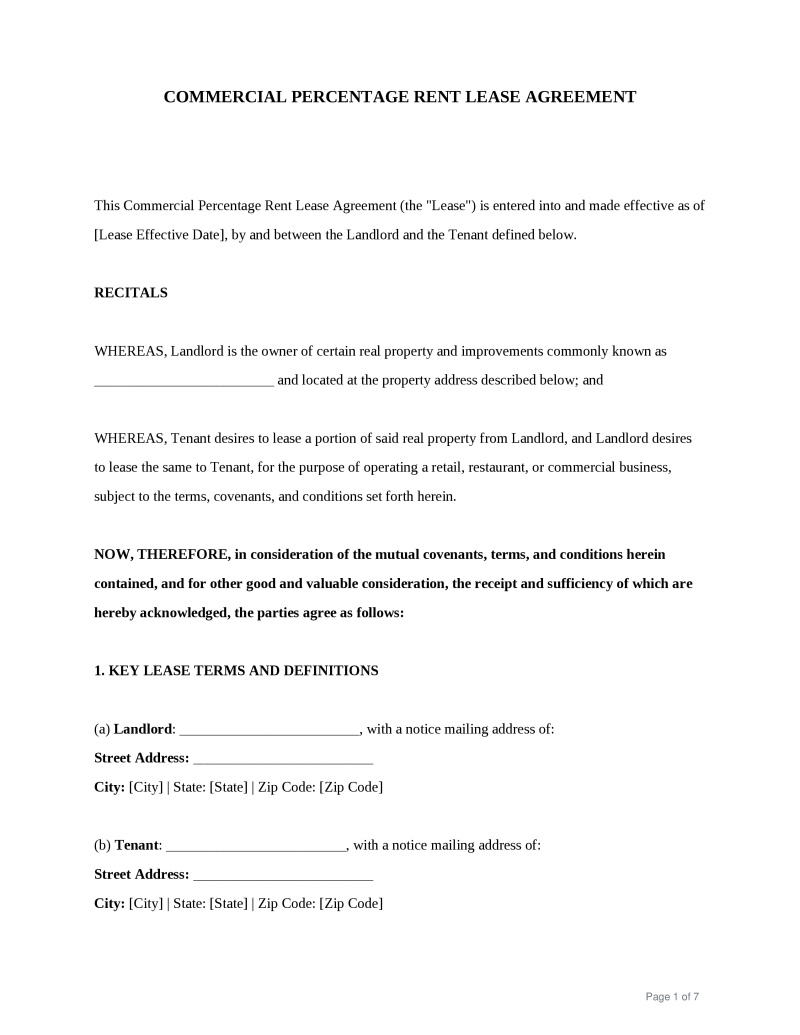
A percentage lease is a commercial real estate rental agreement where the tenant pays a base rent plus a percentage of their gross sales volume generated on the leased premises.
Premises Setting
Percentage leases are most common in shopping centers, malls, mixed-use developments, and restaurant or retail locations where rent is tied to sales performance.
Use this if the property does not fit one of the listed categories.
Table of Contents
What is a Percentage Lease?
A percentage lease is a commercial real estate lease agreement where the tenant pays a base rent plus a percentage of the gross sales generated on the premises. This arrangement is most commonly utilized in retail environments, such as shopping malls, strip centers, and high-traffic retail districts. The primary purpose of this lease structure is to align the financial interests of the landlord and the tenant, allowing both parties to share in the success of a prime retail location. By linking rental costs directly to business performance, the arrangement provides a degree of risk-sharing during economic downturns and rewards landlords for maintaining high consumer traffic.
How a Percentage Lease Works
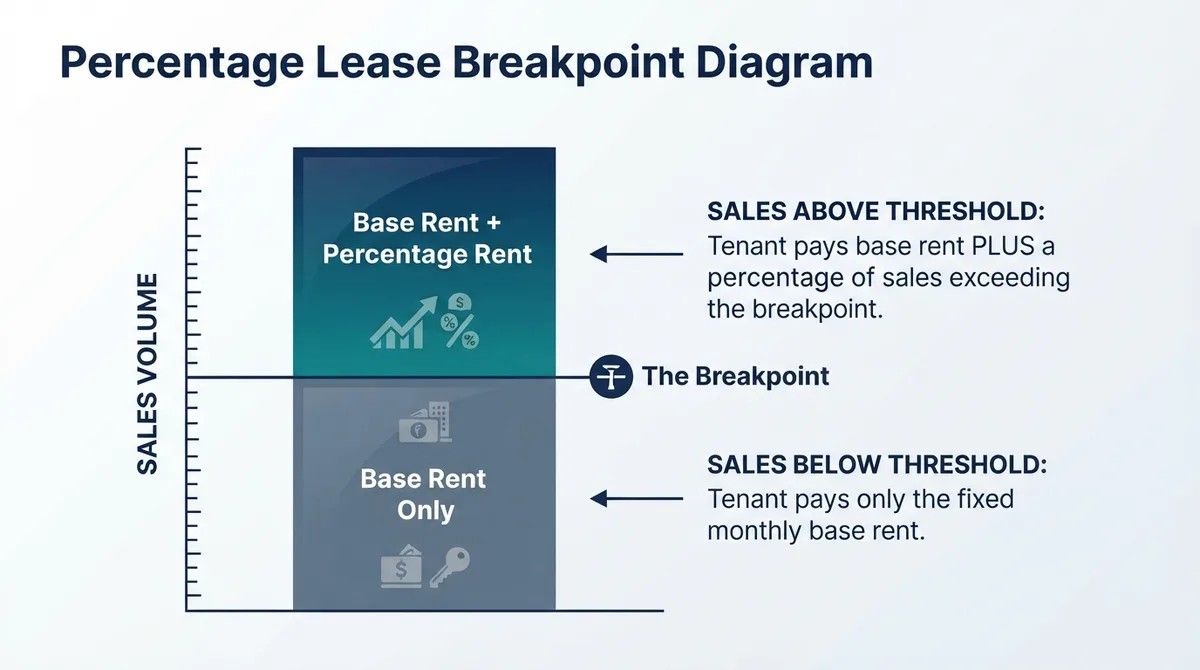
Commercial retail spaces rely heavily on foot traffic and location quality to drive revenue. In a percentage lease, the rental payment consists of two primary components: the base rent and the percentage rent. The base rent is a fixed monthly or annual fee paid regardless of sales volume, providing the landlord with a guaranteed income stream to cover basic property expenses. The percentage rent is calculated by applying an agreed-upon percentage to the tenant's gross sales after reaching a specific threshold known as the breakpoint.
The breakpoint represents the sales volume at which the tenant begins paying percentage rent. Breakpoints are established in one of two ways:
- Natural Breakpoint - Calculated by dividing the annual base rent by the agreed-upon percentage rate.
- Artificial Breakpoint - Established as a mutually agreed-upon flat dollar amount of sales, independent of the base rent calculation.
Once the tenant's gross sales exceed this threshold, the tenant must submit regular sales reports to the landlord and pay the additional percentage rent. This requires detailed record-keeping and auditing provisions within the lease agreement to ensure sales figures are reported accurately. Landlords often require monthly or quarterly reporting to track performance and anticipate rental income fluctuations throughout the fiscal year.
Types of Percentage Lease Structures
Commercial landlords and tenants utilize different variations of this lease model depending on the risk tolerance of both parties:
- Natural Breakpoint Lease - Calculates the threshold by dividing the annual base rent by the percentage rate, ensuring percentage rent only begins when sales theoretically cover the base rent.
- Artificial Breakpoint Lease - Establishes an arbitrary sales threshold agreed upon during negotiations, which can be higher or lower than the natural breakpoint.
- Zero Base Percentage Lease - Eliminates the base rent entirely, requiring the tenant to pay rent based solely on a percentage of gross sales from the first dollar earned.
- Sliding Scale Percentage Lease - Adjusts the percentage rate dynamically as sales reach different tiers, often decreasing the percentage rate as sales volume increases to reward high performance.
Key Clauses and Provisions in a Percentage Lease
To prevent disputes and ensure accurate rental payments, a percentage lease must contain detailed operational and financial definitions:
- Definition of Gross Sales - Specifies exactly what transactions are included in the sales calculations, typically excluding employee discounts, sales taxes, and returned merchandise.
- Reporting and Record-Keeping - Outlines the frequency and format of sales reports that the tenant must submit to the landlord, such as monthly certified statements or annual tax returns.
- Audit Rights Clause - Grants the landlord the right to inspect and audit the tenant's financial books and point-of-sale systems to verify the accuracy of reported sales.
- Radius Clause - Restricts the tenant from opening another competing retail location within a specified distance, protecting the landlord's percentage rent from sales dilution.
- Hours of Operation Clause - Mandates that the tenant maintain specific operating hours to maximize sales potential and contribute to the overall vitality of the commercial center.
- Termination or Kick-Out Clause - Allows either party to terminate the lease if the tenant fails to reach a specified level of gross sales within a certain timeframe.
Advantages and Disadvantages of Percentage Leases
This lease structure offers unique benefits and risks for both property owners and retail tenants:
Landlord advantages and considerations:
- Inflation Protection - Protects landlords against inflation as rental income rises naturally with the increasing prices of goods sold by the tenant.
- Tenant Alignment - Encourages landlords to actively maintain, market, and improve the shopping center to drive consumer traffic to tenant storefronts.
- Revenue Upside - Provides landlords with unlimited earning potential if a tenant's business becomes highly successful.
Tenant advantages and considerations:
- Lower Fixed Overhead - Lowers the initial financial burden on tenants during startup phases or seasonal slow periods by keeping base rent relatively low.
- Shared Risk - Aligns rental expenses with business revenue, offering a financial safety net if market conditions deteriorate or sales drop.
- Operational Audits - Requires tenants to submit to invasive financial audits and strict operational covenants, which can limit business autonomy.
Calculating Percentage Rent
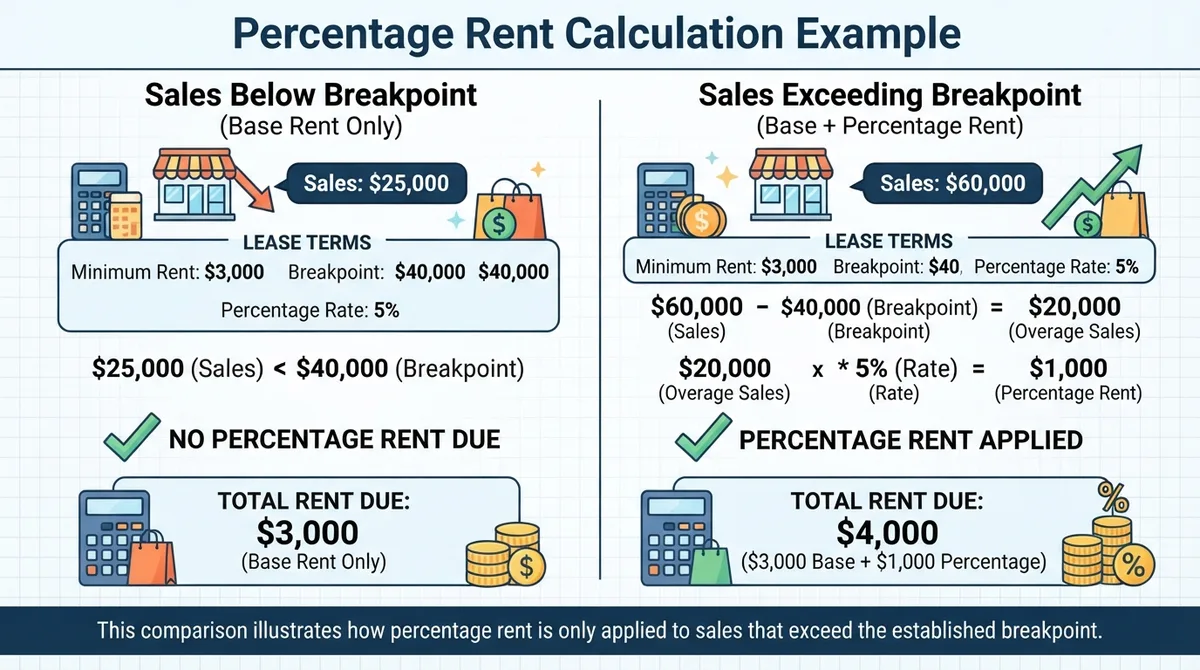
Understanding how rent is calculated is essential for executing a percentage lease. The natural breakpoint is the most common method used in commercial transactions.
For example, if a retail tenant agrees to an annual base rent of $60,000 and a percentage rate of 5%, the natural breakpoint is calculated as follows:
- Natural Breakpoint Calculation - Dividing the $60,000 base rent by the 0.05 percentage rate yields a natural breakpoint of $1,200,000.
- Below-Breakpoint Scenario - If the tenant generates $1,000,000 in gross sales, no percentage rent is owed, and the tenant only pays the $60,000 base rent.
- Above-Breakpoint Scenario - If the tenant generates $1,500,000 in gross sales, the tenant pays 5% on the $300,000 excess, resulting in $15,000 of percentage rent in addition to the base rent.
Frequently Asked Questions
Not the form you're looking for?
Try our legal document generator to create a custom document
Disclaimer: The templates available on this website are provided for general informational purposes only and do not constitute legal advice. They are not intended to be, and should not be interpreted as, compliant with any specific legal, regulatory, or privacy requirements. These templates are not a replacement for professional legal guidance and should not be relied upon for any particular matter or circumstance. Users are strongly encouraged to seek advice from a qualified attorney licensed in their jurisdiction before using, modifying, or relying on any template.
All templates are provided on an "as is," "with all faults," and "as available" basis. The provider disclaims any and all warranties of any kind, whether express, implied, statutory, or otherwise, including without limitation warranties of merchantability, fitness for a particular purpose, title, or non-infringement.
LegalTemplates.com makes no guarantees or representations regarding the accuracy, completeness, expected outcomes, or reliability of the materials contained in these templates or any materials referenced or linked from them.