Disciplinary Action Form
A Disciplinary Action Form is a formal human resources document used by employers to record instances of employee misconduct, policy violations, or performance deficiencies within an organization.
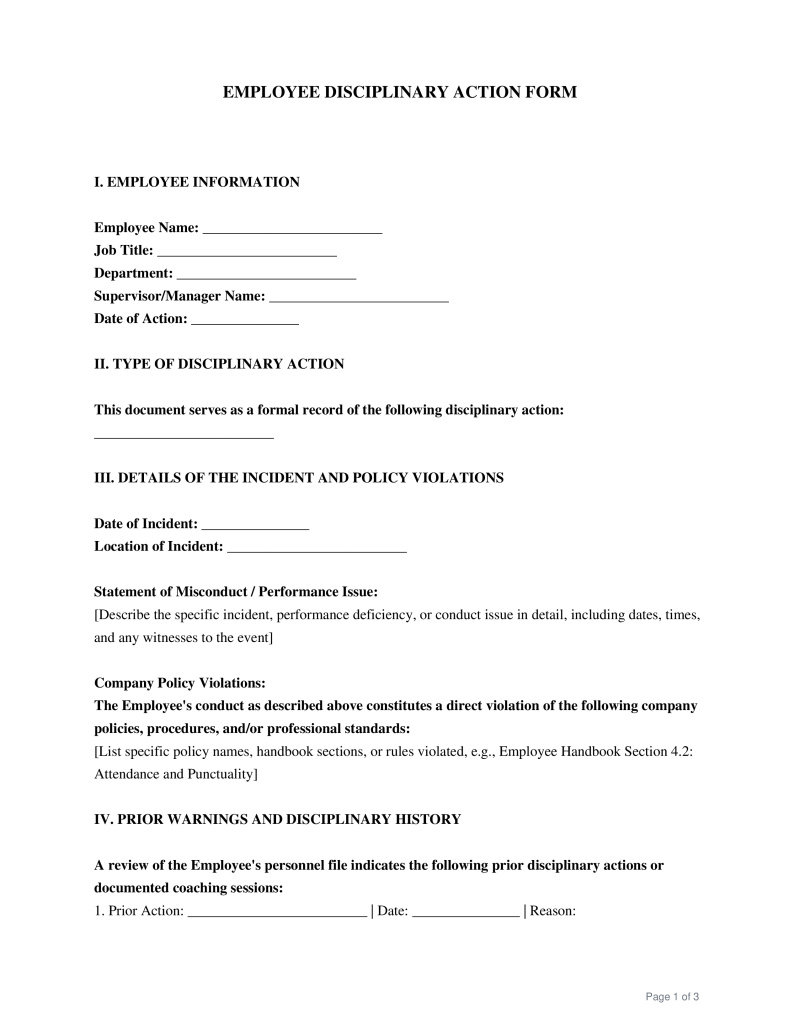
Disciplinary Action Level
Select the action level that best matches the employer's progressive discipline policy or the seriousness of the incident.
Use the employer's internal terminology if different from the listed options.
Table of Contents
What is a Disciplinary Action Form?
A Disciplinary Action Form is an official document used by employers, human resource departments, and regulatory agencies to record employee misconduct, performance deficiencies, or violations of organizational policy. This document establishes a formal, written record of an infraction, the corrective actions required, and the consequences of failing to improve. It serves as a vital tool for performance management and provides essential documentation to support personnel decisions, including suspension or termination. Both private businesses and public sector entities utilize these forms to maintain workplace standards and ensure fair, consistent treatment of personnel.
Purpose and Use Cases
The primary function of a Disciplinary Action Form is to facilitate clear communication between management and personnel regarding behavioral or performance expectations. By documenting the specific details of an incident, employers establish a transparent timeline that helps prevent misunderstandings about performance standards. The form serves several critical organizational functions:
- Performance Correction - Outlines specific areas where an individual must improve, providing a structured pathway to meet organizational standards.
- Legal Protection - Creates a contemporaneous written record of policy violations, defending the organization against potential wrongful termination claims or labor disputes.
- Regulatory Compliance - Satisfies reporting requirements mandated by state licensing boards or government oversight agencies.
- Consistent Enforcement - Ensures that organizational policies are applied uniformly across all departments, reducing the risk of discriminatory practices.
Types of Disciplinary Action Forms
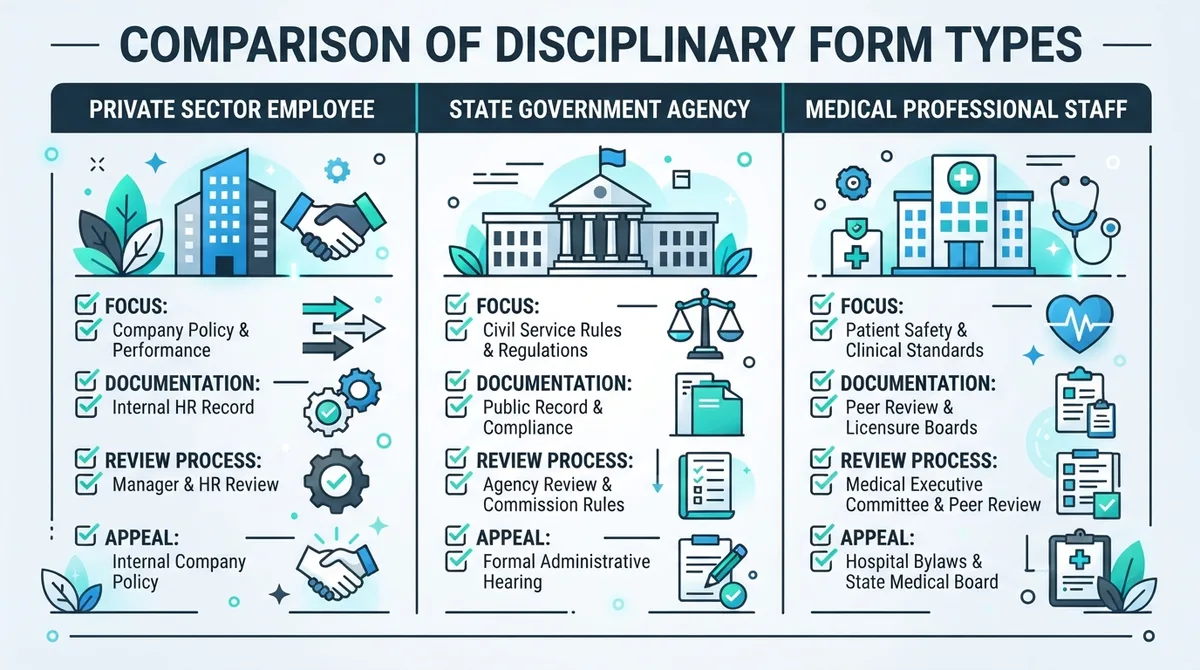
Different administrative bodies and industries require customized documentation to address specific regulatory and organizational needs. Common variations of these forms include:
- Employee Disciplinary Action Form - Used by private sector employers to document workplace policy infractions, safety violations, or performance issues.
- State Employee Disciplinary Record - Utilized by public agencies, such as the Nevada Department of Administration, to manage civil service personnel actions according to state administrative codes.
- Professional Licensing Board Disciplinary Report - Submitted to regulatory bodies, such as the Kansas State Board of Healing Arts, to document complaints and investigations regarding licensed practitioners.
- Healthcare Facility Disciplinary Report - Mandated for medical institutions, such as those in Massachusetts, to report adverse actions against physicians and other healthcare providers to state authorities.
Key Information Included in the Form
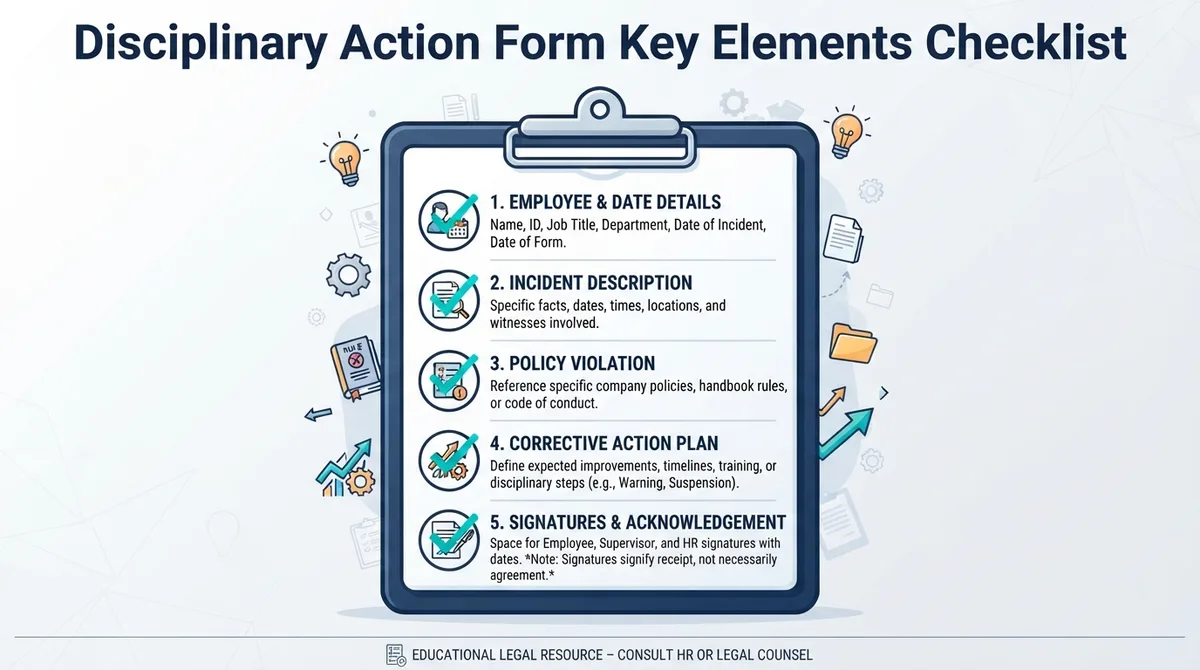
To ensure a Disciplinary Action Form is legally defensible and instructionally clear, it must contain specific objective details. Standard templates generally require the following elements:
- Employee and Supervisor Identification - Full names, job titles, department names, and employee identification numbers.
- Incident Details - The exact date, time, and location of the policy violation, described in factual, non-emotional language.
- Policy Violation Citation - Reference to the specific handbook rule, safety standard, or professional code of conduct that was violated.
- Prior Warnings Record - Documentation of previous oral warnings, written warnings, or coaching sessions related to the issue.
- Corrective Action Plan - Detailed, measurable steps the individual must take to correct the behavior, along with a specified timeframe for improvement.
- Consequences of Non-Compliance - Clear statements outlining subsequent disciplinary steps, up to and including termination of employment.
- Signatures and Dates - Signatures of the supervisor, the employee, and any witnesses present during the disciplinary meeting.
State-Level Regulatory and Reporting Requirements
State agencies frequently mandate specific forms and strict filing procedures for documenting disciplinary actions, particularly in highly regulated industries or public sector employment:
- Nevada State Personnel Regulations - Requires state agencies to utilize standardized forms for progressive disciplinary actions, ensuring civil service compliance (Nev. Admin. Code § 284.656).
- Massachusetts Healthcare Facility Reporting - Mandates that hospitals and clinics file reports of disciplinary actions against physicians with the Board of Registration in Medicine (243 CMR 3.00).
- Kansas Healing Arts Investigations - Outlines reporting requirements for professional misconduct, requiring specific complaint and investigation forms for healthcare practitioners (Kan. Stat. Ann. § 65-2836).
- Mississippi State Personnel Standards - Provides structured charts and templates to ensure state agencies document employee infractions in accordance with state civil service regulations.
Legal Best Practices and Common Mistakes
Improperly drafted forms can expose organizations to legal liability, including retaliation claims or breach of contract lawsuits. Employers should adhere to strict documentation standards to mitigate these risks:
- Objective Language - Document only verifiable facts, dates, and direct observations, avoiding subjective opinions, emotional commentary, or speculation about the individual's intent.
- Employee Acknowledgment - Request the individual sign the document to confirm receipt, noting on the form if the individual refuses to sign.
- Timely Documentation - Complete and present the form immediately following the infraction to ensure details are fresh and the corrective action is relevant.
- Confidentiality Maintenance - Keep completed forms in secured personnel files, restricting access only to authorized human resources personnel and direct management.
Frequently Asked Questions
Sources
- Disciplinary Action Forms - Provides forms for disciplinary actions within the State of Nevada, including instructions and contact information.
- Health Care Facility Disciplinary Action Reports - Details reporting requirements and forms for health care facilities in Massachusetts to report disciplinary actions against physicians.
- Disciplinary/Investigations Forms - Provides various forms related to disciplinary actions and investigations for health care professionals in Kansas.
- Disciplinary Action Charts and Templates - Offers flow charts and templates for documenting disciplinary actions for state employees in Mississippi.
Not the form you're looking for?
Try our legal document generator to create a custom document
Disclaimer: The templates available on this website are provided for general informational purposes only and do not constitute legal advice. They are not intended to be, and should not be interpreted as, compliant with any specific legal, regulatory, or privacy requirements. These templates are not a replacement for professional legal guidance and should not be relied upon for any particular matter or circumstance. Users are strongly encouraged to seek advice from a qualified attorney licensed in their jurisdiction before using, modifying, or relying on any template.
All templates are provided on an "as is," "with all faults," and "as available" basis. The provider disclaims any and all warranties of any kind, whether express, implied, statutory, or otherwise, including without limitation warranties of merchantability, fitness for a particular purpose, title, or non-infringement.
LegalTemplates.com makes no guarantees or representations regarding the accuracy, completeness, expected outcomes, or reliability of the materials contained in these templates or any materials referenced or linked from them.