Certificate of Trust
A Certificate of Trust is a legal document that certifies the existence of a trust and identifies the trustees, allowing them to conduct transactions without disclosing confidential trust details.
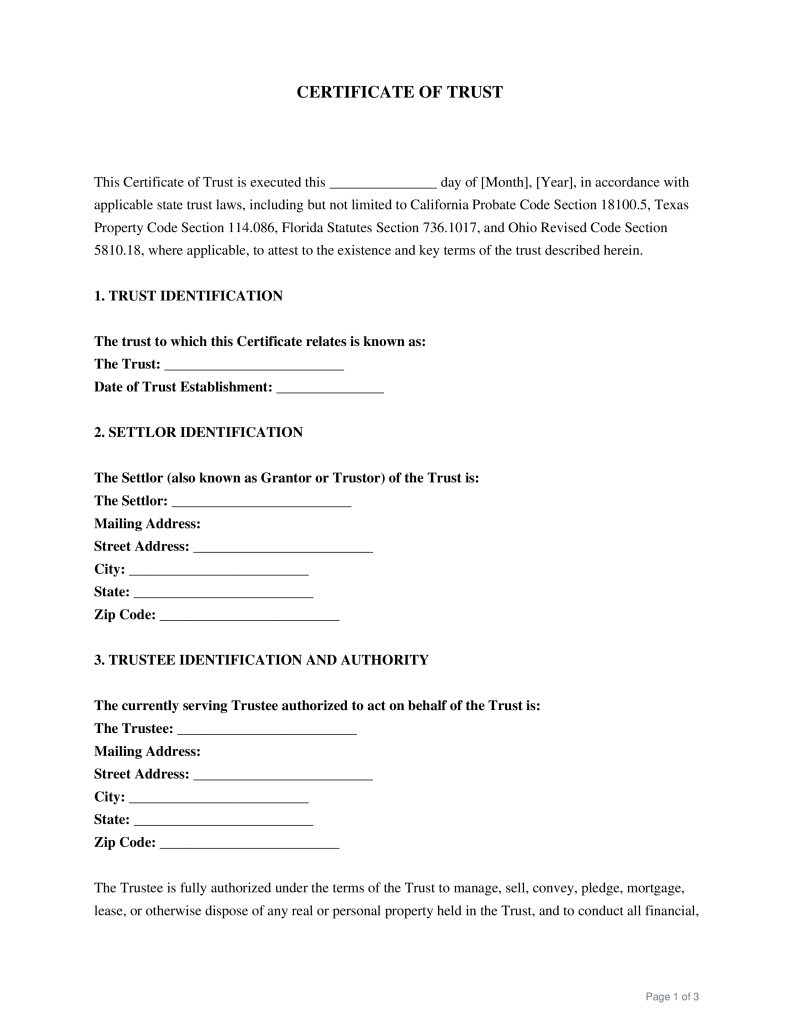
Certificate Primary Use
This helps tailor the certificate language to the third party requesting proof of trustee authority.
Briefly identify the reason the certificate is needed.
Table of Contents
What is a Certificate of Trust?
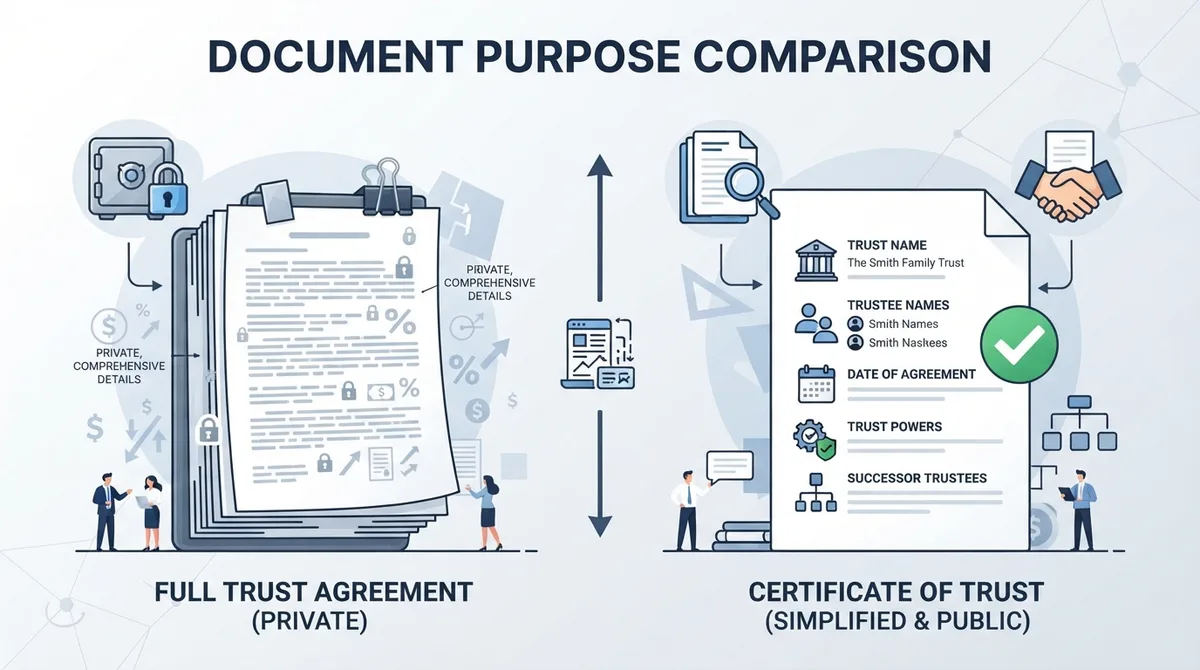
A certificate of trust is a legal document that certifies the existence of a trust and outlines the essential terms and authority of the trustees without disclosing confidential details of the underlying trust agreement. Financial institutions, title companies, and other third parties utilize this document to verify a trustee's legal authority to act on behalf of the trust during transactions. By presenting this certification, trustees can conduct business such as opening bank accounts, purchasing real estate, or transferring assets while keeping the identity of beneficiaries and the distribution of assets private. Many states have codified the use of this document, allowing it to serve as a legally sufficient substitute for the full trust agreement.
Purpose and Practical Applications
The primary function of a certificate of trust is to facilitate transactions between trustees and third parties while preserving the privacy of the trust creators and beneficiaries. Trust agreements often contain highly personal details, including asset distribution schedules, specific monetary inheritances, and the names of family members. Third parties such as banks, brokerage firms, and real estate agencies need to confirm that a trust exists and that the person claiming to be the trustee has the legal power to execute transactions.
The certification serves as a condensed, legally recognized summary that satisfies these verification requirements. It protects sensitive financial and personal information from entering the public record or being stored in the databases of private companies. It also simplifies the review process for financial institutions, as they do not need to read through lengthy, complex trust agreements to find specific authorization clauses.
Statutory Content Requirements
While specific requirements vary by state, standard certifications contain a consistent set of core disclosures. These elements ensure that third parties receive sufficient legal assurance of the trust's validity and the trustee's authority.
Most jurisdictions require the document to contain the following information:
- Trust Identification - The official name of the trust and the exact date the original trust instrument was executed.
- Identity of the Settlor - The name of the individual or individuals who created and funded the trust.
- Trustee Information - The names and mailing addresses of all currently acting trustees authorized to manage trust assets.
- Statement of Powers - A description of the specific powers granted to the trustees, such as the authority to buy, sell, lease, or mortgage real property.
- Revocability Status - A statement indicating whether the trust is revocable or irrevocable, and identifying who holds the power to revoke or amend the instrument.
- Signatory Authority - Clarification on whether a single trustee can act independently or if multiple trustees must sign together to execute transactions.
- Tax Identification Number - The trust's employer identification number or the social security number of the settlor, depending on the trust's structure.
- State of Governance - The specific state jurisdiction under whose laws the trust is created and governed.
State-Specific Legal Frameworks
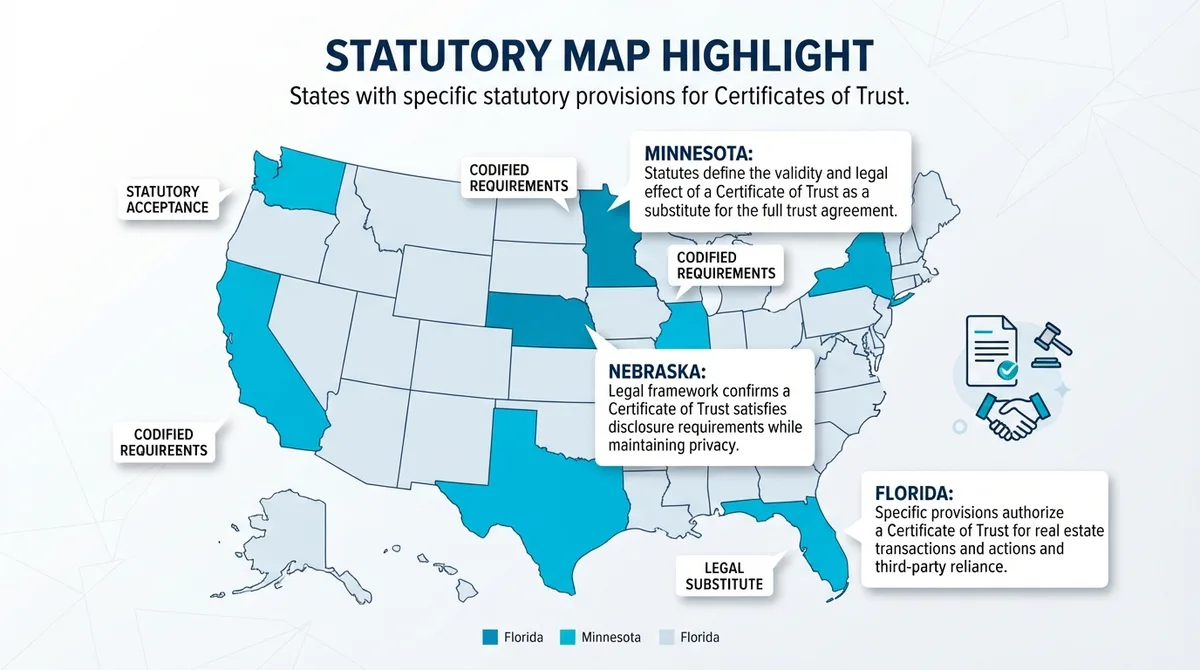
State statutes dictate how a certificate of trust is formed, filed, and accepted by third parties. Some states establish statutory trusts that require public filing, while others allow private certifications to be presented directly to financial institutions.
The following state laws govern the use, contents, and legal status of these certifications:
- District of Columbia Statutory Trust Formation - Requires a certificate of trust to be filed with the Mayor to legally form a statutory trust, detailing the trust name, principal office address, registered agent, and series capability (§ 29–1202.01).
- Minnesota Certification of Trust Requirements - Outlines the mandatory contents of a certification, including the trust name, instrument date, trustee names and addresses, and a statement of trustee powers (§ 501C.1013).
- Vermont Certification of Trust Provisions - Details the necessary components of the document, specifically requiring the trust name, date of the trust instrument, trustee names, and a statement of trustee powers (14A § 1013).
- Nebraska Trust Instrument Substitution - Permits trustees to present a certification of trust to establish the existence or terms of the trust in lieu of providing the full trust instrument (Neb. Rev. Stat. § 30-38,102).
- Florida Trust Certification Allowance - Provides that a trustee may furnish a certification of trust containing specific information instead of disclosing the complete trust instrument to a third party (§ 736.1017).
Execution and Reliance Protection
For a certificate of trust to be legally effective, it must be executed properly according to state laws. Most jurisdictions require the document to be signed by all currently acting trustees. To ensure its authenticity and acceptance by financial institutions, the signatures are typically notarized. The notary public verifies the identity of the trustees, adding an extra layer of security to the transaction.
Statutes also protect third parties who rely in good faith on the information presented in a certification. If a bank or title company conducts a transaction based on the representations in a valid certificate, they are generally shielded from liability if it is later discovered that the trustee exceeded their authority or that the trust was amended. This legal protection encourages third parties to accept the short-form certification rather than demanding the full, private trust agreement.
Frequently Asked Questions
Sources
- § 29–1202.01. Certificate of trust. - Defines the requirements for forming a statutory trust in the District of Columbia, including the filing of a certificate of trust with the Mayor.
- § 501C.1013 CERTIFICATE OF TRUST. - Outlines the contents required in a certificate of trust in Minnesota, including trust name, date, trustee information, and powers granted to trustees.
- § 1013. Certification of trust - Specifies the requirements for a certificate of trust in Vermont, including trust name, date, trustee information, and powers granted to trustees.
- Nebraska Revised Statute 30-38,102 - Allows trustees to present a certification of trust to establish the existence or terms of the trust, in lieu of a copy of the trust instrument.
- § 736.1017 Certification of trust. - Provides that instead of furnishing a copy of the trust instrument, the trustee may furnish a certification of trust containing specific information.
Not the form you're looking for?
Try our legal document generator to create a custom document
Disclaimer: The templates available on this website are provided for general informational purposes only and do not constitute legal advice. They are not intended to be, and should not be interpreted as, compliant with any specific legal, regulatory, or privacy requirements. These templates are not a replacement for professional legal guidance and should not be relied upon for any particular matter or circumstance. Users are strongly encouraged to seek advice from a qualified attorney licensed in their jurisdiction before using, modifying, or relying on any template.
All templates are provided on an "as is," "with all faults," and "as available" basis. The provider disclaims any and all warranties of any kind, whether express, implied, statutory, or otherwise, including without limitation warranties of merchantability, fitness for a particular purpose, title, or non-infringement.
LegalTemplates.com makes no guarantees or representations regarding the accuracy, completeness, expected outcomes, or reliability of the materials contained in these templates or any materials referenced or linked from them.