Temporary Restraining Order
A Temporary Restraining Order is a short-term judicial directive issued to prevent imminent harm by restraining a party from specific actions until a formal court hearing can be conducted.
Filing Posture
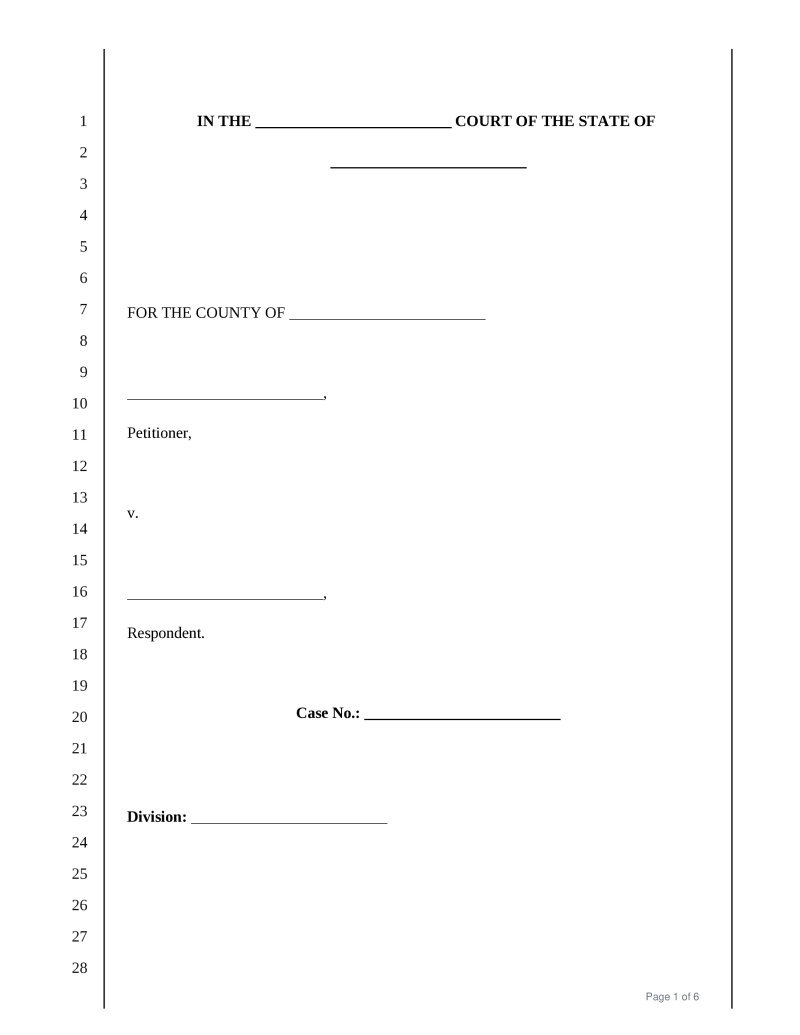
A new case usually starts with a petition, complaint, or application for temporary restraining order. An existing case already has a court-assigned case, cause, or docket number.
Enter the number exactly as it appears on prior court papers.
Table of Contents
What is a Temporary Restraining Order?
A Temporary Restraining Order is a judge's short-term order forbidding certain actions until a full court hearing can be conducted. This emergency legal remedy serves to preserve the status quo and prevent immediate, irreparable harm before the court can fully hear a dispute. Litigants in civil, family, or commercial matters utilize this mechanism when urgent intervention is required to protect assets, safety, or legal rights.
Filing Requirements for a Temporary Restraining Order
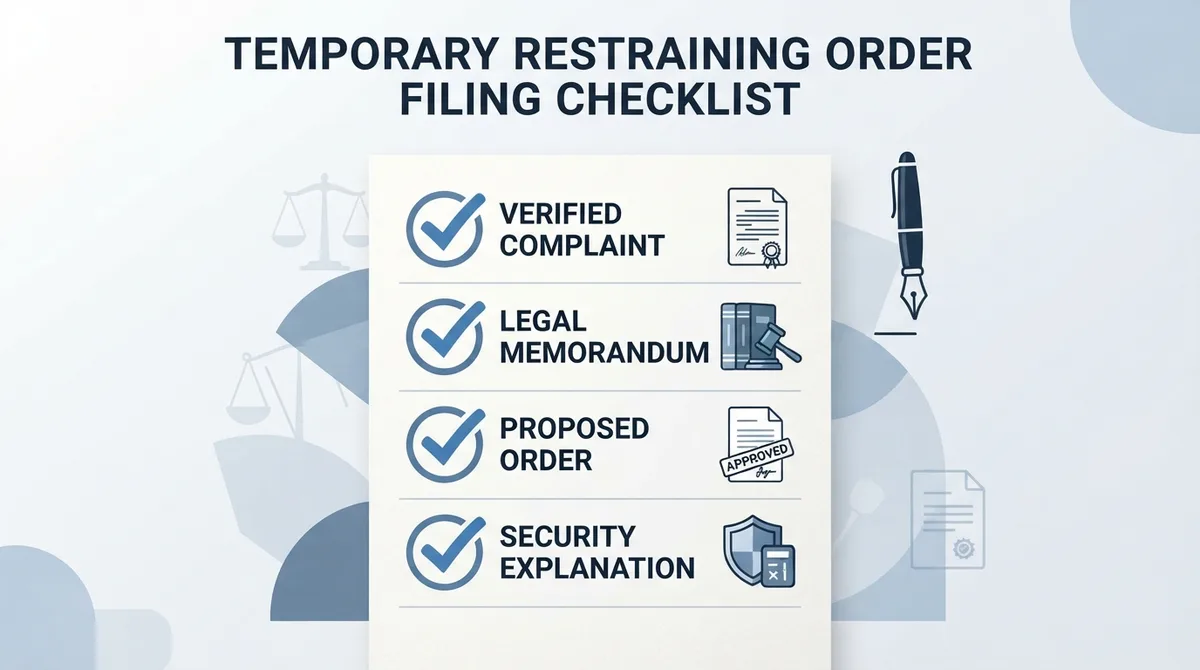
Federal courts adhere to specific standards when evaluating a motion for emergency relief. Under Federal Rule of Civil Procedure 65 and local district rules, a party seeking this urgent intervention must submit a comprehensive set of documents.
The filing party must present clear evidence and legal justification to the court:
- Verified Complaint or Affidavit - Specific facts supported by a verified complaint, affidavit, or other evidence demonstrating entitlement to relief (Fed. R. Civ. P. 65(b)).
- Precise Description of Conduct - A precise description of the conduct and the persons subject to restraint (M.D. Fla. Local Rule 6.01).
- Legal Memorandum - A supporting legal memorandum explaining the legal authority and basis for the requested order (M.D. Fla. Local Rule 6.01).
- Proposed Order - A draft order detailing the exact terms and restrictions the court is asked to enforce (M.D. Fla. Local Rule 6.01).
- Security Explanation - A verified explanation of the amount and form of the required security or bond to protect the enjoined party (M.D. Fla. Local Rule 6.01).
- Information Sheet - A completed Information Sheet for Temporary Restraining Order to identify parties and attorneys involved and provide scheduling information if a hearing is requested (D.N.M. Forms).
Types of Restraining Orders
Courts issue various forms of protective orders depending on the nature of the emergency and the relationship between the parties.
- Domestic Violence Restraining Order - Protects individuals from abuse, threats, or harassment by family or household members.
- Civil Harassment Restraining Order - Restricts non-related individuals, such as neighbors, coworkers, or acquaintances, from engaging in stalking or unwanted contact.
- Commercial Temporary Restraining Order - Prevents business entities or partners from transferring disputed assets, disclosing trade secrets, or destroying records during a commercial dispute.
- Elder Abuse Restraining Order - Safeguards seniors or dependent adults from physical, emotional, or financial exploitation by caregivers or relatives.
Procedural Steps and Service Responsibilities
Initiating an emergency motion requires adherence to strict filing protocols to ensure the court can review the request immediately.
The process of obtaining and enforcing the order follows a structured sequence:
- Case Manager Notification - The filing party must notify the case manager immediately upon filing a motion for a Temporary Restraining Order (E.D. Mich. Local Rule 65.1).
- Electronic Filing - When filing in a new case, both the initial pleading and the emergency motion should be filed electronically (E.D. Pa. Filing Procedures).
- Judicial Review - A judge reviews the submitted affidavits and legal memorandum to determine if immediate, irreparable injury will occur before a hearing.
- Service of Process - If the judge grants the Temporary Restraining Order, it is the responsibility of the plaintiff's counsel to serve the order on the defendant (E.D. Pa. Filing Procedures).
Distinction Between Temporary Restraining Orders and Preliminary Injunctions
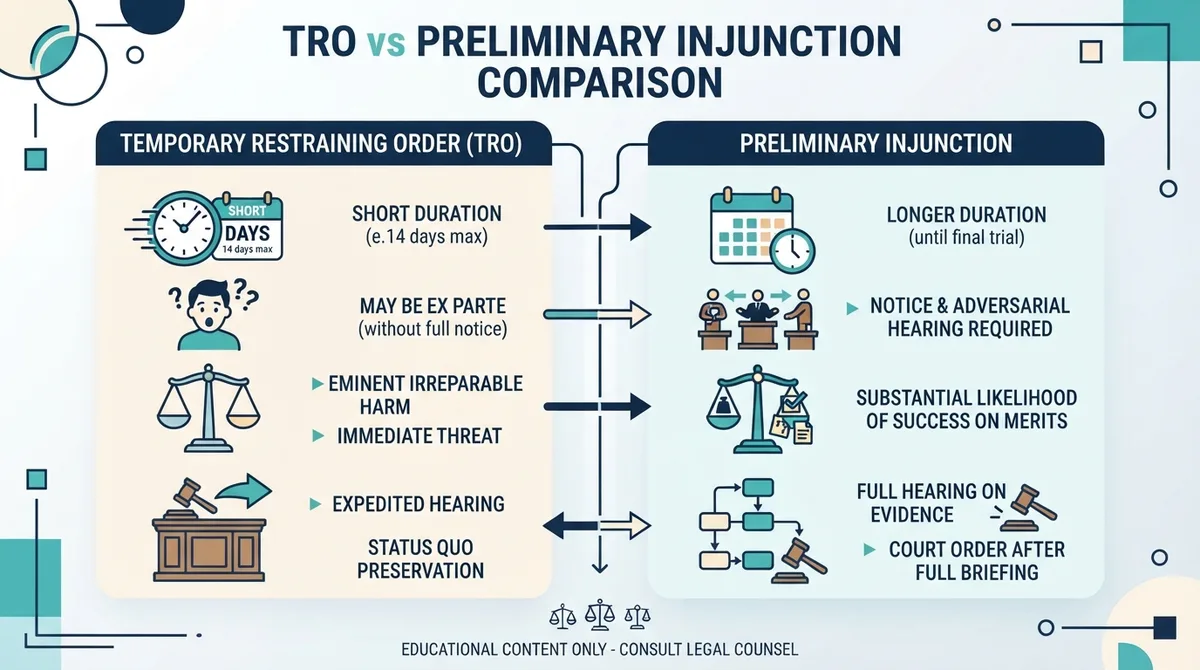
A Temporary Restraining Order differs from a preliminary injunction in its duration, notice requirements, and procedural posture.
The following distinctions govern these two forms of injunctive relief:
- Duration Limits - A Temporary Restraining Order is highly restricted in duration, typically lasting no more than 14 days unless extended by the court, whereas a preliminary injunction remains in effect throughout the litigation (Fed. R. Civ. P. 65(b)(2)).
- Notice Requirements - A Temporary Restraining Order may be issued ex parte without prior notice to the opposing party under extreme circumstances, whereas a preliminary injunction always requires notice and a full evidentiary hearing (Fed. R. Civ. P. 65(a)).
- Standard of Proof - A Temporary Restraining Order focuses on preventing immediate, irreparable harm before a hearing can occur, whereas a preliminary injunction requires a stronger showing of a likelihood of success on the merits of the case.
Frequently Asked Questions
Sources
- Temporary Restraining Order - Provides a definition of a Temporary Restraining Order (TRO) as a judge's short-term order forbidding certain actions until a full hearing can be conducted.
- Rule 6.01 - Temporary Restraining Order - Outlines the requirements for filing a motion for a Temporary Restraining Order, including necessary documentation and legal memorandum.
- Temporary Restraining Order (T.R.O.) - Provides guidance on the procedure for filing a Temporary Restraining Order in a new case, including electronic filing and service responsibilities.
- Information Sheet for Temporary Restraining Order - Details the required Information Sheet for Temporary Restraining Order, which identifies parties and attorneys involved and provides scheduling information if a hearing is requested.
- Temporary Restraining Orders and Preliminary Injunctions - Describes the court's adherence to Federal Rule of Civil Procedure 65 and Local Rule 65.1, and the requirement to notify the case manager upon filing a motion for a Temporary Restraining Order.
Not the form you're looking for?
Try our legal document generator to create a custom document
Disclaimer: The templates available on this website are provided for general informational purposes only and do not constitute legal advice. They are not intended to be, and should not be interpreted as, compliant with any specific legal, regulatory, or privacy requirements. These templates are not a replacement for professional legal guidance and should not be relied upon for any particular matter or circumstance. Users are strongly encouraged to seek advice from a qualified attorney licensed in their jurisdiction before using, modifying, or relying on any template.
All templates are provided on an "as is," "with all faults," and "as available" basis. The provider disclaims any and all warranties of any kind, whether express, implied, statutory, or otherwise, including without limitation warranties of merchantability, fitness for a particular purpose, title, or non-infringement.
LegalTemplates.com makes no guarantees or representations regarding the accuracy, completeness, expected outcomes, or reliability of the materials contained in these templates or any materials referenced or linked from them.