Notice of Appeal
A Notice of Appeal is a formal legal document filed by a party to a lawsuit to initiate appellate review of a trial court's final judgment or order by a higher court.
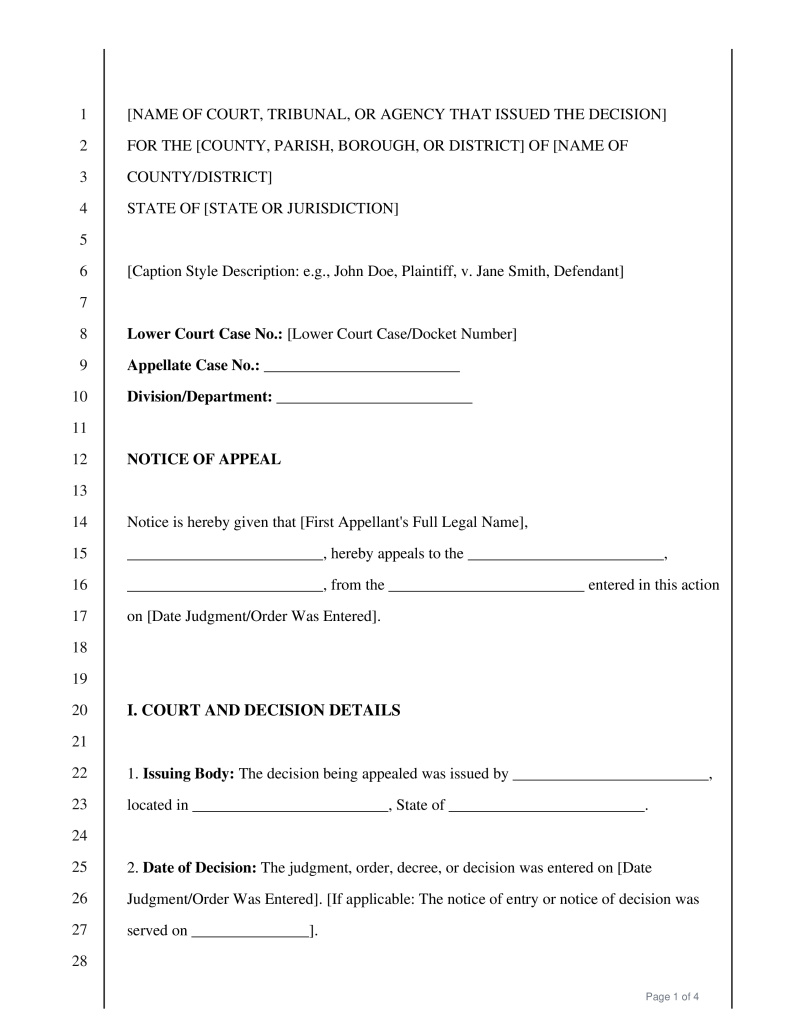
Decision Type
Select the category that best describes the judgment, order, decree, ruling, or agency decision being challenged.
Use the label used by the lower court, tribunal, or agency if known.
Table of Contents
What is a Notice of Appeal?
A Notice of Appeal is a formal document filed to initiate an appeal in a court case, outlining the appellant's intent to seek a higher court's review of a lower court's decision. This filing marks the official beginning of the appellate process and informs both the trial court and the opposing parties that the final judgment is being challenged. The document serves as a jurisdictional trigger, moving the case from the trial court's authority to the appellate court's review. Filing this notice does not reopen the trial for new evidence, but rather begins a review of the existing trial record for legal errors.
Purpose and Legal Function
The filing of this document serves several critical operational functions in the judicial system. It officially transfers jurisdiction of the case, limiting the trial court's ability to make further substantive rulings on the issues being appealed.
The document provides notice to all parties involved in the litigation, allowing them to prepare for the appellate schedule. Key legal functions of this document include:
- Jurisdictional Transfer - Shifts the authority over the specific contested issues from the trial court to the appellate court.
- Party Notification - Alerts the appellee and the court reporter that an appeal is underway and that transcripts must be prepared.
- Scope Limitation - Identifies the specific judgments or orders that the appellate court is being asked to review.
Required Elements of the Document
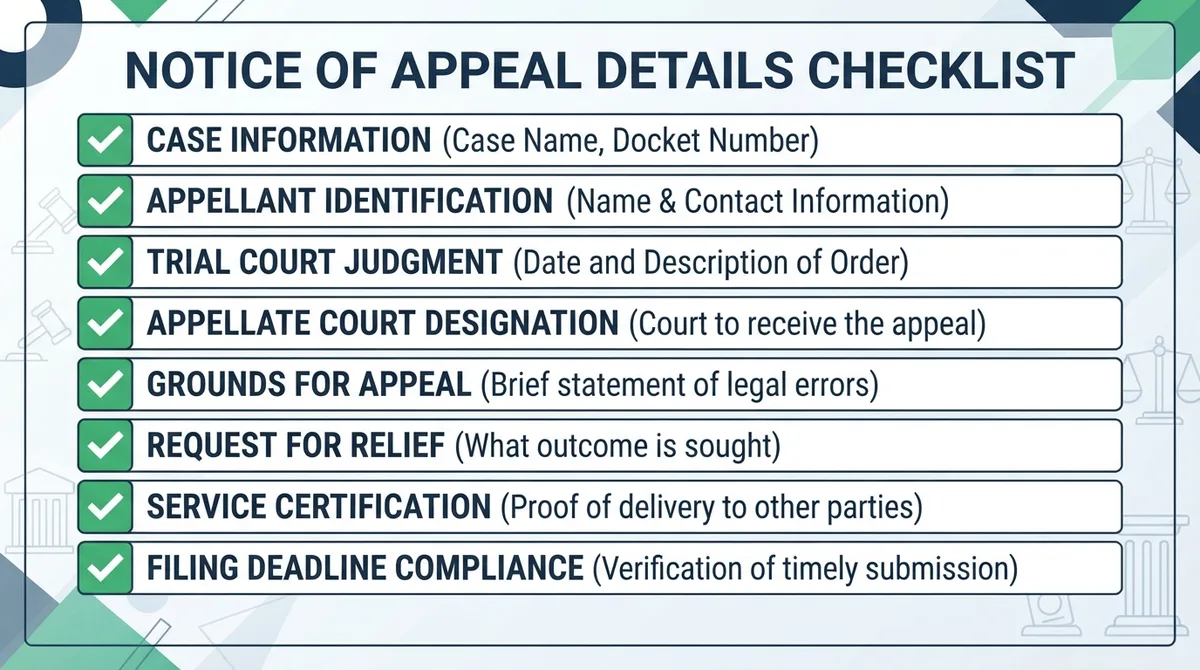
While exact forms vary by jurisdiction, certain standard pieces of information must be included to ensure the document is legally valid. Omitting these key elements can result in delays or dismissal of the appeal.
A standard filing typically requires the following details:
- Case Caption - The names of the parties, the name of the trial court, and the original trial court case number.
- Appealing Party Designation - A clear statement identifying which party is filing the appeal.
- Judgment Specification - The exact date and title of the order or judgment being appealed.
- Target Appellate Court - The specific name of the higher court that will hear the appeal.
- Signature of Counsel - The signature and contact information of the appellant's attorney or the self-represented party.
State-Specific Filing Rules and Deadlines
Filing deadlines for appellate notices are strictly enforced and are generally considered jurisdictional, meaning a late filing cannot be excused by the court. Different states maintain distinct timelines and procedural rules for submitting these forms.
State regulations outline the following specific requirements:
- California Filing Deadlines - Requires the filing of a notice of appeal within 60 days after the superior court clerk or the opponent serves a notice of entry of judgment, or 180 days after judgment entry if no notice is served (California Rules of Court, Rule 8.100).
- New York Civil Appeals - Establishes that an appeal must be taken within 30 days after service by a party upon the appellant of a copy of the judgment or order appealed from and written notice of its entry (New York Civil Practice Law and Rules, Article 55).
- Filing Fees - Dictates that the notice must be accompanied by the prescribed filing fee or an application for a waiver based on financial hardship (California Rules of Court, Rule 8.100).
Types of Appeals
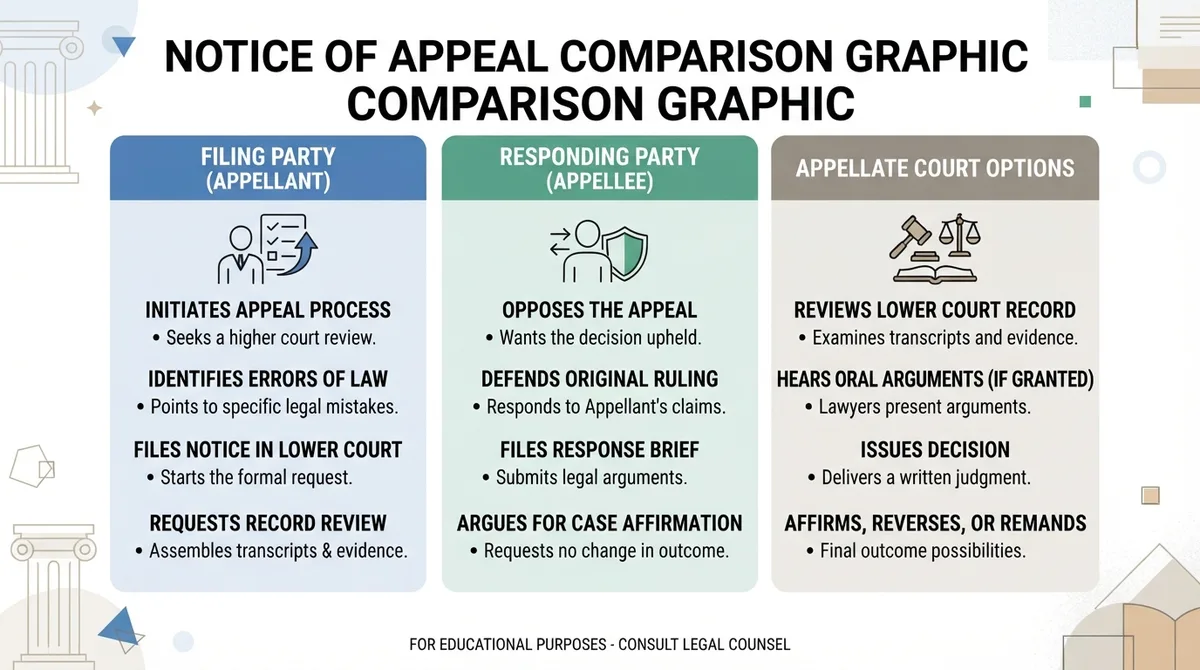
Appellate courts handle different categories of cases depending on the nature of the original trial court decision. The specific procedural rules and standards of review depend heavily on the classification of the appeal.
- Civil Appeals - A request to review decisions in non-criminal disputes, such as contract disagreements, personal injury claims, or family law matters.
- Criminal Appeals - A challenge initiated by a defendant seeking to overturn a conviction, sentence, or specific evidentiary ruling made during a criminal trial.
- Administrative Appeals - A petition to review the final decisions made by government agencies or boards rather than traditional trial courts.
- Interlocutory Appeals - An appeal of a specific ruling or order made by a judge before the final judgment has been entered in the case.
Common Procedural Pitfalls
Filing a notice of appeal involves strict adherence to procedural rules, and minor errors can have severe consequences for the appellant's case. Legal professionals emphasize avoiding common mistakes that can jeopardize the entire appellate process.
Frequent issues encountered during the filing process include:
- Missed Deadlines - Failing to file within the statutory window, which almost always results in an automatic dismissal of the appeal.
- Incorrect Forum - Filing the document in the appellate court instead of the trial court, which is the standard filing location in most jurisdictions.
- Incomplete Judgments - Attempting to appeal an order that is not considered final or appealable under state law.
- Failure to Serve - Neglecting to serve copies of the filed document on all other parties involved in the litigation.
Sources
- California Rules of Court: Rule 8.100. Time to Appeal - Details the time frames for filing a Notice of Appeal in California state courts.
- New York Civil Practice Law and Rules: Article 55. Appeals - Contains provisions related to appeals, including the filing of a Notice of Appeal in New York state courts.
Not the form you're looking for?
Try our legal document generator to create a custom document
Disclaimer: The templates available on this website are provided for general informational purposes only and do not constitute legal advice. They are not intended to be, and should not be interpreted as, compliant with any specific legal, regulatory, or privacy requirements. These templates are not a replacement for professional legal guidance and should not be relied upon for any particular matter or circumstance. Users are strongly encouraged to seek advice from a qualified attorney licensed in their jurisdiction before using, modifying, or relying on any template.
All templates are provided on an "as is," "with all faults," and "as available" basis. The provider disclaims any and all warranties of any kind, whether express, implied, statutory, or otherwise, including without limitation warranties of merchantability, fitness for a particular purpose, title, or non-infringement.
LegalTemplates.com makes no guarantees or representations regarding the accuracy, completeness, expected outcomes, or reliability of the materials contained in these templates or any materials referenced or linked from them.