Divorce Filing Checklist
A Divorce Filing Checklist is a structured compilation of documents, information, and procedural steps typically required for initiating a divorce proceeding within a specific legal jurisdiction.
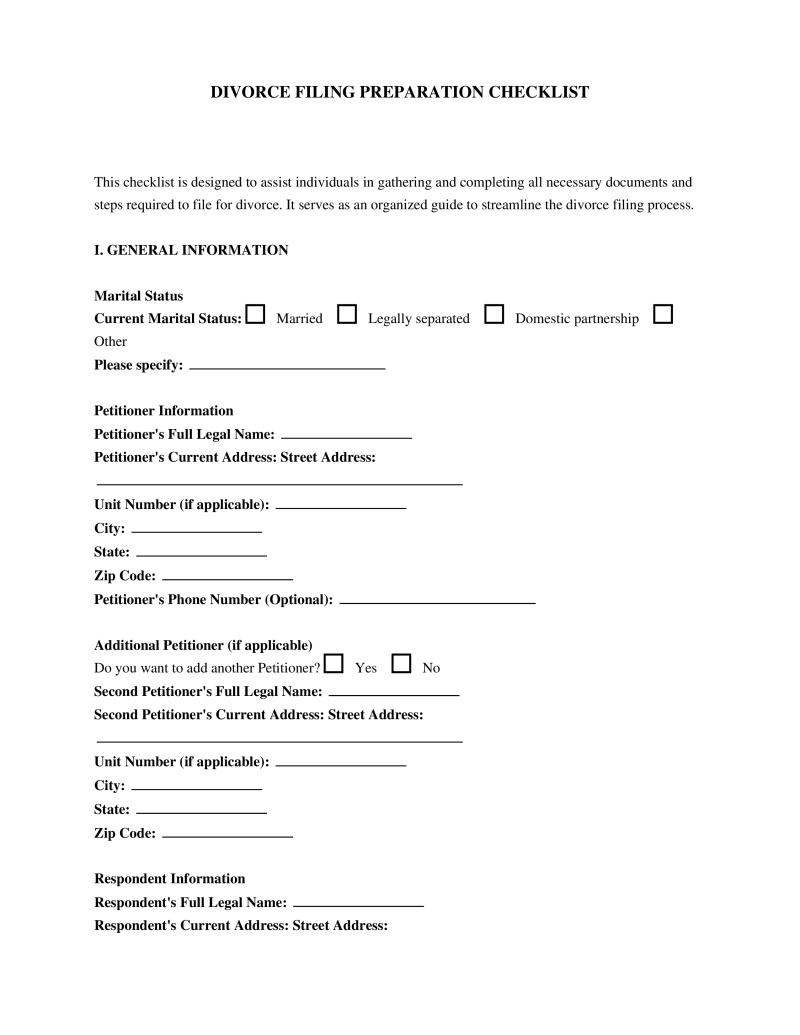
Marital Status
Select the option that best describes your current legal relationship.
Provide details if your status is not listed.
Table of Contents
What is a Divorce Filing Checklist?
A divorce filing checklist is a comprehensive guide that outlines the necessary steps, forms, and documentation required to initiate a divorce proceeding in a specific jurisdiction. Its primary purpose is to help individuals ensure they meet all legal prerequisites and submit the correct paperwork to the court, thereby avoiding delays or rejections. Typically, such checklists are provided by state court systems or legal aid organizations to assist self-represented litigants and legal professionals in navigating the often complex process of dissolving a marriage.
Residency Requirements
Before an individual can file for divorce, most states require that at least one of the spouses has resided in the state for a specified period. These residency requirements ensure that the state's courts have the proper jurisdiction to hear the case.
- State Residency - Many states mandate that one spouse must have lived in the state for a minimum duration, such as six months or one year, before filing. For example, to file for a no-fault 1B divorce in Massachusetts, a petitioner must have lived in the state for one year, or the couple must have lived in the state and the reason for the divorce occurred there.
- County Residency - Some states or local rules may also require residency within a specific county for a certain period before filing in that county's court.
- Active Military Personnel - Special rules may apply to active military members, potentially allowing them to file in a state where they are stationed, even if they do not meet the standard civilian residency duration.
Required Forms and Documentation
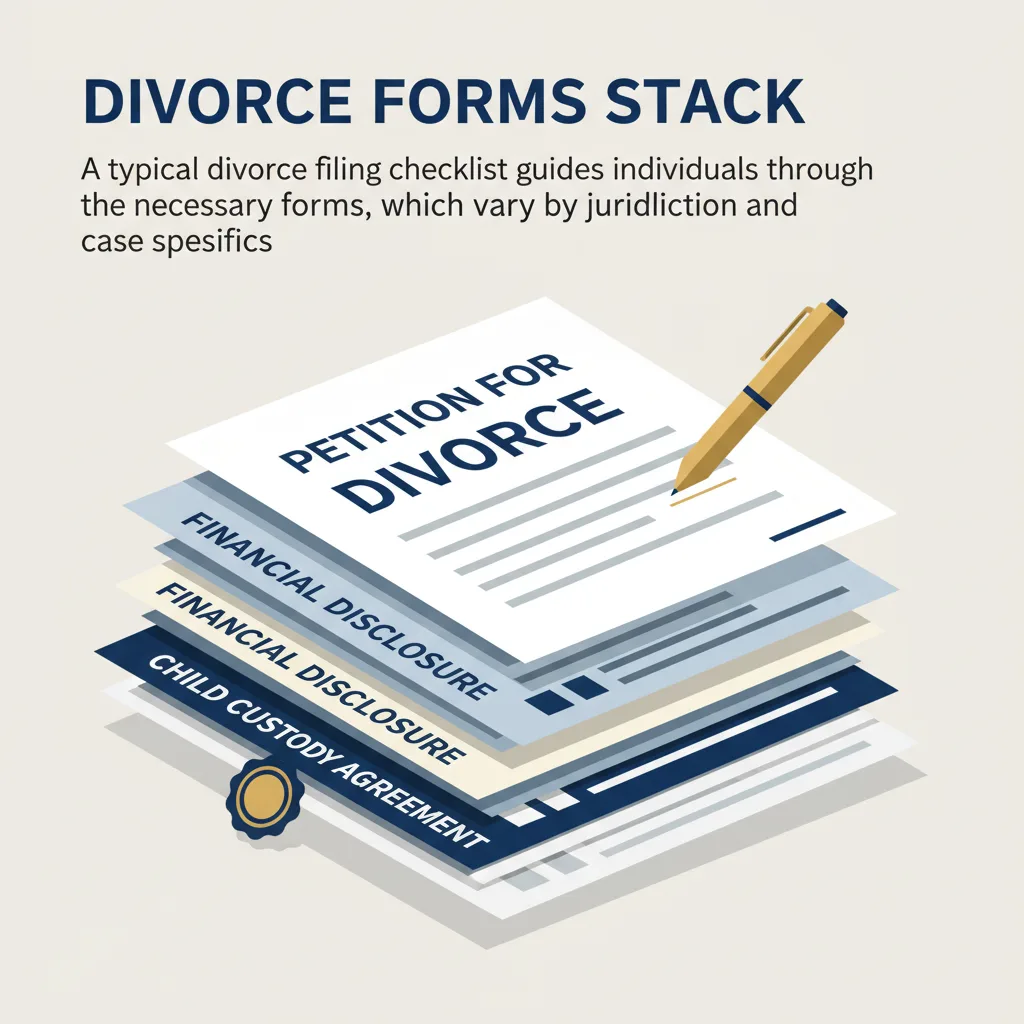
The specific forms needed to file for divorce vary significantly by state and the particular circumstances of the case, such as whether children are involved or if the divorce is contested. However, several core documents are commonly required across jurisdictions.
- Petition for Divorce/Annulment - This is the foundational document that officially starts the divorce case. It informs the court and the other spouse of the petitioner's intent to divorce and typically outlines the grounds for divorce, whether fault-based or no-fault. Delaware Courts, for instance, list the Petition for Divorce/Annulment (Form 442) as a required form.
- Civil Cover Sheet - Many courts require a civil cover sheet to provide basic information about the case for administrative purposes, such as identifying the type of legal action. The Kansas Judicial Council includes this among the necessary forms for filing a divorce petition.
- Summons - This document formally notifies the other spouse that a lawsuit has been filed against them and instructs them on how to respond to the court.
- Self-Represented Litigant Certification Form - For individuals filing without legal representation, some courts require a form confirming their understanding of the process and their choice to represent themselves. This is a requirement in Kansas.
- Financial Disclosure Forms - These forms require both parties to disclose all assets, debts, income, and expenses. They are crucial for property division, spousal support, and child support determinations.
- Child Custody and Support Forms - If the couple has minor children, additional forms related to custody arrangements, visitation schedules, and child support calculations are necessary.
Serving the Divorce Papers
After the initial divorce forms are completed and filed with the court, the petitioner is legally obligated to formally notify the other spouse that a divorce action has been initiated. This process, known as service of process, ensures due process and allows the responding spouse an opportunity to participate in the proceedings.
The specific methods for serving divorce papers are governed by state law and court rules:
- Personal Service - This is the most common method, involving a sheriff, process server, or another authorized adult delivering the documents directly to the responding spouse. California Courts emphasize that serving the spouse or partner a copy of the filed forms is a critical step after filing.
- Certified Mail - Some jurisdictions permit service by certified mail, often with a return receipt requested, to confirm delivery.
- Publication - If the responding spouse cannot be located after diligent effort, a court may allow service by publication, where notice is published in a newspaper.
- Acknowledgment of Service - The responding spouse may voluntarily sign an acknowledgment form, confirming receipt of the divorce papers. This can sometimes expedite the process and avoid the need for a process server.
Filing Fees and Waivers
Initiating a divorce case typically involves court filing fees, which vary by state and sometimes by county. These fees cover the administrative costs associated with processing the legal documents and managing the case.
- Standard Filing Fees - Fees can range from a few hundred dollars to more, depending on the jurisdiction. For instance, Massachusetts mentions filing fees as part of the process for a no-fault 1B divorce.
- Fee Waivers (In Forma Pauperis) - Individuals who cannot afford the filing fees may be eligible for a fee waiver, often referred to as filing in forma pauperis. This requires submitting an application to the court, detailing one's financial situation and demonstrating an inability to pay the required fees without undue hardship. If approved, the petitioner may be exempt from paying some or all court costs.
State-Specific Considerations
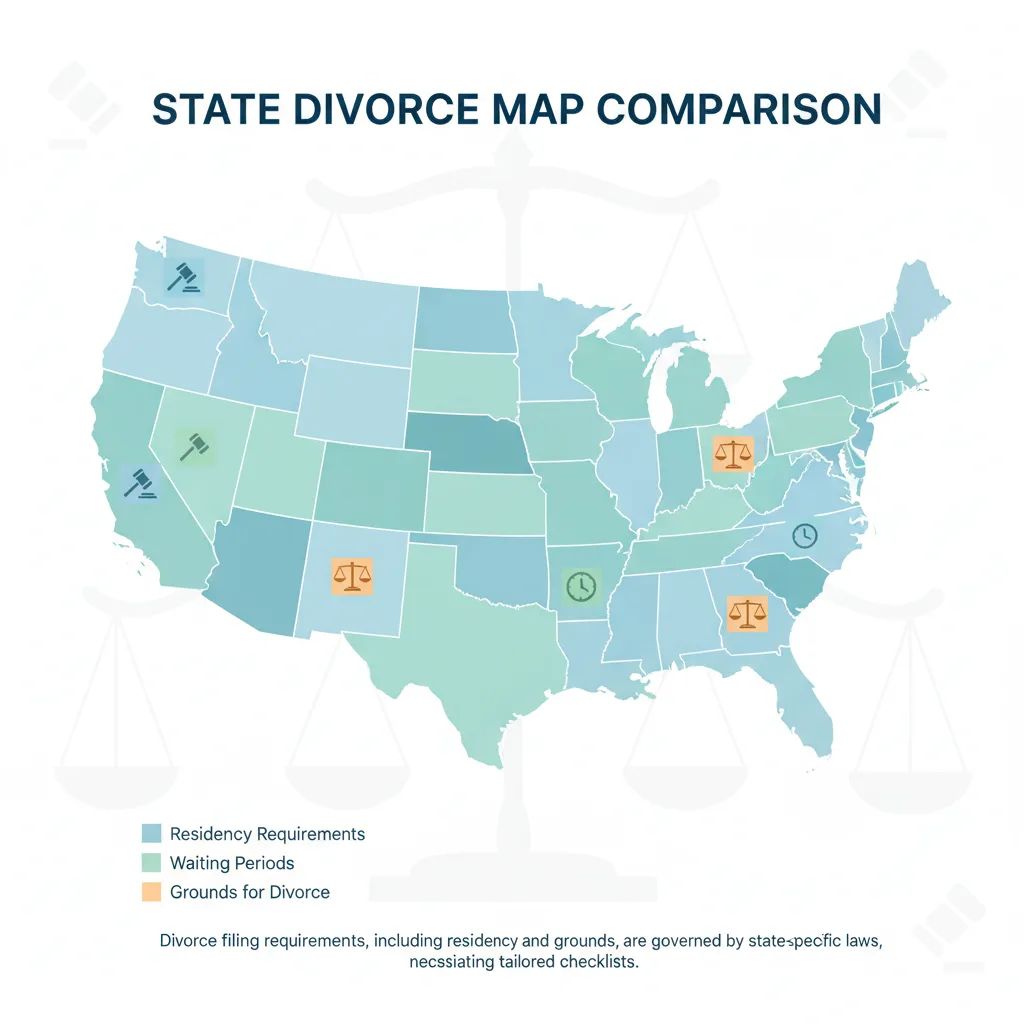
Divorce laws and procedures are primarily governed by state law, leading to significant variations in requirements across the United States. A divorce filing checklist must always be tailored to the specific state and sometimes even the specific county where the divorce is being filed.
Key areas of state-specific variation include:
- Residency Requirements - As noted, the length of time one must reside in a state or county before filing for divorce differs by jurisdiction. Michigan Courts, for example, highlight ensuring proper residence as part of their divorce proceeding checklist.
- Grounds for Divorce - States vary in whether they allow only no-fault divorce (e.g., irreconcilable differences, breakdown of marriage) or also permit fault-based grounds (e.g., adultery, abandonment, cruelty).
- Waiting Periods - Many states impose mandatory waiting periods between the initial filing of the divorce petition and the finalization of the divorce, designed to provide a cooling-off period or allow for reconciliation attempts.
- Mandatory Forms - The exact set of forms required to initiate a divorce can differ, with some states having unique forms for financial disclosures, parenting plans, or statistical information. Delaware Courts provide a list of both required and situational forms.
- Mediation Requirements - Some states mandate participation in mediation for issues like child custody or property division before a case can proceed to trial.
Frequently Asked Questions
Sources
- Start a divorce case | California Courts | Self Help Guide - Provides an overview of the steps to initiate a divorce in California, including filling out and filing court forms and serving the spouse.
- Family Court Divorce Forms - Family Court - Delaware Courts - State of Delaware - Lists the necessary forms required for filing a divorce in Delaware, separated into 'Required Forms' and 'Situational Forms'.
- Get a no-fault 1B divorce | Mass.gov - Outlines the steps to obtain a no-fault 1B divorce in Massachusetts, including residency requirements, filling out paperwork, and filing fees.
- Filing a Petition for Divorce | KS Judicial Council - Provides instructions and forms for filing a divorce petition in Kansas, including necessary forms and steps to take.
- Divorce Proceeding Checklist - A checklist outlining the steps in a divorce proceeding in Michigan, including ensuring proper residence, filing, and statutory conditions.
Not the form you're looking for?
Try our legal document generator to create a custom document
Disclaimer: The templates available on this website are provided for general informational purposes only and do not constitute legal advice. They are not intended to be, and should not be interpreted as, compliant with any specific legal, regulatory, or privacy requirements. These templates are not a replacement for professional legal guidance and should not be relied upon for any particular matter or circumstance. Users are strongly encouraged to seek advice from a qualified attorney licensed in their jurisdiction before using, modifying, or relying on any template.
All templates are provided on an "as is," "with all faults," and "as available" basis. The provider disclaims any and all warranties of any kind, whether express, implied, statutory, or otherwise, including without limitation warranties of merchantability, fitness for a particular purpose, title, or non-infringement.
LegalTemplates.com makes no guarantees or representations regarding the accuracy, completeness, expected outcomes, or reliability of the materials contained in these templates or any materials referenced or linked from them.