Assignment Agreement
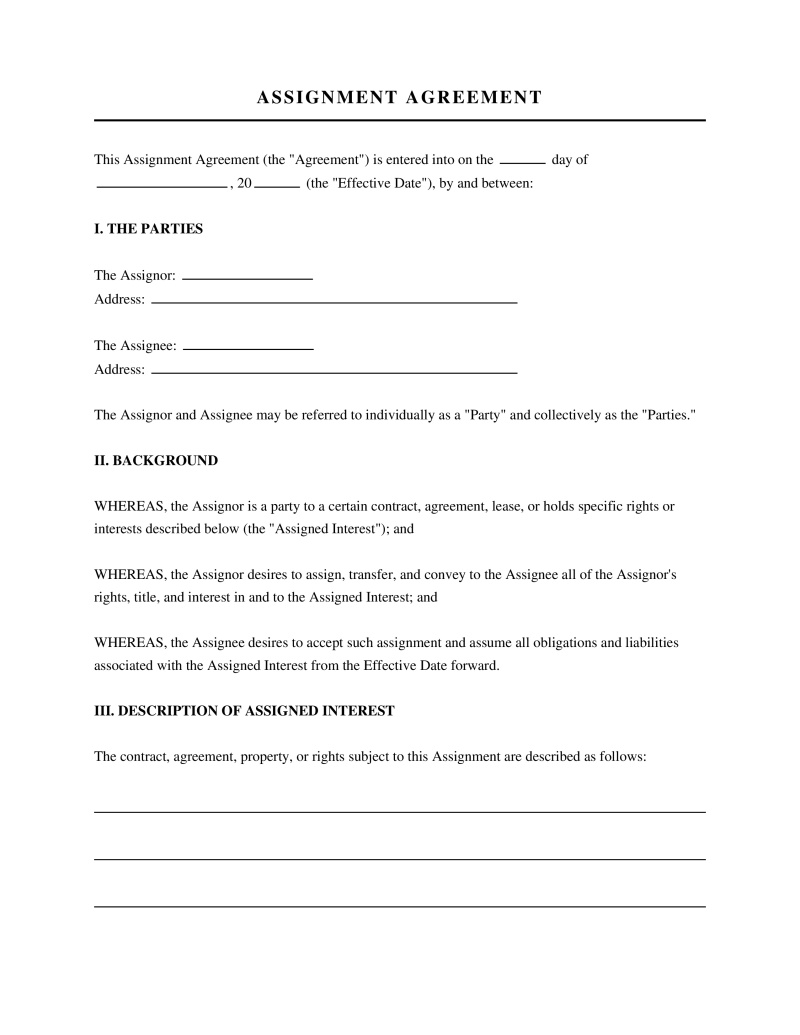
An assignment agreement is a legal instrument that formally transfers rights, benefits, or obligations from an original party to a designated assignee.
Assignment Subject Type
Select the type of right, interest, or obligation being transferred.
Provide a brief description if you selected 'Other'.
Table of Contents
What is a Assignment Agreement?
An Assignment Agreement is a binding legal document used to transfer rights, obligations, and benefits from one party, known as the assignor, to another party, termed the assignee. This instrument serves as the formal record when an individual or entity chooses to assign an agreement, effectively allowing the assignee to step into the shoes of the original contracting party and assume their contractual position. These agreements are fundamental in various commercial contexts, including business acquisitions, real estate transactions, and intellectual property transfers, ensuring that contractual relationships continue uninterrupted despite a change in the underlying parties.
Understanding the Mechanics of Assignment
The concept of assignment functions as a legal mechanism where a party to an existing contract transfers their position to a third party. When entities execute an assignment and assumption agreement, the process involves two distinct legal concepts: the assignment of rights and the delegation of duties. The assignment portion refers to the transfer of benefits, such as the right to receive payment or services, while the assumption portion relates to the acceptance of obligations, such as the duty to perform work or pay rent.
Contract law generally favors the free alienability of property and contract rights. Most contractual rights are assignable unless the assignment would materially change the duty of the other party, increase the burden or risk imposed on them, or impair their chance of obtaining return performance. The original contract remains in force, but the performance or benefit is directed to or comes from a new source. A critical distinction exists between assignment and novation. While assignment transfers rights and duties, it does not always release the original party from liability if the new party fails to perform. A novation, by contrast, creates an entirely new contract that extinguishes the old one and fully releases the original party.
Essential Components of an Assignment Agreement
For an assignment to be legally enforceable and effective, specific elements must be present within the document structure. Missing information can lead to ambiguity regarding which rights were transferred or whether the assignee truly assumed the obligations.
- Identification of Parties - The document must clearly identify the assignor (original party), the assignee (new party), and the obligor (the other party to the original contract).
- Description of Original Contract - Specific details regarding the underlying agreement, including its date, parties, and subject matter, establish the scope of the transfer.
- Scope of Assignment - The text must explicitly state whether the assignment covers all rights and obligations or only specific provisions within the original agreement.
- Representations and Warranties - The assignor typically guarantees they possess the authority to assign the rights and that the contract is free from encumbrances.
- Indemnification Clauses - Provisions often require the assignor to indemnify the assignee for liabilities arising before the effective date, while the assignee indemnifies for those arising afterward.
- Governing Law - The agreement identifies which state laws interpret the terms and govern the validity of the transfer.
Legal Restrictions and Non-Assignability
Although the general rule permits assignment, specific legal and contractual barriers may prohibit the transfer of rights. The most common restriction arises from the text of the original contract itself. Many commercial agreements contain anti-assignment clauses that forbid transfer without the express written consent of the non-assigning party. Courts typically enforce these clauses to protect the obligor's interest in knowing exactly whom they are doing business with.
Nature of the contract dictates assignability in the absence of specific clauses. Personal service contracts, which rely on the unique skills, character, or reputation of a specific individual, are generally not assignable without consent. For example, a contract hiring a specific famous artist to paint a portrait cannot be assigned by that artist to a student. Public policy also limits assignments in certain contexts, such as the assignment of future wages in some jurisdictions or the assignment of legal malpractice claims, which many courts view as promoting impermissible litigation.
How to Complete a Assignment Agreement
Executing an assignment requires careful attention to the terms of the original contract and adherence to procedural formalities to ensure the transfer is valid against third parties.
- Review the Original Contract - Examine the underlying agreement for any anti-assignment clauses or requirements for written consent. This step determines whether the assignment can proceed unilaterally or if the other party must be involved in the process.
- Draft the Assignment Instrument - Prepare the document detailing exactly what rights are being assigned and what duties are being assumed. The language must be precise to avoid retaining liabilities the assignor intends to transfer.
- Obtain Necessary Consents - Secure written permission from the non-assigning party if the original contract or law requires it. Failure to obtain required consent can render the assignment voidable and constitute a breach of the original contract.
- Execute the Agreement - Sign the document according to applicable formalities. Some jurisdictions or specific types of assignments, such as those involving real estate or patents, may require notarization or witnessing.
- Provide Notice to the Obligor - Inform the non-assigning party that the assignment has occurred. Notice is crucial because, until the obligor receives notice, they may validly discharge their obligation by paying or performing for the original assignor.
Governing Laws and Statutes
The validity and enforcement of assignment agreements fall under state contract law, the Uniform Commercial Code (UCC), and specific federal statutes depending on the subject matter.
- Uniform Commercial Code Article 2 - Governs the assignment of rights and delegation of duties in contracts for the sale of goods, generally allowing assignment unless it materially alters the risk or duty (UCC § 2-210).
- Uniform Commercial Code Article 9 - Regulates the assignment of accounts, payment intangibles, and promissory notes, often overriding anti-assignment clauses in commercial transactions to facilitate financing (UCC § 9-406).
- Restatement (Second) of Contracts - Provides the common law framework adopted by many courts regarding the alienability of contract rights and the validity of assignment restrictions (Restatement (Second) of Contracts § 317).
- Patent Act - Mandates that assignments of patents be in writing and establishes a recording system with the United States Patent and Trademark Office to protect against subsequent purchasers (35 U.S.C. § 261).
- Copyright Act - Requires that transfers of copyright ownership be in writing and signed by the owner of the rights conveyed (17 U.S.C. § 204).
Frequently Asked Questions
Assignment Agreement Sample
Not the form you're looking for?
Try our legal document generator to create a custom document
Disclaimer: The templates available on this website are provided for general informational purposes only and do not constitute legal advice. They are not intended to be, and should not be interpreted as, compliant with any specific legal, regulatory, or privacy requirements. These templates are not a replacement for professional legal guidance and should not be relied upon for any particular matter or circumstance. Users are strongly encouraged to seek advice from a qualified attorney licensed in their jurisdiction before using, modifying, or relying on any template.
All templates are provided on an "as is," "with all faults," and "as available" basis. The provider disclaims any and all warranties of any kind, whether express, implied, statutory, or otherwise, including without limitation warranties of merchantability, fitness for a particular purpose, title, or non-infringement.
LegalTemplates.com makes no guarantees or representations regarding the accuracy, completeness, expected outcomes, or reliability of the materials contained in these templates or any materials referenced or linked from them.