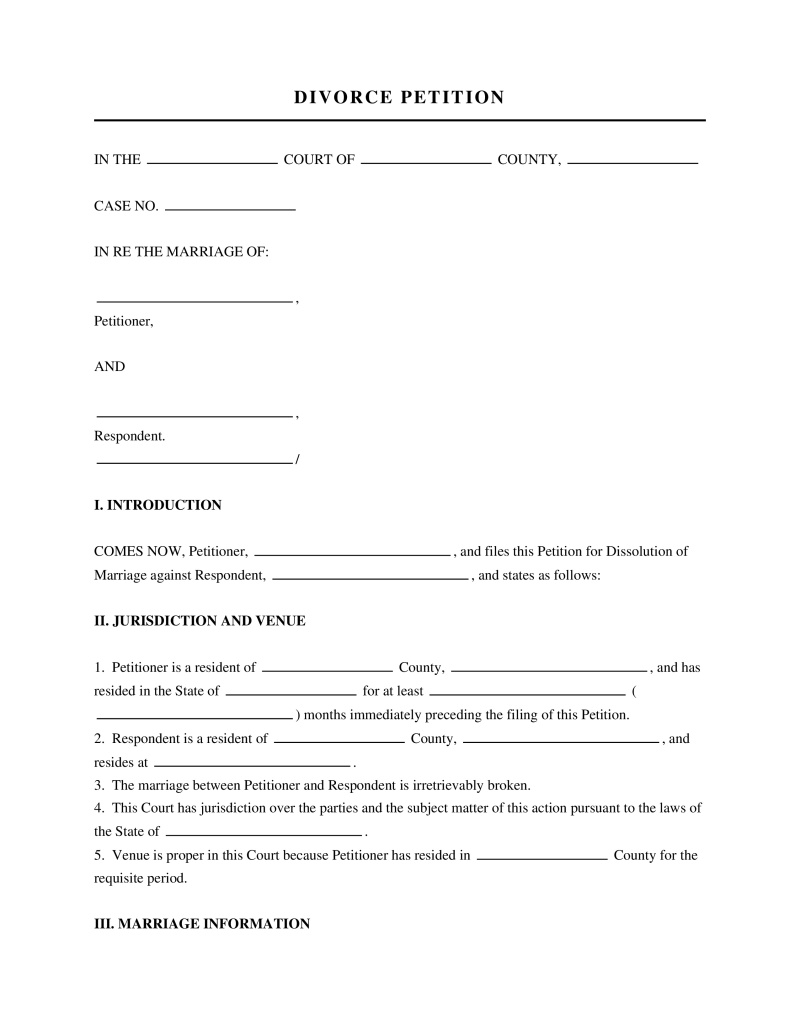
Divorce Petition
A Divorce Petition is a formal legal document filed with a court to initiate the dissolution of a marriage or civil partnership.
Grounds For Divorce Type
Select the primary legal reason for the divorce. Options vary by state.
Provide a brief description of the grounds if you selected 'Other'.
Table of Contents
What is a Divorce Petition?
A Divorce Petition, also known as a Petition for Dissolution of Marriage, is the initial legal document filed with a court to formally request the termination of a marriage. This document serves as the official commencement of divorce proceedings, outlining the petitioner's request for the court to dissolve the marital bond and address related issues such as property division, child custody, child support, and spousal support. It is typically filed by one spouse, known as the petitioner, against the other spouse, referred to as the respondent, thereby initiating the legal process that will lead to the dissolution of their marriage.
Legal Requirements and Validity
For a Divorce Petition to be considered legally valid and proceed through the court system, it must adhere to specific jurisdictional and procedural requirements. These requirements ensure that the court has the authority to hear the case and that both parties are afforded due process under the law. Failure to meet these criteria can result in the petition being dismissed or significant delays in the divorce process.
- Jurisdiction and Residency - The petitioner must satisfy the residency requirements of the state and county where the petition is filed. These requirements typically mandate that one or both spouses have lived in the state for a specified period, ranging from a few months to a year, before filing the petition.
- Proper Grounds for Divorce - The petition must state valid legal grounds for the dissolution of the marriage. These grounds can be either "no-fault," such as irreconcilable differences or an irretrievable breakdown of the marriage, or "fault-based," which might include adultery, abandonment, or cruelty, depending on the state's laws.
- Accurate Information - The petition must contain accurate and complete identifying information for both spouses, details of the marriage (date and place), information about any minor children, and a general overview of marital assets and debts.
- Service of Process - The respondent must be formally notified of the divorce action through a legal procedure known as service of process. This ensures the respondent receives a copy of the petition and summons, informing them of the legal action and their obligation to respond.
- Filing with the Court - The completed petition, along with any required attachments, must be filed with the clerk of the appropriate family or circuit court. This usually involves paying a filing fee, which can sometimes be waived for individuals who meet specific income eligibility criteria.
Rights and Obligations of Parties Involved
Both the petitioner and the respondent in a divorce proceeding have distinct rights and obligations that govern their conduct and participation throughout the legal process. Understanding these roles is crucial for navigating the complexities of dissolving a marriage.
- Petitioner's Rights - The petitioner has the right to initiate the divorce action, state their desired outcomes regarding property division, child custody, and support, and present their case to the court. They also have the right to seek temporary orders from the court to address immediate needs during the divorce proceedings.
- Petitioner's Obligations - The petitioner is obligated to provide accurate and truthful information in the divorce petition and all subsequent court filings. They must ensure proper service of process on the respondent and comply with all court orders and procedural deadlines. The petitioner also has a duty to disclose all relevant financial information to the court and the respondent.
- Respondent's Rights - The respondent has the right to receive proper notice of the divorce petition through legal service of process. They have the right to file a response to the petition, known as an Answer or Counter-Petition, to contest any claims made by the petitioner or to present their own requests for relief. The respondent can also seek temporary orders and has the right to legal representation.
- Respondent's Obligations - The respondent is obligated to file a timely response to the divorce petition within the period specified by court rules, typically 20 to 30 days after service. They must also provide accurate financial disclosures, comply with all court orders, and participate in discovery processes such as depositions or interrogatories. Both parties share an obligation to act in good faith and cooperate in reaching a fair resolution, particularly concerning the best interests of any minor children.
How to Complete a Divorce Petition
The process of completing and filing a Divorce Petition involves several critical steps that must be followed diligently to ensure the document's validity and the smooth progression of the divorce case.
- Gather Necessary Information - Before beginning, collect all pertinent personal and marital details. This includes the full legal names and addresses of both spouses, dates of birth, the date and place of marriage, and the date of separation if applicable. If there are minor children, their full names, dates of birth, and current living arrangements are essential. Additionally, compile a preliminary list of all marital assets, debts, and income information for both parties.
- Determine Grounds for Divorce - Identify the legal basis for seeking the divorce. Most states offer "no-fault" grounds, such as "irreconcilable differences" or "irretrievable breakdown," which do not require proving fault on the part of either spouse. Some states also permit "fault-based" grounds like adultery, desertion, or cruel and inhuman treatment, though these can complicate proceedings. Choosing the appropriate ground is a foundational step that influences subsequent legal arguments.
- Draft the Petition Document - Utilize the standardized forms provided by your state's court system, if available, or draft a formal legal pleading. The petition must clearly state the parties' identifying information, the marriage details, the grounds for divorce, and the specific relief requested from the court concerning property division, child custody, child support, and spousal support. Ensure all sections are completed thoroughly and accurately, as omissions or errors can lead to delays.
- Review and Sign the Petition - Carefully review the entire drafted Divorce Petition for accuracy, completeness, and any typographical errors. Once satisfied, the petitioner must sign the document. In many jurisdictions, the petition also requires notarization or a declaration under penalty of perjury, affirming the truthfulness of the information provided. Legal counsel typically handles this for their clients, but self-represented individuals must ensure proper execution.
- File with the Appropriate Court - Submit the signed and completed Divorce Petition to the clerk of the circuit court, family court, or superior court in the county where the residency requirements are met. At this stage, a filing fee is typically required, which varies by jurisdiction. Upon filing, the court clerk will assign a case number, officially opening the divorce case and making it a matter of public record.
- Serve the Respondent - After the petition is filed, the respondent must be formally served with a copy of the Divorce Petition and a summons. This legal notification ensures the respondent is aware of the lawsuit and the deadline by which they must file a response with the court. Service must be performed according to specific court rules, often by a sheriff, process server, or certified mail, and proof of service must be filed with the court.
Required Elements of a Valid Divorce Petition
A Divorce Petition must contain specific information to be considered complete and legally sufficient by the court. These elements ensure that the court has all necessary facts to process the dissolution of marriage and address related issues.
- Names and Addresses of Both Spouses - Full legal names, current residential addresses, and sometimes mailing addresses for both the petitioner and the respondent.
- Date and Place of Marriage - The exact date and location where the marriage ceremony took place.
- Date of Separation - The date when the spouses ceased living together as husband and wife, if applicable, as this can impact property division in some states.
- Names and Birthdates of Minor Children - Full legal names and dates of birth for all children born or adopted during the marriage who are still minors.
- Statement of Grounds for Divorce - A clear statement of the legal reason(s) for seeking the divorce, whether no-fault (e.g., irreconcilable differences) or fault-based (e.g., adultery).
- Request for Relief - A specific enumeration of what the petitioner is asking the court to order, including property division, debt allocation, child custody, child support, and spousal support.
- Signature of Petitioner or Attorney - The legal signature of the petitioner or their attorney, affirming the truthfulness of the document's contents.
- Verification or Notarization - A sworn statement, often notarized, by the petitioner attesting to the accuracy of the information provided in the petition.
Federal Laws and Divorce Proceedings
While divorce is primarily a matter of state law, several federal statutes and constitutional principles intersect with and influence divorce proceedings, particularly in areas involving interstate issues, military personnel, and retirement assets.
- Full Faith and Credit Clause - Requires states to respect the "public acts, records, and judicial proceedings of every other state" (U.S. Constitution, Art. IV, § 1). This means a divorce decree granted in one state is generally recognized as valid in all other states.
- Uniform Child Custody Jurisdiction and Enforcement Act (UCCJEA) - A uniform act adopted by nearly all states that provides a framework for determining which state has jurisdiction to make or modify child custody orders and for enforcing those orders across state lines (e.g., California Family Code § 3400 et seq.).
- Employee Retirement Income Security Act (ERISA) - A federal law that sets minimum standards for most voluntarily established retirement and health plans in private industry (29 U.S.C. § 1001 et seq.). ERISA is particularly relevant in divorce as it governs how qualified retirement plans are divided between spouses through Qualified Domestic Relations Orders (QDROs).
- Servicemembers Civil Relief Act (SCRA) - Provides legal and financial protections for military members as they enter active duty (50 U.S.C. § 3901 et seq.). In divorce cases, the SCRA can delay proceedings or prevent default judgments against military personnel who are unable to participate due to their service.
State Laws Governing Divorce Petitions
State laws are the primary authority governing the substantive and procedural aspects of divorce. Each state has its own statutes detailing the requirements for filing a Divorce Petition, the grounds for divorce, and how related issues are resolved.
- Residency Requirements - Mandates that at least one spouse must have resided in the state for a specific period (e.g., six months to one year) and often in the county for a shorter period (e.g., three months) before a Divorce Petition can be filed (e.g., Texas Family Code § 6.301).
- Grounds for Divorce - Specifies the legal reasons a marriage can be dissolved. States generally offer both "no-fault" grounds, such as "irreconcilable differences," and some retain "fault-based" grounds, including adultery, desertion, or habitual drunkenness (e.g., New York Domestic Relations Law § 170).
- Service of Process Rules - Outlines the precise legal methods by which the respondent must be formally notified of the divorce action. These rules dictate who can serve the papers, how they must be delivered, and the timeframe for response (e.g., California Code of Civil Procedure § 413.10 et seq.).
- Child Custody and Support Guidelines - Establishes the legal framework and mathematical formulas for determining parental responsibilities, visitation schedules, and the financial contributions of parents for their children's welfare (e.g., Florida Statute § 61.13).
- Equitable Distribution or Community Property Laws - Governs how marital assets and debts acquired during the marriage are divided between the spouses. Most states follow equitable distribution, aiming for a fair, though not necessarily equal, division, while a few states adhere to community property laws, which typically mandate a 50/50 split (e.g., Illinois Marriage and Dissolution of Marriage Act, 750 ILCS 5/503).
Penalties for Non-Compliance
Failure to comply with the legal requirements for a Divorce Petition or court orders during the divorce process can lead to various adverse consequences, impacting the outcome of the case and potentially incurring additional legal liabilities.
- Dismissal of Petition - If the Divorce Petition does not meet jurisdictional or procedural requirements, or if the petitioner fails to prosecute the case diligently, the court may dismiss the petition, requiring the petitioner to refile and restart the process.
- Delays in Proceedings - Errors in the petition, improper service of process, or failure to meet deadlines can significantly prolong the divorce process, increasing legal costs and emotional strain.
- Monetary Sanctions - Courts can impose financial penalties on parties who fail to comply with rules, orders, or discovery requests. These sanctions might include fines or an order to pay the opposing party's attorney's fees.
- Loss of Rights or Claims - Non-compliance, such as failing to respond to discovery requests or appear at scheduled hearings, can result in the court making adverse rulings. This could lead to a party losing certain claims regarding property, custody, or support.
- Default Judgment - If a respondent fails to file a timely response to a properly served Divorce Petition, the court may enter a default judgment. This allows the petitioner to proceed with the divorce and obtain the relief requested in their petition without the respondent's input.
- Contempt of Court - Deliberate disobedience of a court order, such as failing to pay temporary support or violating a custody order, can result in a finding of contempt of court. Penalties for contempt can range from fines to incarceration.
Frequently Asked Questions
Divorce Petition Example
Not the form you're looking for?
Try our legal document generator to create a custom document
Disclaimer: The templates available on this website are provided for general informational purposes only and do not constitute legal advice. They are not intended to be, and should not be interpreted as, compliant with any specific legal, regulatory, or privacy requirements. These templates are not a replacement for professional legal guidance and should not be relied upon for any particular matter or circumstance. Users are strongly encouraged to seek advice from a qualified attorney licensed in their jurisdiction before using, modifying, or relying on any template.
All templates are provided on an "as is," "with all faults," and "as available" basis. The provider disclaims any and all warranties of any kind, whether express, implied, statutory, or otherwise, including without limitation warranties of merchantability, fitness for a particular purpose, title, or non-infringement.
LegalTemplates.com makes no guarantees or representations regarding the accuracy, completeness, expected outcomes, or reliability of the materials contained in these templates or any materials referenced or linked from them.