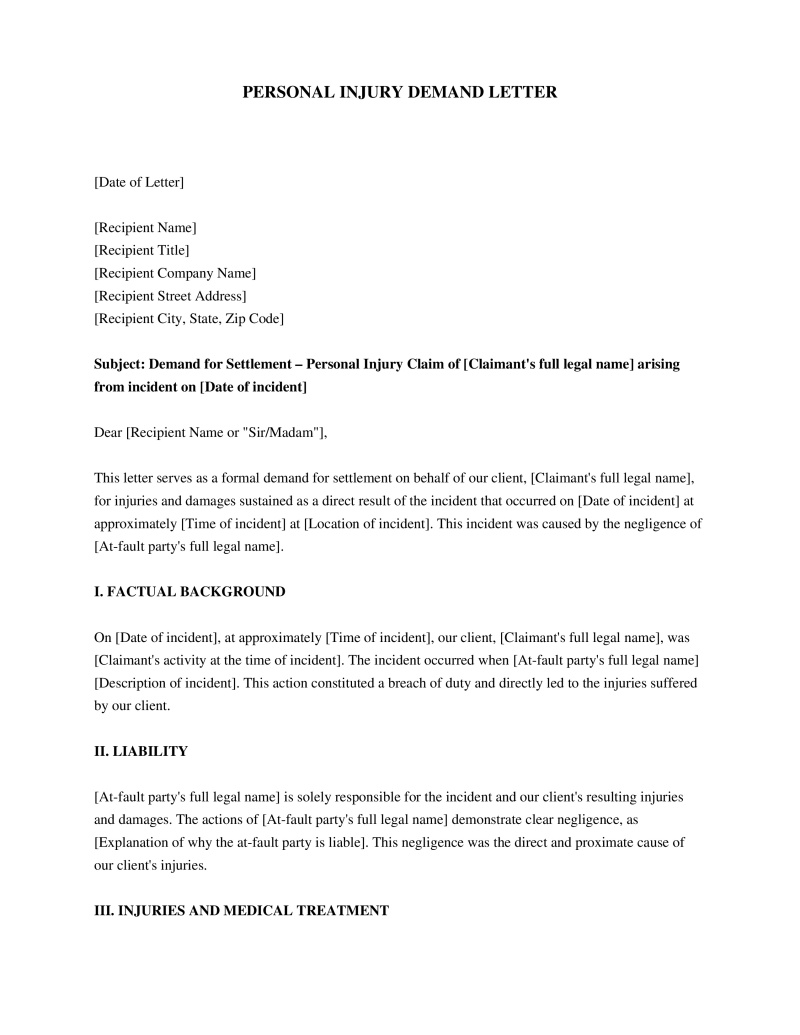
Personal Injury Demand Letter
A Personal Injury Demand Letter is a formal legal communication, often prepared by an attorney, detailing a claimant's injuries and damages from an incident and proposing a settlement to the at-fault party or their insurer.
Claimant 1 Full Name
Enter the full legal name of the person making the injury claim.
Provide the Claimant's complete mailing address.
Enter the Claimant's date of birth, if relevant to the claim.
Select 'Yes' if there are multiple people making this claim.
Enter the full legal name of the second Claimant, if applicable.
Provide the second Claimant's complete mailing address.
Enter the second Claimant's date of birth, if relevant.
Select 'Yes' if there are three or more Claimants.
Enter the full legal name of the third Claimant, if applicable.
Provide the third Claimant's complete mailing address.
Enter the third Claimant's date of birth, if relevant.
Table of Contents
What is a Personal Injury Demand Letter?
A Personal Injury Demand Letter is a formal document sent by an injured party, or their legal representative, to the at-fault party or their insurance company, seeking compensation for damages incurred due to an accident or injury. Its primary purpose is to initiate settlement negotiations before a lawsuit is filed. This letter outlines the facts of the incident, details the injuries sustained, summarizes medical treatment and expenses, and presents a demand for a specific monetary amount to resolve the claim.
Purpose and Strategic Importance
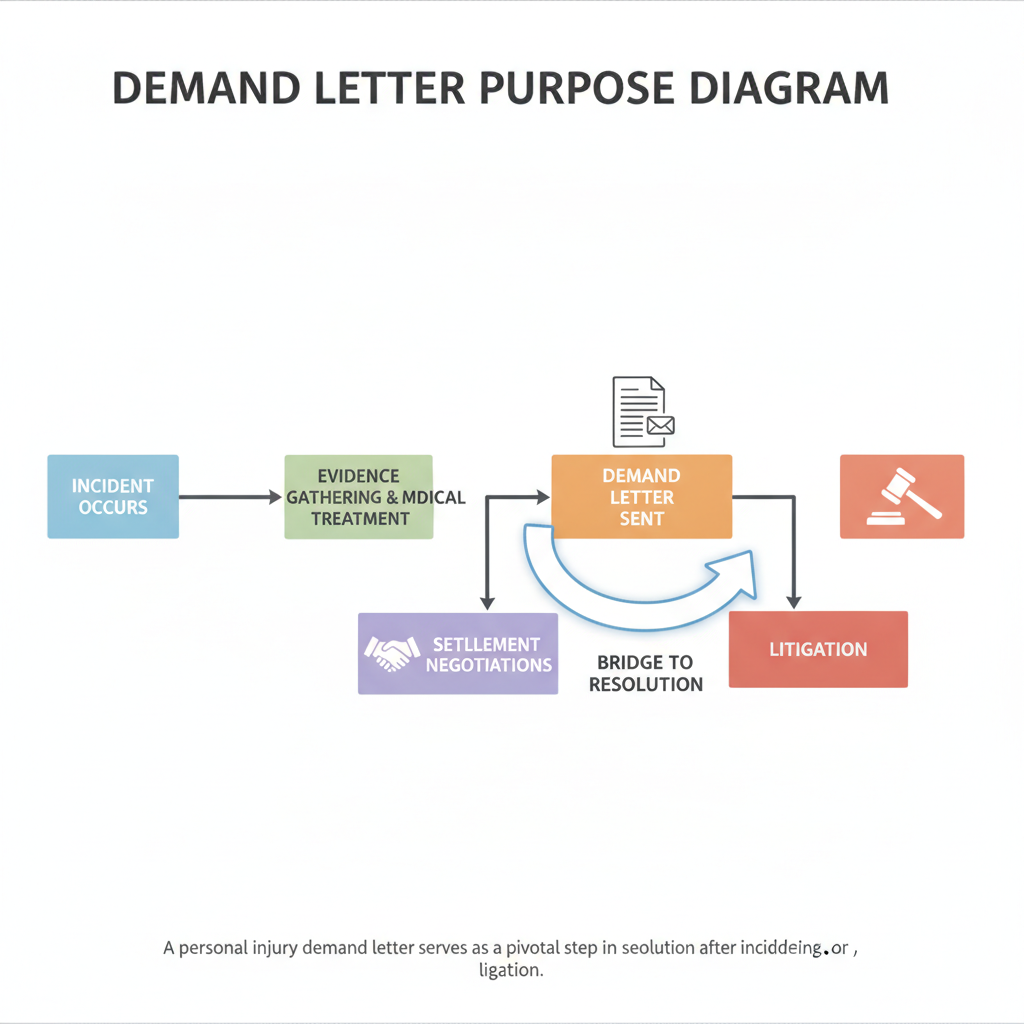
The demand letter serves as a critical pre-litigation tool in personal injury cases. It formally notifies the opposing party of the claim, provides a comprehensive overview of the damages, and establishes a basis for negotiation. By presenting a clear and detailed account, the letter aims to persuade the recipient to settle the claim without the need for court intervention, which can be costly and time-consuming for all parties involved.
Sending a demand letter often represents the culmination of the investigation and evidence-gathering phase of a personal injury claim. It allows the claimant to articulate the full extent of their losses, including economic damages like medical bills and lost wages, and non-economic damages such as pain and suffering. The strategic presentation of these details is crucial for establishing the value of the claim and encouraging a reasonable settlement offer.
Key Components and Content
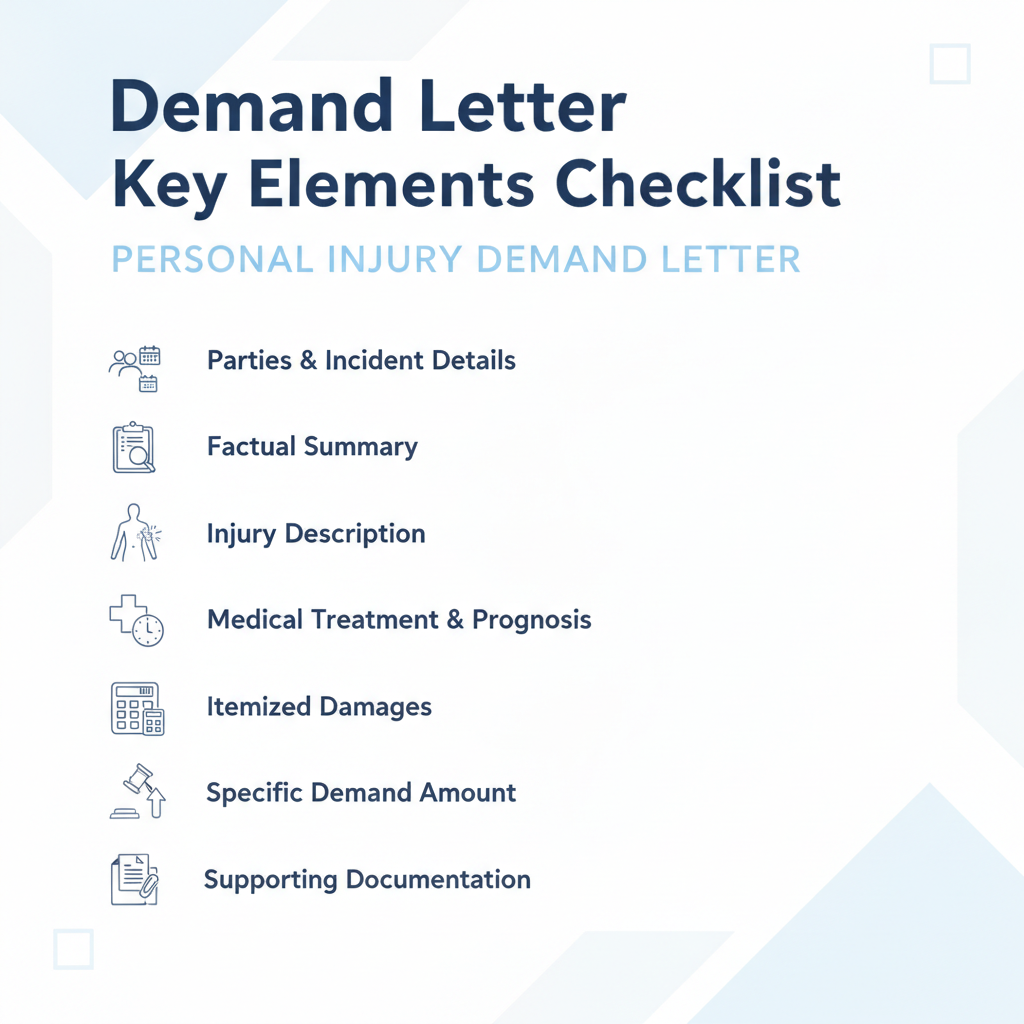
While the specific details will vary based on the nature of the personal injury claim, a comprehensive demand letter typically includes several core components:
- Introduction - Identifies the parties involved, the date and location of the incident, and states the purpose of the letter.
- Factual Summary of the Incident - Provides a clear, concise, and objective account of how the injury occurred, establishing liability.
- Description of Injuries - Details all physical and psychological injuries sustained as a direct result of the incident.
- Medical Treatment and Prognosis - Outlines the course of medical treatment, including doctor visits, hospitalizations, therapies, and any ongoing or future medical needs. It may also include a statement regarding the long-term prognosis.
- Damages Sustained - Itemizes all economic losses, such as medical expenses, lost wages, property damage, and other out-of-pocket costs. It also addresses non-economic damages, like pain, suffering, emotional distress, and loss of enjoyment of life.
- Legal Argument - Briefly explains why the recipient is legally responsible for the claimant's injuries, often referencing negligence or other relevant legal principles.
- Demand for Settlement - Clearly states the specific monetary amount the claimant is seeking to resolve the claim, along with a deadline for response.
- Supporting Documentation - Mentions or encloses relevant evidence, such as medical records, bills, police reports, photographs, witness statements, and wage loss documentation.
The Negotiation Process
Upon receipt of a personal injury demand letter, the at-fault party or their insurance company typically reviews the presented information and evidence. This review process involves evaluating liability, assessing the severity of injuries, and calculating the potential value of the claim. The insurer's response may include accepting the demand, making a counteroffer, or denying the claim outright.
If a counteroffer is made, it marks the beginning of the negotiation phase. During this period, the parties exchange offers and counteroffers, often supported by further clarification or additional evidence. The goal is to reach a mutually agreeable settlement amount that avoids the complexities and uncertainties of litigation. If an agreement cannot be reached through negotiation, the claimant may then consider filing a lawsuit to pursue their claim in court.
Legal Context and Pre-Litigation Requirements
While a personal injury demand letter is a common and often essential step in resolving a claim, specific legal requirements for sending one can vary by jurisdiction and the nature of the claim. In some contexts, a demand letter may be a prerequisite before initiating certain types of legal action.
- Small Claims Court Requirements - In California, for instance, a demand letter is often a required step before filing a small claims court case, serving as a formal request for payment owed before litigation (California Courts Self-Help Guide: Demand Letter).
- Consumer Protection Claims - Demand letters are also utilized in other areas of law. For example, in Massachusetts, a sample 30-day demand letter is provided for consumers seeking relief under Massachusetts General Laws, Chapter 93A, Section 9, for unfair or deceptive acts (Massachusetts Attorney General's Office: Sample 30-Day Demand Letter).
- Commercial and Government Claims - The use of demand letters extends to commercial claims, such as those arising out of consumer transactions in New York City Civil Court, for which a specific form (UCS-124) exists (New York Courts: Demand Letter Form UCS-124). Additionally, the Department of the Army outlines procedures for asserting claims, which include the use of demand letters (Department of the Army, DoD: Assertion of Claims, 32 CFR § 537.9).
These examples illustrate that while the personal injury demand letter is a widely accepted practice, its mandatory nature or specific format can depend on the jurisdiction and the specific type of claim being asserted. For personal injury cases, it primarily functions as a strategic document to facilitate settlement rather than a universally mandated legal filing.
Frequently Asked Questions
Sources
- California Courts Self-Help Guide: Demand Letter - Provides guidance on writing a demand letter before filing a small claims court case in California.
- New York Courts: Demand Letter Form UCS-124 - Offers a sample demand letter form for commercial claims arising out of consumer transactions in New York City Civil Court.
- Department of the Army, DoD: Assertion of Claims - Details procedures for asserting claims, including the use of demand letters in the Department of the Army.
- Massachusetts Attorney General's Office: Sample 30-Day Demand Letter - Provides a sample 30-day demand letter for consumers under Massachusetts General Laws, Chapter 93A, Section 9.
Not the form you're looking for?
Try our legal document generator to create a custom document
Disclaimer: The templates available on this website are provided for general informational purposes only and do not constitute legal advice. They are not intended to be, and should not be interpreted as, compliant with any specific legal, regulatory, or privacy requirements. These templates are not a replacement for professional legal guidance and should not be relied upon for any particular matter or circumstance. Users are strongly encouraged to seek advice from a qualified attorney licensed in their jurisdiction before using, modifying, or relying on any template.
All templates are provided on an "as is," "with all faults," and "as available" basis. The provider disclaims any and all warranties of any kind, whether express, implied, statutory, or otherwise, including without limitation warranties of merchantability, fitness for a particular purpose, title, or non-infringement.
LegalTemplates.com makes no guarantees or representations regarding the accuracy, completeness, expected outcomes, or reliability of the materials contained in these templates or any materials referenced or linked from them.