Financial Affidavit
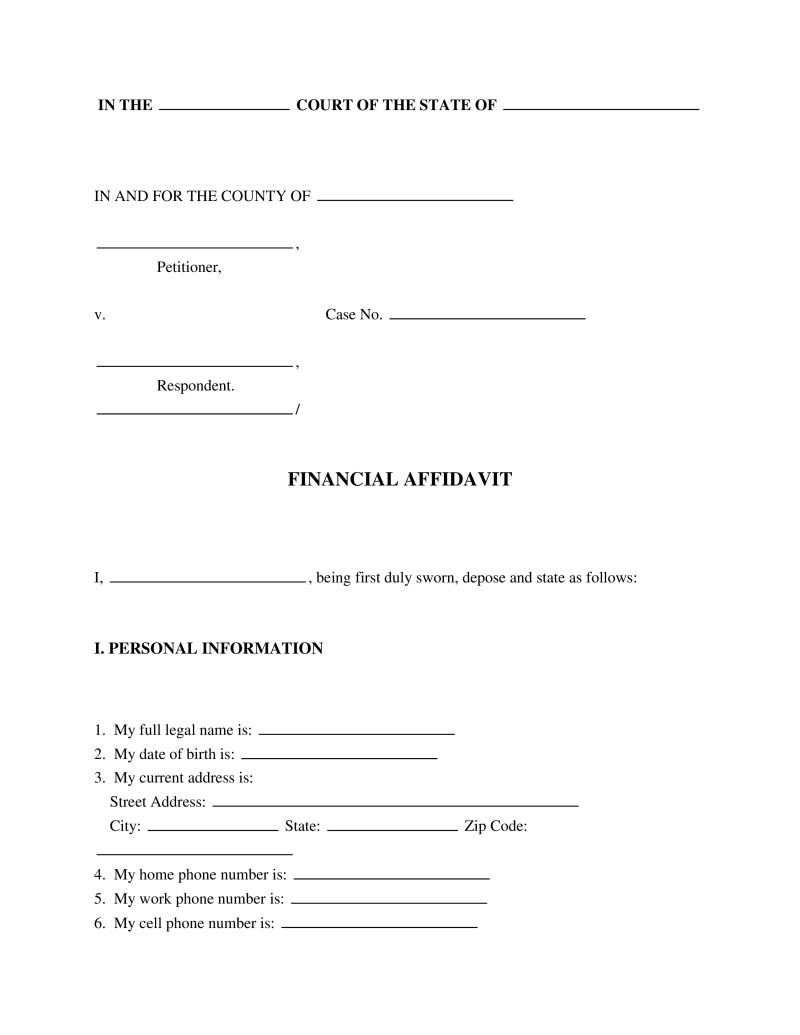
A Financial Affidavit is a sworn legal document detailing an individual's assets, liabilities, income, and expenses, typically submitted in judicial proceedings requiring financial disclosure.
Filing Party Role
Select the party designation that matches your role in this legal matter.
Enter your party designation if not listed above.
Table of Contents
What is a Financial Affidavit?
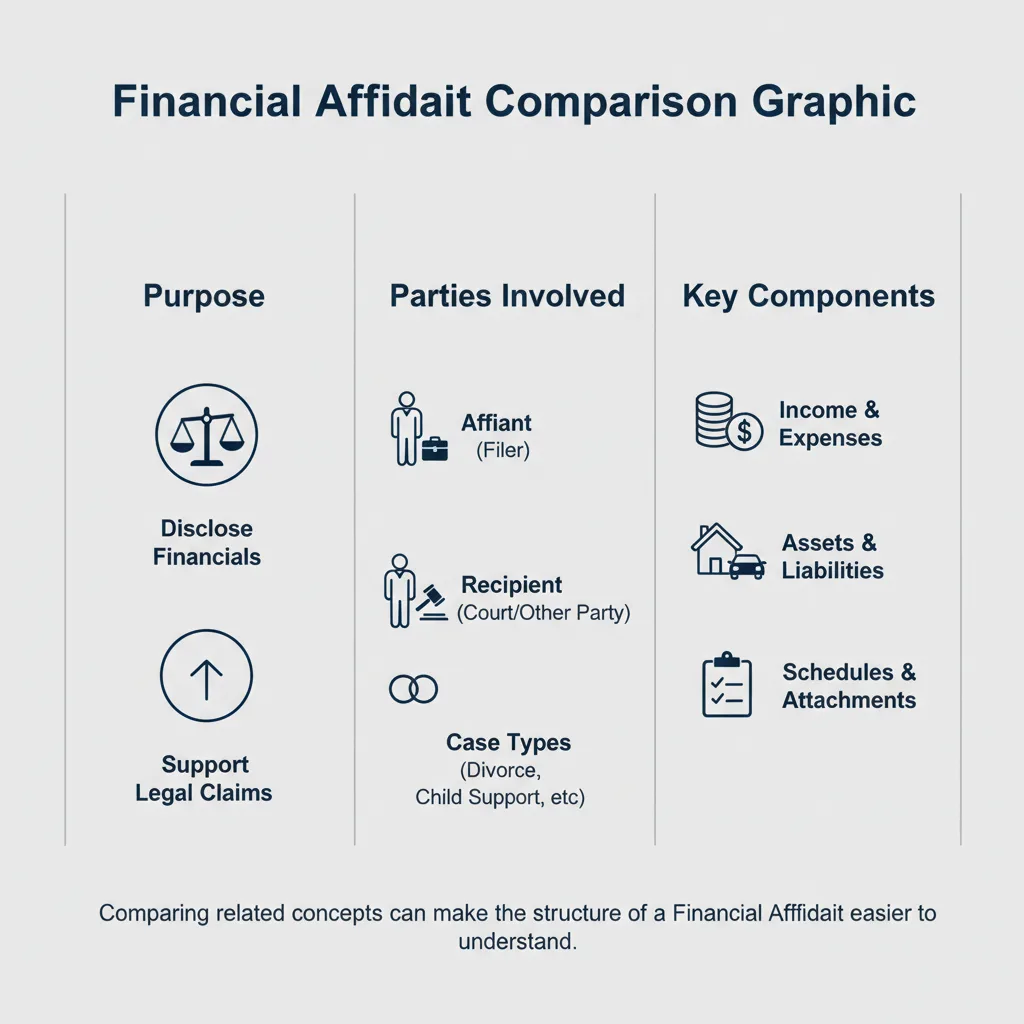
A Financial Affidavit is a sworn legal document that provides a comprehensive overview of an individual's financial situation. It details income, expenses, assets, and liabilities, typically signed under penalty of perjury. This document is primarily used in legal proceedings to determine a party's financial capacity or need for assistance, such as eligibility for court-appointed legal services.
Purpose and Application
Financial Affidavits serve as a critical tool in legal systems, particularly within federal courts, to ensure fairness and access to justice. Their primary purpose is to establish an individual's financial eligibility for various court-appointed services or to inform judicial decisions regarding financial obligations.
The document is commonly utilized in federal court districts to assess an individual's financial eligibility for court-appointed services provided under the Criminal Justice Act (CJA). For instance, the Southern District of Mississippi offers a Financial Affidavit form for individuals seeking attorney services due to financial constraints. Similarly, the District of Alaska provides the CJA 23 Financial Affidavit form for requests for attorney services without payment of a fee.
Beyond CJA cases, such affidavits can also be relevant in other contexts. The Sixth Circuit Court of Appeals, for example, provides Form 4 Motion/Financial Affidavit for individuals seeking pauper status in non-CJA cases, indicating its broader application in determining an individual's inability to pay court fees or costs.
Key Information Included

While the specific structure and detail may vary slightly between jurisdictions and forms, a Financial Affidavit consistently requires a thorough disclosure of an individual's financial standing. The information provided allows courts to make informed decisions based on verified financial data.
Common categories of financial information typically requested include:
- Income Sources - Details on all forms of income, such as wages, salaries, self-employment earnings, social security benefits, unemployment compensation, disability payments, pensions, and any other regular sources of funds.
- Monthly Expenses - An itemized list of recurring monthly expenditures, including housing costs (rent or mortgage), utilities, food, transportation, insurance premiums, medical expenses, and other necessary living costs.
- Assets - A declaration of all owned property and valuables, which may include real estate, bank accounts (checking, savings), investment accounts, retirement funds, vehicles, and other significant personal property.
- Liabilities and Debts - A comprehensive listing of all outstanding debts, such as credit card balances, personal loans, student loans, medical bills, and mortgages, often including the creditor's name, original amount, current balance, and monthly payment.
- Dependents - Information about any dependents, including their names, ages, and relationship to the affiant, as this can affect financial obligations and eligibility for services.
The CJA 23 Form in Federal Courts
The CJA 23 Financial Affidavit form is a standardized document widely adopted across various federal court districts for specific types of financial disclosure. This form is central to the administration of the Criminal Justice Act, which ensures legal representation for individuals who cannot afford an attorney in federal criminal proceedings.
Several federal judicial districts explicitly use or reference the CJA 23 form:
- Northern District of Georgia - Offers the CJA-23 Financial Affidavit form for financial disclosure statements.
- Middle District of Florida - Provides the CJA 23 Financial Affidavit form specifically for Criminal Justice Act cases.
- District of Alaska - Uses the CJA 23 Financial Affidavit form for requests for attorney services without payment of fee.
The widespread use of the CJA 23 form underscores a consistent federal approach to assessing financial need for appointed counsel, ensuring that individuals facing federal charges, regardless of their financial status, have access to legal representation as guaranteed by the Sixth Amendment.
Submission and Verification
The process of submitting a Financial Affidavit involves several crucial steps to ensure its validity and accuracy. Because the information contained within these documents is used to make significant legal determinations, the integrity of the submission is paramount.
Key aspects of submission and verification include:
- Signing Under Penalty of Perjury - The affiant, the individual completing the affidavit, must sign the document under penalty of perjury. This means that the person is swearing under oath that the information provided is true and accurate to the best of their knowledge, and intentionally providing false information can lead to severe legal consequences, including criminal charges.
- Notarization - In many jurisdictions, a Financial Affidavit must be notarized. A notary public verifies the identity of the signer and witnesses their signature, adding another layer of authenticity to the document.
- Filing with the Court - Once completed and properly executed, the Financial Affidavit is filed with the appropriate court. This makes it part of the official court record and accessible to relevant parties involved in the legal proceeding.
- Supporting Documentation - Courts often require or request supporting documentation to verify the information presented in the affidavit. This can include pay stubs, bank statements, tax returns, loan statements, and property deeds, which corroborate the declared income, assets, and liabilities.
The verification process helps prevent fraud and ensures that court decisions are based on reliable financial disclosures. Courts may scrutinize the details provided and may request additional evidence if discrepancies or inconsistencies are found.
Frequently Asked Questions
Sources
- Financial Affidavit | Southern District of Mississippi - Provides a Financial Affidavit form for requesting attorney services based on financial need.
- Financial Affidavit | Northern District of Georgia - Offers a Financial Affidavit form (CJA-23) for financial disclosure statements.
- Financial Affidavit | Middle District of Florida - Provides the CJA 23 Financial Affidavit form for Criminal Justice Act cases.
- Form 4 Motion/Financial Affidavit | Sixth Circuit - Provides Form 4 Motion/Financial Affidavit for pauper status in non-CJA cases.
- Financial Affidavit (CJA 23) | District of Alaska - Provides the CJA 23 Financial Affidavit form for requests for attorney services without payment of fee.
Not the form you're looking for?
Try our legal document generator to create a custom document
Disclaimer: The templates available on this website are provided for general informational purposes only and do not constitute legal advice. They are not intended to be, and should not be interpreted as, compliant with any specific legal, regulatory, or privacy requirements. These templates are not a replacement for professional legal guidance and should not be relied upon for any particular matter or circumstance. Users are strongly encouraged to seek advice from a qualified attorney licensed in their jurisdiction before using, modifying, or relying on any template.
All templates are provided on an "as is," "with all faults," and "as available" basis. The provider disclaims any and all warranties of any kind, whether express, implied, statutory, or otherwise, including without limitation warranties of merchantability, fitness for a particular purpose, title, or non-infringement.
LegalTemplates.com makes no guarantees or representations regarding the accuracy, completeness, expected outcomes, or reliability of the materials contained in these templates or any materials referenced or linked from them.