Schedule of Assets and Debts
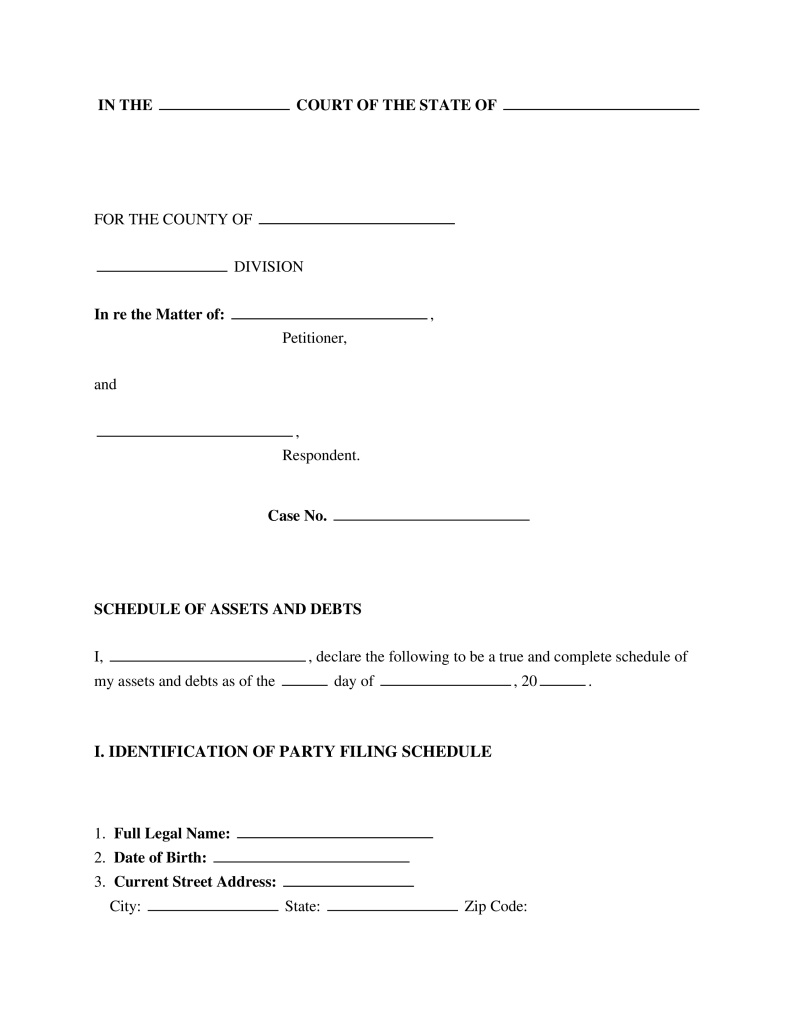
A Schedule of Assets and Debts is a formal legal document itemizing an individual's or entity's property and financial obligations, often submitted in legal proceedings like bankruptcy or divorce.
Asset Debt Scope
Select whether you are listing only your own assets and debts, or those of a couple, estate, or business.
Table of Contents
What is a Schedule of Assets and Debts?
A Schedule of Assets and Debts is a comprehensive financial statement required in bankruptcy proceedings, detailing all property owned by a debtor and all financial obligations owed to creditors. This document provides a complete snapshot of an individual's or entity's financial condition at the time of filing for bankruptcy. Its primary purpose is to inform the bankruptcy court, trustee, and creditors about the debtor's financial standing, enabling the court to administer the bankruptcy estate and determine the debtor's eligibility for relief.
Purpose in Bankruptcy Proceedings
The Schedule of Assets and Debts is a cornerstone document in nearly all bankruptcy filings under the U.S. Bankruptcy Code. It serves multiple critical functions, ensuring transparency and facilitating the fair and orderly resolution of a debtor's financial affairs. The detailed information it provides allows the bankruptcy trustee to identify assets that can be liquidated to pay creditors and to differentiate between exempt and non-exempt property.
The accuracy and completeness of this schedule are paramount. Any omissions or misrepresentations can have serious legal consequences, including the denial of discharge or even criminal penalties. Debtors are required to disclose all assets, regardless of their value or whether they believe the assets are exempt from seizure, and all debts, even those they dispute or intend to pay.
Components of the Schedule
The Schedule of Assets and Debts is typically divided into several sections, each requiring specific details about different categories of property and liabilities. For individual debtors, the official form is designated as B 106A/B (Schedules A/B: Assets – Real and Personal Property, and Schedules D-J for other financial details). For non-individual debtors, the form is B 206A/B. Schedule A/B specifically lists all real and personal property owned by the debtor, its location, and its value as of the date of filing.
The asset section (Schedule A/B) requires a detailed listing of various types of property:
- Real Property - Includes land, houses, condominiums, and any other fixed structures, along with their estimated current market value and details of any co-owners or liens.
- Personal Property - Covers a broad range of items, such as:
- Cash and bank accounts.
- Vehicles (cars, boats, motorcycles).
- Household goods and furnishings.
- Electronics and collectibles.
- Jewelry and furs.
- Farm animals and crops.
- Stocks, bonds, and other financial instruments.
- Interests in businesses.
- Retirement accounts and insurance policies.
- Accounts receivable, intellectual property, and other general intangibles.
The debt section (Schedules D-J) systematically categorizes all liabilities:
- Secured Debts - Debts backed by collateral, such as mortgages (Schedule D) and car loans, specifying the creditor, amount owed, and the property securing the debt.
- Unsecured Priority Debts - Certain unsecured debts that receive preferential treatment in bankruptcy, like some taxes and child support obligations (Schedule E/F).
- Unsecured Non-Priority Debts - General unsecured debts without collateral, such as credit card balances, medical bills, and personal loans (Schedule E/F).
Filing Requirements and Deadlines
The Schedule of Assets and Debts, along with other required bankruptcy forms, must be filed with the bankruptcy court according to specific deadlines. Generally, these schedules are filed either concurrently with the bankruptcy petition itself or within 14 days of filing the petition. This strict timeline ensures that the court and all interested parties receive timely and complete financial information to proceed with the case.
The filing process typically involves:
- Preparation - Debtors must gather extensive financial documentation, including bank statements, tax returns, pay stubs, deeds, titles, and credit reports, to ensure all assets and debts are accurately identified and valued.
- Declaration Under Penalty of Perjury - The debtor must sign the schedules under penalty of perjury, affirming that the information provided is true and correct to the best of their knowledge. This emphasizes the legal weight and importance of accuracy.
- Electronic Filing - In most jurisdictions, bankruptcy documents, including the Schedule of Assets and Debts, are filed electronically through the court's CM/ECF (Case Management/Electronic Case Files) system.
The Summary of Assets and Liabilities form is also filed with the petition or within 14 days of filing the petition. This summary consolidates the detailed financial information provided in the debtor’s various schedules, including the Schedule of Assets and Debts, into a concise overview.
Importance and Impact
The Schedule of Assets and Debts plays a pivotal role in several aspects of the bankruptcy process. It is used by the bankruptcy trustee to identify assets that can be sold to repay creditors, a process central to Chapter 7 liquidations. For Chapter 13 reorganizations, the schedule helps determine the debtor's ability to make plan payments and ensures that unsecured creditors receive at least as much as they would in a Chapter 7 liquidation.
Furthermore, the schedule informs the court's decision regarding the debtor's eligibility for specific types of bankruptcy and the discharge of debts. Creditors rely on this document to understand the debtor's financial situation and to assess their potential recovery. Any significant discrepancies or intentional omissions can lead to severe consequences, including the dismissal of the bankruptcy case or the denial of debt discharge.
Frequently Asked Questions
Sources
- Bankruptcy Forms | United States Courts - Official source listing the Schedule of Assets and Debts form (B 106A/B) and related forms.
- Summary of Assets and Liabilities | Southern District of Florida | United States Bankruptcy Court - Court-specific guidance on filing the Summary of Assets and Liabilities, which includes the Schedule of Assets and Debts.
- Schedule A/B | Northern District of Georgia | United States Bankruptcy Court - Court-specific instructions for filing Schedule A/B, which lists all real and personal property owned by the debtor.
Not the form you're looking for?
Try our legal document generator to create a custom document
Disclaimer: The templates available on this website are provided for general informational purposes only and do not constitute legal advice. They are not intended to be, and should not be interpreted as, compliant with any specific legal, regulatory, or privacy requirements. These templates are not a replacement for professional legal guidance and should not be relied upon for any particular matter or circumstance. Users are strongly encouraged to seek advice from a qualified attorney licensed in their jurisdiction before using, modifying, or relying on any template.
All templates are provided on an "as is," "with all faults," and "as available" basis. The provider disclaims any and all warranties of any kind, whether express, implied, statutory, or otherwise, including without limitation warranties of merchantability, fitness for a particular purpose, title, or non-infringement.
LegalTemplates.com makes no guarantees or representations regarding the accuracy, completeness, expected outcomes, or reliability of the materials contained in these templates or any materials referenced or linked from them.