Response to Motion to Withdraw Counsel
A Response to Motion to Withdraw Counsel is a formal legal pleading filed by a party to address an attorney's request to cease representation in a pending legal matter.
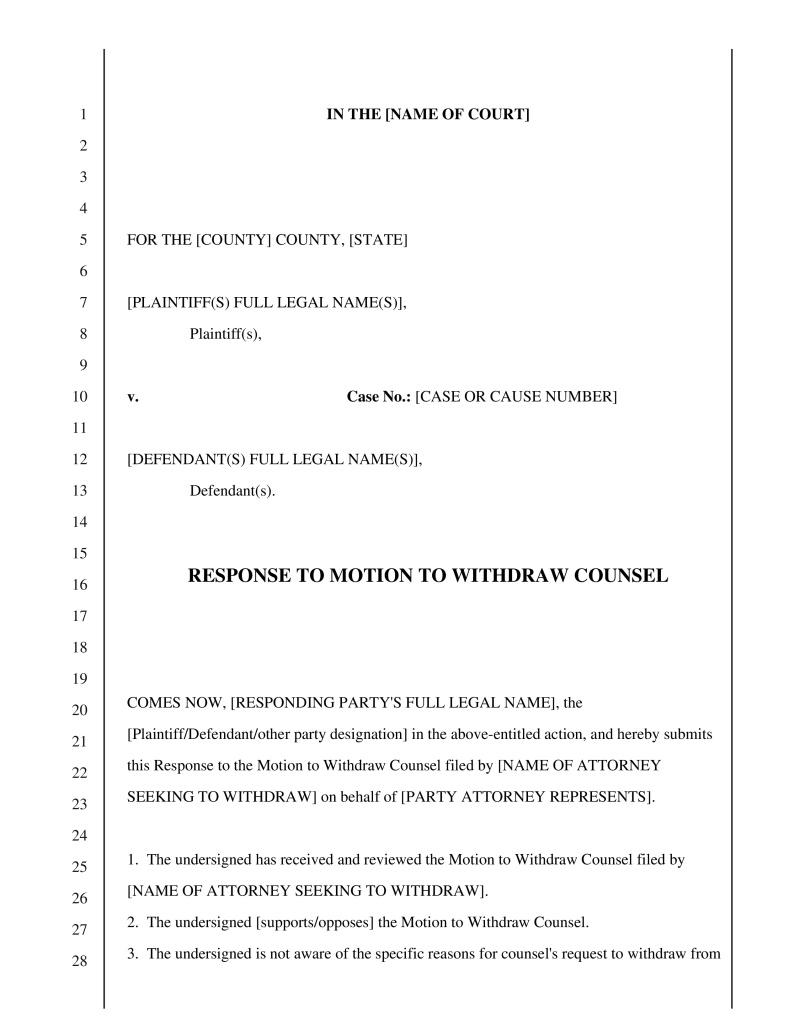
Responding Party Position
Select whether you agree with or object to the attorney's request to withdraw.
Describe any facts, concerns, or circumstances you want the judge to consider regarding the attorney's withdrawal.
Table of Contents
What is a Response to Motion to Withdraw Counsel?
A Response to Motion to Withdraw Counsel is a legal document filed in court by a party affected by an attorney's request to cease representation. This document typically comes from the client whose attorney seeks to withdraw, or from opposing counsel. Its purpose is to inform the court whether the responding party consents to, opposes, or has specific information regarding the attorney's motion, often addressing potential impacts on the case or compliance with procedural rules.
Reasons for Seeking Withdrawal of Counsel
Attorneys may seek to withdraw from a case for various reasons, which are typically outlined in their motion to withdraw. These reasons often relate to the attorney-client relationship, ethical obligations, or practical considerations that make continued representation impractical or impossible. The court evaluates these stated reasons when deciding whether to grant the withdrawal.
- Irreconcilable Differences - A breakdown in the attorney-client relationship that prevents effective representation, such as disagreements over litigation strategy or communication issues.
- Client Non-Cooperation - The client's failure to communicate, provide necessary information, or adhere to the terms of the retainer agreement, including non-payment of fees.
- Ethical Conflicts - Situations where continued representation would violate rules of professional conduct, such as conflicts of interest or obligations to present false evidence.
- Attorney Incapacity - The attorney's illness, disability, or other personal circumstances that prevent them from continuing to provide competent representation.
- Substitution of Counsel - The client has secured new legal representation, and the original attorney seeks to formally withdraw and be replaced.
Procedural Requirements for Attorney Withdrawal
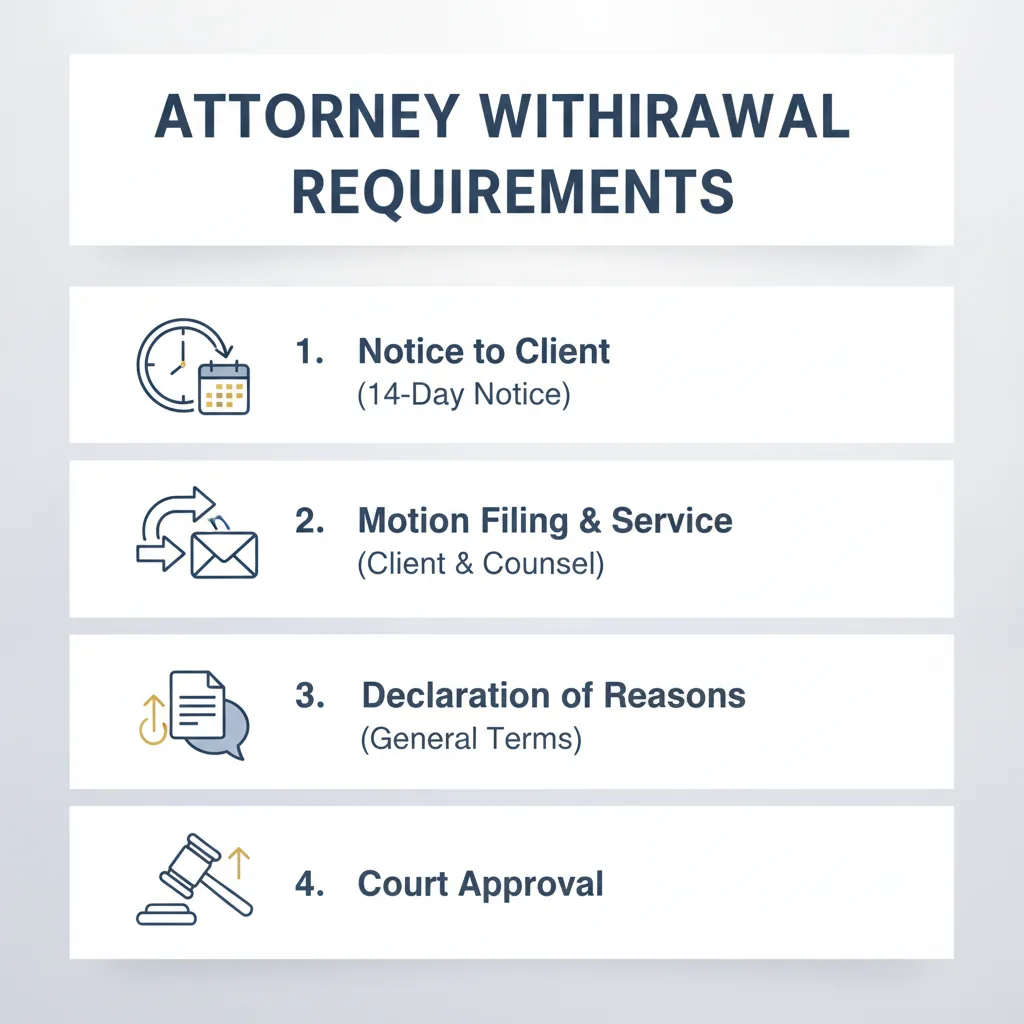
The process for an attorney to withdraw from a case is governed by specific court rules, which often vary between jurisdictions and case types. These rules ensure that the client's rights are protected and that the withdrawal does not unduly prejudice the case or cause unnecessary delay. A response to a motion to withdraw counsel often scrutinizes whether these procedural requirements have been met.
- Notice to Client - Attorneys are generally required to provide their client with advance notice of their intent to withdraw. For instance, in the Middle District of Florida, an attorney must notify each affected client fourteen days before moving to withdraw unless the client consents to withdrawal (Rule 2.02 - Appearance and Withdrawal of a Lawyer).
- Motion Filing and Service - The attorney must file a formal motion with the court. This motion must typically be served on the client and all other attorneys of record in the case. In California appellate cases, a motion to withdraw must be served on the party represented and the attorneys directly affected (Rule 8.814. Substituting parties; substituting or withdrawing attorneys).
- Declaration of Reasons - The motion is often accompanied by a declaration explaining, in general terms, the reasons for seeking withdrawal. In California civil cases, a motion to be relieved as counsel must be accompanied by a declaration stating, in general terms, why the motion is brought instead of filing a consent (Rule 3.1362. Motion to be relieved as counsel).
- Specific Forms - Some jurisdictions mandate the use of specific forms for motions to withdraw. In California civil cases, the motion must be made on the Notice of Motion and Motion to Be Relieved as Counsel-Civil (form MC-051) (Rule 3.1362. Motion to be relieved as counsel).
- Substitute Counsel Requirements - In some criminal cases, a motion to withdraw must be accompanied by a notice of appearance of substitute counsel. If no substitute counsel is provided, the motion must contain sufficient information for the court to make a ruling (LR Cr P 44.4 | Withdrawal and/or Termination of Representation).
- Withdrawal by Notice - In certain civil contexts, such as the Southern District of West Virginia, an attorney may withdraw by filing and serving a notice of withdrawal if multiple attorneys represent the party and at least one remains counsel of record. Withdrawal by notice and substitution is also permitted if it does not delay trial and is filed at least 90 days prior to trial (LR Civ P 83.4 | Withdrawal and/or Termination of Representation).
Factors Influencing the Court's Decision

When an attorney files a motion to withdraw, the court considers several factors before granting or denying the request. The primary concern is often to ensure the orderly administration of justice and to prevent prejudice to the client or other parties involved in the litigation. A well-crafted response to a motion to withdraw will address these factors directly.
- Prejudice to the Client - The court assesses whether the withdrawal would significantly harm the client's ability to pursue or defend their case, especially if it's close to a critical deadline or trial.
- Undue Delay of Proceedings - Courts are reluctant to grant withdrawals that would necessitate a continuance of trial or other scheduled proceedings, particularly if the case has been pending for an extended period.
- Availability of Substitute Counsel - The likelihood of the client finding new representation in a timely manner is a key consideration. The presence of substitute counsel often facilitates the approval of a withdrawal.
- Stage of Litigation - Withdrawals sought early in a case are generally viewed more favorably than those requested on the eve of trial or during complex discovery.
- Reasons for Withdrawal - The court evaluates the merits of the attorney's stated reasons, ensuring they are legitimate and not merely a tactic to avoid an unfavorable outcome.
- Impact on Other Parties - The court also considers whether the withdrawal would unfairly prejudice opposing parties, such as by delaying discovery or trial preparations.
Client's Role in Responding to a Motion to Withdraw
When a client receives a motion to withdraw counsel, they have a critical role in informing the court of their position. The client's response can significantly influence the court's decision, particularly regarding the potential for prejudice or delay. It is important for clients to understand their options and the implications of their response.
A client's response might include:
- Consent to Withdrawal - The client agrees with the attorney's request and has either secured new counsel or intends to represent themselves. This often simplifies the court's decision.
- Opposition to Withdrawal - The client believes the withdrawal is unjustified, would cause significant prejudice to their case, or that the attorney has not complied with procedural requirements. The client would then present arguments and evidence to support their position.
- Request for Conditions - The client might agree to the withdrawal but request specific conditions, such as a reasonable period to find new counsel or a requirement for the withdrawing attorney to provide specific documents.
- Providing Contact Information - If the court grants the motion, the withdrawing attorney is often required to provide the client's current contact information to the court and opposing party (Rule 8.814. Substituting parties; substituting or withdrawing attorneys). A client's response might confirm or update this information.
Frequently Asked Questions
Sources
- Rule 8.814. Substituting parties; substituting or withdrawing attorneys - Provides procedures for attorneys to withdraw from representation in California appellate cases.
- Rule 2.02 - Appearance and Withdrawal of a Lawyer - Outlines the requirements for attorneys to withdraw from cases in the Middle District of Florida.
- Rule 3.1362. Motion to be relieved as counsel - Details the procedure for attorneys to be relieved from their duties in California civil cases.
- LR Civ P 83.4 | Withdrawal and/or Termination of Representation - Specifies the conditions under which attorneys may withdraw from cases in the Southern District of West Virginia.
- LR Cr P 44.4 | Withdrawal and/or Termination of Representation - Addresses the withdrawal of attorneys in criminal cases within the Southern District of West Virginia.
Not the form you're looking for?
Try our legal document generator to create a custom document
Disclaimer: The templates available on this website are provided for general informational purposes only and do not constitute legal advice. They are not intended to be, and should not be interpreted as, compliant with any specific legal, regulatory, or privacy requirements. These templates are not a replacement for professional legal guidance and should not be relied upon for any particular matter or circumstance. Users are strongly encouraged to seek advice from a qualified attorney licensed in their jurisdiction before using, modifying, or relying on any template.
All templates are provided on an "as is," "with all faults," and "as available" basis. The provider disclaims any and all warranties of any kind, whether express, implied, statutory, or otherwise, including without limitation warranties of merchantability, fitness for a particular purpose, title, or non-infringement.
LegalTemplates.com makes no guarantees or representations regarding the accuracy, completeness, expected outcomes, or reliability of the materials contained in these templates or any materials referenced or linked from them.