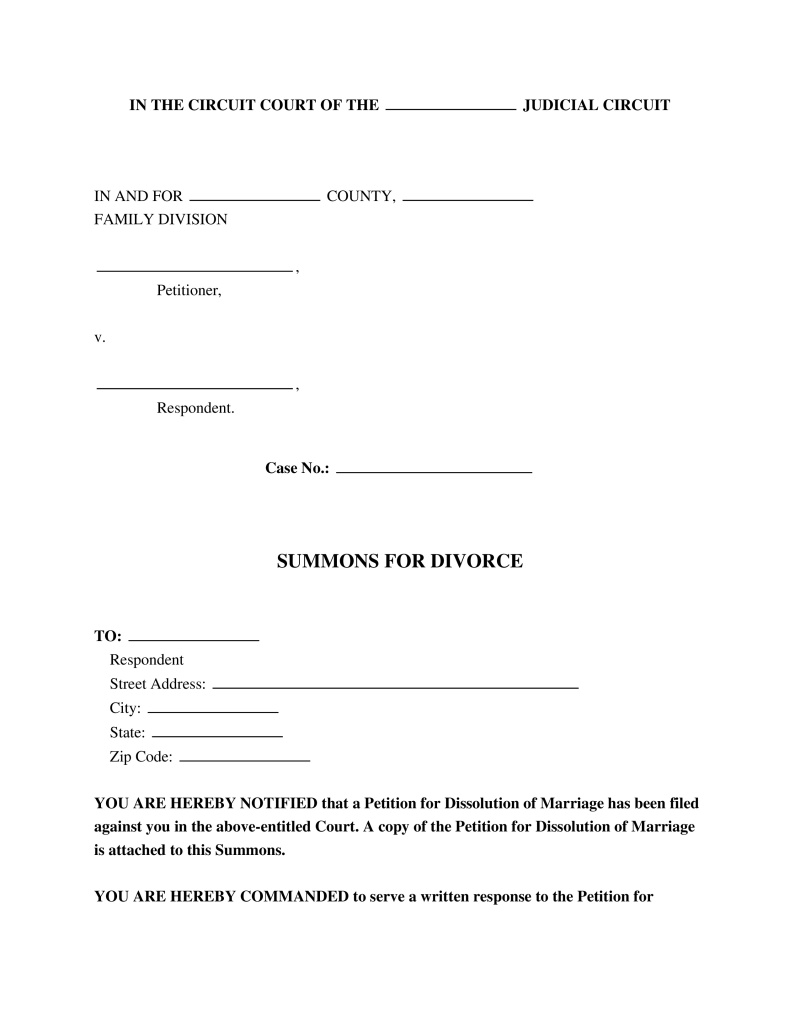
Divorce Summons
A Divorce Summons is a formal legal document issued by a court to notify a respondent that divorce proceedings have been initiated against them, detailing the asserted grounds and requiring a response or appearance.
Jurisdiction Type
Most divorces are filed in state courts. Select the appropriate jurisdiction for your case.
Table of Contents
What is a Divorce Summons?
A Divorce Summons is a formal legal document used to initiate a divorce proceeding by officially notifying one party that the other has filed for divorce. It serves as the primary instrument for alerting the respondent (the defendant) that a lawsuit, in this case, a divorce action, has been commenced against them. The Summons in a Civil Case (AO 440) is the official form used to notify a defendant of a lawsuit, including divorce actions, establishing the court's jurisdiction over the parties involved.
Purpose and Function of a Divorce Summons
The fundamental purpose of a Divorce Summons is to ensure due process by providing formal notice to the defendant. This notification informs the defendant of the legal action against them and the court where the case has been filed, giving them an opportunity to respond. Without proper issuance and service of a summons, a court generally cannot proceed with a divorce case, as it lacks personal jurisdiction over the defendant.
Beyond mere notification, the Divorce Summons serves several critical functions in the legal process:
- Establishes Jurisdiction - It formally brings the defendant under the jurisdiction of the court where the divorce petition was filed, allowing the court to make legally binding decisions regarding the marriage.
- Informs of Legal Obligation - It clearly states that the defendant is being sued and outlines the timeframe within which they must respond to the divorce petition.
- Warns of Consequences - The summons typically includes a warning that failure to respond within the stipulated period can result in a default judgment, meaning the court may grant the divorce and other relief requested by the plaintiff without the defendant's input.
- Identifies Parties and Court - It identifies the plaintiff (the spouse who filed for divorce), the defendant, the court handling the case, and the case number, providing essential identifiers for the legal action.
Key Elements of a Divorce Summons
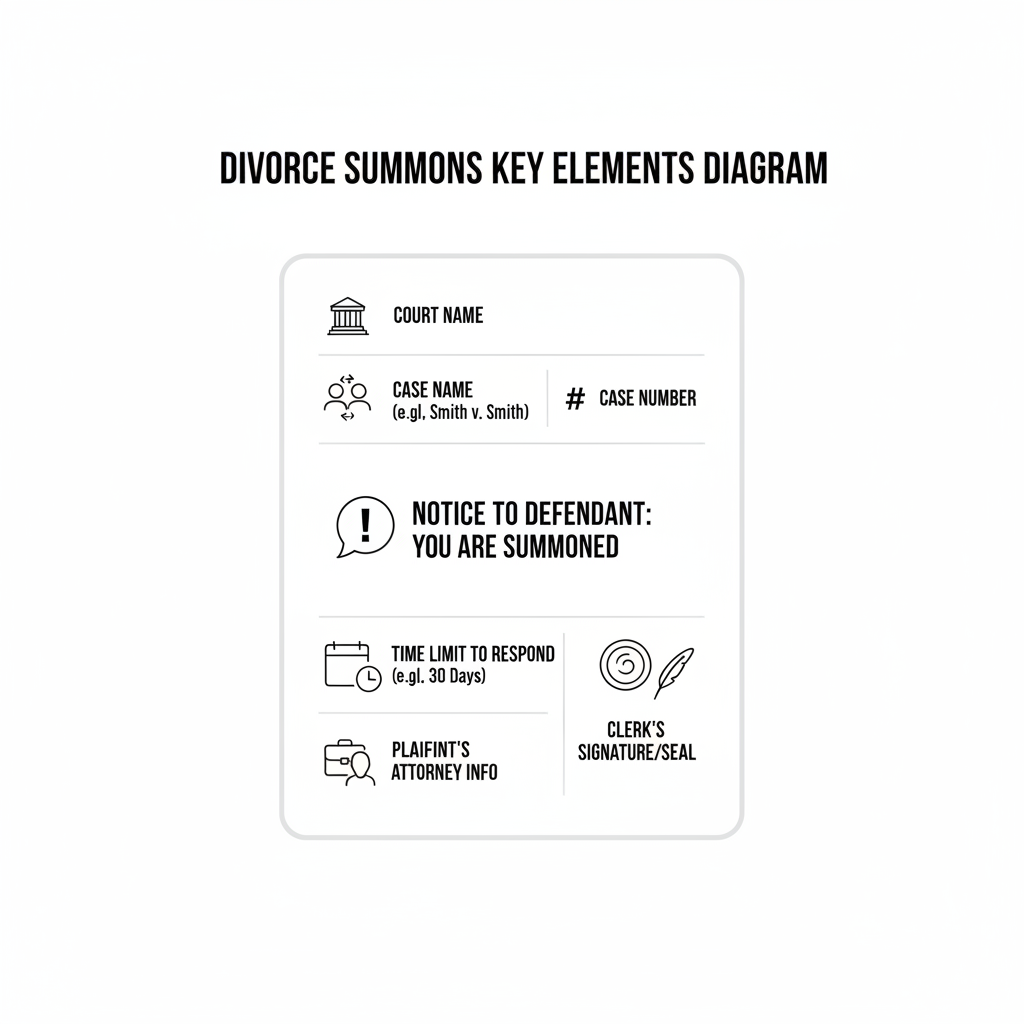
While specific content may vary slightly by jurisdiction, a Divorce Summons, like the Summons in a Civil Case (AO 440), generally contains several standard elements to ensure clear and legally sufficient notification:
- Court Information - The name of the court where the divorce action has been filed, along with the specific judicial district or county.
- Case Name and Number - The names of the parties involved (e.g., "Jane Doe v. John Doe") and the unique case number assigned by the court clerk upon filing.
- Parties' Identification - The full legal names and addresses of both the plaintiff (petitioner) and the defendant (respondent).
- Notice to Defendant - A clear statement that the defendant is being sued and must respond to the accompanying divorce petition or complaint.
- Time Limit to Respond - The precise number of days (e.g., 20, 30 days) the defendant has to file a formal response with the court, calculated from the date of service.
- Consequences of Non-Response - An explicit warning that if the defendant fails to respond within the stated timeframe, a default judgment may be entered against them.
- Plaintiff's Attorney Information - The name, address, and contact information of the plaintiff's attorney, or the plaintiff themselves if they are representing themselves (pro se).
- Clerk's Signature and Seal - The official signature of the court clerk and the court's seal, indicating the summons has been properly issued by the court.
- Date of Issuance - The date on which the summons was officially issued by the court.
Issuance and Service of a Divorce Summons

The process of delivering a Divorce Summons is governed by strict procedural rules to ensure the defendant receives proper notice. This process typically involves two main stages: issuance and service.
Issuance by the Court Clerk
Once a divorce petition or complaint is filed, the plaintiff or their attorney presents a prepared Divorce Summons to the court clerk. The clerk then reviews the summons for completeness, officially signs and seals it, and assigns a case number. This act of issuance formally validates the summons as an official court document, authorizing its delivery to the defendant. The Summons (AO 440) form is used to notify a defendant of a civil action, including divorce cases, after it has been issued by the court clerk.
Formal Service of Process
After issuance, the summons, along with a copy of the divorce petition, must be formally "served" on the defendant. Service of process ensures that the defendant is legally notified of the lawsuit. Common methods of service include:
- Personal Service - A sheriff, professional process server, or another authorized individual personally delivers the documents directly to the defendant. This is generally considered the most effective and preferred method.
- Substituted Service - If personal service is difficult, some jurisdictions allow service by leaving the documents with a competent adult at the defendant's usual place of abode or business.
- Service by Mail - In certain circumstances and jurisdictions, service can be accomplished by certified or registered mail, often requiring an acknowledgment of receipt from the defendant.
- Service by Publication - As a last resort, when the defendant's whereabouts are unknown, a court may permit service by publishing notice of the divorce action in a newspaper for a specified period. This method is typically used only when all other attempts at service have failed.
Regardless of the method used, proof of service must be filed with the court. This document, typically an affidavit from the person who performed the service, attests that the summons and petition were delivered to the defendant in accordance with legal requirements.
Responding to a Divorce Summons
Upon receiving a Divorce Summons, the defendant has a limited timeframe to take action. Ignoring a summons can lead to severe legal consequences, including the loss of the right to contest the divorce terms. The Summons in a Civil Action (AO 440) form notifies a defendant of a civil action, including divorce actions, and explicitly states the requirement to respond.
Key steps for a defendant receiving a Divorce Summons often include:
- Consult Legal Counsel - It is highly advisable for the defendant to seek immediate legal advice from a qualified attorney. An attorney can explain the defendant's rights, the implications of the divorce petition, and the appropriate legal responses.
- File a Formal Response - The defendant must file a formal response with the court within the timeframe specified on the summons. This response, often called an "Answer," addresses the allegations made in the divorce petition and may include counter-petitions or requests for specific relief.
- Attend Court Hearings - The defendant must comply with any court orders or notices to appear for hearings or mediation sessions throughout the divorce process.
Failure to file a timely response can result in a "default judgment." In a default judgment, the court may grant the plaintiff all the relief requested in the divorce petition, including issues related to property division, spousal support, and child custody, without the defendant having the opportunity to present their side of the case.
Frequently Asked Questions
Sources
- Summons in a Civil Case - Provides the official form for a civil summons, which is used to notify a defendant of a lawsuit, including divorce actions.
- Summons (AO 440) - Offers the official Summons (AO 440) form, which is used to notify a defendant of a civil action, including divorce cases.
- Summons in a Civil Action (AO 440) - Provides the Summons in a Civil Action (AO 440) form, which is used to notify a defendant of a civil action, including divorce actions.
Not the form you're looking for?
Try our legal document generator to create a custom document
Disclaimer: The templates available on this website are provided for general informational purposes only and do not constitute legal advice. They are not intended to be, and should not be interpreted as, compliant with any specific legal, regulatory, or privacy requirements. These templates are not a replacement for professional legal guidance and should not be relied upon for any particular matter or circumstance. Users are strongly encouraged to seek advice from a qualified attorney licensed in their jurisdiction before using, modifying, or relying on any template.
All templates are provided on an "as is," "with all faults," and "as available" basis. The provider disclaims any and all warranties of any kind, whether express, implied, statutory, or otherwise, including without limitation warranties of merchantability, fitness for a particular purpose, title, or non-infringement.
LegalTemplates.com makes no guarantees or representations regarding the accuracy, completeness, expected outcomes, or reliability of the materials contained in these templates or any materials referenced or linked from them.