Affidavit of Collection for Personal Property
An Affidavit of Collection for Personal Property is a sworn legal instrument affirming an affiant's entitlement to collect specific personal assets of a decedent without formal probate administration.
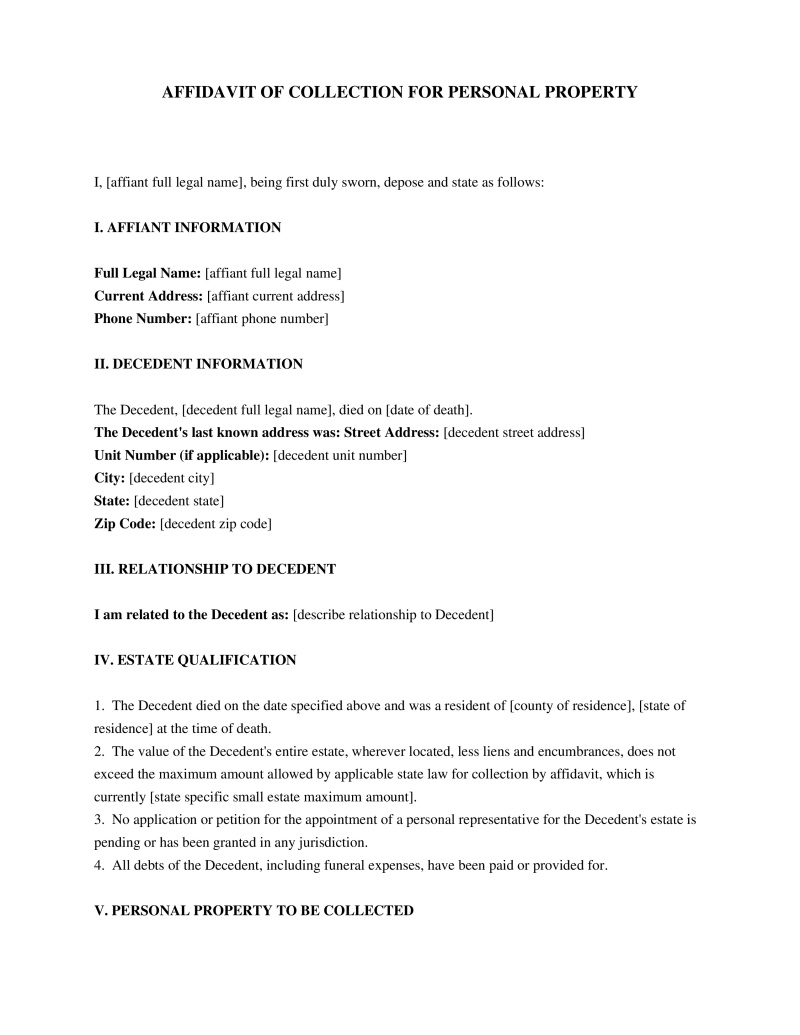
Decedent Full Name
Enter the Decedent's complete legal name as it appears on official records.
Provide the exact date of death as shown on the death certificate.
Enter the Decedent's last residence or domicile.
Table of Contents
What is an Affidavit of Collection for Personal Property?
An Affidavit of Collection for Personal Property is a legal document that allows a designated individual to collect a deceased person's personal assets without undergoing formal probate proceedings. This simplified procedure is typically available for smaller estates that meet specific state-mandated criteria, such as a maximum estate value and a waiting period after the decedent's death. It serves as a sworn statement asserting the claimant's right to receive the property, thereby streamlining the transfer of assets to rightful heirs or beneficiaries.
Purpose and Conditions for Use
The primary purpose of an Affidavit of Collection for Personal Property is to provide an expedited method for transferring a decedent's personal property, such as bank accounts, vehicles, or household goods, to their rightful successors. This process avoids the often lengthy and costly formal probate court proceedings, which are typically reserved for larger or more complex estates.
The use of this affidavit is generally subject to several critical conditions, which vary by state but commonly include:
- Waiting Period - A specified period, often 30 days, must have elapsed since the date of the decedent's death before the affidavit can be used (Arizona ARS 14-3971(B); Mass. General Laws c.190B § 3-1201; Sec. 524.3-1201 MN Statutes).
- Estate Value Limit - The total value of the personal property in the decedent's estate must not exceed a certain monetary threshold. For example, in Arizona, this limit is $50,000 for personal property (Arizona ARS 14-3971(B)).
- No Formal Probate - No petition for the appointment of a personal representative (executor) should have been filed or granted in court (Mass. General Laws c.190B § 3-1201).
- Certified Death Record - In some jurisdictions, presentation of a certified death record is required along with the affidavit (Sec. 524.3-1201 MN Statutes).
Information Typically Included
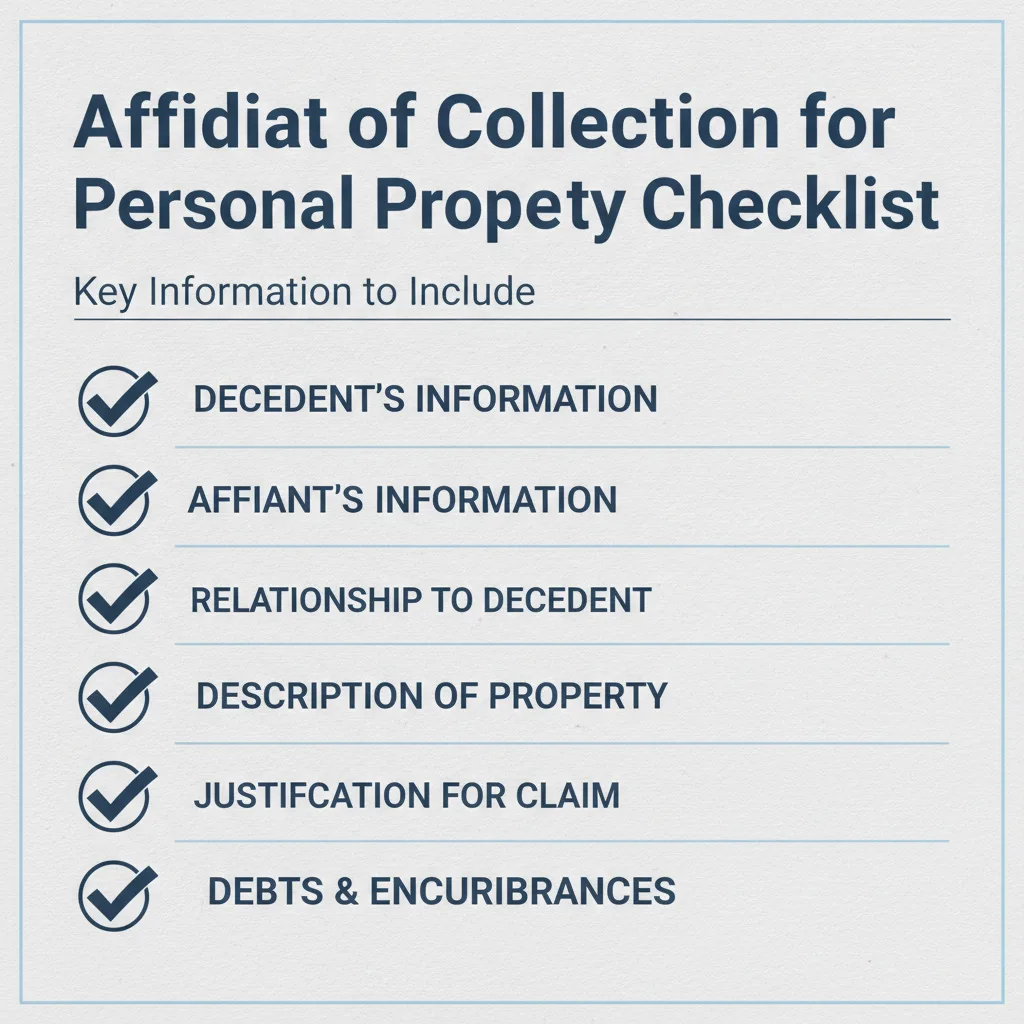
To be valid and effective, an Affidavit of Collection for Personal Property must contain specific information that identifies the decedent, the claimant, and the property in question. While exact requirements can differ by state, common elements include:
- Decedent's Details - The full legal name of the deceased, their date of death, and their last known address.
- Claimant's Information - The full legal name, address, and relationship of the person claiming the property to the decedent.
- Property Description - A clear and detailed description of all personal property being collected, including account numbers, vehicle identification numbers (VINs), or other identifying details.
- Statement of Eligibility - An affirmation that the claimant is legally entitled to receive the property as a successor, heir, or beneficiary.
- Compliance with Conditions - A sworn statement that all statutory conditions for using the affidavit have been met, such as the passage of the required waiting period and the estate's value falling within the permissible limits.
- No Probate Proceedings - A declaration that no formal probate or administration proceedings have been initiated or are pending for the decedent's estate.
- Acknowledgement of Liability - An understanding that the claimant may be personally liable to other rightful heirs or creditors if the property is improperly collected or distributed.
State-Specific Considerations
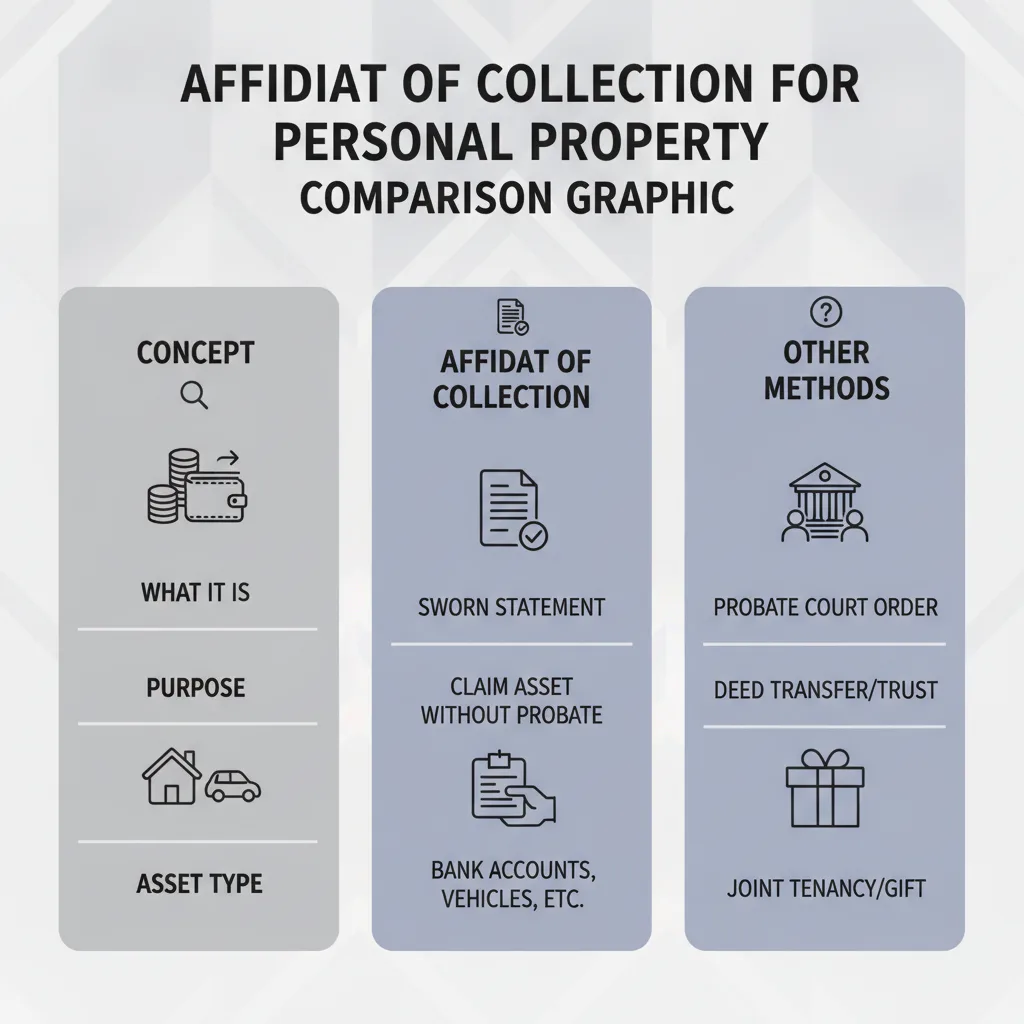
The rules governing the use of an Affidavit of Collection for Personal Property are established at the state level, leading to variations in requirements, procedures, and terminology. It is crucial for individuals to consult the specific laws of the relevant jurisdiction.
- Arizona - An affidavit for collection of personal property may be used if 30 days have elapsed since the decedent's death and the total value of personal property in the estate does not exceed $50,000 (Arizona ARS 14-3971(B)). Official forms are provided by the state to facilitate this process (azdor.gov).
- Massachusetts - Any interested person may file an affidavit with the court 30 days after the decedent's death, provided no petition for the appointment of a personal representative has been filed. The affidavit must contain specific information about the estate and the petitioner's relationship to the decedent (Mass. General Laws c.190B § 3-1201).
- Minnesota - After 30 days from the decedent's death, certain individuals can receive the decedent's property by presenting a certified death record and an affidavit. This affidavit must state specific conditions, such as that the claiming successor is entitled to the property (Sec. 524.3-1201 MN Statutes).
- North Dakota - An affidavit for collection of personal property allows the person entitled to receive the property of the deceased to present the affidavit to the holder of the personal property for transfer. Importantly, this affidavit does not require filing with a North Dakota state court (ndcourts.gov).
Process of Collection
The process of collecting personal property using an affidavit is generally straightforward, designed to be less burdensome than formal probate. While specific steps may vary by state, the typical procedure involves:
- Confirm Eligibility - Verify that the decedent's estate meets all state-specific criteria, including the waiting period since death and the maximum estate value.
- Gather Information - Collect all necessary details about the decedent, the claiming successor, and the specific personal property to be collected. This includes obtaining a certified copy of the death certificate.
- Complete the Affidavit - Fill out the appropriate Affidavit of Collection for Personal Property form, ensuring all required information is accurate and complete.
- Sign and Notarize - Sign the affidavit in the presence of a notary public, who will then notarize the document. Some states may also require witnesses.
- Present the Affidavit - Deliver the completed and notarized affidavit, along with the certified death certificate, to the individual or entity holding the property (e.g., bank, motor vehicle department, stock transfer agent).
- Receive Property - Once the holder verifies the affidavit's validity and compliance with legal requirements, they will release the personal property to the claimant.
Frequently Asked Questions
Sources
- Affidavit for Collection of Personal Property of the Decedent - Provides instructions and requirements for using an affidavit to collect a decedent's personal property in North Dakota.
- Affidavit for Collection of Personal Property ARS 14-3971(B) - Details the procedure for collecting a decedent's personal property in Arizona using an affidavit, including requirements and limitations.
- Mass. General Laws c.190B § 3-1201 - Outlines the process for collecting a decedent's personal property in Massachusetts using an affidavit, including necessary conditions and procedures.
- Sec. 524.3-1201 MN Statutes - Describes the procedure for collecting a decedent's personal property in Minnesota using an affidavit, including requirements and limitations.
- Affidavit for Collection of Personal Property - Provides the official form for collecting a decedent's personal property in Arizona, including instructions and requirements.
Not the form you're looking for?
Try our legal document generator to create a custom document
Disclaimer: The templates available on this website are provided for general informational purposes only and do not constitute legal advice. They are not intended to be, and should not be interpreted as, compliant with any specific legal, regulatory, or privacy requirements. These templates are not a replacement for professional legal guidance and should not be relied upon for any particular matter or circumstance. Users are strongly encouraged to seek advice from a qualified attorney licensed in their jurisdiction before using, modifying, or relying on any template.
All templates are provided on an "as is," "with all faults," and "as available" basis. The provider disclaims any and all warranties of any kind, whether express, implied, statutory, or otherwise, including without limitation warranties of merchantability, fitness for a particular purpose, title, or non-infringement.
LegalTemplates.com makes no guarantees or representations regarding the accuracy, completeness, expected outcomes, or reliability of the materials contained in these templates or any materials referenced or linked from them.