Proposed Order
A Proposed Order is a draft legal document submitted to a court by a party, outlining the specific relief or action requested from the court for judicial consideration.
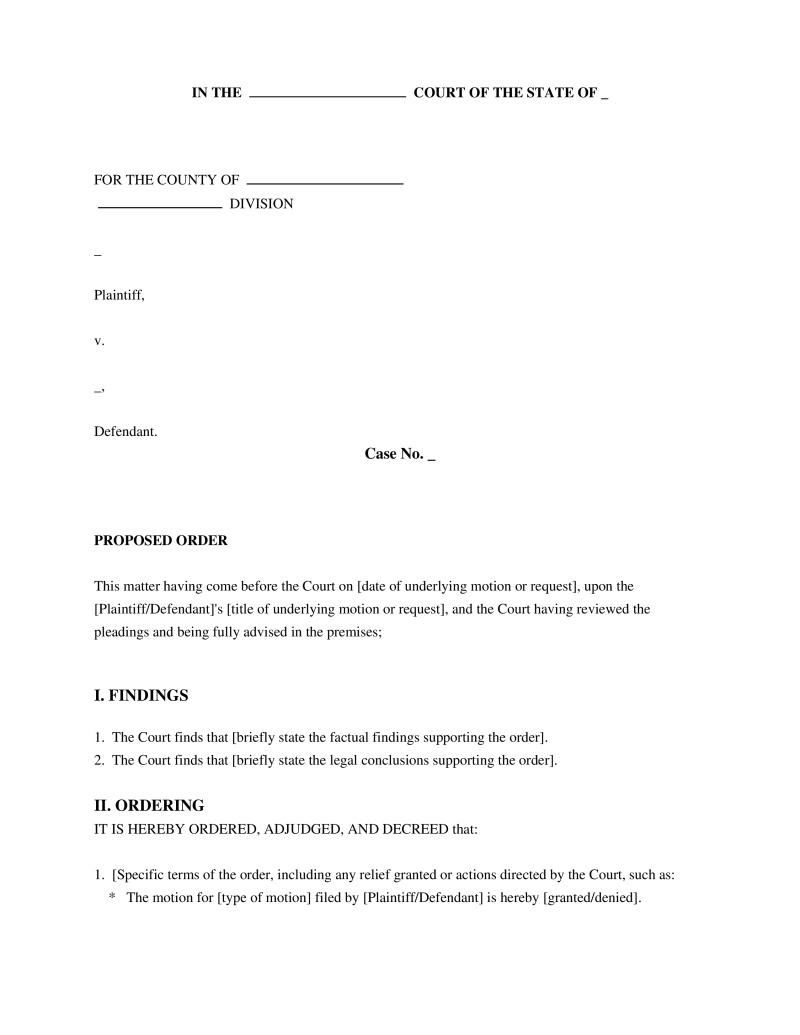
Order Basis
Select the event or filing that the judge is being asked to rule on. This helps shape the order's introductory findings and procedural references.
Use the wording commonly used by your court if known.
Table of Contents
What is a Proposed Order?
A proposed order is a draft document submitted to a court by one or more parties involved in a legal case. It outlines a court's requested decision or directive, typically following a hearing, motion, or agreement between the parties. The purpose of a proposed order is to present the court with a formal document ready for judicial review and signature, thereby formalizing the court's ruling or instruction. Courts rely on proposed orders to streamline the process of issuing judgments and directives in various legal proceedings.
Purpose and Significance
Proposed orders serve as a crucial mechanism in judicial administration, allowing parties to articulate the precise relief or directive sought from the court. They translate the outcome of legal arguments, negotiations, or judicial rulings into a formal, enforceable document. By submitting a proposed order, parties assist the court in accurately reflecting its decisions, ensuring clarity and precision in the court's directives.
The submission of a proposed order demonstrates a party's understanding of the court's decision or the requested action, providing a structured format for the court's final endorsement. This practice helps to reduce potential ambiguities in legal outcomes and ensures that the court's intent is accurately captured in the official record. The court then reviews the proposed order to ensure it aligns with its ruling and applicable legal standards before signing it.
Standard Elements of a Proposed Order
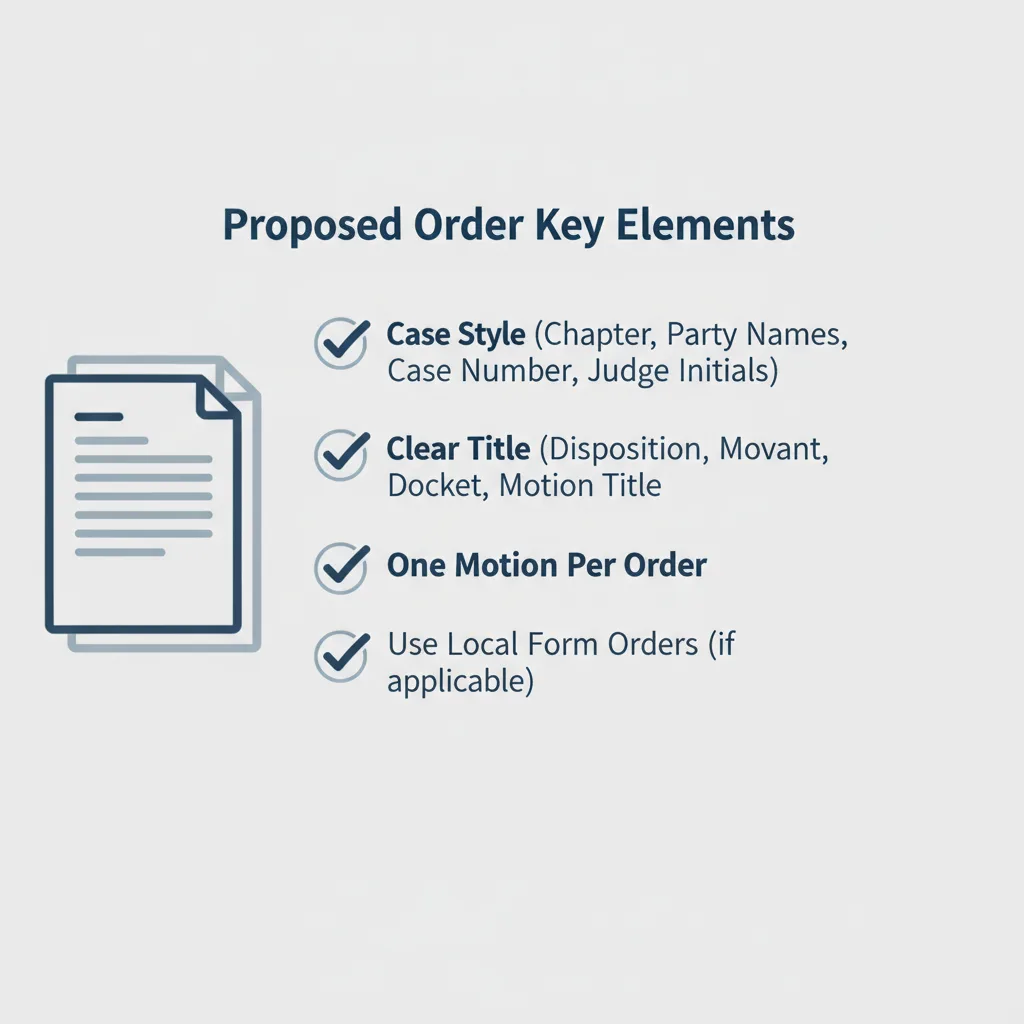
While specific requirements can vary between jurisdictions, proposed orders generally adhere to a common structure and include essential identifying information to ensure clarity and proper filing. These elements are critical for the court to accurately process and sign the order.
Key information commonly found in a proposed order includes:
- Case Style - Must include the chapter, complete names of the debtor or plaintiff and defendant, and the full case number, along with the assigned judge’s initials.
- Title of the Order - Should clearly state the disposition of the motion, the name of the movant, the docket number, and the title of the related motion.
- Single Motion Per Order - Typically, only one motion should be addressed per proposed order, ensuring each judicial directive is distinct.
- Specific Local Forms - For certain motions, applications, or objections, parties are often required to use specific local form orders as mandated by administrative directives (Proposed Order Guidelines - flnb.uscourts.gov).
Submission Requirements and Timelines
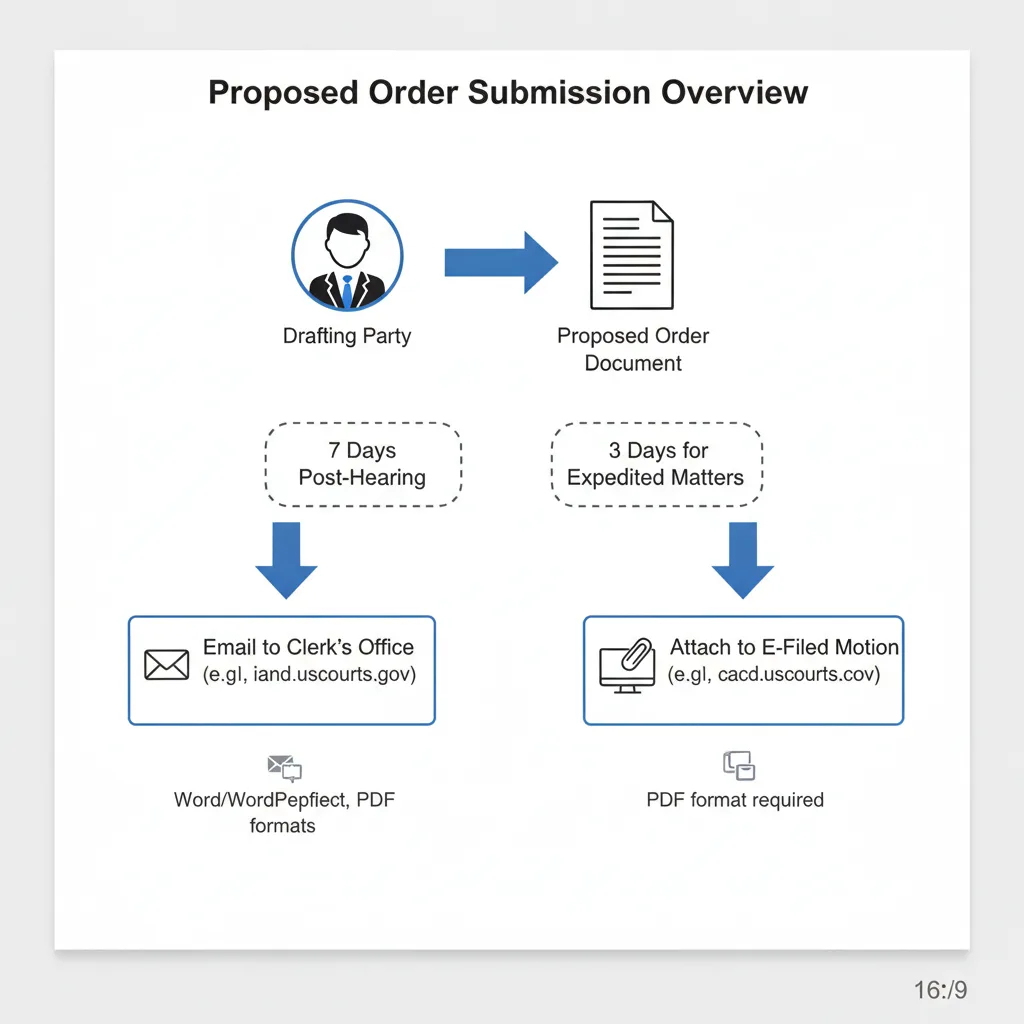
The process and deadlines for submitting proposed orders are strictly governed by local court rules, which vary significantly by jurisdiction. Adherence to these rules is essential for the timely processing of judicial decisions.
General submission requirements and timelines include:
- Submission Deadline - Proposed orders must typically be submitted no later than seven days after a hearing. If the order sets a deadline or further hearing on less than 14 days’ notice, the submission period may be shortened to three days (When a Judgment or Order Becomes Effective – Proposed Orders and Judgments - flsb.uscourts.gov).
- Electronic Submission - Many courts require proposed orders to be submitted electronically, often via email to a specific Clerk's Office address (Proposed Order Instructions - iand.uscourts.gov) or through the court's e-filing system.
- File Format - Courts commonly specify the required file format, such as Word or WordPerfect for editable versions, and PDF for attachments to main electronic filings (Submitting a Proposed Order - sdb.uscourts.gov; Proposed Documents - cacd.uscourts.gov).
- Accompanying Motions - Proposed orders may be electronically attached to the motion requesting entry of the order. In some instances, they must be submitted concurrently with specific filings, such as motions for relief from stay, motions to compel abandonment, or fee applications (Submitting a Proposed Order - sdb.uscourts.gov).
- Emailing to Chambers - In addition to lodging a PDF version, parties may be required to email a word-processing version of the proposed order directly to chambers (Proposed Documents - cacd.uscourts.gov).
Jurisdictional Differences in Practice
The specific procedural requirements for preparing and submitting proposed orders are not uniform across all courts and jurisdictions. Local rules and guidelines often dictate the precise format, content, and method of submission, necessitating careful attention to the court in which a case is pending.
Examples of jurisdictional variations include:
- Northern District of Florida - Emphasizes the use of specific local form orders for particular motions and mandates detailed case style requirements including chapter, full party names, case number, and judge’s initials (Proposed Order Guidelines - flnb.uscourts.gov).
- Southern District of Florida - Sets clear deadlines for submission, requiring proposed orders within seven days of a hearing, or three days if the order establishes a short-notice deadline or hearing (When a Judgment or Order Becomes Effective – Proposed Orders and Judgments - flsb.uscourts.gov).
- Northern District of Iowa - Directs parties to email proposed documents, including orders, judgments, and stipulations, to a specific Clerk's Office email address, often permitting attachment to the related motion (Proposed Order Instructions - iand.uscourts.gov).
- District of South Dakota - Requires proposed orders to be submitted in Word or WordPerfect format to a dedicated email address and specifies that they should be filed concurrently with certain types of motions, such as relief from stay or fee applications (Submitting a Proposed Order - sdb.uscourts.gov).
- Central District of California - Instructs parties to lodge proposed orders in PDF format as an attachment to the electronically filed main document and also to email a word-processing version directly to chambers (Proposed Documents - cacd.uscourts.gov).
Consequences of Non-Compliance
Failing to adhere to the court's rules regarding proposed orders can have significant adverse effects on a party's case. Courts often impose penalties or deny the requested relief when submission guidelines are not followed.
Key consequences of non-compliance include:
- Denial of Relief - Untimely submission of a proposed order may result in the denial of the relief requested in the underlying motion due to a lack of prosecution (When a Judgment or Order Becomes Effective – Proposed Orders and Judgments - flsb.uscourts.gov).
- Delay in Proceedings - Non-conforming submissions can lead to delays as the court may require resubmission or clarification, prolonging the resolution of the matter.
- Judicial Scrutiny - Repeated failures to follow local rules can reflect poorly on a party or their counsel, potentially affecting judicial disposition in future interactions.
Frequently Asked Questions
Sources
- Proposed Order Guidelines - Provides detailed guidelines for preparing and submitting proposed orders in the Northern District of Florida.
- When a Judgment or Order Becomes Effective – Proposed Orders and Judgments - Outlines the procedures for submitting proposed orders and judgments in the Southern District of Florida.
- Proposed Order Instructions - Provides instructions for submitting proposed orders in the Northern District of Iowa.
- Submitting a Proposed Order - Details the submission process for proposed orders in the District of South Dakota.
- Proposed Documents - Guidelines for submitting proposed documents in the Central District of California.
Not the form you're looking for?
Try our legal document generator to create a custom document
Disclaimer: The templates available on this website are provided for general informational purposes only and do not constitute legal advice. They are not intended to be, and should not be interpreted as, compliant with any specific legal, regulatory, or privacy requirements. These templates are not a replacement for professional legal guidance and should not be relied upon for any particular matter or circumstance. Users are strongly encouraged to seek advice from a qualified attorney licensed in their jurisdiction before using, modifying, or relying on any template.
All templates are provided on an "as is," "with all faults," and "as available" basis. The provider disclaims any and all warranties of any kind, whether express, implied, statutory, or otherwise, including without limitation warranties of merchantability, fitness for a particular purpose, title, or non-infringement.
LegalTemplates.com makes no guarantees or representations regarding the accuracy, completeness, expected outcomes, or reliability of the materials contained in these templates or any materials referenced or linked from them.