Transfer on Death Deed
A Transfer on Death Deed allows property owners to designate beneficiaries, enabling direct transfer of real estate upon their death.
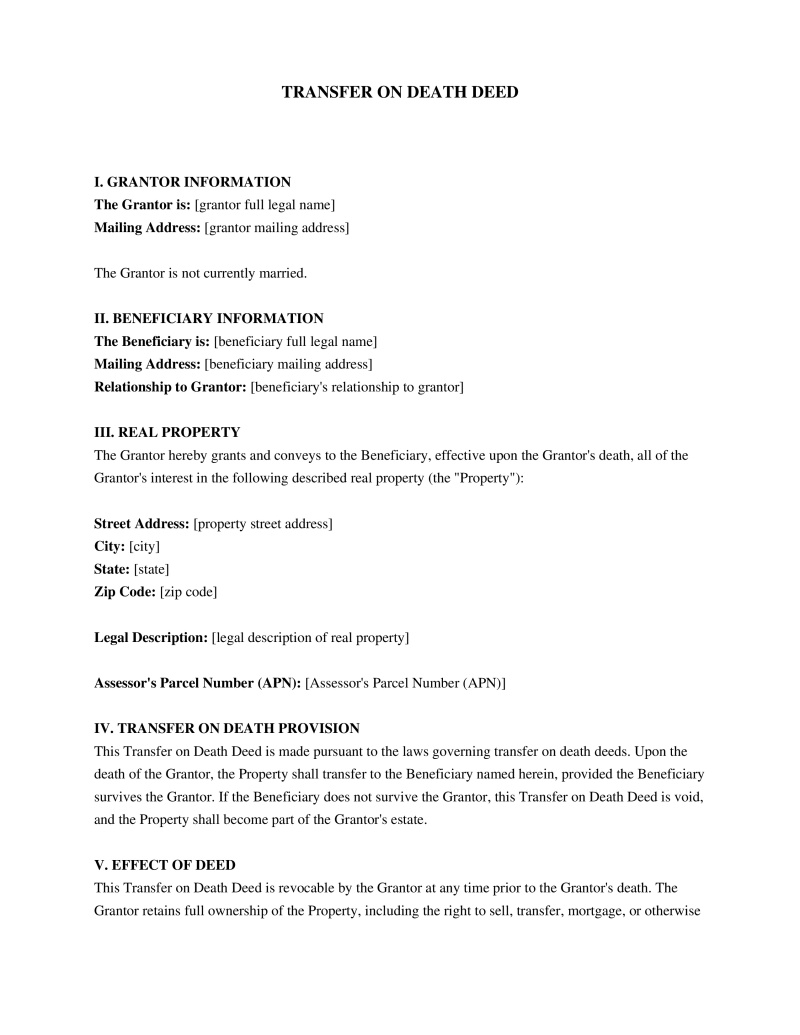
Property Type
Select the type of property being transferred by choosing one of the options provided: Single Family Home, Condominium, Townhouse, Multi-Family (2-4 units), Vacant Land, or Other. This information is important as it helps determine the legal requirements and processes for the transfer. Make sure your choice accurately reflects the property type to avoid any complications during the transaction.
Provide details if you selected 'Other'.
Table of Contents
What is a Transfer on Death (Beneficiary) Deed?
A Transfer on Death (TOD) Deed, also known as a Beneficiary Deed in some jurisdictions, is a legal instrument that allows a property owner to designate a beneficiary who will receive the property directly upon the owner's death. This mechanism facilitates the transfer of real estate outside of the probate process, streamlining the estate settlement for heirs. It is a non-testamentary transfer, meaning it operates independently of a will, providing a direct and often quicker method for property inheritance.
Key Characteristics of Transfer on Death Deeds
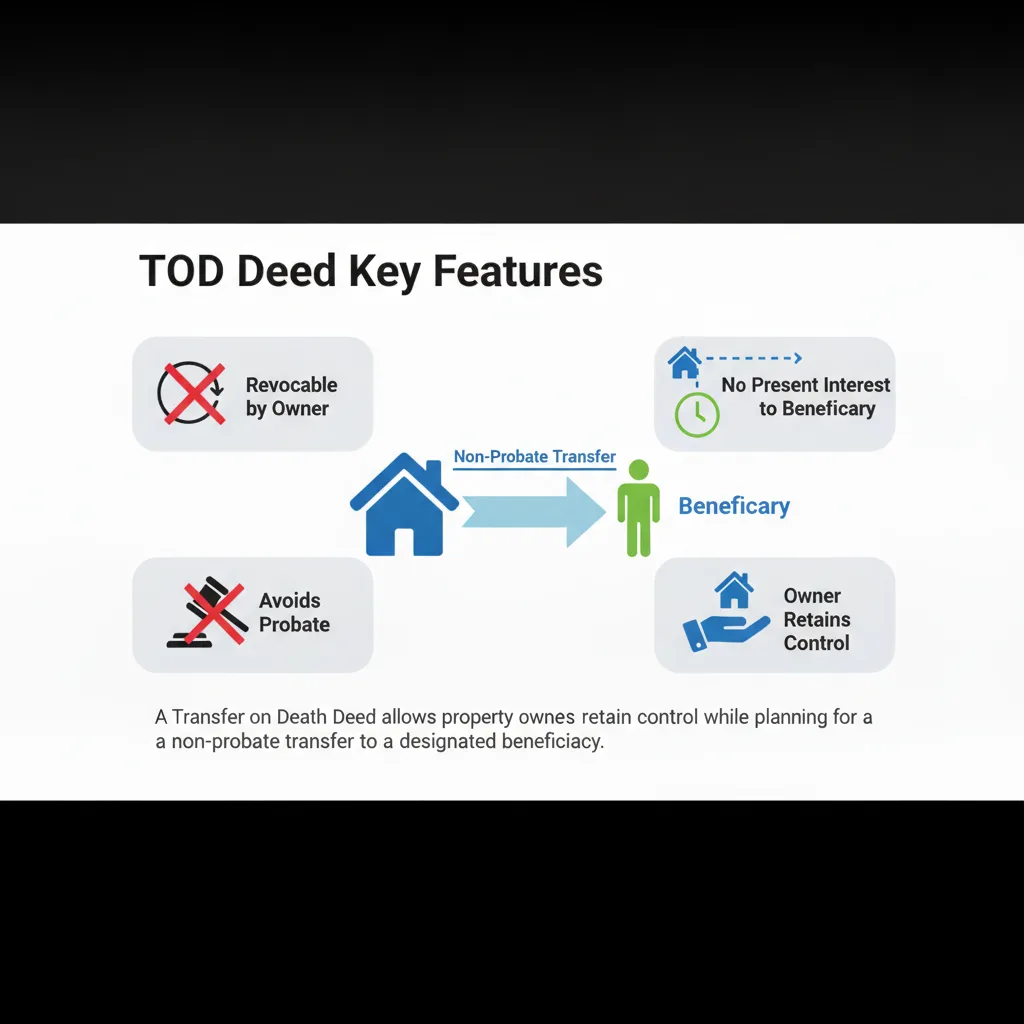
Transfer on Death Deeds possess several defining characteristics that distinguish them from other property transfer methods. These deeds are designed to provide flexibility to property owners while ensuring a clear path for property transfer upon their demise.
- Revocability - The deed remains fully revocable by the transferor at any time before their death, allowing them to change beneficiaries or cancel the deed without the beneficiary's consent (Alaska Court System; D.C. Code § 19–604.16).
- Non-Probate Transfer - Property transferred via a Transfer on Death Deed bypasses the probate court process, which can save time and legal expenses for the beneficiary.
- No Present Interest Transferred - The beneficiary does not acquire any ownership interest in the property until the transferor's death. The transferor retains full ownership and control, including the right to sell, mortgage, or otherwise dispose of the property, during their lifetime.
- Contingent Interest - The beneficiary's interest in the property is contingent upon their survival of the transferor. If a designated beneficiary does not survive the transferor, their interest typically lapses, and the property either passes to an alternative beneficiary named in the deed or reverts to the transferor's estate (Maine Title 18-C, §6-413; RCW 64.80.100).
Requirements for Validity and Recording
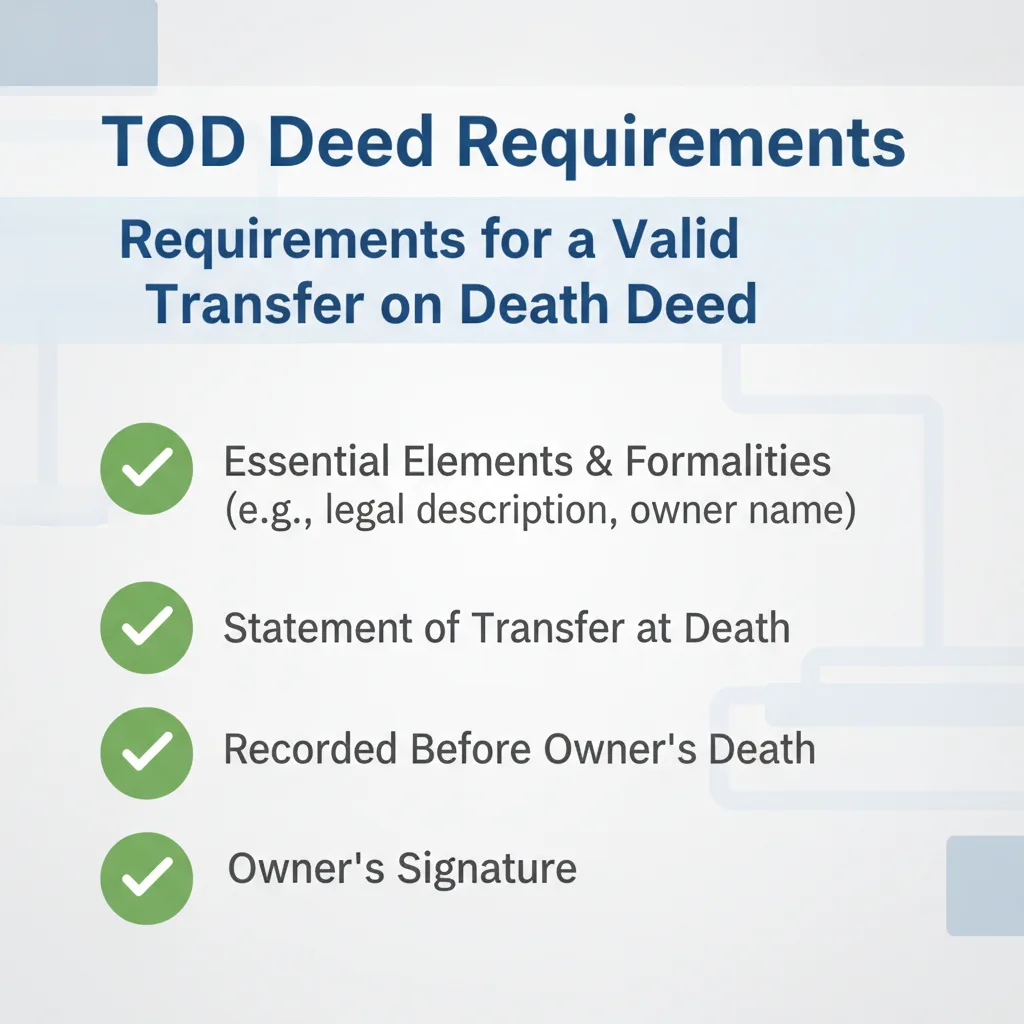
For a Transfer on Death Deed to be legally effective, it must meet specific formal and procedural requirements, primarily centered around its content and proper recording. These requirements ensure the deed clearly expresses the transferor's intent and is publicly accessible.
- Essential Elements and Formalities - The deed must contain the essential elements and formalities of a properly recordable inter vivos deed, which typically includes a legal description of the property, the transferor's name, and a clear designation of the beneficiary (West Virginia Code §36-12-9).
- Statement of Transfer at Death - The deed must explicitly state that the transfer to the designated beneficiary is to occur at the transferor's death (West Virginia Code §36-12-9).
- Recording Before Death - To be effective, the Transfer on Death Deed must be recorded in the public records of the county where the property is located before the transferor's death (Alaska Court System; D.C. Code § 19–604.16). Failure to record the deed prior to death renders it invalid.
- Transferor's Signature - The deed must be signed by the property owner(s) making the transfer, usually in the presence of witnesses and a notary public, similar to other real estate conveyances.
Revocation and Effect at Transferor's Death
The revocable nature of a Transfer on Death Deed provides property owners with significant flexibility. Understanding how a deed can be revoked and its precise effect upon the transferor's death is crucial for both transferors and beneficiaries.
A Transfer on Death Deed can be revoked through various methods before the transferor's death, reflecting the owner's continued control over their property. Common methods of revocation include:
- Recording a Revocation Instrument - The most direct way to revoke a Transfer on Death Deed is by executing and recording an instrument of revocation in the same public records office where the original deed was recorded (Alaska Court System; D.C. Code § 19–604.16).
- Recording a Subsequent Transfer on Death Deed - Recording a new Transfer on Death Deed that disposes of the same property to a different beneficiary implicitly revokes any previously recorded Transfer on Death Deed for that property.
- Transferring the Property to Another Party - If the transferor conveys the property to another individual or entity via a traditional deed before their death, the Transfer on Death Deed is automatically revoked with respect to that property.
Upon the transferor's death, if the Transfer on Death Deed has not been revoked, the property interest is transferred directly to the designated beneficiary. This transfer occurs automatically by operation of law, without the need for probate court involvement. The beneficiary receives the property subject to any liens, encumbrances, or claims that existed at the time of the transferor's death (Maine Title 18-C, §6-413; RCW 64.80.100).
Comparison with Other Estate Planning Tools
While Transfer on Death Deeds offer a straightforward way to transfer real estate outside of probate, they differ from other common estate planning instruments like wills and living trusts in several key aspects. These distinctions often influence a property owner's choice of planning method.
- Wills - A will directs the distribution of assets through the probate process, which can be time-consuming and public. A Transfer on Death Deed, by contrast, facilitates a direct, non-probate transfer of specific real estate, often resulting in quicker distribution to the beneficiary. While a will can specify who inherits property, the TOD deed provides a direct mechanism for real estate that avoids the probate court entirely for that asset.
- Living Trusts - A living trust also allows for non-probate transfer of assets, including real estate. However, establishing and maintaining a living trust typically involves more complexity and expense than preparing a Transfer on Death Deed. A living trust can manage a broader range of assets and provide for more intricate distribution schemes, whereas a TOD deed is generally limited to the transfer of real property.
Frequently Asked Questions
Sources
- Title 18-C, §6-413: Effect of transfer on death deed at transferor's death - Defines the effect of transfer on death deeds in Maine, including transfer conditions and beneficiary rights.
- § 19–604.16. Optional form of transfer on death deed - Provides an optional form for creating a transfer on death deed in the District of Columbia, including requirements for recording and revocation.
- RCW 64.80.100: Effect at transferor's death - Details the effect of transfer on death deeds in Washington State, including transfer conditions and beneficiary rights.
- West Virginia Code | §36-12-9 - Outlines the requirements for a transfer on death deed in West Virginia, including necessary elements and recording procedures.
- Transfer on Death Deed - Alaska Court System - Provides information on transfer on death deeds in Alaska, including frequently asked questions and requirements for recording.
Not the form you're looking for?
Try our legal document generator to create a custom document
Disclaimer: The templates available on this website are provided for general informational purposes only and do not constitute legal advice. They are not intended to be, and should not be interpreted as, compliant with any specific legal, regulatory, or privacy requirements. These templates are not a replacement for professional legal guidance and should not be relied upon for any particular matter or circumstance. Users are strongly encouraged to seek advice from a qualified attorney licensed in their jurisdiction before using, modifying, or relying on any template.
All templates are provided on an "as is," "with all faults," and "as available" basis. The provider disclaims any and all warranties of any kind, whether express, implied, statutory, or otherwise, including without limitation warranties of merchantability, fitness for a particular purpose, title, or non-infringement.
LegalTemplates.com makes no guarantees or representations regarding the accuracy, completeness, expected outcomes, or reliability of the materials contained in these templates or any materials referenced or linked from them.