Special Warranty Deed
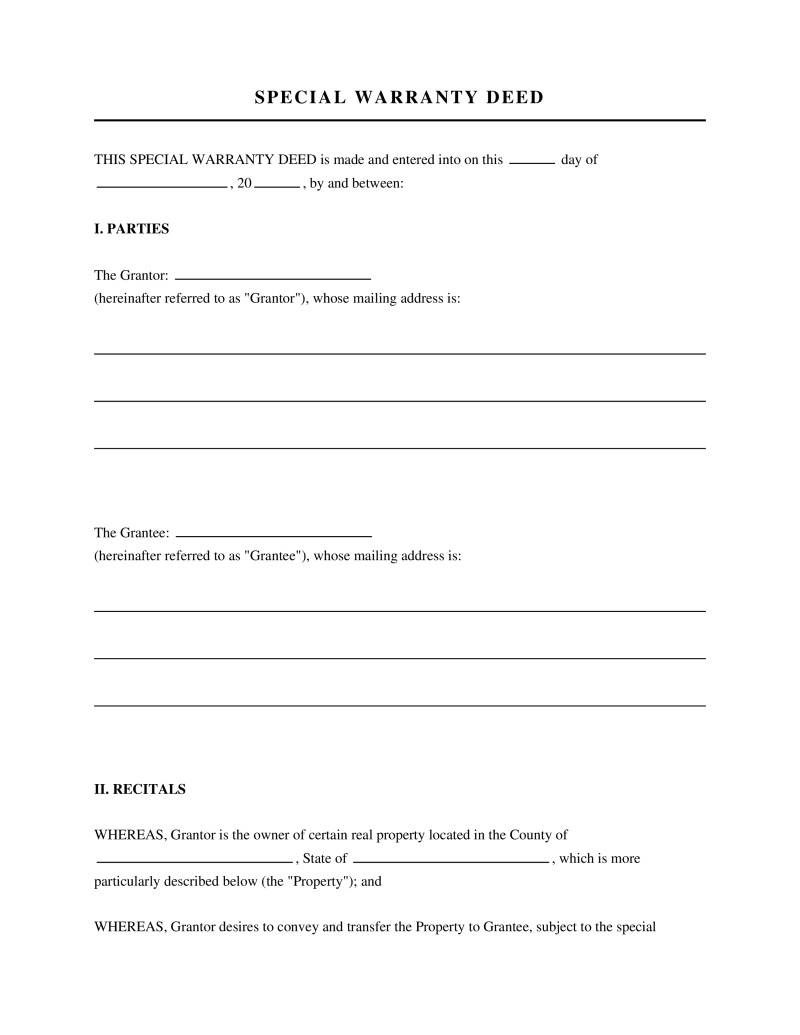
A Special Warranty Deed conveys property with limited warranties, protecting the buyer only against claims during the seller's ownership period.
Property Type
Select the property type to tailor deed language and requirements.
Provide a brief description of the property if 'Other' was selected.
Table of Contents
What is a Special Warranty Deed?
A Special Warranty Deed is a legal instrument used in real estate transactions to transfer property ownership from a grantor to a grantee. This type of deed provides a limited warranty of title, meaning the grantor guarantees the property is free from defects or encumbrances only for the period during which they owned the property. It does not offer assurances against title issues that may have existed before the grantor acquired the property. This deed is commonly employed in commercial real estate sales, foreclosures, and transactions involving fiduciaries.
Understanding the Limited Warranty
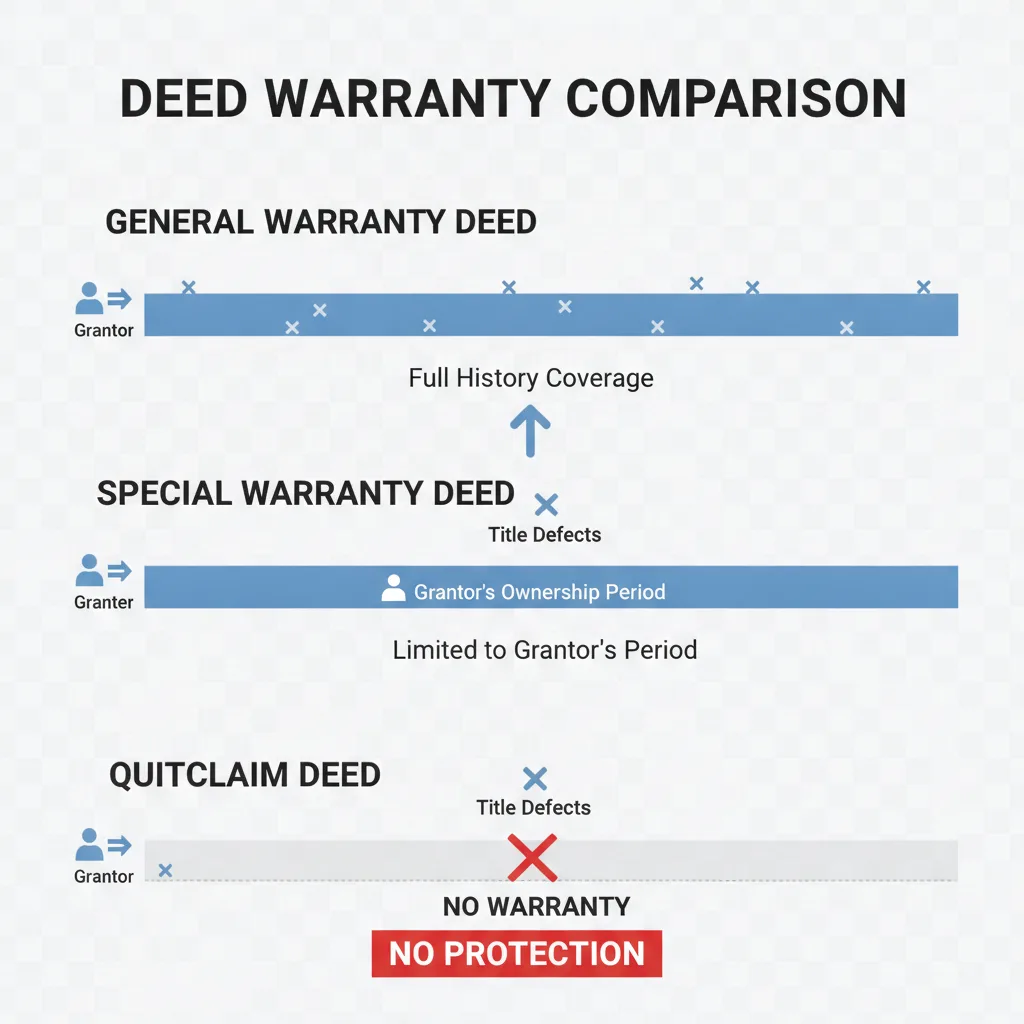
The defining characteristic of a Special Warranty Deed is its limited scope of warranty. Unlike a General Warranty Deed, which guarantees a clear title against all claims for the property's entire history, a Special Warranty Deed confines the grantor's liability. The grantor assures the grantee that they have not personally done anything to encumber the title during their ownership. However, they make no promises regarding the actions of previous owners.
This limitation means the grantee assumes the risk for any title defects or claims that arose prior to the grantor's ownership. For this reason, buyers receiving a Special Warranty Deed typically conduct thorough title searches and often purchase title insurance. The insurance protects against undisclosed defects that fall outside the grantor's limited warranty, providing a crucial layer of financial security for the grantee.
Key Covenants in a Special Warranty Deed
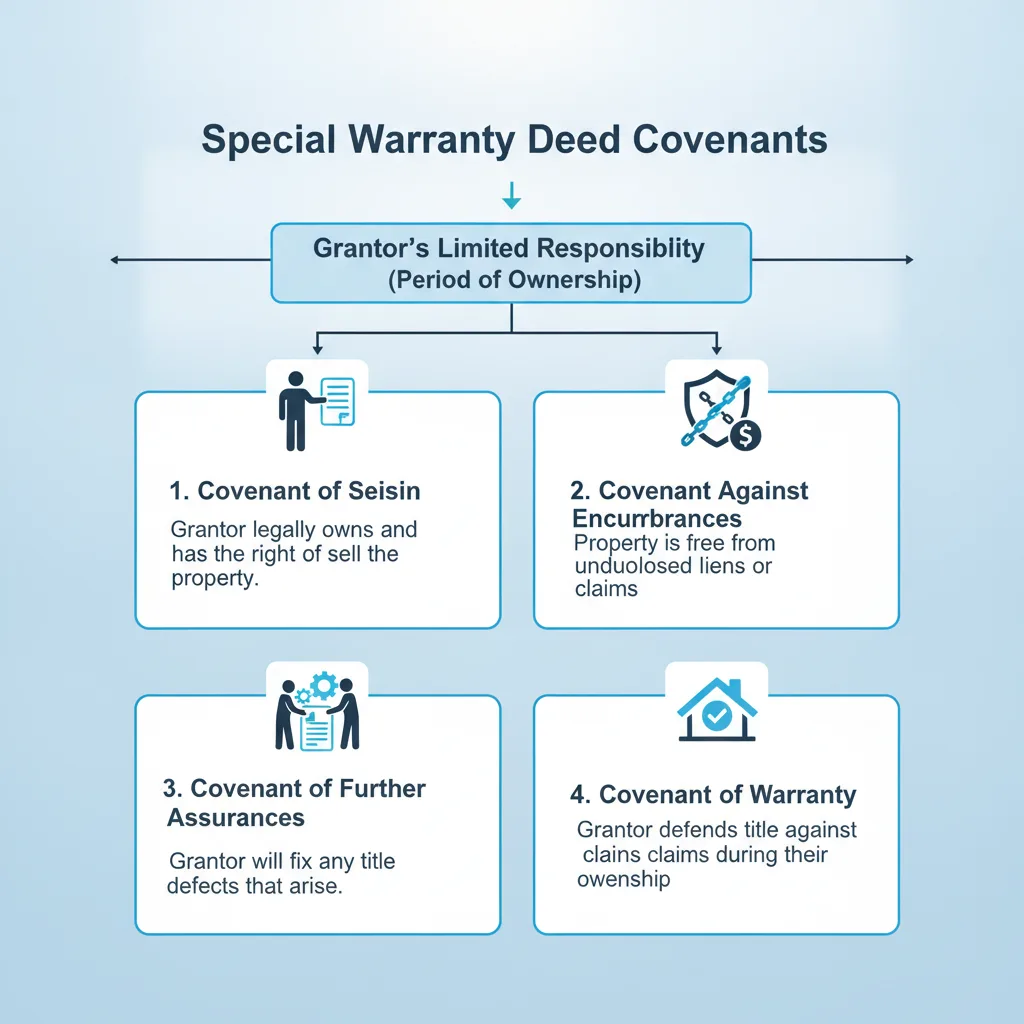
Although limited, a Special Warranty Deed typically includes several key covenants, which are promises made by the grantor to the grantee. These covenants specifically relate to the grantor's period of ownership:
- Covenant of Seisin - The grantor warrants that they own the property and have the legal right to convey it.
- Covenant Against Encumbrances - The grantor promises that the property is free from encumbrances (such as liens, mortgages, or easements) that arose during their ownership, except those specifically disclosed in the deed.
- Covenant of Further Assurances - The grantor agrees to take reasonable steps to cure any title defects that arose during their ownership, should they become known.
- Covenant of Warranty - The grantor guarantees they will defend the title against any claims made by third parties that arose through the grantor's own actions or inactions during their period of ownership.
These covenants collectively define the extent of the grantor's responsibility, focusing solely on the period they held title to the property. Any issues originating before their ownership are not covered by these specific promises.
Common Applications and Scenarios
Special Warranty Deeds are frequently utilized in specific types of real estate transactions where the grantor may not have full knowledge of the property's distant title history or wishes to limit their liability. Common scenarios include:
- Commercial Real Estate Transactions - In large commercial deals, sophisticated parties often negotiate for a Special Warranty Deed. Buyers typically perform extensive due diligence and title research, relying less on a broad warranty from the seller.
- Foreclosures and Lender Sales (REO Properties) - When a bank or lender sells a property acquired through foreclosure (REO, or Real Estate Owned), they typically use a Special Warranty Deed. The bank only guarantees the title against issues that arose while they owned the property, as they have no personal knowledge of prior ownership.
- Executor, Administrator, or Trustee Sales - Fiduciaries selling property on behalf of an estate or trust often use this deed. They guarantee that they, in their role as fiduciary, have not encumbered the title, but they cannot warrant against actions of the deceased or previous owners.
- Government or Public Entity Sales - Government agencies selling surplus property may also opt for Special Warranty Deeds to limit their liability concerning historical title matters.
In these situations, the limited warranty is a practical solution that balances the grantor's need to avoid unknown historical liabilities with the grantee's expectation of a clear title during the most recent ownership period.
Essential Elements and Execution
For a Special Warranty Deed to be legally valid and effective, it must contain several essential elements and follow proper execution procedures. These requirements ensure the clear transfer of ownership and proper recording of the transaction:
- Grantor and Grantee Identification - Full legal names and addresses of both the party conveying the property (grantor) and the party receiving it (grantee).
- Legal Description of Property - A precise and unambiguous description of the real estate being transferred, typically found in prior deeds or surveys.
- Granting Clause - Language explicitly stating the grantor's intention to convey the property to the grantee, often including phrases like "grant, bargain, sell, and convey."
- Consideration - A statement of value exchanged for the property, which can be nominal (e.g., "for Ten Dollars and other good and valuable consideration") or the actual purchase price.
- Covenants of Title - The specific limited warranties and promises made by the grantor, as discussed previously, defining the scope of protection.
- Execution by Grantor - The grantor must sign the deed. In some jurisdictions, the grantor's spouse may also need to sign to release any dower or homestead rights.
- Notarization - The grantor's signature must be acknowledged by a notary public. This notarization verifies the identity of the signatory and confirms they signed voluntarily.
- Witnesses - Some states require one or two witnesses in addition to notarization for a deed to be valid.
- Recording - After execution, the deed should be recorded in the land records office (e.g., county recorder's office or clerk's office) where the property is located. Recording provides public notice of the transfer and protects the grantee's interest against subsequent claims.
Comparison to Other Deed Types
The Special Warranty Deed occupies a middle ground between the robust protection of a General Warranty Deed and the minimal assurance of a Quitclaim Deed. Understanding these distinctions is crucial for both buyers and sellers:
A General Warranty Deed offers the most comprehensive protection to the grantee. The grantor guarantees a clear title against all defects, encumbrances, and claims that arose throughout the property's entire history, even those predating their ownership. This deed includes all six standard covenants of title, extending backward indefinitely.
Conversely, a Quitclaim Deed offers the least protection. The grantor conveys whatever interest they may have in the property, if any, without making any warranties or guarantees about the title's validity or freedom from encumbrances. It simply transfers the grantor's current interest, whatever that may be, with no promises. Quitclaim Deeds are often used to clear title defects, resolve boundary disputes, or transfer property between family members.
The Special Warranty Deed strikes a balance by limiting the grantor's liability to their period of ownership. This makes it more favorable for sellers than a General Warranty Deed, as they avoid responsibility for historical title issues. For buyers, it offers more protection than a Quitclaim Deed, as they receive assurances against issues created by the immediate seller. The choice of deed type depends heavily on the specific transaction, the relationship between the parties, and the level of risk each party is willing to assume.
Frequently Asked Questions
Not the form you're looking for?
Try our legal document generator to create a custom document
Disclaimer: The templates available on this website are provided for general informational purposes only and do not constitute legal advice. They are not intended to be, and should not be interpreted as, compliant with any specific legal, regulatory, or privacy requirements. These templates are not a replacement for professional legal guidance and should not be relied upon for any particular matter or circumstance. Users are strongly encouraged to seek advice from a qualified attorney licensed in their jurisdiction before using, modifying, or relying on any template.
All templates are provided on an "as is," "with all faults," and "as available" basis. The provider disclaims any and all warranties of any kind, whether express, implied, statutory, or otherwise, including without limitation warranties of merchantability, fitness for a particular purpose, title, or non-infringement.
LegalTemplates.com makes no guarantees or representations regarding the accuracy, completeness, expected outcomes, or reliability of the materials contained in these templates or any materials referenced or linked from them.