Quitclaim Deed
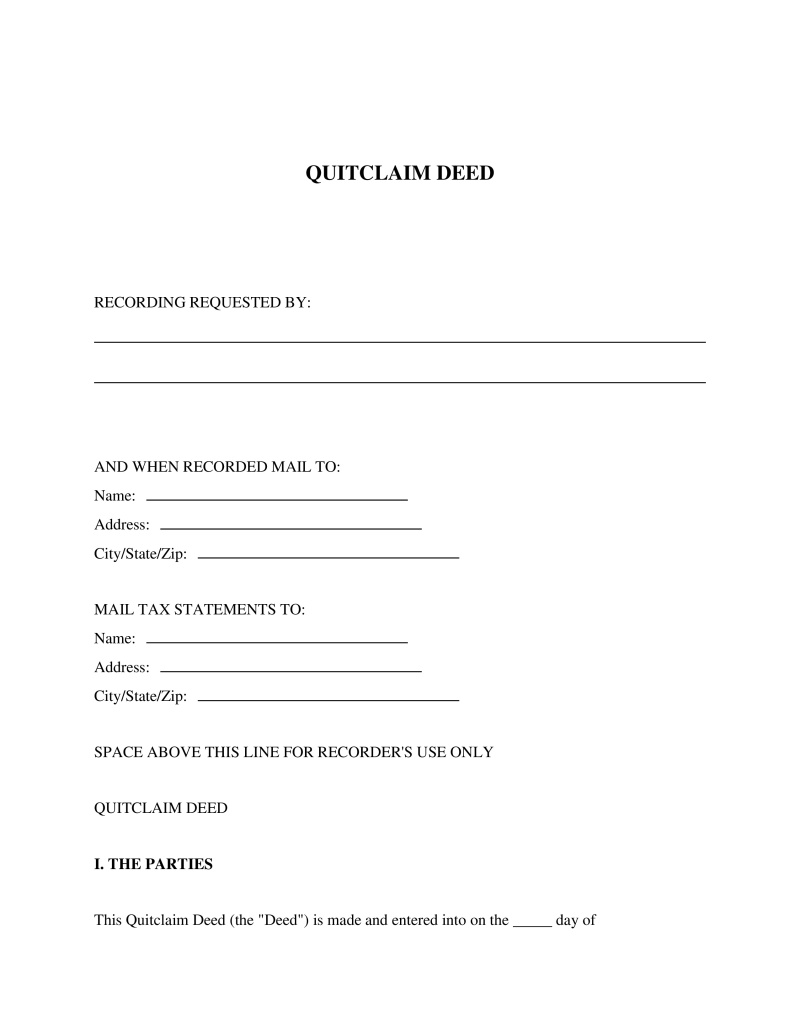
A quitclaim deed is a legal document that transfers ownership rights in property without guaranteeing the title's validity or clear status.
Is Property In Us
Select 'Yes' if the property is within the United States. Quitclaim Deed requirements may differ for international properties.
Select the state where the property is located. This determines legal requirements for the deed.
Table of Contents
What is a Quitclaim Deed?
A quitclaim deed is a legal instrument used to transfer any interest in real property that the grantor may have, without providing any warranties of title. Unlike other deed types, a quitclaim deed does not guarantee that the grantor actually owns the property or that the title is free from defects or encumbrances. Its primary purpose is to convey whatever interest, if any, the grantor possesses at the time of the transfer to the grantee, making it a common choice for specific, low-risk property transfers.
Key Characteristics and Lack of Warranties
The defining feature of a quitclaim deed is its lack of warranties regarding the property's title. When a grantor executes a quitclaim deed, they are essentially saying, "I transfer whatever interest I have in this property to you, but I make no promises about the extent of that interest or whether it is free from claims by others." This distinguishes it significantly from other forms of deeds that offer various levels of protection to the grantee.
Specifically, a quitclaim deed does not provide:
- Warranty of Title - A guarantee that the grantor actually owns the property being conveyed.
- Warranty Against Encumbrances - A guarantee that there are no liens, mortgages, easements, or other claims against the property.
- Covenant of Further Assurances - A promise that the grantor will take future actions to perfect the title if defects are discovered.
Because of this absence of guarantees, the grantee in a quitclaim deed assumes all risks associated with the property's title. If a title defect or undisclosed lien emerges after the transfer, the grantee generally has no recourse against the grantor under the deed itself.
Common Uses of Quitclaim Deeds
Despite the lack of warranties, quitclaim deeds serve important functions in specific situations where the parties have an existing relationship or a clear understanding of the title's status. They are often used in transfers where money is not exchanged or where the risk of title defects is minimal or accepted by the grantee.
Typical scenarios for using a quitclaim deed include:
- Intra-Family Transfers - Conveying property between family members, such as a parent to a child, or between spouses (e.g., adding a spouse to a deed).
- Divorce Settlements - Transferring property from one spouse to another as part of a divorce decree or property settlement agreement.
- Clearing Title Defects - Removing a cloud on a property's title, such as correcting a misspelling in a previous deed or resolving a minor boundary dispute.
- Transferring Property to a Trust or LLC - Moving real estate into a living trust or a limited liability company (LLC) for estate planning or business purposes.
- Gift Deeds - Gifting property to another party without any monetary exchange.
- Removing an Ex-Spouse from a Deed - After a divorce, one spouse may quitclaim their interest in the marital home to the other.
Parties Involved and Essential Elements
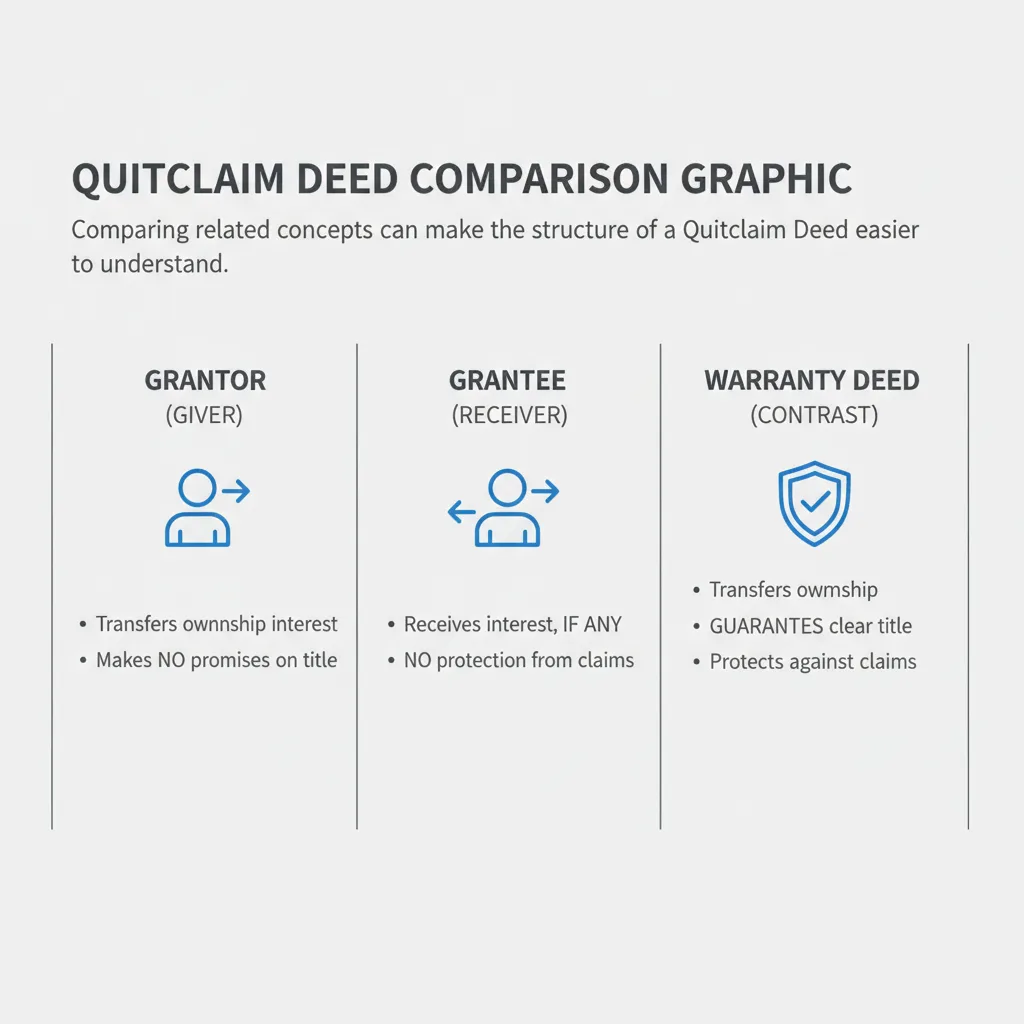
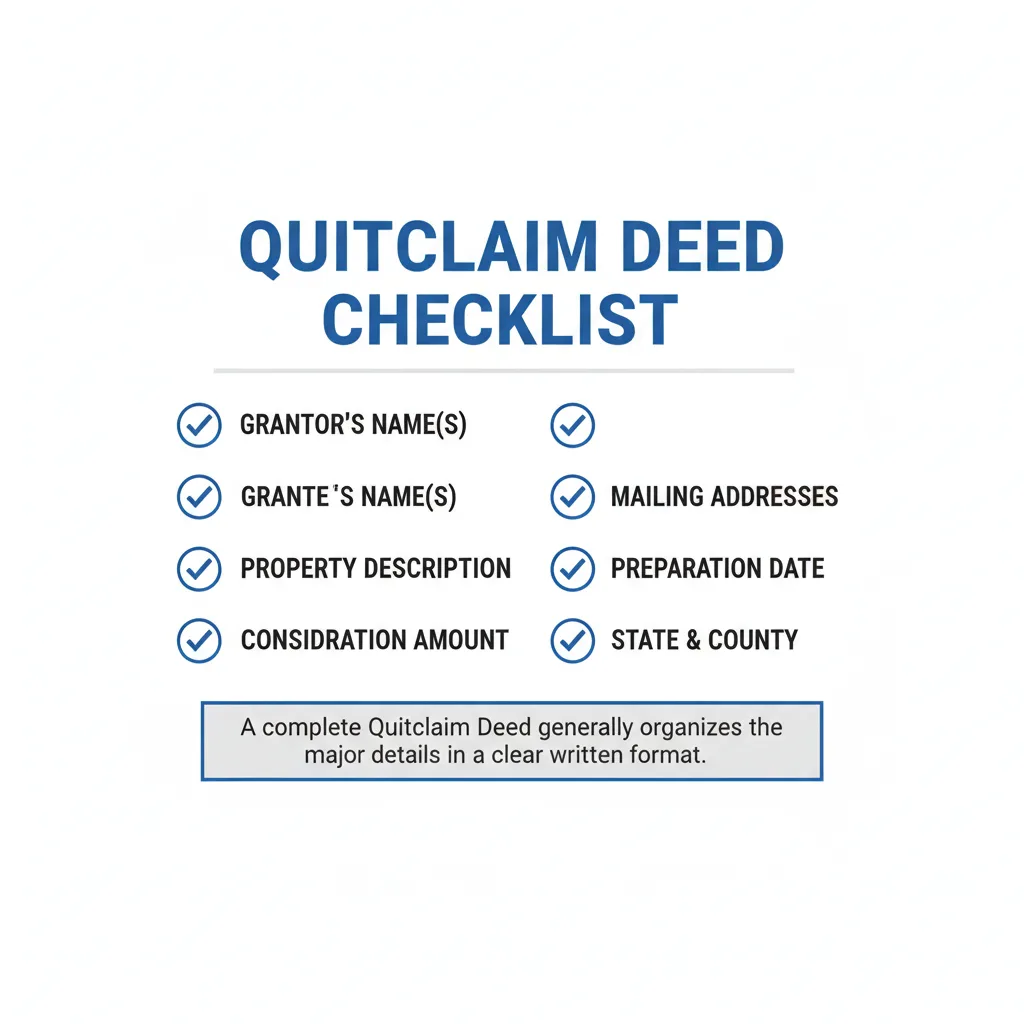
A quitclaim deed involves two primary parties: the grantor and the grantee. The grantor is the individual or entity conveying their interest, and the grantee is the individual or entity receiving that interest. For the deed to be legally effective, it must contain several essential elements, though specific requirements can vary by jurisdiction.
Generally, a quitclaim deed must include:
- Grantor's Name and Address - The full legal name and mailing address of the party conveying their interest.
- Grantee's Name and Address - The full legal name and mailing address of the party receiving the interest.
- Legal Description of the Property - A precise and unambiguous description of the real estate being transferred, often including lot numbers, block numbers, subdivision names, and metes and bounds descriptions. This ensures the property can be uniquely identified (Florida Statutes § 689.025).
Frequently Asked Questions
Sources
- Form of quitclaim deed prescribed - Prescribes the form of quitclaim deeds in Florida, including required elements and legal description.
- Quitclaim deed—Form and effect - Provides the statutory form and effect of quitclaim deeds in Washington State.
- Quitclaim Deed Form - Offers a downloadable quitclaim deed form and outlines recording requirements in Michigan.
- Quitclaim Deed Form RD 1955-49 - Provides a federal quitclaim deed form used by the USDA for property conveyance.
Not the form you're looking for?
Try our legal document generator to create a custom document
Disclaimer: The templates available on this website are provided for general informational purposes only and do not constitute legal advice. They are not intended to be, and should not be interpreted as, compliant with any specific legal, regulatory, or privacy requirements. These templates are not a replacement for professional legal guidance and should not be relied upon for any particular matter or circumstance. Users are strongly encouraged to seek advice from a qualified attorney licensed in their jurisdiction before using, modifying, or relying on any template.
All templates are provided on an "as is," "with all faults," and "as available" basis. The provider disclaims any and all warranties of any kind, whether express, implied, statutory, or otherwise, including without limitation warranties of merchantability, fitness for a particular purpose, title, or non-infringement.
LegalTemplates.com makes no guarantees or representations regarding the accuracy, completeness, expected outcomes, or reliability of the materials contained in these templates or any materials referenced or linked from them.