Lady Bird Deed
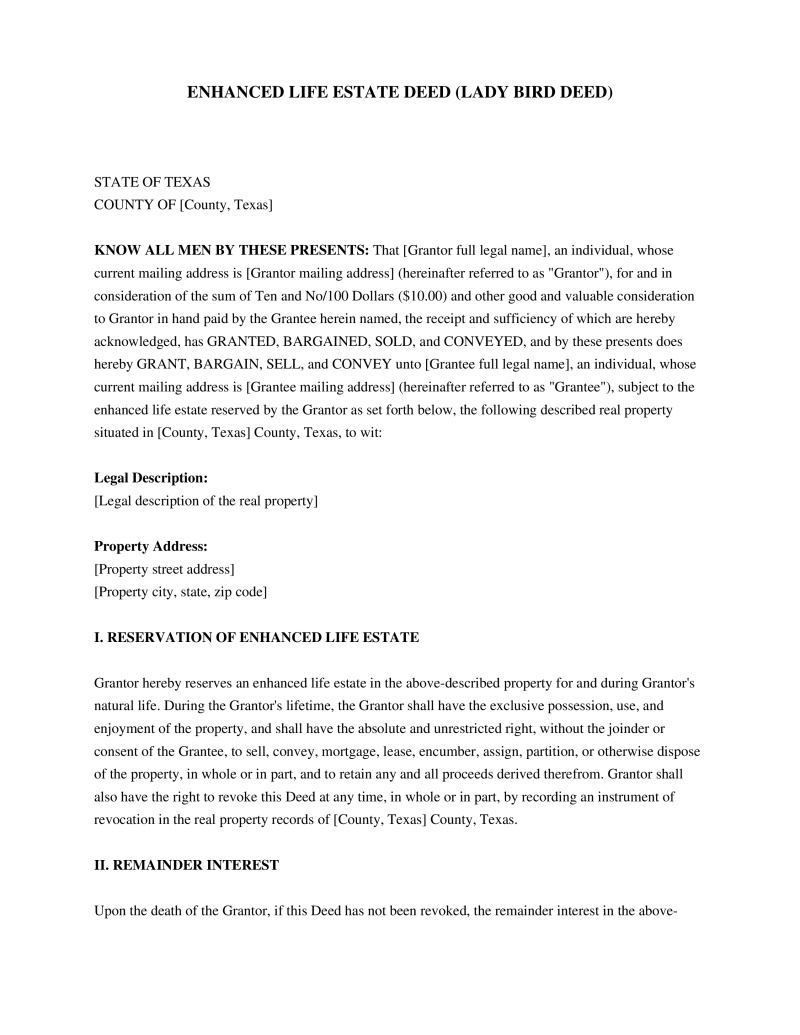
A Lady Bird Deed is a legal instrument used in certain jurisdictions to transfer real property while retaining a life estate and control over the property during the grantor's lifetime.
Property Type
Select the property type. This will help tailor the deed language appropriately.
Provide a description if 'Other' was selected.
Table of Contents
What is a Lady Bird Deed?
An Enhanced Life Estate Deed, commonly known as a Lady Bird Deed, is a specialized type of deed used in certain states to transfer property ownership while allowing the original owner to retain significant control during their lifetime. This document permits a property owner to designate beneficiaries who will automatically inherit the property upon the owner's death, bypassing the probate process. It is primarily used for estate planning purposes, offering flexibility and control that traditional life estate deeds do not.
Key Characteristics and Purpose
The defining feature of a Lady Bird Deed is the grantor's ability to retain a wide range of powers over the property even after executing the deed. Unlike a traditional life estate, which typically restricts the life tenant's ability to sell or mortgage the property without the consent of the remainder beneficiaries, an Enhanced Life Estate Deed grants the grantor full control. This retained control is crucial for individuals who wish to plan for future property transfer without relinquishing present authority.
The primary purpose of this deed is to facilitate the transfer of real property to designated beneficiaries upon the grantor's death, effectively avoiding the often time-consuming and costly probate process. This direct transfer mechanism ensures that the property passes directly to the named beneficiaries outside of the decedent's estate. Additionally, the Lady Bird Deed can be a valuable tool in Medicaid planning, as the property transferred through such a deed may not be considered a countable asset for Medicaid eligibility purposes, depending on state-specific rules and look-back periods.
How a Lady Bird Deed Works
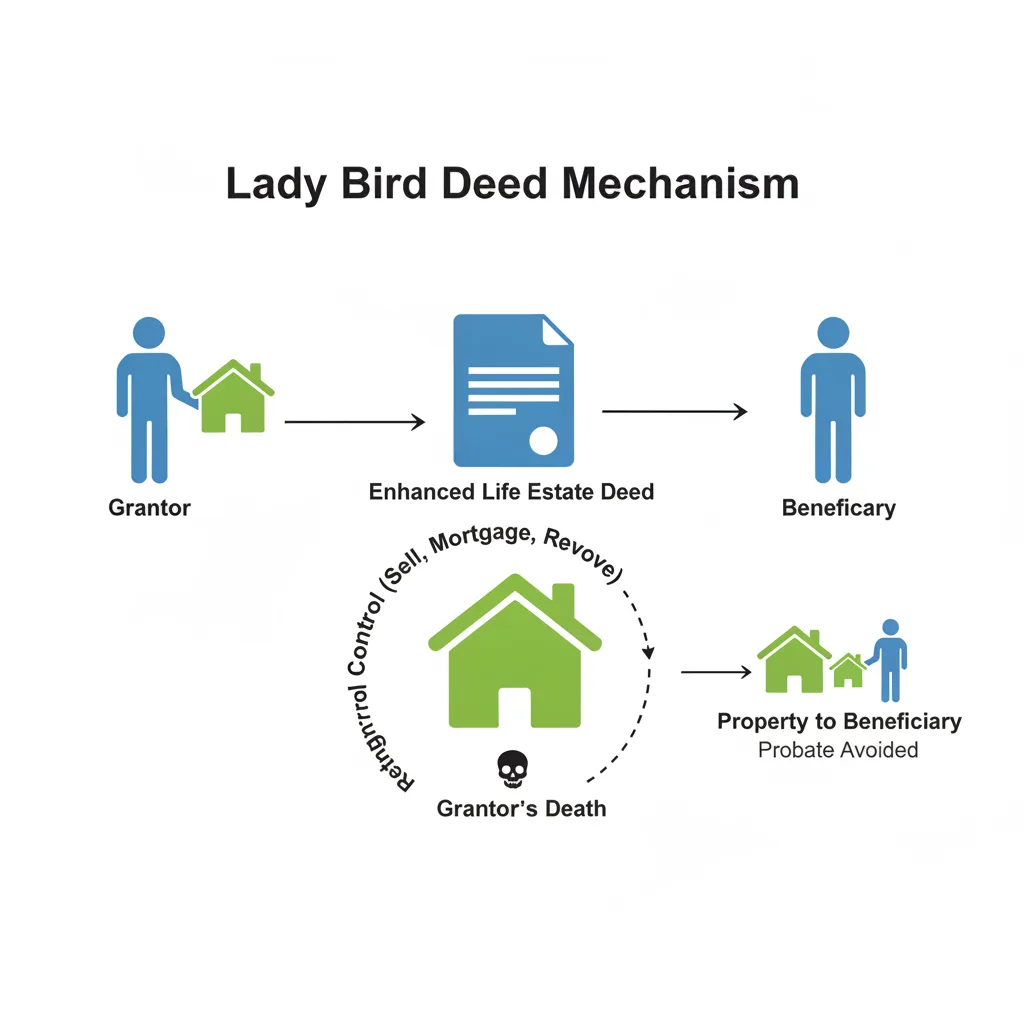
A Lady Bird Deed involves a grantor (the current property owner) and one or more remainder beneficiaries. The grantor executes the deed, naming themselves as the life tenant with enhanced powers, and specifies who will receive the property upon their death. This transfer is not immediate but is contingent upon the grantor's demise.
The mechanism operates as follows:
- Grantor Retains Life Estate - The original property owner retains a life estate, which includes the right to possess, use, and enjoy the property for the remainder of their life.
- Enhanced Powers - Crucially, the grantor also retains the power to sell, mortgage, lease, or otherwise dispose of the property, or even revoke the deed entirely, without needing the consent of the remainder beneficiaries.
- Automatic Transfer at Death - Upon the grantor's death, the property automatically transfers to the named remainder beneficiaries, by reason of the deed itself, without requiring probate administration.
Benefits and Advantages
The Lady Bird Deed offers several distinct advantages, making it an attractive option for certain estate planning scenarios:
- Probate Avoidance - The property passes directly to the beneficiaries upon the grantor's death, bypassing the probate court process entirely, which can save time and legal fees.
- Retained Control - The grantor maintains full control over the property during their lifetime, including the ability to sell, mortgage, or gift it, or to cancel the deed, without the consent of the beneficiaries.
- Medicaid Planning - In some states, a Lady Bird Deed can be used to protect the home from Medicaid estate recovery, as the property may not be considered part of the probate estate subject to recovery.
- Homestead Protection - For primary residences, this deed can preserve homestead exemptions and protections that might otherwise be lost through other transfer methods.
- Simplicity - Once executed and recorded, the transfer is largely automatic upon death, simplifying the inheritance process for beneficiaries.
Distinction from Traditional Life Estate Deeds
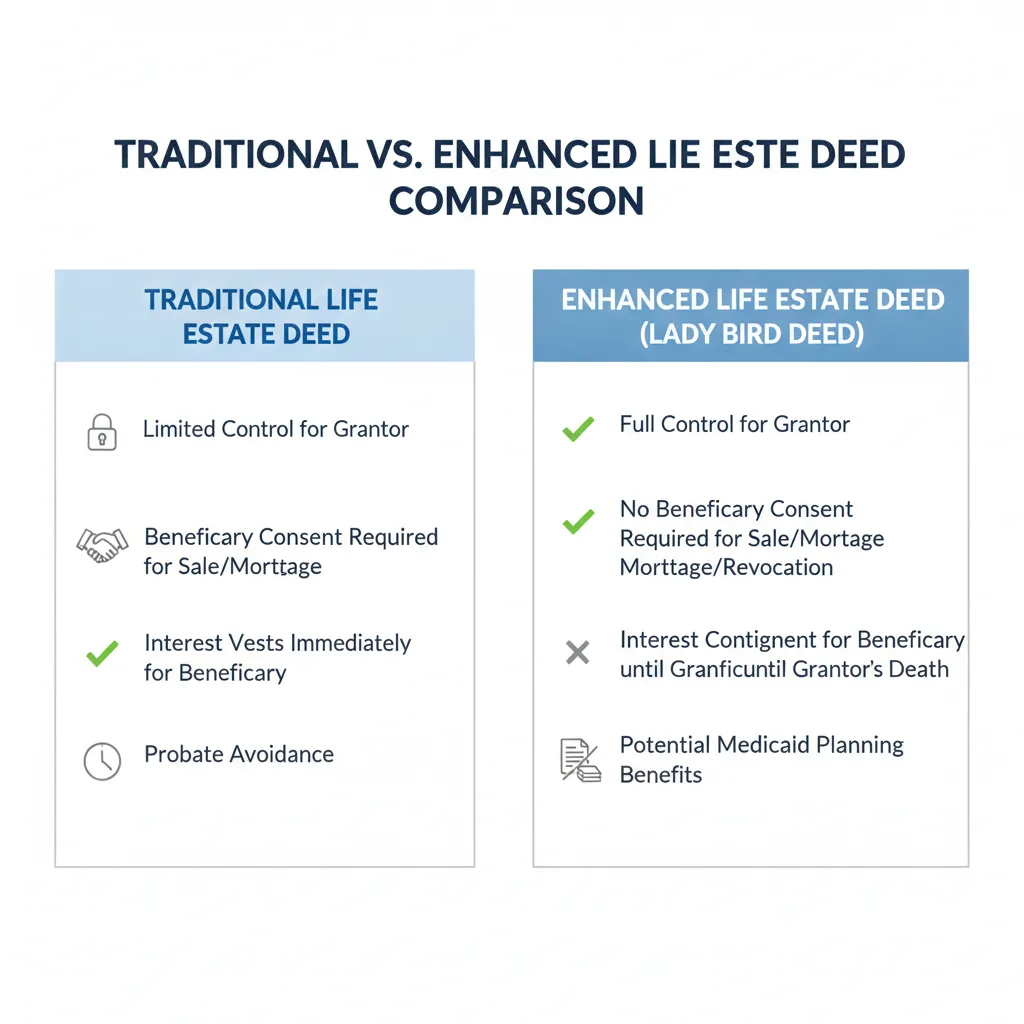
While both Lady Bird Deeds and traditional life estate deeds involve the creation of a life estate and the designation of remainder beneficiaries, a critical difference lies in the grantor's retained powers. A traditional life estate typically creates two distinct interests: a life estate for the grantor (life tenant) and a vested remainder interest for the beneficiaries. Under a traditional life estate, the life tenant cannot sell, mortgage, or otherwise transfer the property without the consent of the remainder beneficiaries, as their interest is already vested.
In contrast, the Enhanced Life Estate Deed allows the grantor to retain all the powers of full ownership, including the right to revoke the deed or change beneficiaries, without the consent or even knowledge of the named beneficiaries. This provides the grantor with unparalleled flexibility, ensuring they do not lose control over their most significant asset during their lifetime. The remainder beneficiaries' interest under a Lady Bird Deed is contingent and does not vest until the grantor's death.
State-Specific Recognition
The validity and specific characteristics of a Lady Bird Deed are determined by state law. Not all states formally recognize this type of deed, and where it is recognized, the statutory framework may vary. It is important for property owners to understand the specific laws in their jurisdiction.
States that have explicitly addressed or recognize the Enhanced Life Estate Deed include:
- Florida - Provides a sample form for an Enhanced Life Estate Deed, also known as a Lady Bird Deed, allowing a property owner to transfer ownership while retaining the right to hold and occupy the property during their lifetime (Enhanced Life Estate Deed (Lady Bird Deed)).
- South Carolina - The South Carolina Enhanced Life Estate Deed Act permits a grantor to transfer real property to one or more designated remainder beneficiaries upon the grantor's death, effective by reason of this part and not subject to estate administration (South Carolina Enhanced Life Estate Deed Act).
- Vermont - Vermont law states that nothing in the chapter shall be construed to affect the validity of an Enhanced Life Estate Deed, also known as a Lady Bird Deed, executed and recorded prior to July 13, 2020 (Vermont Statutes Online: Enhanced Life Estate Deeds).
Execution and Recording
To be legally effective, a Lady Bird Deed must be properly executed and recorded in the county where the property is located. The process generally involves:
- Drafting the Deed - The deed must be drafted to specifically include the enhanced life estate language, clearly identifying the grantor, the property, and the remainder beneficiaries, and explicitly stating the grantor's retained powers.
- Grantor's Signature - The grantor must sign the deed in the presence of witnesses as required by state law.
- Notarization - The grantor's signature typically needs to be notarized by a qualified notary public.
- Recording - The executed and notarized deed must be filed with the county recorder's office or equivalent authority in the county where the property is situated. This step provides public notice of the transfer and establishes its legal validity.
Proper execution and recording are essential to ensure the deed's effectiveness and to avoid future disputes regarding property ownership and transfer.
Frequently Asked Questions
Sources
- Enhanced Life Estate Deed (Lady Bird Deed) - Provides a sample form for an Enhanced Life Estate Deed, also known as a Lady Bird Deed, used in Florida.
- South Carolina Enhanced Life Estate Deed Act - Establishes the Enhanced Life Estate Deed, also known as a Lady Bird Deed, in South Carolina law.
- Vermont Statutes Online: Enhanced Life Estate Deeds - Addresses the validity of Enhanced Life Estate Deeds, also known as Lady Bird Deeds, in Vermont.
Not the form you're looking for?
Try our legal document generator to create a custom document
Disclaimer: The templates available on this website are provided for general informational purposes only and do not constitute legal advice. They are not intended to be, and should not be interpreted as, compliant with any specific legal, regulatory, or privacy requirements. These templates are not a replacement for professional legal guidance and should not be relied upon for any particular matter or circumstance. Users are strongly encouraged to seek advice from a qualified attorney licensed in their jurisdiction before using, modifying, or relying on any template.
All templates are provided on an "as is," "with all faults," and "as available" basis. The provider disclaims any and all warranties of any kind, whether express, implied, statutory, or otherwise, including without limitation warranties of merchantability, fitness for a particular purpose, title, or non-infringement.
LegalTemplates.com makes no guarantees or representations regarding the accuracy, completeness, expected outcomes, or reliability of the materials contained in these templates or any materials referenced or linked from them.