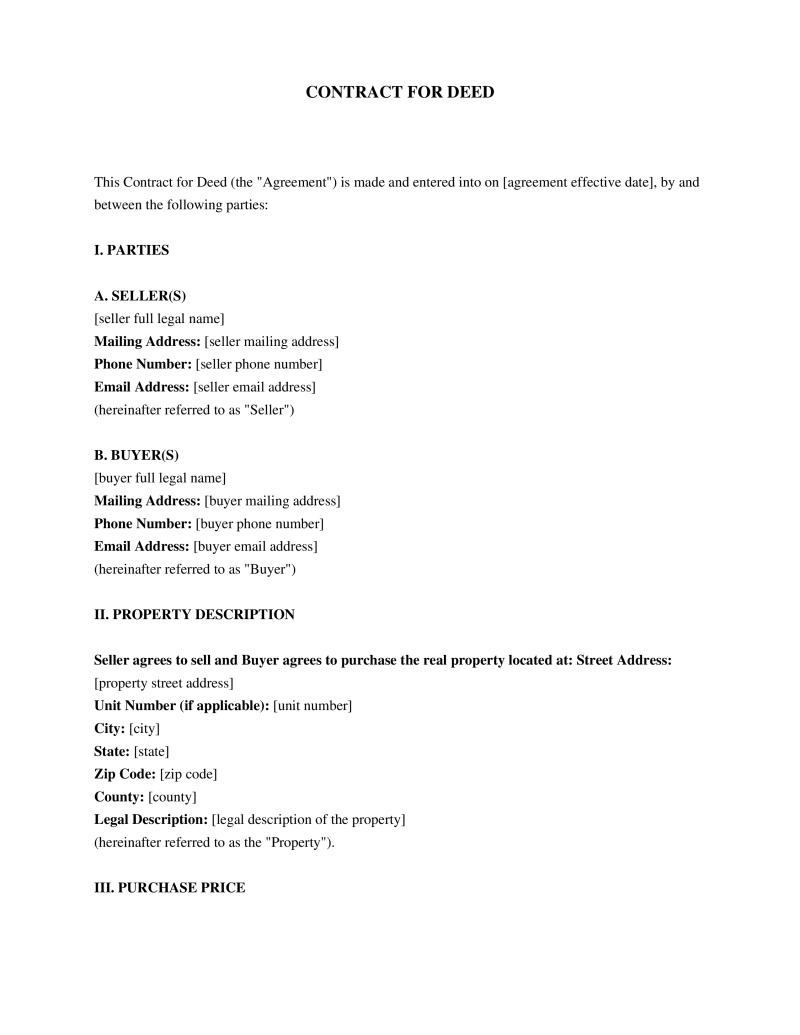
Contract for Deed
A Contract for Deed is a legal agreement for the sale of real property where the seller finances the purchase and retains legal title until the buyer completes all agreed payments.
Property Type
Select the property type that best describes the real estate being sold.
Provide a description if you selected 'Other'.
Table of Contents
What is a Contract for Deed?
A Contract for Deed, also known as a land contract or installment land contract, is a legal agreement for the sale of real property where the seller finances the purchase for the buyer. Under this arrangement, the seller retains legal title to the property until the buyer completes all agreed-upon payments, while the buyer typically takes immediate possession and equitable title. This type of contract is often used as an alternative to traditional mortgage financing, particularly for buyers who may not qualify for conventional loans.
Key Characteristics and Parties
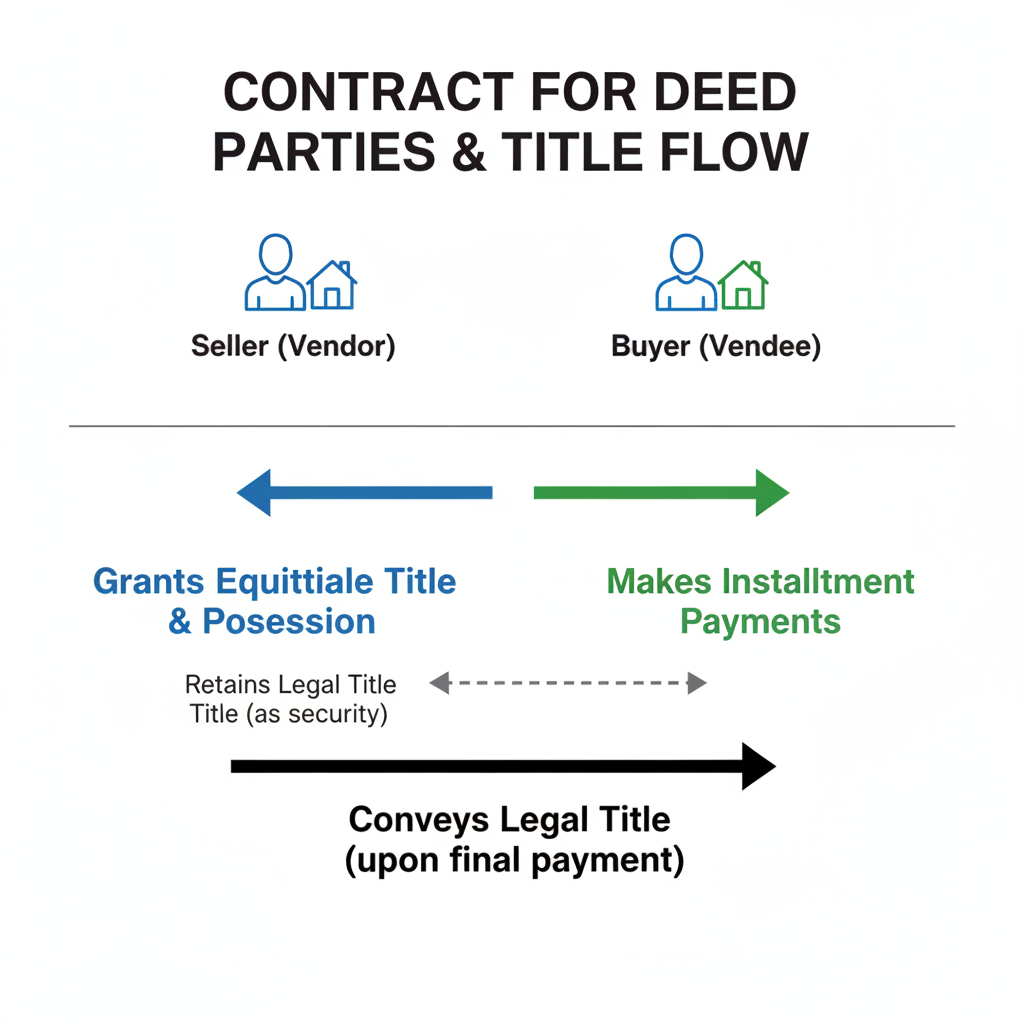
A Contract for Deed establishes a unique relationship between the buyer and seller, differing from a standard real estate transaction involving a mortgage. The core characteristic is the seller's retention of legal title as security for the purchase price, which the buyer agrees to pay in multiple installments.
- Seller (Vendor) - The party who agrees to sell an interest in property and retains legal title until the full purchase price is paid.
- Buyer (Vendee) - The party who agrees to pay the purchase price in five or more subsequent payments and typically takes possession of the property. The buyer gains equitable title, meaning they have an interest in the property that can be protected in court (G.S. 47H-1, 58-5201).
- Property Definition - In some jurisdictions, like Kansas, the definition of "property" under a contract for deed specifically refers to real property with a structure for one to four families, intended as the buyer's principal residence (58-5201).
- Exclusions - Option contracts for the purchase of real property are generally excluded from the definition of a contract for deed (58-5201).
Essential Elements and Contents
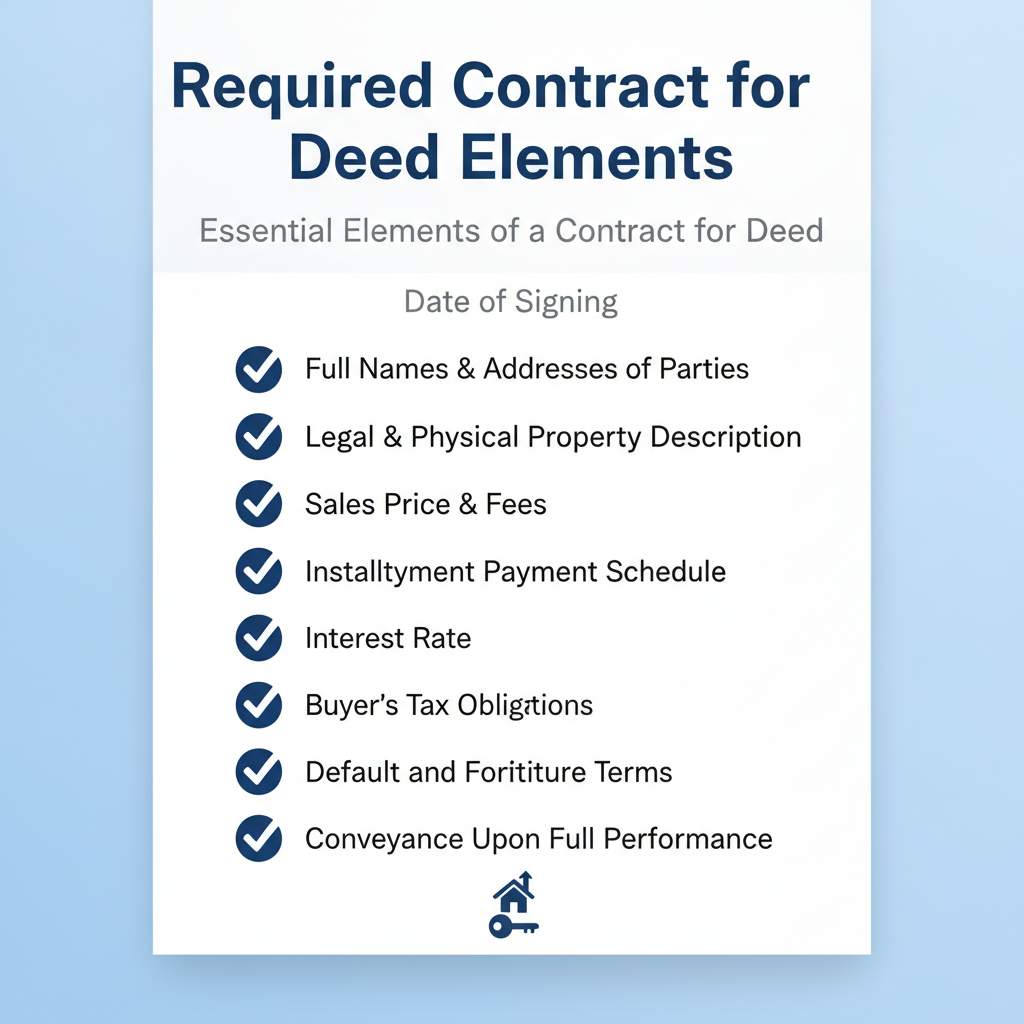
To be legally enforceable, a Contract for Deed must contain specific details and be properly executed. These requirements ensure clarity regarding the terms of sale and the rights and obligations of both parties.
- Written Agreement - Every contract for deed must be evidenced by a signed and acknowledged contract containing all agreed-upon terms. The seller is typically required to deliver an exact copy to the purchaser at the time of signing (Chapter 47H).
- Party Identification - The contract must include the full names and addresses of all parties involved and the date it was signed by each party (Chapter 47H).
- Property Description - A legal description and physical address of the property being sold are mandatory (Chapter 47H).
- Financial Terms - Key financial details must be clearly stated, including the sales price, any charges or fees for services, the amount of the purchaser's down payment, annual installments, payment dates, and interest rates (Chapter 47H, SDCL 6-13-13).
- Conveyance Clause - The contract must state that the political subdivision (seller, in certain contexts) agrees to convey all right, title, and interest upon full performance by the purchaser (SDCL 6-13-13).
- Tax Obligation - It typically mandates the purchaser to make payments of all taxes assessed and levied on the property each year during the term of the contract (SDCL 6-13-13).
Recording and Filing Requirements
Recording a Contract for Deed is a critical step that provides public notice of the buyer's equitable interest in the property and protects both parties. Failure to record can have legal and financial consequences.
- Vendee's Responsibility - In Minnesota, contracts for deed executed on or after January 1, 1984, must be recorded by the vendee within four months in the county where the land is located (Sec. 507.235 MN Statutes).
- Extension for Property Tax - The filing period may be extended if the failure to pay property tax due in the current year prevents the filing and recording of the contract (Sec. 507.235 MN Statutes).
- Civil Penalty for Non-Recording - A vendee who fails to record a contract for deed may be subject to a civil penalty equal to two percent of the principal amount of the contract debt, unless the vendee has not received a copy of the contract in recordable form (Sec. 507.235 MN Statutes).
Default and Forfeiture
Contracts for deed typically include provisions outlining the procedures for handling defaults by the buyer and the seller's remedies, which often involve forfeiture of the buyer's interest.
- Conditions of Forfeiture - The contract must specify the conditions under which the seller may declare a forfeiture and what actions the buyer can take to avoid it (Chapter 47H).
- Right to Cure Default - Buyers are generally granted a right to "cure the default," meaning they can perform the obligations under the contract necessary to reinstate the agreement before forfeiture occurs (G.S. 47H-1, Chapter 47H).
- Seller's Remedy in Default - In case of default by the purchaser, the governing board (seller, in certain contexts) may declare the contract at an end and proceed to foreclose the deed as provided by law (SDCL 6-13-13).
State-Specific Provisions
The legal framework for Contracts for Deed varies significantly by jurisdiction, with individual states enacting specific statutes to govern their use and protect involved parties.
- North Carolina Requirements - Requires contracts for deed to be evidenced by a signed and acknowledged contract, with the seller delivering an exact copy to the purchaser at the time of signing. It also defines terms like "contract for deed," "cure the default," and "down payment" (G.S. 47H-1, Chapter 47H).
- South Dakota Execution and Terms - Mandates that contracts for deed involving political subdivisions be executed in the name of the chairman of the governing board and attested by the fiscal officer. It specifies required content, including conveyance terms, payment schedules, and tax obligations (SDCL 6-13-13).
- Minnesota Recording Obligations - Imposes a requirement for vendees to record contracts for deed within four months in the county where the land is located, with penalties for non-compliance (Sec. 507.235 MN Statutes).
- Kansas Act Scope - Defines "contract for deed" as an executory agreement for real property with a structure for one to four families, intended as the buyer's principal residence, and explicitly excludes option contracts (58-5201).
Frequently Asked Questions
Sources
- Codified Law 6-13-13 | South Dakota Legislature - Details the execution and requirements of contracts for deed in South Dakota, including terms, conditions, and procedures for political subdivisions.
- Sec. 507.235 MN Statutes | Filing Contracts for Deed - Outlines the requirements for recording contracts for deed in Minnesota, including filing deadlines and penalties for non-compliance.
- G.S. 47H-1 | North Carolina General Statutes - Provides definitions related to contracts for deed in North Carolina, including terms like 'contract for deed,' 'cure the default,' and 'down payment.'
- Chapter 47H | North Carolina General Statutes - Details the requirements for contracts for deed in North Carolina, including minimum contents, recordation, conditions of forfeiture, and rights to cure defaults.
- 58-5201 | Kansas State Legislature - Defines 'contract for deed' and related terms under the Kansas Contract for Deed Act, including buyer, seller, and property definitions.
Already have a Contract?
Get it reviewed free — checked against your state's laws in about a minute.
Not the form you're looking for?
Try our legal document generator to create a custom document
Disclaimer: The templates available on this website are provided for general informational purposes only and do not constitute legal advice. They are not intended to be, and should not be interpreted as, compliant with any specific legal, regulatory, or privacy requirements. These templates are not a replacement for professional legal guidance and should not be relied upon for any particular matter or circumstance. Users are strongly encouraged to seek advice from a qualified attorney licensed in their jurisdiction before using, modifying, or relying on any template.
All templates are provided on an "as is," "with all faults," and "as available" basis. The provider disclaims any and all warranties of any kind, whether express, implied, statutory, or otherwise, including without limitation warranties of merchantability, fitness for a particular purpose, title, or non-infringement.
LegalTemplates.com makes no guarantees or representations regarding the accuracy, completeness, expected outcomes, or reliability of the materials contained in these templates or any materials referenced or linked from them.