Guaranteed Investment Contract
A Guaranteed Investment Contract (GIC) is a privately placed debt instrument issued by an insurance company, wherein a specified principal sum is invested for a fixed term and guaranteed to earn a predetermined rate of interest.
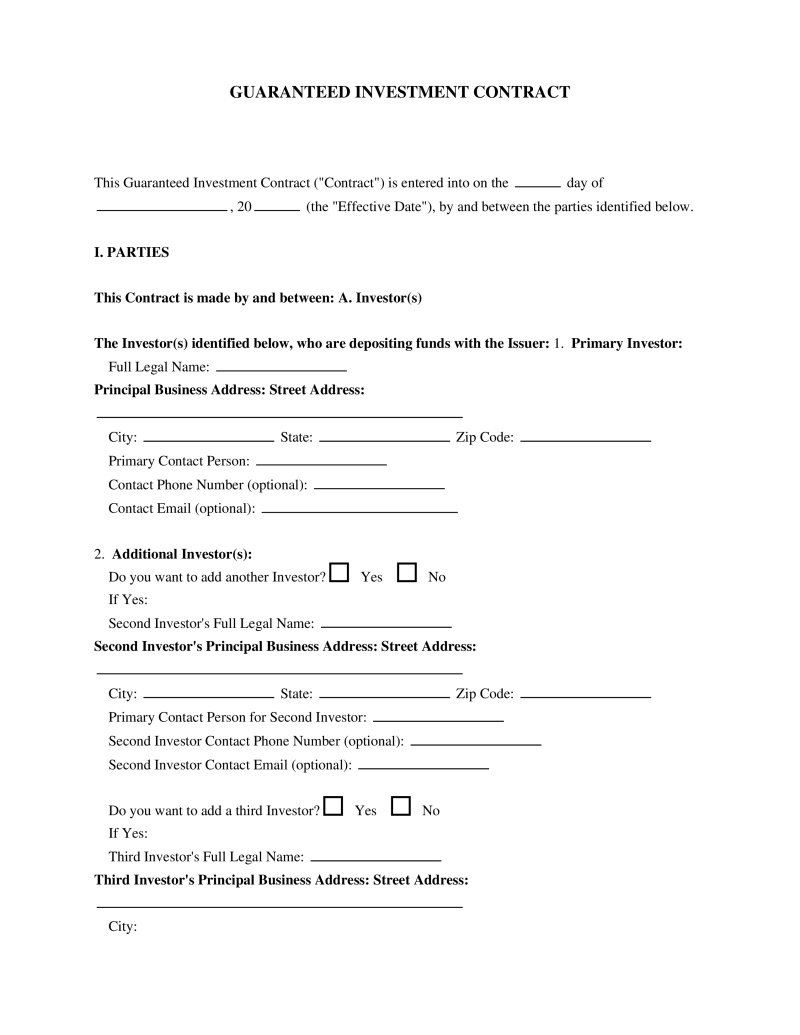
Gic Type
Choose the structure that best fits your investment needs. 'Traditional' GICs offer a fixed rate for a set term. 'Participating' GICs may share in portfolio performance. 'Floating Rate' GICs have rates tied to an index.
Provide details if you selected 'Other'.
Table of Contents
What is a Guaranteed Investment Contract?
A Guaranteed Investment Contract (GIC) is a short-term, privately placed debt instrument issued by an insurance company. These contracts involve cash contributions made to a deposit fund within the insurance company’s general account, which then earn negotiated interest rates. GICs are designed to provide a guaranteed rate of return on invested funds, making them attractive to institutional investors seeking predictable income streams.
Nature and Characteristics

Guaranteed Investment Contracts are distinct financial instruments due to their structure and the parties involved. They are fundamentally a form of debt issued by an insurance company, where the investor provides capital in exchange for a guaranteed return.
- Issuer - GICs are exclusively issued by insurance companies, leveraging their general accounts to back the investment.
- Investment Structure - They operate as privately placed debt instruments, meaning they are not typically offered to the general public through traditional capital markets.
- Funding Mechanism - Investors make cash contributions directly into a deposit fund held within the insurance company's general account.
- Interest Rates - The rates of return on GICs are not market-determined in the same way as publicly traded bonds; instead, they are negotiated between the investor and the issuing insurance company.
Terms and Conditions
The specific terms and conditions governing a Guaranteed Investment Contract are crucial in defining the investment's duration, payment structure, and overall commitment. These elements are typically established at the outset of the contract.
- Guaranteed Term Duration - The period for which the interest rate is guaranteed can range significantly, extending up to ten years from the contract's inception.
- Term Commencement - Guaranteed Terms consistently begin on the first business day of a given month, providing a clear and predictable start date for the investment period.
- Minimum Purchase Requirements - A single purchase of a GIC requires a minimum payment of at least $10,000.
- Allocation to Terms - Within a single purchase, a minimum of $1,000 must be specifically allocated to any individual Guaranteed Term chosen by the investor.
Illiquidity and Transferability

A significant characteristic of Guaranteed Investment Contracts is their limited liquidity and restricted transferability, which differentiates them from many other debt instruments. Investors should be aware of these limitations before committing funds.
- Non-Transferability - GICs are not assignable or transferable to another party without obtaining explicit permission from the issuing insurance company.
- Absence of Secondary Market - Unlike publicly traded securities, there is no active secondary market where GICs can be readily bought and sold. This lack of a market means investors cannot easily liquidate their investment before its maturity.
- Potential Illiquidity - The inherent illiquidity is further underscored by the possibility that the issuer may be unable to repay the principal amount within a short notice period, such as seven days or less. This condition can effectively lock in an investor's funds until the contract's maturity or a mutually agreed-upon withdrawal.
Guaranteed Rate of Return and Bidding Process
One of the primary appeals of a Guaranteed Investment Contract is the assurance of a fixed rate of return, which provides stability for investors. The process for securing a GIC often involves a competitive bidding framework to ensure favorable terms.
- Guaranteed Return - GICs are structured to provide a guaranteed rate of return on the invested funds, offering predictability for financial planning.
- Competitive Bidding Requirement - For many applications, particularly in contexts involving tax-exempt financing, the issuer of the GIC is required to solicit and review at least three bids from prospective insurance companies.
- Highest Yield Selection - The issuer must enter into the GIC that offers the highest yielding bona fide bid. This selection process is critical for maximizing the return on investment.
- Net of Broker's Fees - When determining the highest yielding bid, any broker's fees associated with the transaction are taken into account, ensuring that the net return to the investor is the primary consideration.
Use in Tax-Exempt Bond Financing
Guaranteed Investment Contracts play a role in the broader landscape of financial management, particularly in the context of tax-exempt bond financing. Their use in this area is subject to specific regulations aimed at maintaining the integrity of such financing.
When GICs are utilized in connection with tax-exempt bonds, the selection of the contract is governed by stringent rules:
- Arbitrage Restrictions - Regulations concerning arbitrage restrictions on tax-exempt bonds often influence how GICs are procured and managed.
- Bona Fide Bid Requirement - The winning bid for a GIC in this context must be the highest yielding bona fide bid. This ensures fair market practices and prevents manipulation.
- Consideration of Broker's Fees - As with other GIC procurements, the determination of the highest yielding bid is made net of any broker’s fees, emphasizing the actual return on the investment.
Frequently Asked Questions
Sources
- Guaranteed Investment Contracts (Funding Agreements) - Provides definitions and characteristics of Guaranteed Investment Contracts (GICs).
- Guaranteed Investment Contracts (Funding Agreements) - Details on the nature and risks associated with GICs.
- Guaranteed Investment Contracts (Funding Agreements) - Information on the terms and conditions of GICs.
- 1996 EO CPE Text - Guidance on the use of GICs in investment strategies.
- TD 8801 - Arbitrage Restrictions on Tax-Exempt Bonds - Regulations on the use of GICs in tax-exempt bond financing.
Not the form you're looking for?
Try our legal document generator to create a custom document
Disclaimer: The templates available on this website are provided for general informational purposes only and do not constitute legal advice. They are not intended to be, and should not be interpreted as, compliant with any specific legal, regulatory, or privacy requirements. These templates are not a replacement for professional legal guidance and should not be relied upon for any particular matter or circumstance. Users are strongly encouraged to seek advice from a qualified attorney licensed in their jurisdiction before using, modifying, or relying on any template.
All templates are provided on an "as is," "with all faults," and "as available" basis. The provider disclaims any and all warranties of any kind, whether express, implied, statutory, or otherwise, including without limitation warranties of merchantability, fitness for a particular purpose, title, or non-infringement.
LegalTemplates.com makes no guarantees or representations regarding the accuracy, completeness, expected outcomes, or reliability of the materials contained in these templates or any materials referenced or linked from them.