Contract
Create Contract
Contract
A contract is a legally binding agreement between two or more parties that creates mutual obligations enforceable by law.
Answer the question(s) below to create your Contract
Contract Type
Select the primary purpose of this contract. This will tailor the form to your needs.
Provide a brief description of the contract if you selected 'Other'.
Table of Contents
What is a Contract?
A contract is a legally binding agreement between two or more parties, creating mutual obligations enforceable by law. Its primary purpose is to formalize an understanding, ensuring that each party's promises are clear and that remedies exist if those promises are not kept. Contracts are fundamental to commerce, personal transactions, and various legal relationships, providing a framework of predictability and trust. They are utilized by individuals, businesses, and organizations to define terms for everything from employment and sales to real estate and service provision.
Legal Requirements and Validity
For an agreement to be recognized as a legally valid contract, it must generally satisfy several core elements. The absence of any one of these elements can render an agreement unenforceable or voidable. These essential components ensure that parties enter into agreements knowingly and willingly, and that the terms are fair and capable of being performed:
- Offer - One party must present a clear, definite proposal to another, indicating a willingness to enter into a bargain. The offer must be communicated to the offeree.
- Acceptance - The party receiving the offer must unequivocally agree to its terms. Acceptance must mirror the offer exactly (mirror image rule in common law) and be communicated to the offeror.
- Consideration - Each party must provide something of value to the other. This 'bargained-for exchange' can be a promise, an act, or a forbearance, and it serves as the incentive for each party to enter into the agreement.
- Intention to Create Legal Relations - The parties must intend their agreement to be legally binding and enforceable in a court of law. Social or domestic agreements are generally presumed not to have this intention.
- Capacity - All parties to the contract must have the legal ability to enter into an agreement. This typically means they must be of legal age and sound mind. Minors, individuals with severe mental incapacitation, or those under duress may lack the capacity to contract.
- Legality of Object - The purpose and subject matter of the contract must be legal and not contrary to public policy. Contracts for illegal activities, such as drug sales or gambling where prohibited, are void.
Rights and Obligations of Parties Involved
Once a valid contract is formed, it establishes specific rights and obligations for each party. These duties are legally enforceable, meaning a failure to perform them can lead to legal consequences. Understanding these rights and obligations is crucial for ensuring compliance and protecting one's interests throughout the contract's duration.
- Performance - Each party is obligated to perform the duties explicitly outlined in the contract. This involves fulfilling promises, delivering goods, providing services, or making payments as agreed upon. Substantial performance, where duties are largely but not perfectly fulfilled, may still be considered adequate performance, though minor deviations might entitle the non-breaching party to damages.
- Good Faith and Fair Dealing - Most jurisdictions impose an implied covenant of good faith and fair dealing on contracting parties. This means parties must act honestly and fairly in performing their contractual obligations and not do anything to destroy the other party's right to receive the benefits of the contract.
- Right to Expect Performance - Each party has the right to expect that the other party will perform their agreed-upon obligations according to the contract's terms. This includes expectations regarding quality, quantity, timeliness, and payment.
- Remedies for Breach - If one party fails to fulfill their obligations, the non-breaching party has the right to seek legal remedies. These remedies are designed to compensate the injured party and put them in the position they would have been in had the contract been performed.
- Duty to Mitigate Damages - A non-breaching party typically has a duty to take reasonable steps to minimize the losses resulting from a breach of contract. They cannot simply allow damages to accumulate without effort to reduce them and then seek full compensation for all losses.
How to Form a Valid Contract
The process of forming a valid contract involves several key stages, from initial discussions to the finalization of the agreement. Adhering to these steps helps ensure that the contract is legally sound and accurately reflects the intentions of all parties.
- Negotiate Terms and Conditions - Engage in discussions to define the specific terms, expectations, and responsibilities of each party. This stage involves identifying the subject matter, consideration, duration, payment terms, and any specific conditions or contingencies. Clear communication and a mutual understanding of the objectives are paramount during this phase.
- Draft the Agreement - Once terms are agreed upon, memorialize them in a written document. While some contracts can be oral, a written contract provides clarity, reduces ambiguity, and serves as strong evidence of the agreement. Ensure the language is precise, unambiguous, and covers all negotiated points, including dispute resolution mechanisms.
- Review and Seek Legal Counsel - Before finalizing, all parties should thoroughly review the draft contract. It is highly advisable to seek independent legal advice to ensure the terms are fair, enforceable, and protect individual interests. A legal professional can identify potential pitfalls, clarify complex clauses, and confirm compliance with applicable laws.
- Execute the Contract - Formalize the agreement by having all parties sign and date the document. Signatures signify acceptance of the terms and an intention to be legally bound. In some cases, witnesses or notarization may be required or recommended to validate the signatures and the agreement's authenticity.
- Distribute and Retain Copies - After execution, ensure that each party receives a complete, signed copy of the contract. Maintaining accurate records is essential for future reference, compliance monitoring, and potential enforcement. Electronic copies should be securely stored, and physical copies should be kept in a safe location.
Consideration in Contract Law
Consideration is a critical element for the formation of a contract, serving as the legal value exchanged between parties. It signifies that each party has given up something of value or undertaken a burden in exchange for the other party's promise. This 'bargained-for exchange' distinguishes enforceable contracts from mere gifts or gratuitous promises, which are generally not legally binding.
The concept of consideration requires that something of legal value passes between the parties. This can take various forms, including a promise to perform an act, an actual performance of an act, or a promise to refrain from doing something (forbearance). The value does not have to be monetary; it can be anything that is recognized as having legal sufficiency, even if its economic value is minimal. Courts generally do not inquire into the adequacy of consideration, only its existence, provided it is not merely nominal or illusory.
For consideration to be valid, it must be part of a mutual exchange. Past consideration, which refers to an act performed before the promise was made, is typically not considered valid consideration because it was not given in exchange for the current promise. Similarly, a promise to perform an existing legal duty is generally not valid consideration, as the party is already obligated to perform that duty.
Breach of Contract and Remedies
A breach of contract occurs when one party fails to fulfill their contractual obligations without a legal excuse. The nature and severity of the breach determine the available remedies for the non-breaching party. Remedies aim to compensate the injured party for their losses and, in some cases, compel performance.
When a breach occurs, the non-breaching party typically has several legal avenues to pursue, depending on the specific circumstances and the terms of the contract. The goal of these remedies is generally to place the injured party in the position they would have been in had the contract been fully performed. Common remedies for breach of contract include:
- Damages - Monetary compensation awarded to the non-breaching party to cover losses incurred due to the breach.
- Compensatory Damages - Directly compensate for losses suffered, such as lost profits or the cost of obtaining substitute performance.
- Consequential Damages - Indirect losses that result from the breach, provided they were foreseeable at the time the contract was made.
- Liquidated Damages - A predetermined amount specified in the contract to be paid in the event of a breach, intended to be a reasonable estimate of actual damages.
- Specific Performance - A court order compelling the breaching party to perform their contractual obligations as originally agreed. This remedy is typically granted only when monetary damages are inadequate, such as in contracts involving unique goods or real estate.
- Rescission and Restitution - Rescission involves canceling the contract and returning the parties to their pre-contractual positions. Restitution requires the breaching party to return any money or property received under the contract to the non-breaching party.
- Reformation - A court may reform or rewrite a contract to correct a mistake or reflect the true intentions of the parties, rather than canceling it entirely.
Applicable Federal and State Laws
Contracts are governed by a complex interplay of federal statutes, state common law, and statutory enactments. While common law principles form the foundational understanding of contract law in most jurisdictions, specific areas are often regulated by comprehensive statutes.
Federal Statutes
While contract law is primarily a matter of state law, several federal statutes impact contract formation, enforcement, and consumer protection:
- Electronic Signatures in Global and National Commerce Act (ESIGN Act) - Validates the use of electronic signatures and records in transactions affecting interstate or foreign commerce, giving them the same legal force as traditional paper documents (15 U.S.C. § 7001 et seq.).
- Magnuson-Moss Warranty Act - Governs written warranties for consumer products, requiring clear and conspicuous disclosure of warranty terms and conditions (15 U.S.C. § 2301 et seq.).
- Truth in Lending Act (TILA) - Mandates clear disclosure of credit terms and costs in consumer credit transactions, including certain loans and credit cards, enabling consumers to compare offers (15 U.S.C. § 1601 et seq.).
- Fair Debt Collection Practices Act (FDCPA) - Prohibits abusive practices by third-party debt collectors, impacting contracts for credit and the enforcement of debt obligations (15 U.S.C. § 1692 et seq.).
State Law Considerations
State laws, largely based on common law and model acts, provide the primary legal framework for contracts. Penalties for non-compliance with contractual terms generally involve the remedies discussed above, such as damages or specific performance, rather than criminal sanctions, unless the breach also constitutes a separate criminal offense like fraud.
- Uniform Commercial Code (UCC) - A comprehensive set of laws governing commercial transactions, widely adopted by all U.S. states (with some variations).
- UCC Article 2 (Sales) - Specifically governs contracts for the sale of goods, outlining rules for offer, acceptance, warranties, and remedies (e.g., Cal. Com. Code § 2101 et seq.).
- UCC Article 9 (Secured Transactions) - Deals with contracts that create security interests in personal property, used in lending and financing agreements (e.g., Tex. Bus. & Com. Code Ann. § 9.101 et seq.).
- Statute of Frauds - Requires certain types of contracts to be in writing to be enforceable. These often include contracts for the sale of land, contracts that cannot be performed within one year, and contracts for the sale of goods over a certain value (e.g., N.Y. Gen. Oblig. Law § 5-701).
- State Consumer Protection Acts - Many states have enacted their own consumer protection laws that prohibit deceptive trade practices and unfair contract terms in consumer transactions (e.g., Mass. Gen. Laws ch. 93A).
- Contractual Capacity Laws - State statutes define who has the legal capacity to enter into a contract, often setting the age of majority and rules concerning contracts with minors or individuals deemed mentally incapacitated (e.g., Fla. Stat. § 743.07 for age of majority).
Frequently Asked Questions
A bilateral contract involves a promise for a promise, where both parties make commitments to each other. A unilateral contract, conversely, involves a promise for an act, where one party makes a promise and the other party accepts by performing a specific action.
Yes, many oral agreements can be legally binding contracts, provided they meet all the essential elements of a contract. However, certain types of contracts, such as those involving real estate or agreements that cannot be performed within a year, are required by the Statute of Frauds to be in writing to be enforceable.
A void contract is one that is considered invalid from its inception and has no legal effect, often due to illegality or impossibility. A voidable contract, on the other hand, is initially valid but can be legally canceled or rejected by one or more of the parties, typically due to issues like lack of capacity or misrepresentation.
If a contract becomes objectively impossible to perform due to unforeseen circumstances beyond the parties' control, it may be discharged under the doctrine of impossibility or impracticability. This typically releases the parties from their obligations, and any partial performance may require restitution.
A force majeure clause is a contractual provision that excuses one or both parties from performing their obligations when certain extraordinary events occur that are beyond their control, such as natural disasters, wars, or pandemics. It defines the specific events that trigger the clause and the consequences for non-performance.
A handshake agreement can be legally binding if it satisfies all the essential elements of a valid contract, including offer, acceptance, consideration, and intent to create legal relations. However, proving the terms of a handshake agreement can be challenging in court compared to a written contract.
The Statute of Limitations sets a time limit within which legal action for a breach of contract must be initiated. This period varies by jurisdiction and the type of contract, typically ranging from three to six years, after which the right to sue is generally lost.
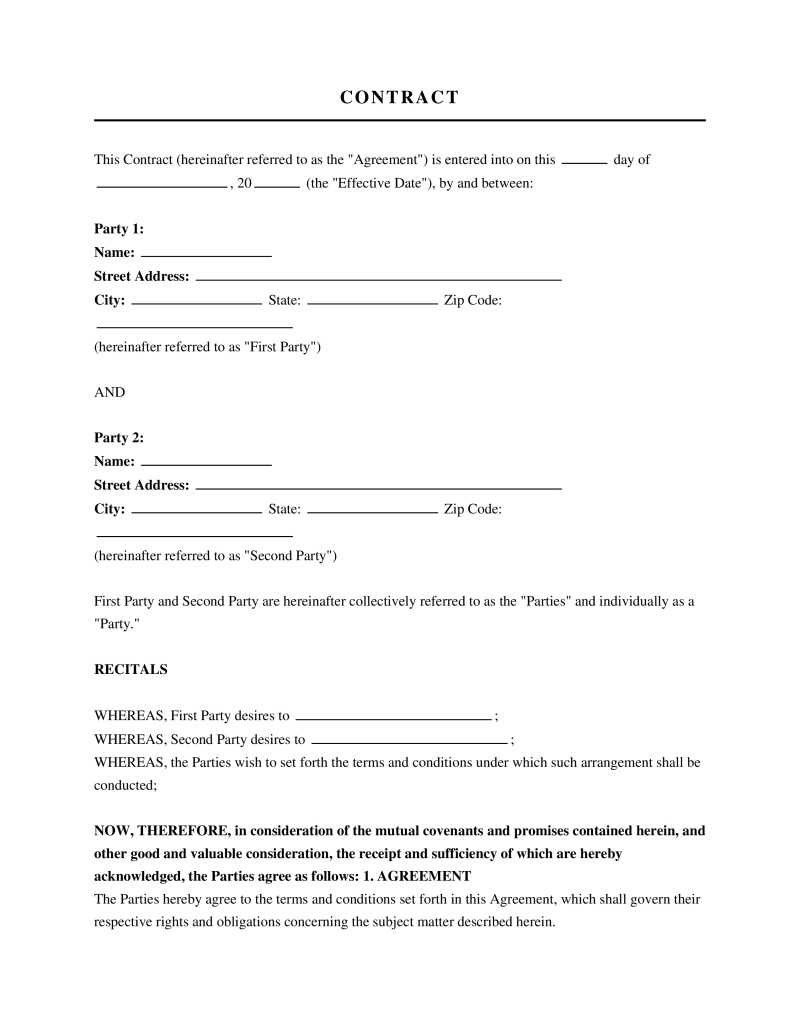
Contract Sample
0% Complete
0/0 Fields
Related Documents
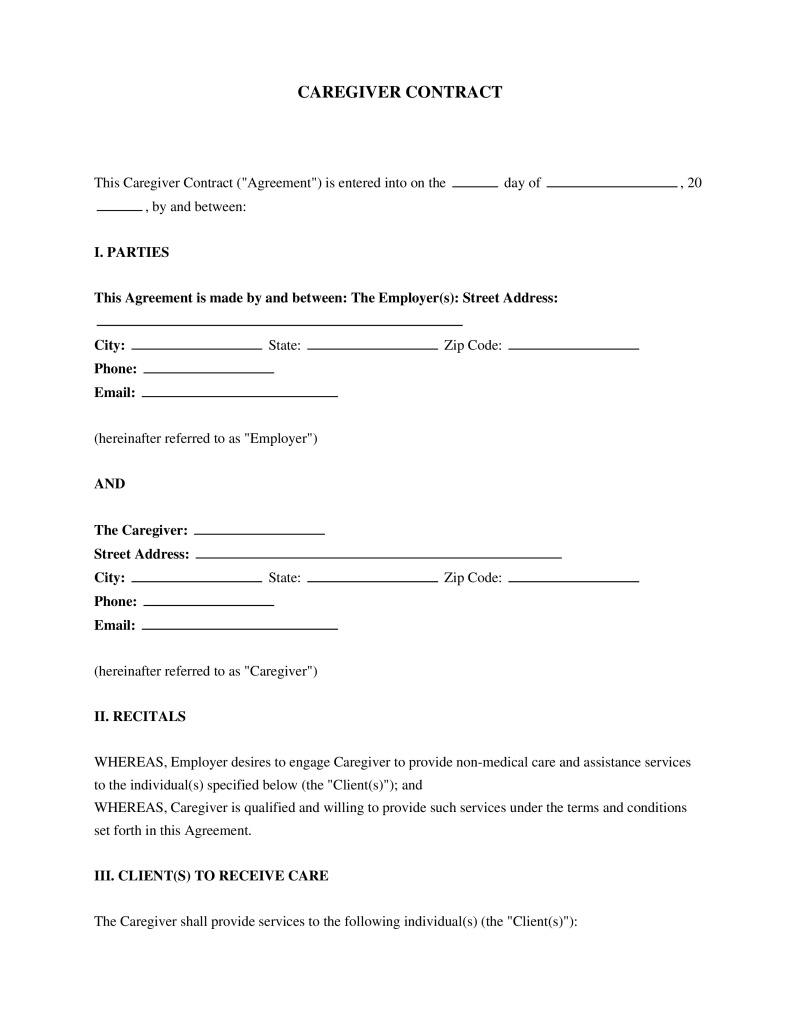
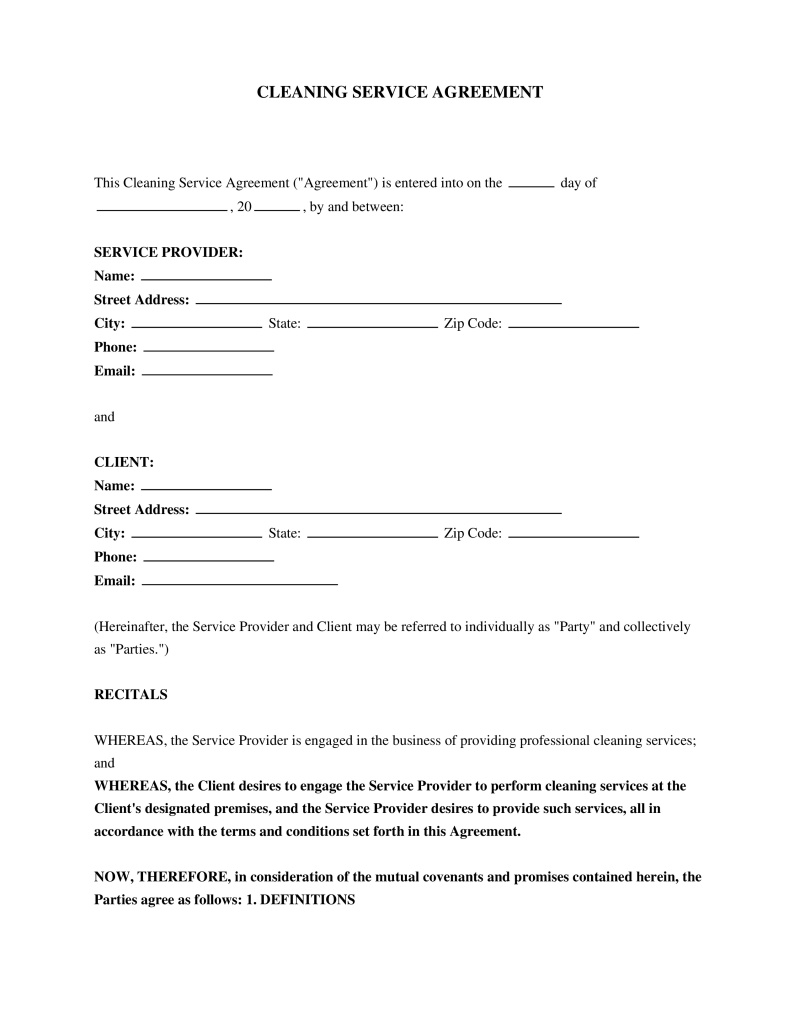
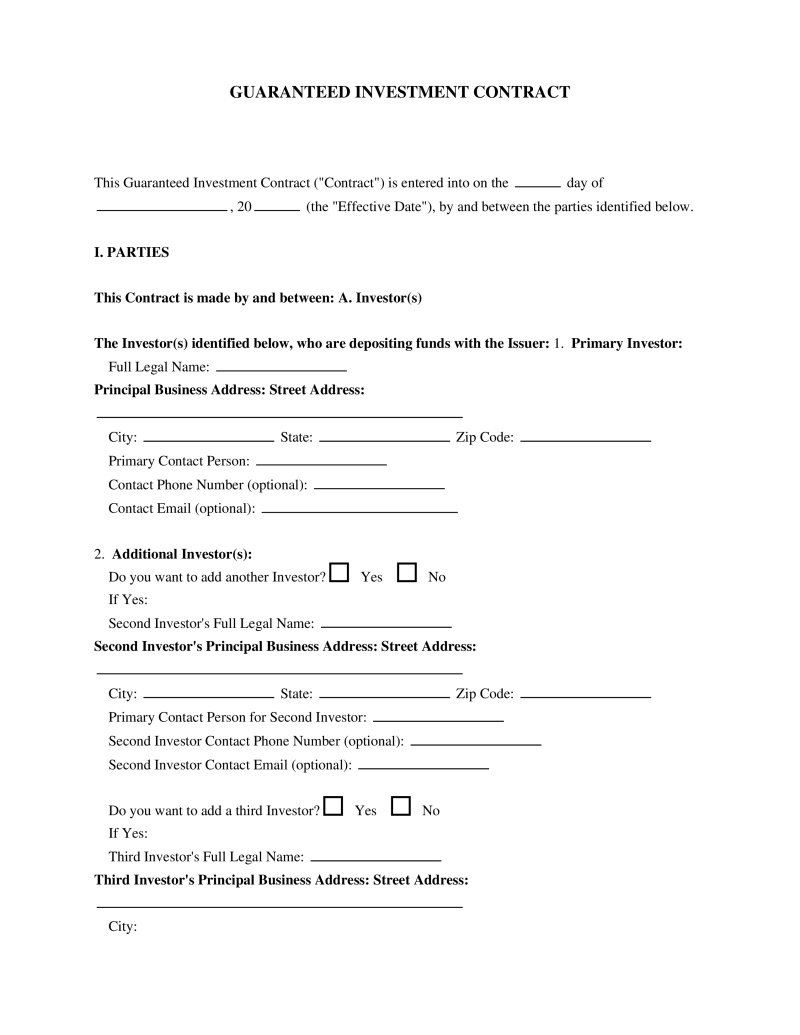
Forms commonly used with Contract.
Not the form you're looking for?
Try our legal document generator to create a custom document
Disclaimer: The templates available on this website are provided for general informational purposes only and do not constitute legal advice. They are not intended to be, and should not be interpreted as, compliant with any specific legal, regulatory, or privacy requirements. These templates are not a replacement for professional legal guidance and should not be relied upon for any particular matter or circumstance. Users are strongly encouraged to seek advice from a qualified attorney licensed in their jurisdiction before using, modifying, or relying on any template.
All templates are provided on an "as is," "with all faults," and "as available" basis. The provider disclaims any and all warranties of any kind, whether express, implied, statutory, or otherwise, including without limitation warranties of merchantability, fitness for a particular purpose, title, or non-infringement.
LegalTemplates.com makes no guarantees or representations regarding the accuracy, completeness, expected outcomes, or reliability of the materials contained in these templates or any materials referenced or linked from them.