Addendum
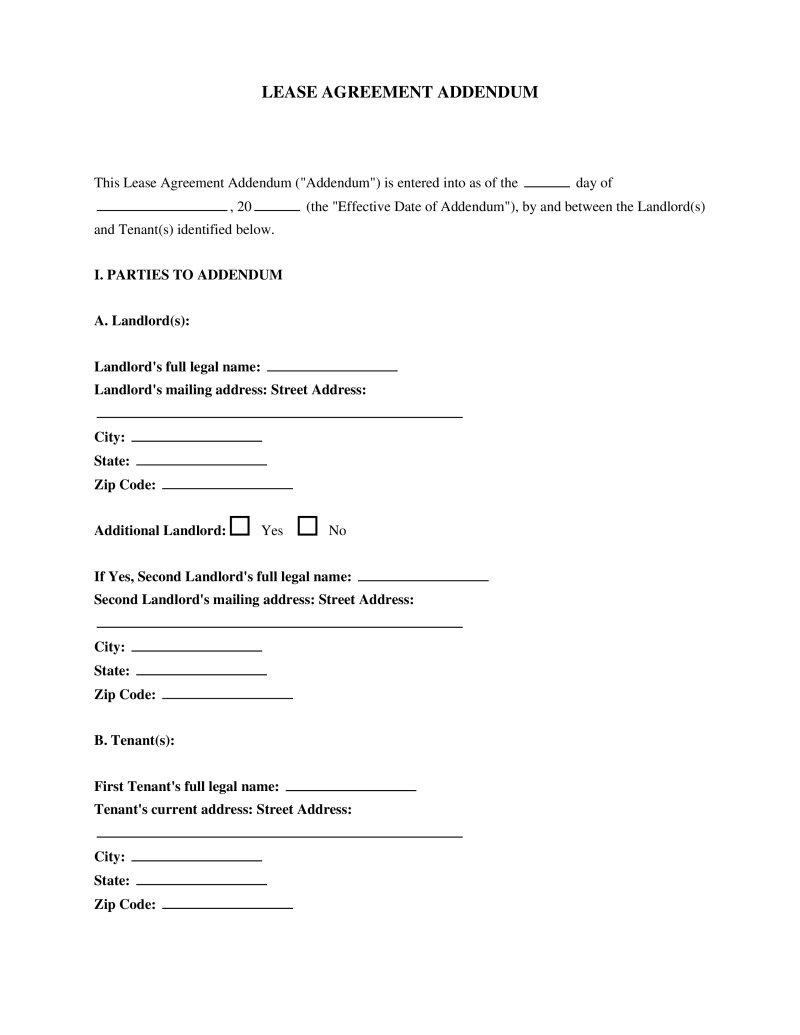
An Addendum is a supplemental legal document that modifies, clarifies, or adds specific terms and conditions to an existing primary agreement or instrument without altering its original text.
Addendum Effect Type
Select the main reason for this Addendum. You may specify details later.
Provide a brief description if you selected 'Other'.
Table of Contents
What is an Addendum?
An addendum is a document added to an existing agreement or contract, serving to introduce new terms, conditions, or information without altering the original text of the agreement. It typically clarifies or expands upon specific provisions that were not initially included or fully detailed. Parties use an addendum to ensure all aspects of an agreement are comprehensively addressed and mutually understood.
Purpose and Use of Addenda
The primary purpose of an addendum is to supplement an existing document, providing additional information or establishing new stipulations that become part of the original agreement. Unlike modifications that change existing clauses, an addendum typically introduces entirely new provisions while leaving the original text intact. This method allows for flexibility in contracts and agreements, enabling parties to adapt to new circumstances or requirements after the initial drafting.
Addenda are commonly employed across various legal and business contexts. They ensure that all pertinent details are formally incorporated into an agreement, maintaining the integrity of the original document while addressing evolving needs. The use of an addendum helps to prevent misunderstandings and disputes by clearly outlining additional responsibilities, rights, or conditions that arise post-execution of the main agreement.
Addendum vs. Amendment
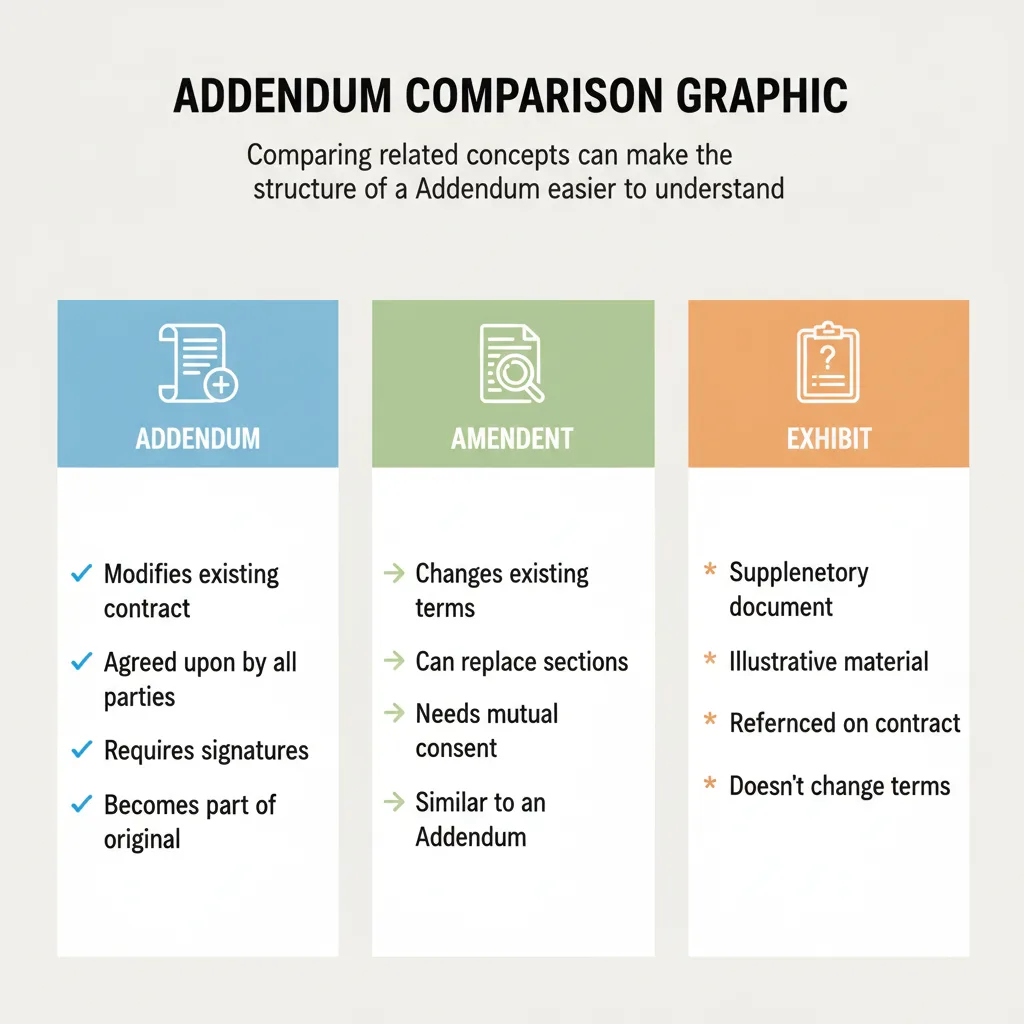
While often used interchangeably in casual language, 'addendum' and 'amendment' have distinct legal meanings and functions. Understanding this distinction is crucial for proper document management and legal clarity. An addendum generally adds new material to a document without changing any of the original text.
Conversely, an amendment involves a proposed change to a pending text, such as a bill, resolution, or treaty. An amendment directly modifies, strikes, or replaces existing language within the original document. In some legislative contexts, an 'amendment in the nature of a substitute' seeks to replace the entire text of an underlying measure with new content (Glossary of Legislative Terms).
Therefore, an addendum expands upon an agreement by appending new, supplementary information, whereas an amendment alters or substitutes parts of the agreement's original content. Both serve to refine or update a document, but they do so through different mechanisms.
Key Elements for Validity
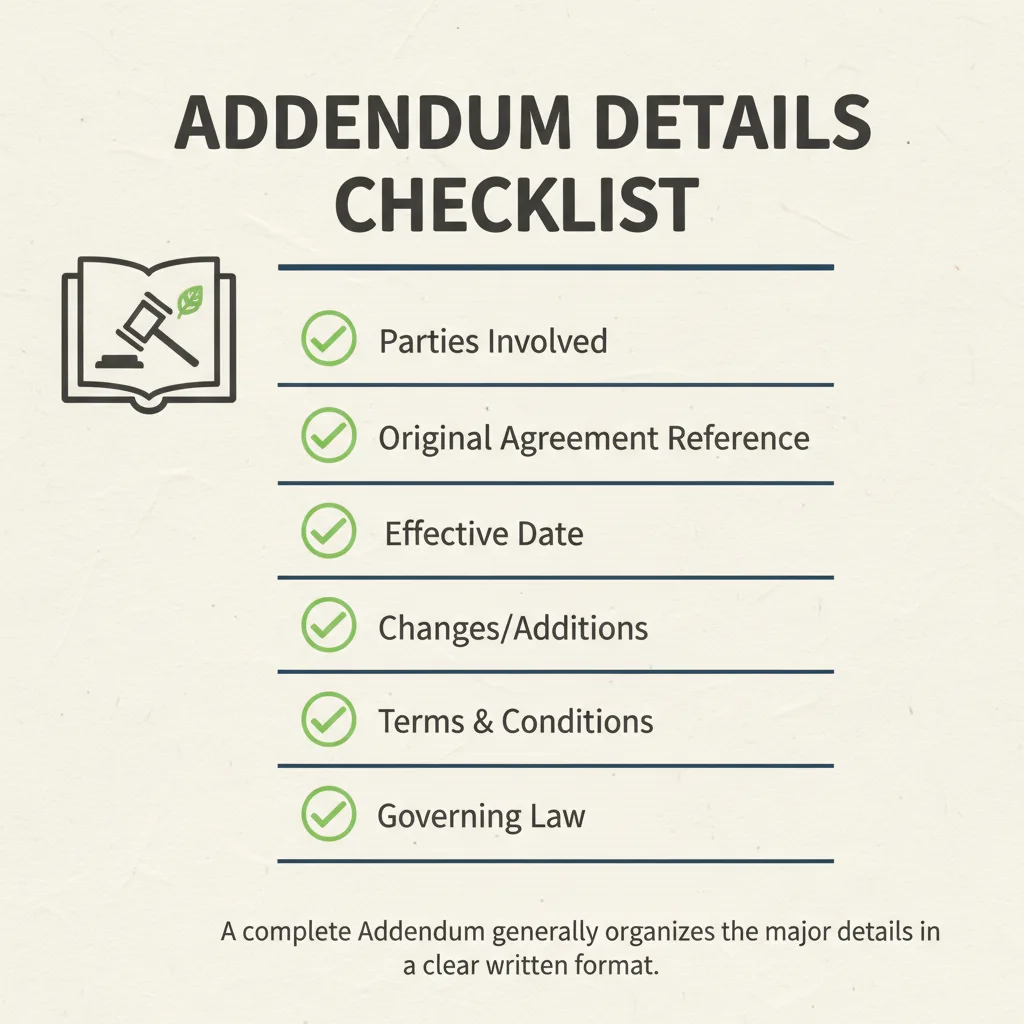
For an addendum to be legally binding and effective, it must meet several key criteria that ensure its proper integration with the original document and the informed consent of all parties involved. These elements are crucial for avoiding future disputes and ensuring enforceability:
- Clear Reference to Original Document - The addendum must explicitly identify the original contract or agreement it is intended to modify or supplement. This typically includes the date of the original agreement, the names of the parties involved, and sometimes a contract number or title.
- Specific New Terms or Conditions - The content of the addendum must clearly and unambiguously state the new terms, conditions, or information being added. Vague or open-ended language can lead to misinterpretation.
- Mutual Agreement and Intent - All parties to the original agreement must agree to the terms of the addendum. This signifies their intent to be bound by the additional provisions.
- Signatures of All Parties - The addendum must be signed by all parties who signed the original agreement. This formalizes their consent and makes the addendum an integral part of the overall contract.
- Effective Date - An addendum should specify an effective date, indicating when the new terms and conditions come into force. This can be the date of signing or a future specified date.
Proper adherence to these elements ensures that the addendum functions as a seamless extension of the original agreement, with the same legal weight and enforceability.
Addenda in Rental Housing
In the context of rental housing, addenda play a significant role, particularly in properties receiving federal funding. For instance, the rental housing tenancy addendum is a crucial document for properties that receive HOME funding for their construction, rehabilitation, or acquisition on or after the rule's effective date (HOME Program 2025 Final Rule: In Brief).
This specific addendum is designed to lay out important tenant protections for residents. Key provisions typically included in such tenancy addendums are:
- Owner's Responsibilities - Details the owner's obligation to maintain the physical condition of both the individual unit and the entire project.
- Tenant Rights - Outlines tenant rights to organize and establish tenant associations, promoting collective action and representation.
- Security Deposit Limitations - Specifies limitations on the amount and use of security deposits, protecting tenants from excessive or improperly withheld funds.
- Lease Term Requirements - Ensures that initial lease terms are for a minimum of one year, providing tenants with stability.
- Notice Requirements for Non-Renewal - Mandates appropriate notice periods for lease non-renewal, giving tenants sufficient time to find alternative housing.
These addendums ensure that tenants in federally supported housing are afforded specific protections beyond what might be in a standard lease agreement, aligning with program goals for affordable and safe housing.
Addenda and Confidential Business Information
Addenda can also be essential when dealing with sensitive information, such as confidential business information, especially in regulated industries. The Chemical Weapons Convention Implementation Act of 1998, for example, defines confidential business information to include various categories of data.
When parties enter into agreements that involve the sharing or handling of such sensitive data, an addendum may be used to specify additional non-disclosure terms, data handling protocols, or security measures that supplement a broader contract. The Act defines confidential business information as information falling into categories such as (Chemical Weapons Convention Regulations):
- Financial Data - Pertaining to a company's financial performance, assets, or liabilities.
- Sales and Marketing Data - Information related to sales strategies, customer lists, or market analysis.
- Pricing Data - Details regarding product or service pricing structures and methodologies.
- Personnel Data - Information about employees, including salaries, performance, or personal details.
- Research Data - Findings, methodologies, or intellectual property from research and development activities.
- Patent Data - Information related to patents, patent applications, or proprietary technologies.
In such scenarios, a confidentiality addendum ensures that all parties are explicitly aware of their obligations regarding the protection and restricted use of this sensitive information, reinforcing the terms of the main agreement.
Frequently Asked Questions
Sources
- Glossary of Legislative Terms - Provides definitions of legislative terms, including 'amendment' and 'amendment in the nature of a substitute'.
- HOME Program 2025 Final Rule: In Brief - Discusses tenant protections in rental housing, including requirements for tenancy addendums in properties receiving HOME funding.
Not the form you're looking for?
Try our legal document generator to create a custom document
Disclaimer: The templates available on this website are provided for general informational purposes only and do not constitute legal advice. They are not intended to be, and should not be interpreted as, compliant with any specific legal, regulatory, or privacy requirements. These templates are not a replacement for professional legal guidance and should not be relied upon for any particular matter or circumstance. Users are strongly encouraged to seek advice from a qualified attorney licensed in their jurisdiction before using, modifying, or relying on any template.
All templates are provided on an "as is," "with all faults," and "as available" basis. The provider disclaims any and all warranties of any kind, whether express, implied, statutory, or otherwise, including without limitation warranties of merchantability, fitness for a particular purpose, title, or non-infringement.
LegalTemplates.com makes no guarantees or representations regarding the accuracy, completeness, expected outcomes, or reliability of the materials contained in these templates or any materials referenced or linked from them.