Writ of Possession
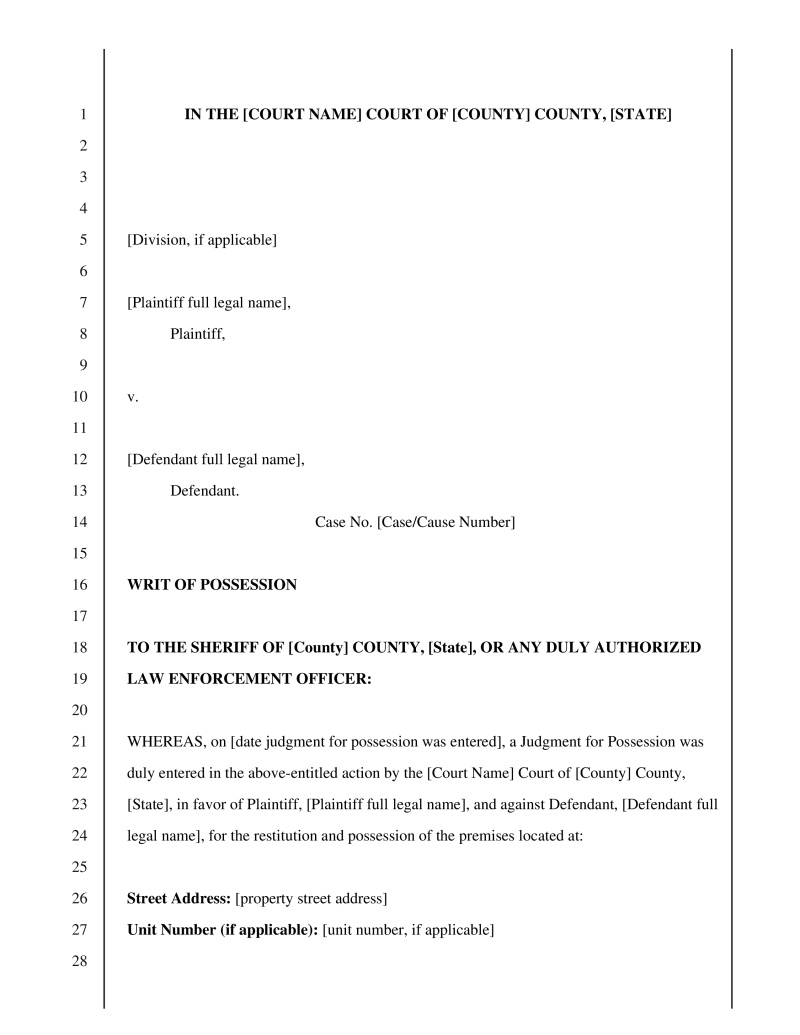
A Writ of Possession is a legal instrument issued by a court, compelling law enforcement to restore physical possession of real property to a successful claimant, typically following an eviction judgment.
Property Type
Select the category that best describes the property.
Provide details if you selected 'Other'.
Table of Contents
What is a Writ of Possession?
A Writ of Possession is a legal document issued by a court that authorizes a party to take physical possession of property, most commonly real estate. It serves as the enforcement mechanism for a judgment that grants possession to a plaintiff. This judicial order directs a law enforcement officer, such as a sheriff or marshal, to remove occupants or property and transfer control to the rightful claimant.
Purpose and Scope
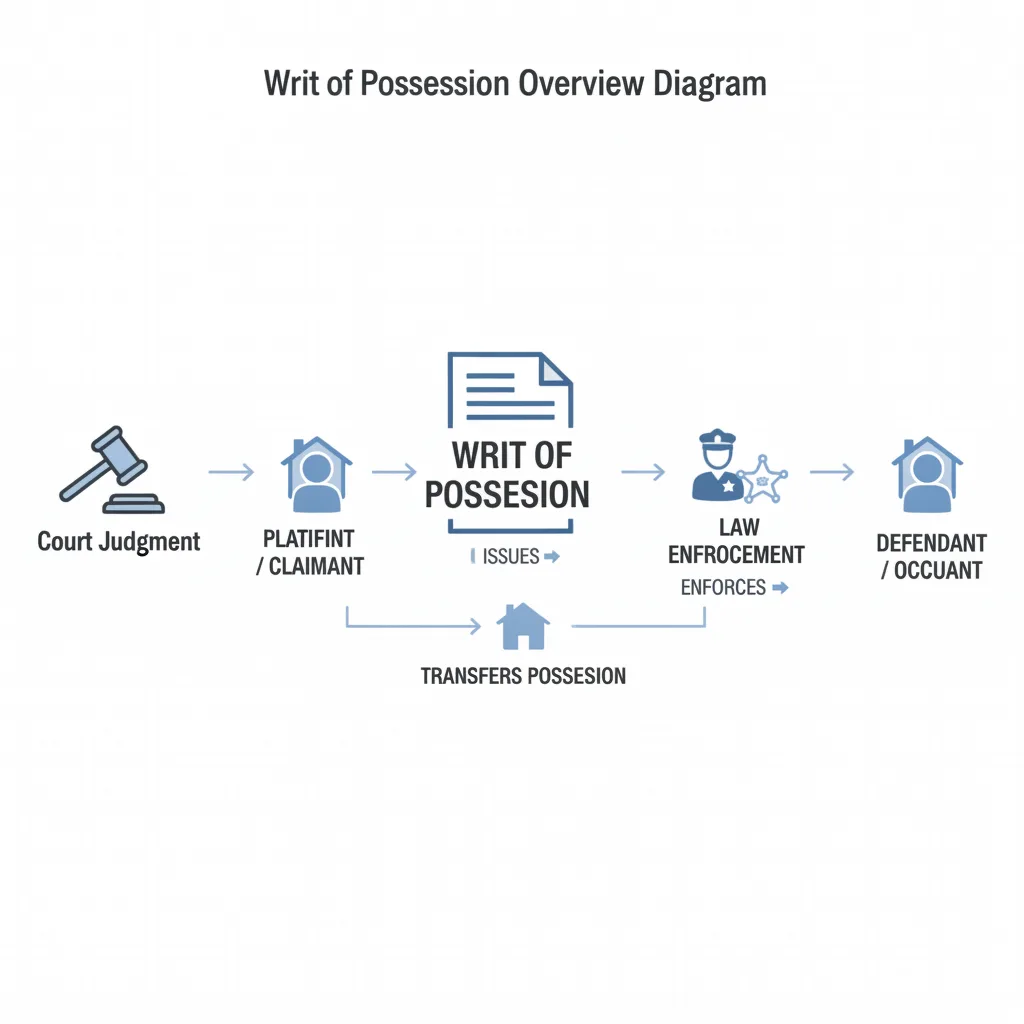
The primary purpose of a Writ of Possession is to ensure that a court's judgment regarding property ownership or tenancy is physically enforced. It provides a definitive legal remedy for a party who has successfully proven their right to occupy or control a specific piece of property.
While most commonly associated with real estate, such as in eviction or foreclosure proceedings, a writ of possession can also apply to personal property. In such cases, it enables a party to recover specific movable items that are unlawfully held by another, following a successful claim in a legal action like replevin.
The Legal Process Leading to a Writ
A Writ of Possession is not an initial filing but rather the culmination of a successful legal proceeding. It is issued only after a court has rendered a judgment in favor of the party seeking possession.
The process generally involves several stages:
- Initial Legal Action - A plaintiff initiates a lawsuit, such as an unlawful detainer (eviction), foreclosure, or replevin action, to establish their right to possession.
- Court Judgment - If the plaintiff prevails in the lawsuit, the court issues a judgment declaring their entitlement to the property. This judgment is a prerequisite for obtaining the writ.
- Application for Writ - The winning party then applies to the court clerk for the issuance of the Writ of Possession, presenting the judgment as proof of their entitlement.
- Issuance of the Writ - Upon verifying the judgment and application, the court clerk formally issues the writ, directing law enforcement to execute the court's order.
Key Elements and Information
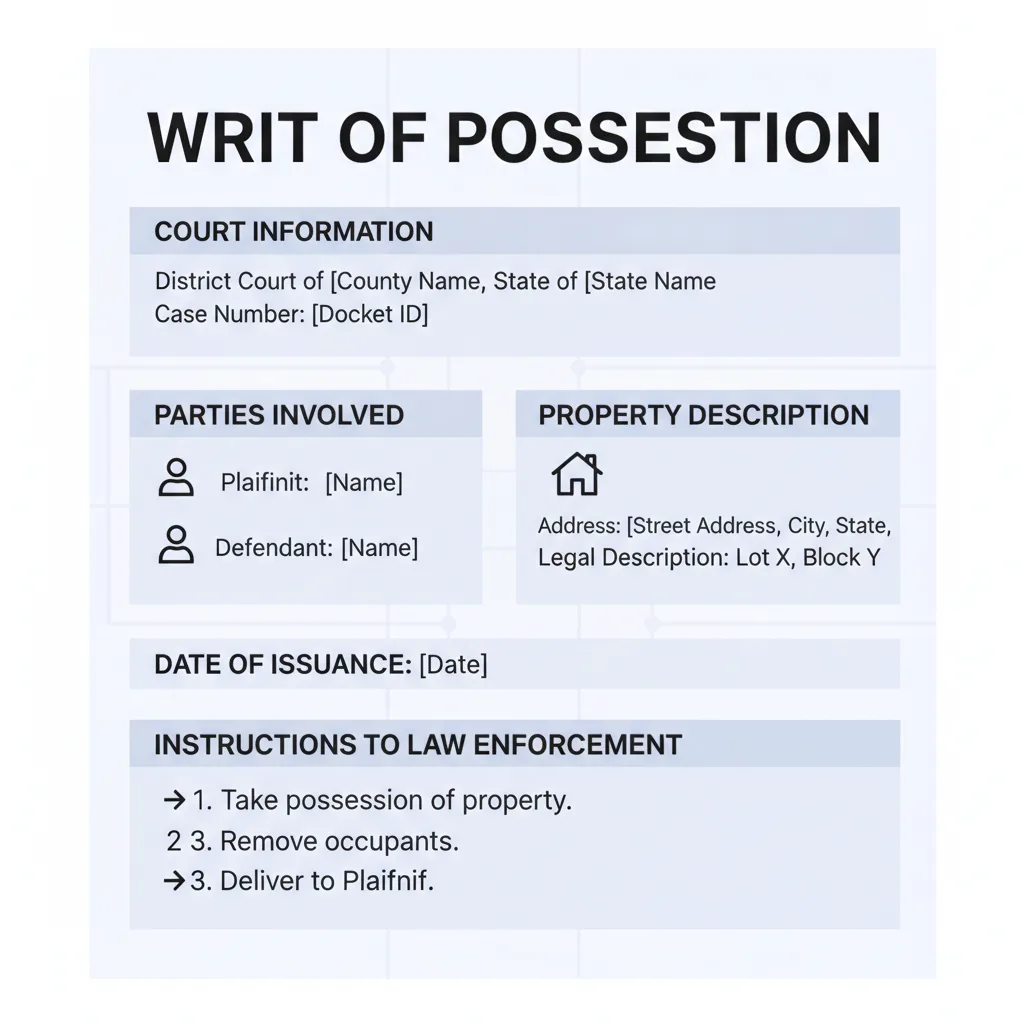
A Writ of Possession is a formal court document and typically contains specific information necessary for its proper execution. The details included ensure that the enforcing officer can accurately identify the parties involved and the property in question.
Common elements found on a Writ of Possession include:
- Court Information - The name of the court that issued the writ and the case number.
- Parties Involved - The full names of the plaintiff (the party entitled to possession) and the defendant (the party to be removed or from whom property is recovered).
- Property Description - A clear and precise description of the property to be possessed. For real estate, this includes the full street address. For personal property, it involves specific identifying details of the items.
- Date of Issuance - The date on which the writ was formally issued by the court.
- Direction to Law Enforcement - An explicit command to a specific law enforcement agency (e.g., sheriff's department, marshal's office) to execute the order.
- Execution Period - Often, a timeframe within which the writ must be executed, typically a number of days from its issuance.
Execution of the Writ
Once issued, the Writ of Possession is delivered to the designated law enforcement agency for execution. The execution process is typically governed by specific procedural rules to ensure due process while facilitating the transfer of possession.
Key aspects of executing a Writ of Possession include:
- Delivery to Law Enforcement - The plaintiff usually delivers the writ to the sheriff or marshal, along with any required fees for service.
- Notice to Occupants - In most jurisdictions, law enforcement is required to provide a notice period to the occupants of the property. This notice, often posted on the premises, informs them of the impending eviction and the deadline to vacate, which can range from 24 to 72 hours.
- Removal of Occupants - If the occupants fail to vacate the premises by the specified deadline, the law enforcement officer is authorized to forcibly remove them.
- Handling of Personal Property - Procedures for dealing with personal belongings left behind vary by jurisdiction. Often, the plaintiff is responsible for removing and storing the property, with specific guidelines for notification to the former occupants and eventual disposal if not claimed.
- Securing the Property - After occupants and their belongings are removed, law enforcement will typically turn over possession of the property to the plaintiff, who then takes steps to secure it, such as changing locks.
Types of Writs of Possession
While the fundamental purpose of a writ of possession remains consistent—to restore physical control of property—its application can vary depending on the nature of the property involved and the underlying legal action.
- Writ of Possession of Real Property - This is the most common form, used to remove individuals from land or buildings. It is typically issued after a successful unlawful detainer action (eviction) or a foreclosure proceeding, granting the landlord or new owner legal possession of the premises.
- Writ of Possession of Personal Property - Less frequent but equally valid, this writ is issued in cases where a court has determined that a plaintiff is entitled to specific movable items (chattels) that are currently in the unlawful possession of another party. This typically arises from replevin actions, where the plaintiff seeks the return of their specific property, rather than monetary damages.
Distinctions and Related Concepts
It is important to differentiate a Writ of Possession from other related legal instruments that serve different enforcement purposes.
The Writ of Possession focuses exclusively on restoring physical control of property. In contrast, a Writ of Execution is a broader court order primarily used to enforce a monetary judgment. It authorizes law enforcement to seize and sell a debtor's assets (both real and personal) to satisfy a debt, rather than to transfer possession of a specific property to a claimant. While both are tools for enforcing judgments, their objectives and methods of application differ significantly.
Frequently Asked Questions
Not the form you're looking for?
Try our legal document generator to create a custom document
Disclaimer: The templates available on this website are provided for general informational purposes only and do not constitute legal advice. They are not intended to be, and should not be interpreted as, compliant with any specific legal, regulatory, or privacy requirements. These templates are not a replacement for professional legal guidance and should not be relied upon for any particular matter or circumstance. Users are strongly encouraged to seek advice from a qualified attorney licensed in their jurisdiction before using, modifying, or relying on any template.
All templates are provided on an "as is," "with all faults," and "as available" basis. The provider disclaims any and all warranties of any kind, whether express, implied, statutory, or otherwise, including without limitation warranties of merchantability, fitness for a particular purpose, title, or non-infringement.
LegalTemplates.com makes no guarantees or representations regarding the accuracy, completeness, expected outcomes, or reliability of the materials contained in these templates or any materials referenced or linked from them.