Subpoena
A subpoena is a legal writ or order issued by a court or administrative agency, compelling an individual to appear and provide testimony, or to produce specified documents or other evidence, in a legal or administrative proceeding.
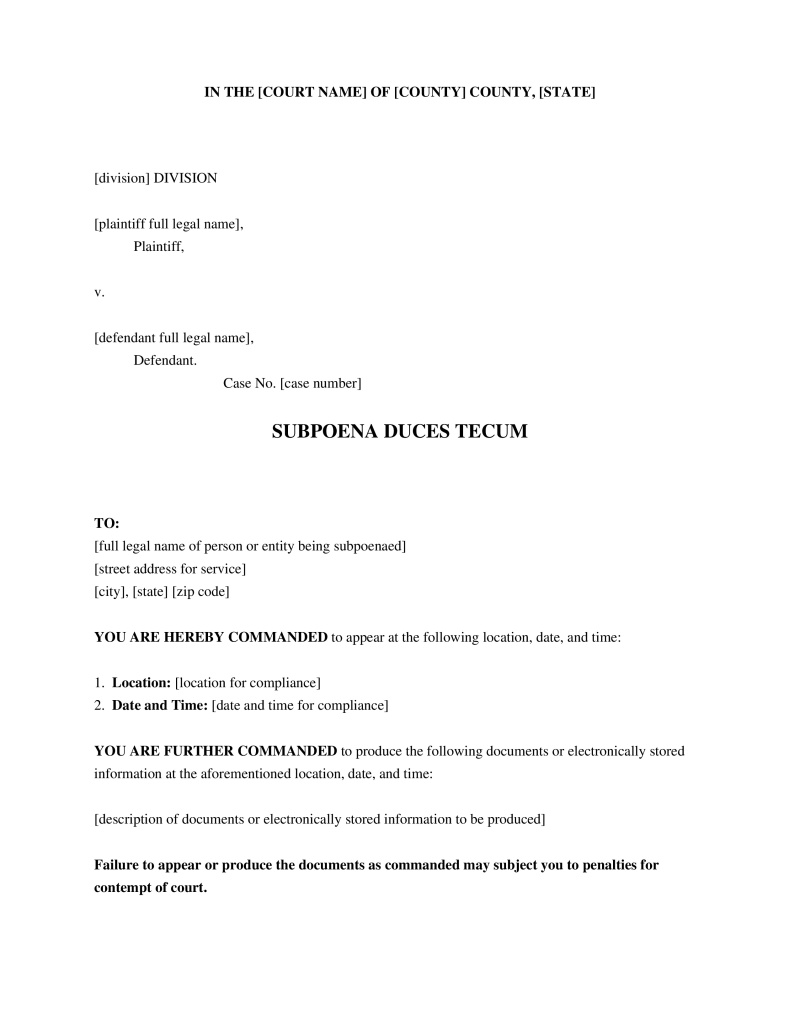
Subpoena Action Type
Select whether the subpoena commands appearance, production of documents, or both.
Specify the type of proceeding for which appearance is required.
Provide details if 'Other' was selected.
Table of Contents
What is a Subpoena?
A subpoena is a legal document that compels an individual to appear, testify, or produce evidence in a legal proceeding. Issued by a court, it serves as an official command, ensuring the availability of necessary information or witnesses for trials, hearings, or depositions. Subpoenas are critical instruments in the discovery phase of litigation, helping parties gather facts and prepare their cases.
Purpose and Function
The primary purpose of a subpoena is to facilitate the administration of justice by ensuring that all relevant information and testimony are brought before the court. It grants parties in a legal dispute the ability to compel attendance or production from non-parties who might possess crucial evidence but are not directly involved in the lawsuit. This legal mechanism prevents individuals or entities from withholding information vital to a fair resolution.
Subpoenas are commonly employed in civil and criminal cases, as well as administrative proceedings. They are essential for obtaining witness testimony under oath, whether in a courtroom or during a deposition, and for securing physical evidence such as documents, electronic data, or objects relevant to the case. Without the power of a subpoena, parties would struggle to access information held by reluctant third parties, potentially hindering the pursuit of truth and justice.
Types of Subpoenas
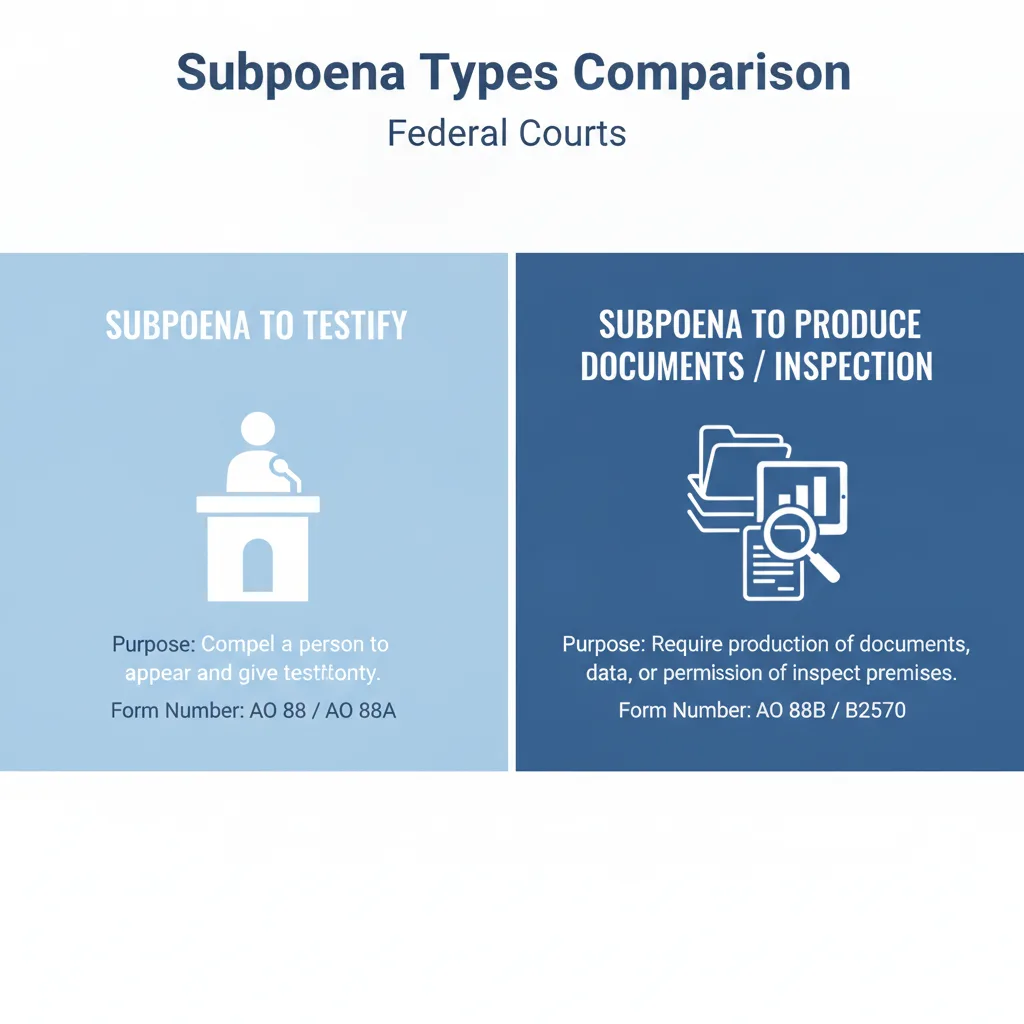
Federal courts utilize specific forms for different types of subpoenas, each designed for a particular purpose:
- Subpoena to Appear and Testify at a Hearing or Trial in a Civil Action (Form AO 88) - This form commands an individual to appear in court to give testimony during a civil hearing or trial.
- Subpoena to Testify at a Deposition in a Civil Action (Form AO 88A) - Used to compel a person to appear and provide sworn testimony outside of court, typically before a court reporter, in a civil deposition.
- Subpoena to Produce Documents, Information, or Objects or to Permit Inspection of Premises in a Civil Action (Form AO 88B) - This subpoena requires a person or entity to produce specified documents, electronically stored information, or physical objects, or to allow inspection of premises relevant to a civil action.
- Subpoena to Produce Documents, Information, or Objects or to Permit Inspection of Premises in a Bankruptcy Case (or Adversary Proceeding) (Form B2570) - Specifically tailored for bankruptcy proceedings, this form compels the production of evidence or permission for inspection in a bankruptcy case or an associated adversary proceeding.
Issuance and Form Requirements
In federal courts, subpoenas are typically issued by the clerk of court. Parties requesting a subpoena must follow specific procedures to ensure its validity and proper issuance. The process can often be completed either by mail or in person at the Clerk's Office.
When requesting a subpoena, certain details and documents are required:
- Mail Requests - Must include a cover letter, the appropriate subpoena form (AO-88, AO-88A, or AO-88B), and a self-addressed stamped envelope for return.
- In-Person Requests - Require the completed subpoena form and specific case details; the Clerk's Office will issue a signed but otherwise blank subpoena, which the requesting party must then complete before service.
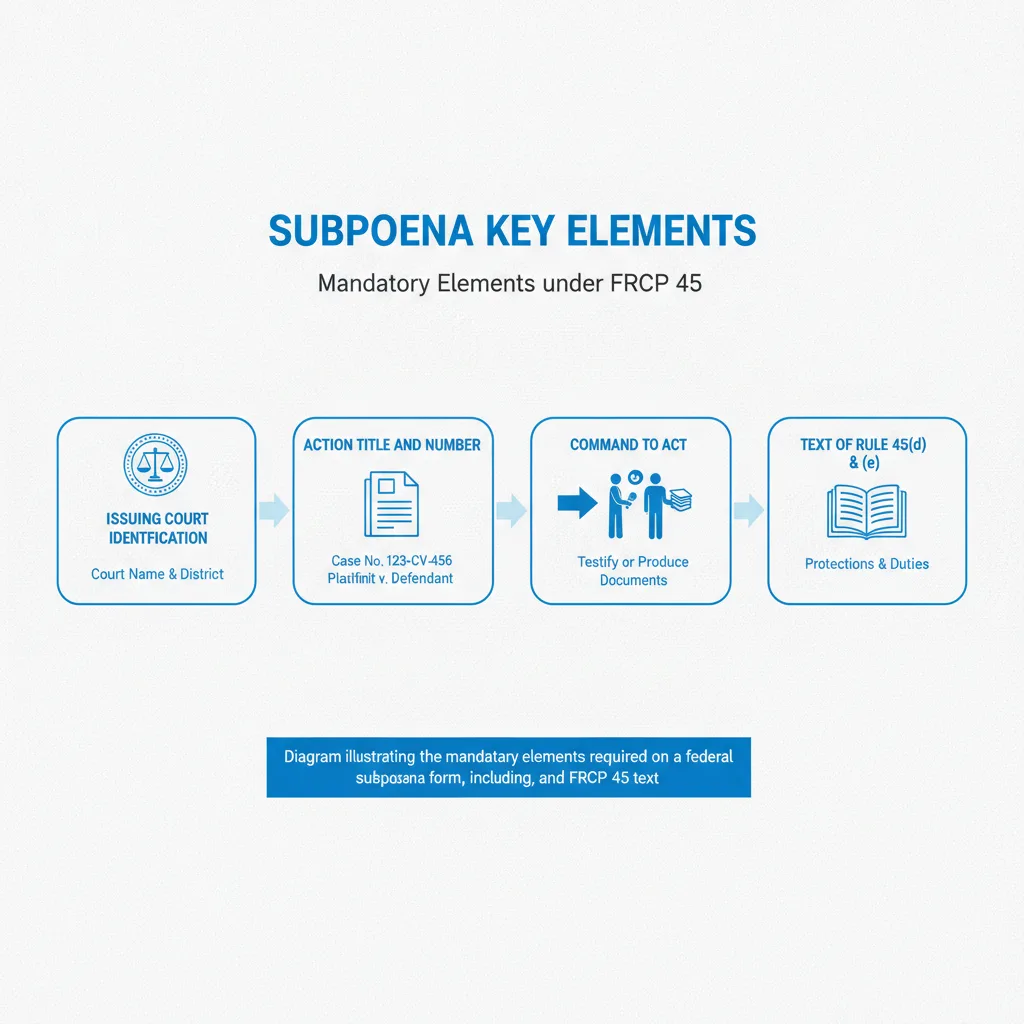
Federal Rule of Civil Procedure 45 outlines the essential elements that a subpoena must contain to be valid:
- Issuing Court Identification - The subpoena must clearly state the court from which it was issued.
- Action Title and Number - It must include the title of the action and its civil-action number to identify the specific case.
- Command to Act - The subpoena must command each person to attend and testify, produce designated documents, electronically stored information, or objects, or permit the inspection of premises at a specified time and place.
- Text of Rule 45(d) and (e) - The subpoena must explicitly set out the text of Federal Rule of Civil Procedure 45(d) and (e), which detail the duties in responding to a subpoena and protecting persons subject to a subpoena.
Service of Process
Once issued, a subpoena must be properly served on the person or entity it is directed to. Federal Rule of Civil Procedure 45 governs the requirements for serving a subpoena in federal civil cases. Proper service is crucial for the subpoena to be legally binding and enforceable.
Generally, a subpoena must be served personally, meaning it must be delivered directly to the individual named. The person serving the subpoena must be at least 18 years old and not a party to the action. Proof of service, often in the form of an affidavit or declaration, must be filed with the court, confirming that the subpoena was delivered according to the rules. This documentation is essential for demonstrating that the recipient was duly notified of their legal obligation.
Federal Rule of Civil Procedure 45
Federal Rule of Civil Procedure 45 (FRCP 45) provides the comprehensive framework for subpoenas in federal civil cases. This rule governs every aspect, from the form and issuance to the service and enforcement of subpoenas. Its provisions ensure that subpoenas are used appropriately and that individuals subject to them are afforded proper protections.
Key aspects governed by FRCP 45 include:
- Form and Contents - Dictates what information must be included in a subpoena, such as the court, case details, and the specific command (e.g., to testify or produce documents).
- Issuance - Specifies who can issue a subpoena and the procedures for obtaining one from the clerk of court.
- Service - Outlines the requirements for properly serving a subpoena, including who can serve it and how.
- Protecting a Person Subject to a Subpoena - Provides mechanisms for individuals to object to or move to quash a subpoena if it is unduly burdensome, requires disclosure of privileged information, or does not allow sufficient time for compliance.
- Duties in Responding to a Subpoena - Details the obligations of the recipient, such as producing documents as they are kept in the ordinary course of business or organizing them to correspond to the categories in the demand.
- Contempt - Establishes that failure to obey a subpoena without adequate excuse may be considered contempt of court, leading to potential penalties.
Frequently Asked Questions
Sources
- Obtaining a Subpoena | Central District of California | United States District Court - Guidelines for requesting a subpoena in the Central District of California, including required forms and procedures.
- Forms | United States Courts - Official forms for subpoenas used in federal courts, including AO 88, AO 88A, and AO 88B.
- Rule 45. Subpoena | United States District Court for the Northern District of Illinois - Text of Federal Rule of Civil Procedure 45, governing subpoenas in federal civil cases.
- Subpoena to Produce Documents, Information, or Objects or to Permit Inspection of Premises in a Bankruptcy Case (or Adversary Proceeding) | - Official form B2570 for subpoenas in bankruptcy cases or adversary proceedings.
Not the form you're looking for?
Try our legal document generator to create a custom document
Disclaimer: The templates available on this website are provided for general informational purposes only and do not constitute legal advice. They are not intended to be, and should not be interpreted as, compliant with any specific legal, regulatory, or privacy requirements. These templates are not a replacement for professional legal guidance and should not be relied upon for any particular matter or circumstance. Users are strongly encouraged to seek advice from a qualified attorney licensed in their jurisdiction before using, modifying, or relying on any template.
All templates are provided on an "as is," "with all faults," and "as available" basis. The provider disclaims any and all warranties of any kind, whether express, implied, statutory, or otherwise, including without limitation warranties of merchantability, fitness for a particular purpose, title, or non-infringement.
LegalTemplates.com makes no guarantees or representations regarding the accuracy, completeness, expected outcomes, or reliability of the materials contained in these templates or any materials referenced or linked from them.