Week on Week Off Schedule Template
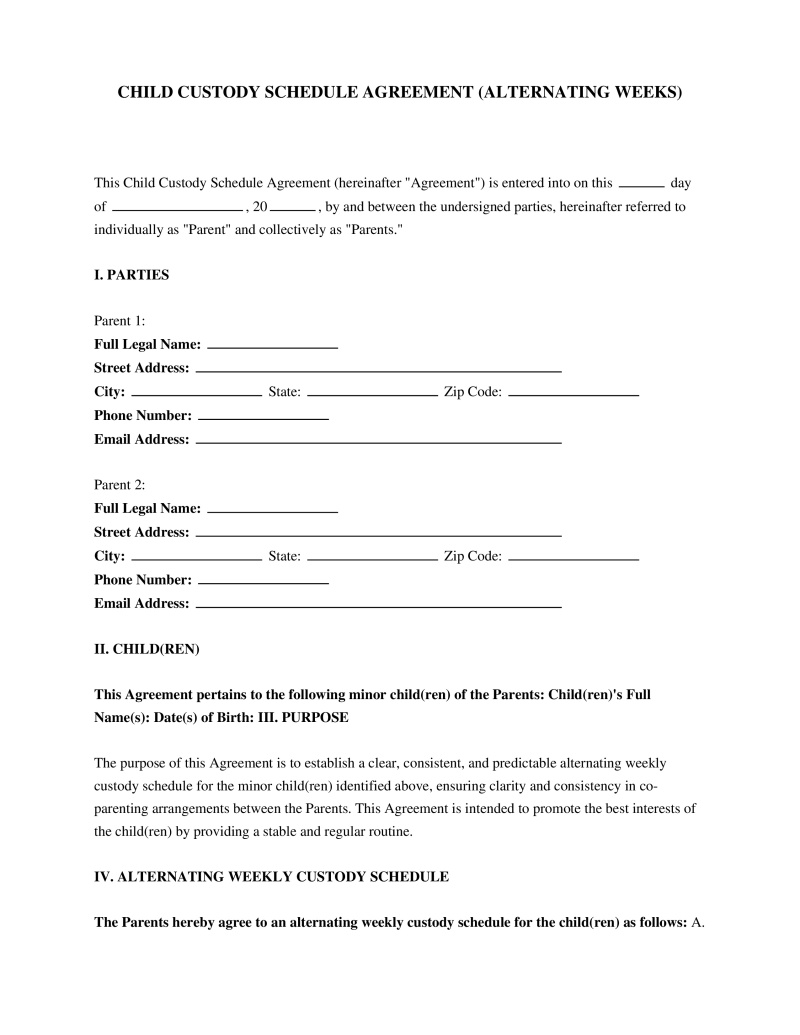
A Week on Week Off Schedule Template is a standardized legal instrument used within parenting plans to delineate alternating residential custody.
Schedule Start Type
Choose whether the schedule starts on a specific date or with a specific parent.
Enter the date the schedule will begin.
Select the parent who will begin the alternating week schedule.
Table of Contents
What Is a Week-On, Week-Off Parenting Schedule?
A week-on, week-off parenting schedule is a 50/50 shared physical custody arrangement where a child spends seven consecutive days with one parent before rotating to the other. In legal terms, this is often referred to as alternating weekly custody.
While this model is popular for its simplicity, its success depends heavily on the "Best Interests of the Child" standard—a legal doctrine used by family courts globally to determine custody arrangements.
The Legal Framework: Why Courts Approve This Schedule
Most jurisdictions (such as under the Uniform Child Custody Jurisdiction and Enforcement Act (UCCJEA) in the U.S. or the Children Act 1989 in the UK) operate on the presumption that frequent and continuing contact with both parents is beneficial.
1. The "Best Interests of the Child" Standard
Courts do not grant 50/50 schedules just because it is "fair" to parents. Under statutes like California Family Code § 3011 or Florida Statutes § 61.13, judges evaluate:
- The emotional ties between the parent and child.
- The ability of each parent to provide a stable environment.
- The child’s developmental stage (week-long separations can be difficult for infants).
2. Geographic Proximity
For a week-on, week-off schedule to be legally viable, parents must typically live in close proximity. If the commute interferes with the child's right to education (compulsory attendance laws), a judge may rule the schedule "logistically auctions" and deny the plan.
Strategic Components of an Enforceable Parenting Plan
To make a parenting plan legally robust and "Google-friendly" (by providing high utility), it must address the following technical details:
| Component | Legal/Practical Importance |
|---|---|
| The "Transition Day" | Often Friday (after school) or Monday (dropping off at school) to minimize direct parental conflict. |
| Right of First Refusal | A clause stating that if a parent cannot care for the child for more than X hours, they must offer the other parent the time first. |
| Choice of Law | Specifying which state/county laws govern the agreement, especially in move-away cases. |
| Tie-Breaker Provisions | Legal language defining how disputes are settled (e.g., mandatory mediation) before returning to court. |
Expert Tips for Successful Implementation
- The "School Sack" System: To reduce transition anxiety, keep duplicate sets of essentials (pajamas, toiletries, chargers) at both homes. The child should only need to transport a backpack and specific school projects.
- Shared Digital Calendars: Use tools like OurFamilyWizard or AppClose. Courts often prefer these because they create an admissible "paper trail" of communication.
- Standardized Discipline: Research suggests that 50/50 splits are most effective when "House Rules" (bedtimes, screen time, homework) are synchronized to prevent "splitting" behaviors in children.
Risks and Legal Consequences
It is vital to remember that once a parenting plan is signed by a judge, it becomes a Court Order.
- Contempt of Court: Repeatedly failing to follow the exchange times can lead to "Contempt" charges, resulting in fines or even jail time.
- Custody Modification: Under laws like Texas Family Code § 156.101, a "material and substantial change in circumstances" is required to change this schedule once it's set.
- Child Support Impact: In many states, a 50/50 split may reduce child support obligations, but it does not necessarily eliminate them if there is a significant income disparity between parents.
Disclaimer: While this guide outlines legal principles, family law varies significantly by jurisdiction. Always consult with a licensed attorney in your area to ensure your parenting plan complies with local statutes.
Not the form you're looking for?
Try our legal document generator to create a custom document
Disclaimer: The templates available on this website are provided for general informational purposes only and do not constitute legal advice. They are not intended to be, and should not be interpreted as, compliant with any specific legal, regulatory, or privacy requirements. These templates are not a replacement for professional legal guidance and should not be relied upon for any particular matter or circumstance. Users are strongly encouraged to seek advice from a qualified attorney licensed in their jurisdiction before using, modifying, or relying on any template.
All templates are provided on an "as is," "with all faults," and "as available" basis. The provider disclaims any and all warranties of any kind, whether express, implied, statutory, or otherwise, including without limitation warranties of merchantability, fitness for a particular purpose, title, or non-infringement.
LegalTemplates.com makes no guarantees or representations regarding the accuracy, completeness, expected outcomes, or reliability of the materials contained in these templates or any materials referenced or linked from them.