Lien Waiver Form
A Lien Waiver Form is a legal document that formally relinquishes a party's right to assert a lien against a property, typically upon receipt of payment.
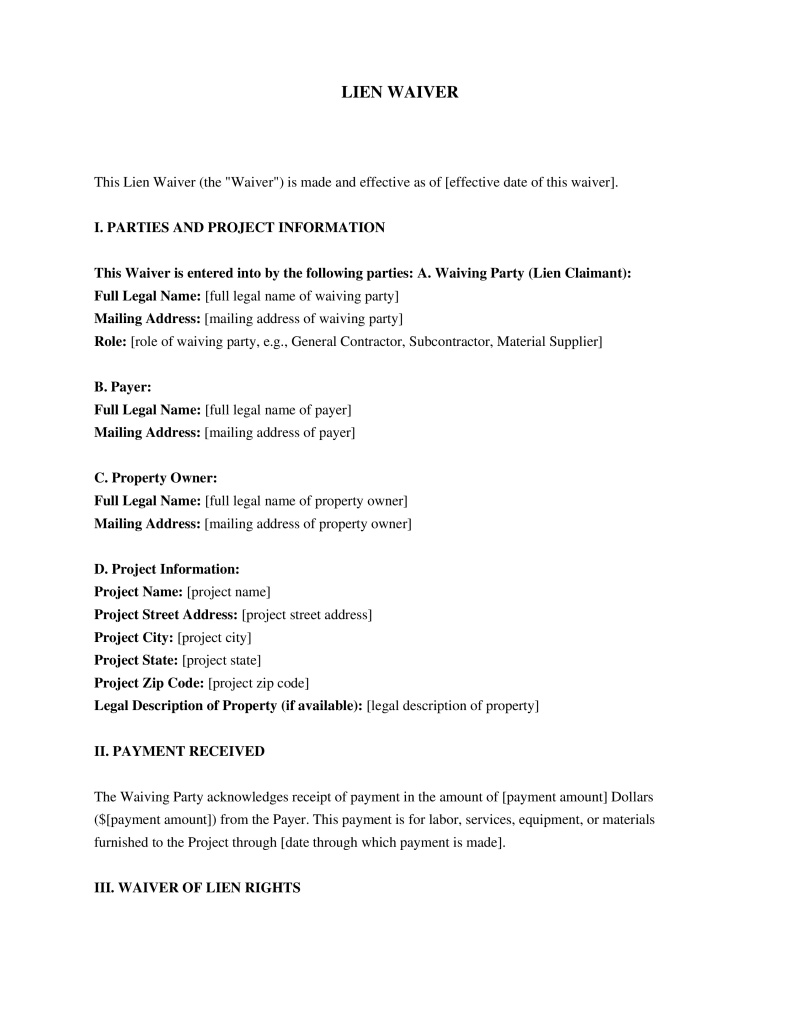
Waiver Type
Select the type of lien waiver that applies to your situation. Consult your contract or state law if unsure.
Table of Contents
What is a Lien Waiver Form?
A lien waiver form is a legal document used to relinquish a party's right to place a lien on a property. It is typically executed in exchange for payment, serving as proof that the claimant has received funds and therefore waives their ability to assert a lien claim for the specified amount or period. This document is crucial in various industries, particularly in construction and real estate, but also in specific agricultural contexts, to ensure clear title and mitigate financial risk for property owners and lenders.
Types of Lien Waivers
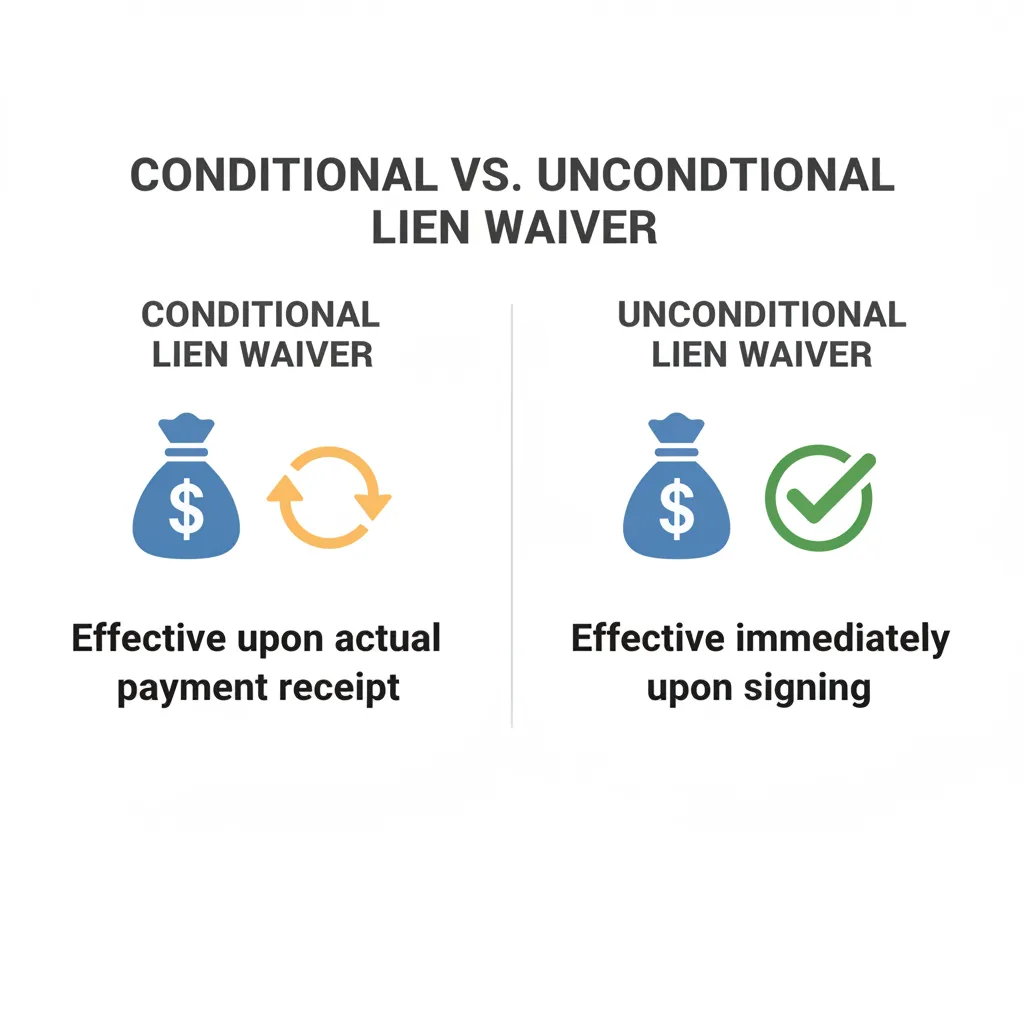
Lien waivers are primarily categorized based on when they become effective, a distinction critical for managing payment and risk in transactions. The specific forms and their precise wording are often dictated by state law, as seen in jurisdictions like California and Arizona.
- Conditional Waiver and Release - This type of waiver becomes legally binding only upon the actual receipt of the payment specified in the document. It protects the claimant by ensuring their lien rights are not fully extinguished until funds have cleared. For example, in California, specific forms for conditional waiver and release upon progress payment or final payment are outlined in Civil Code sections 8132 and 8136 respectively.
- Unconditional Waiver and Release - An unconditional waiver becomes effective and legally binding immediately upon signing, regardless of whether the payment has actually been received or cleared. This type carries a higher risk for the claimant, as they relinquish their lien rights even if the payment subsequently fails. California Civil Code sections 8134 and 8138 provide forms for unconditional waiver and release upon progress payment and final payment.
Contexts of Use
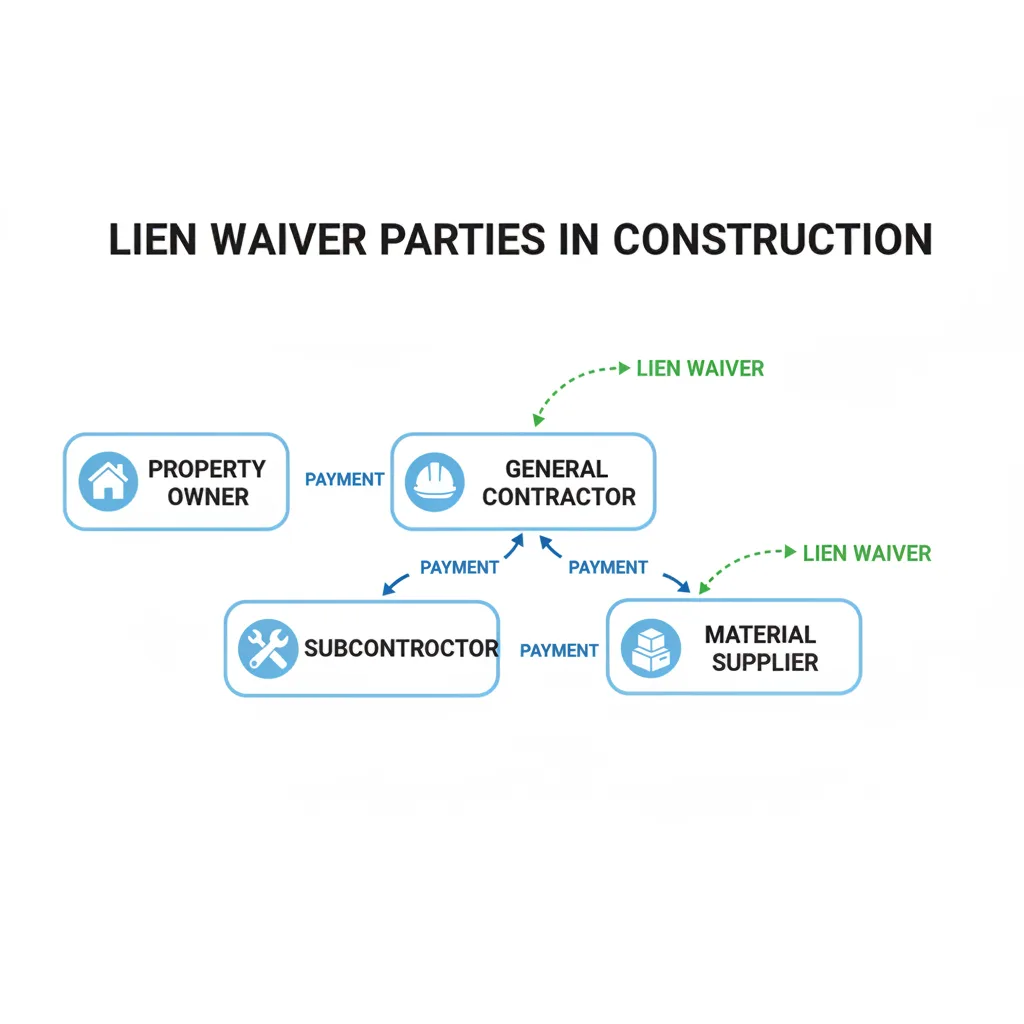
Lien waivers are employed across different sectors, each with specific requirements tailored to the nature of the transaction and the assets involved. The application of these forms directly reflects the legal and financial frameworks governing particular industries.
Construction and Mechanics' Liens
In the construction industry, lien waivers are fundamental tools for managing payments and protecting property owners from mechanics' liens. As work progresses and payments are made to contractors, subcontractors, and suppliers, waivers are exchanged to confirm that these parties have received their due funds and are no longer entitled to place a lien on the property for that specific payment or work period. This process ensures that the property's title remains clear and facilitates the smooth flow of funds throughout a construction project.
- Protection for Owners and Lenders - Property owners and construction lenders commonly require lien waivers from all parties who could potentially file a mechanics' lien. This practice safeguards the property against future claims and ensures that funds disbursed are accounted for.
- State-Specific Forms - Many states, such as Washington, provide official lien waiver forms for contractors, subcontractors, and suppliers, often mandated by state statute. For example, Washington's Department of Labor & Industries provides forms under RCW 60.04.250.
Commodity Loan Transactions
Beyond construction, lien waivers also play a critical role in agricultural finance, particularly concerning commodity loans. The Commodity Credit Corporation (CCC) of the U.S. Department of Agriculture utilizes specific lien waiver forms to manage collateral pledged for loans.
- CCC-679 Lien Waiver Form - This form is specifically used to obtain a lien waiver for commodities pledged as security for a Commodity Credit Corporation loan or those sold to the Corporation under a purchase agreement. The form also serves to designate how loan proceeds should be disbursed when another party holds a lien on the commodity.
- Ensuring Clear Title to Commodities - By obtaining a lien waiver, the CCC ensures that it has a clear and unencumbered interest in the commodities, which are often crops or other agricultural products, thereby securing its loan position.
Legal Requirements and State Variations
The enforceability and specific requirements for lien waivers are largely governed by state law, which can vary significantly by jurisdiction. Understanding these state-specific provisions is crucial for all parties involved to ensure the waiver is valid and binding.
- Claimant Consent - No lien release is binding unless the claimant has signed and delivered a waiver and release. This ensures that the party relinquishing their rights has provided explicit consent.
- Statutory Forms - Many states mandate the use of specific statutory forms for lien waivers to ensure clarity and uniformity. For instance, in California, the waiver and release forms must substantially follow one of the forms set forth in Civil Code sections 8132, 8134, 8136, and 8138.
- Waiver of Claims and Liens - In some jurisdictions, such as Arizona, an owner or contractor cannot waive or impair the claims or liens of other persons except by their written consent or as prescribed by statute. Any written consent provided by a claimant is unenforceable unless the claimant executes and delivers a waiver and release (A.R.S. § 33-1008).
- Receipt of Payment Acknowledgment - Official forms, such as the F625-029-000 Waiver of Lien by Contractor, Subcontractor(s) and Supplier in Washington, require acknowledgment of receipt of payment and explicitly state the waiver of lien rights on the specified property.
Significance for Project Stakeholders
Lien waivers hold significant importance for all parties involved in a construction project or a commodity loan transaction. They are instrumental in maintaining financial transparency and mitigating legal risks throughout the lifecycle of a project or loan.
For property owners and general contractors, securing proper lien waivers at each payment interval provides assurance that the property is protected from subsequent lien claims from subcontractors or suppliers. This practice is essential for avoiding disputes, ensuring a clear title, and facilitating property sales or refinancing. For subcontractors and suppliers, understanding the implications of signing a lien waiver—especially the distinction between conditional and unconditional types—is vital to protect their right to payment.
Frequently Asked Questions
Sources
- Lien Waiver Form Instructions - Provides instructions for the CCC-679 Lien Waiver form used in commodity loan transactions.
- Lien Waiver Form (CCC-679) - Official version of the CCC-679 Lien Waiver form for commodity loan transactions.
- Conditional and Unconditional Waiver and Release Forms - Guidance on conditional and unconditional waiver and release forms for mechanics liens in California.
- 33-1008 - Waiver of lien - Arizona statute detailing waiver of lien requirements and forms.
- F625-029-000 WAIVER OF LIEN BY CONTRACTOR, SUBCONTRACTOR(S) AND SUPPLIER - Official lien waiver form for contractors, subcontractors, and suppliers in Washington State.
Not the form you're looking for?
Try our legal document generator to create a custom document
Disclaimer: The templates available on this website are provided for general informational purposes only and do not constitute legal advice. They are not intended to be, and should not be interpreted as, compliant with any specific legal, regulatory, or privacy requirements. These templates are not a replacement for professional legal guidance and should not be relied upon for any particular matter or circumstance. Users are strongly encouraged to seek advice from a qualified attorney licensed in their jurisdiction before using, modifying, or relying on any template.
All templates are provided on an "as is," "with all faults," and "as available" basis. The provider disclaims any and all warranties of any kind, whether express, implied, statutory, or otherwise, including without limitation warranties of merchantability, fitness for a particular purpose, title, or non-infringement.
LegalTemplates.com makes no guarantees or representations regarding the accuracy, completeness, expected outcomes, or reliability of the materials contained in these templates or any materials referenced or linked from them.