30 Day Notice to Quit
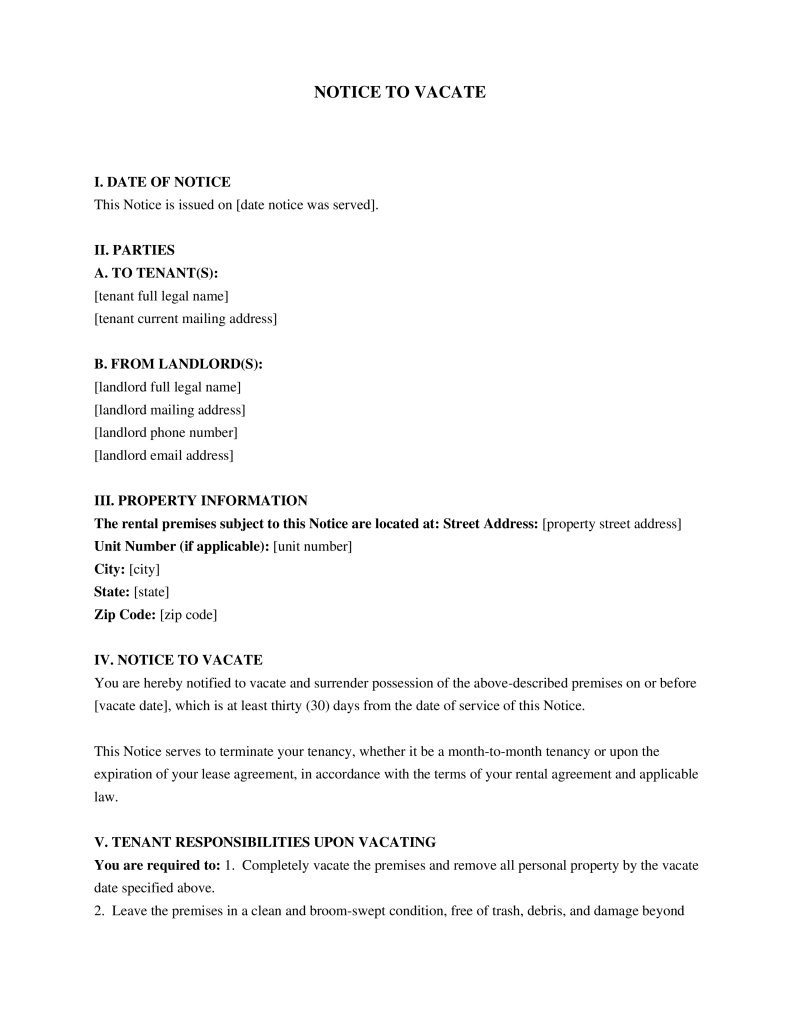
A 30 Day Notice to Quit is a formal legal instrument issued by a landlord to a tenant, requiring the tenant to vacate the rented premises within thirty days, often preceding an eviction action.
Property Type
Select the type of property being vacated. This helps ensure the notice language is appropriate.
Provide details if the property type is not listed.
Table of Contents
What is a 30 Day Notice to Quit?
A 30 Day Notice to Quit is a formal written communication from a landlord to a tenant, serving as official notification of the landlord's intent to terminate a tenancy. This document typically applies to month-to-month tenancies or tenancies without a fixed end date, requiring the tenant to vacate the rented premises within 30 days of receiving the notice. Its primary purpose is to legally initiate the process of ending an agreement, providing the tenant with a specific timeframe to find new housing and move out.
Purpose and Common Scenarios
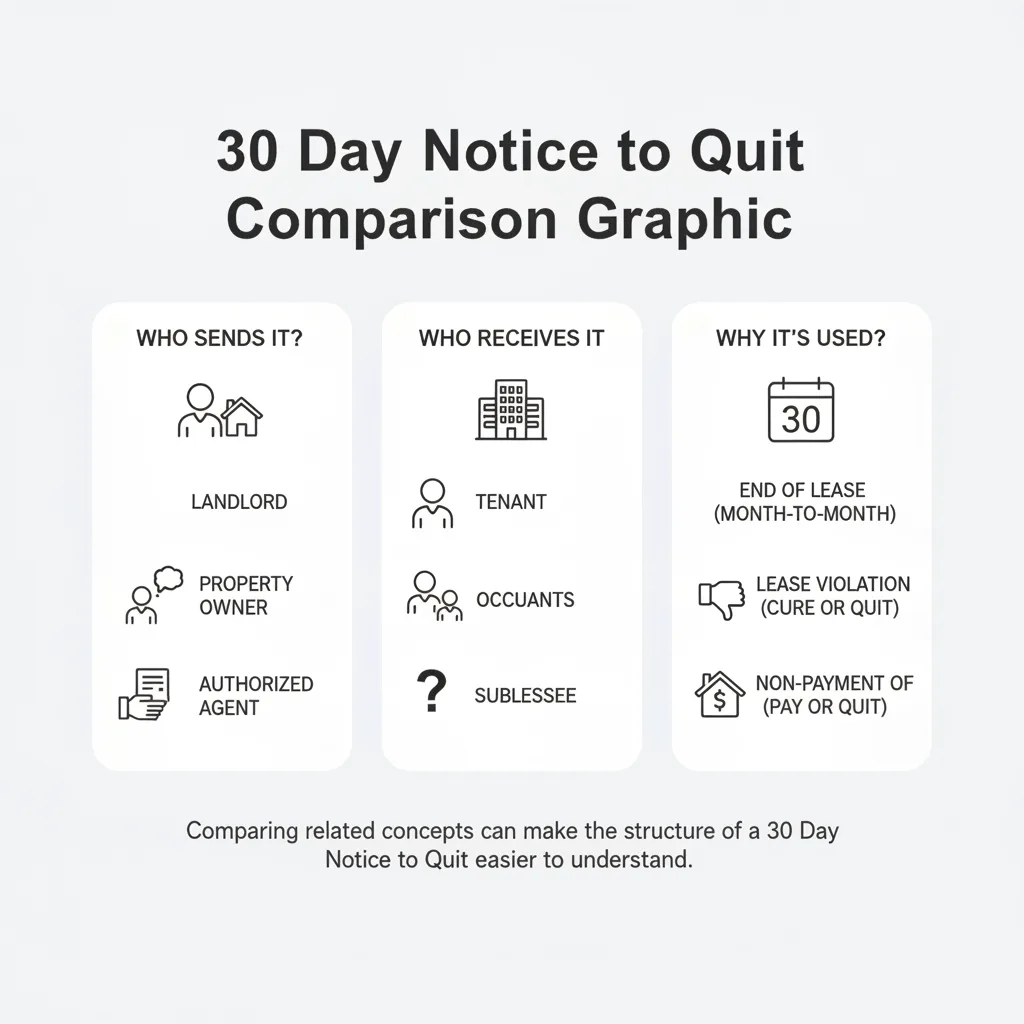
The 30 Day Notice to Quit is a foundational document in landlord-tenant relations, primarily used to end a month-to-month tenancy without cause, provided the tenancy has not exceeded a certain duration in some jurisdictions. It establishes a clear termination date, ensuring both parties understand the landlord's intent to regain possession of the property. While often associated with the landlord's desire to end a tenancy, it can also be a prerequisite for initiating formal eviction proceedings if the tenant does not vacate by the specified date.
This notice is commonly employed in situations where a landlord wishes to:
- Terminate a Month-to-Month Tenancy - When there is no fixed-term lease, allowing either party to end the agreement with proper notice.
- Reclaim Property for Personal Use - If the landlord or a family member intends to move into the property.
- Sell the Property - To ensure the property is vacant for a sale to a new owner.
- Address Lease Violations (in some states) - In specific jurisdictions like Virginia, it can be used when a tenant has violated a term of the lease or rental agreement.
Key Elements of a 30 Day Notice to Quit
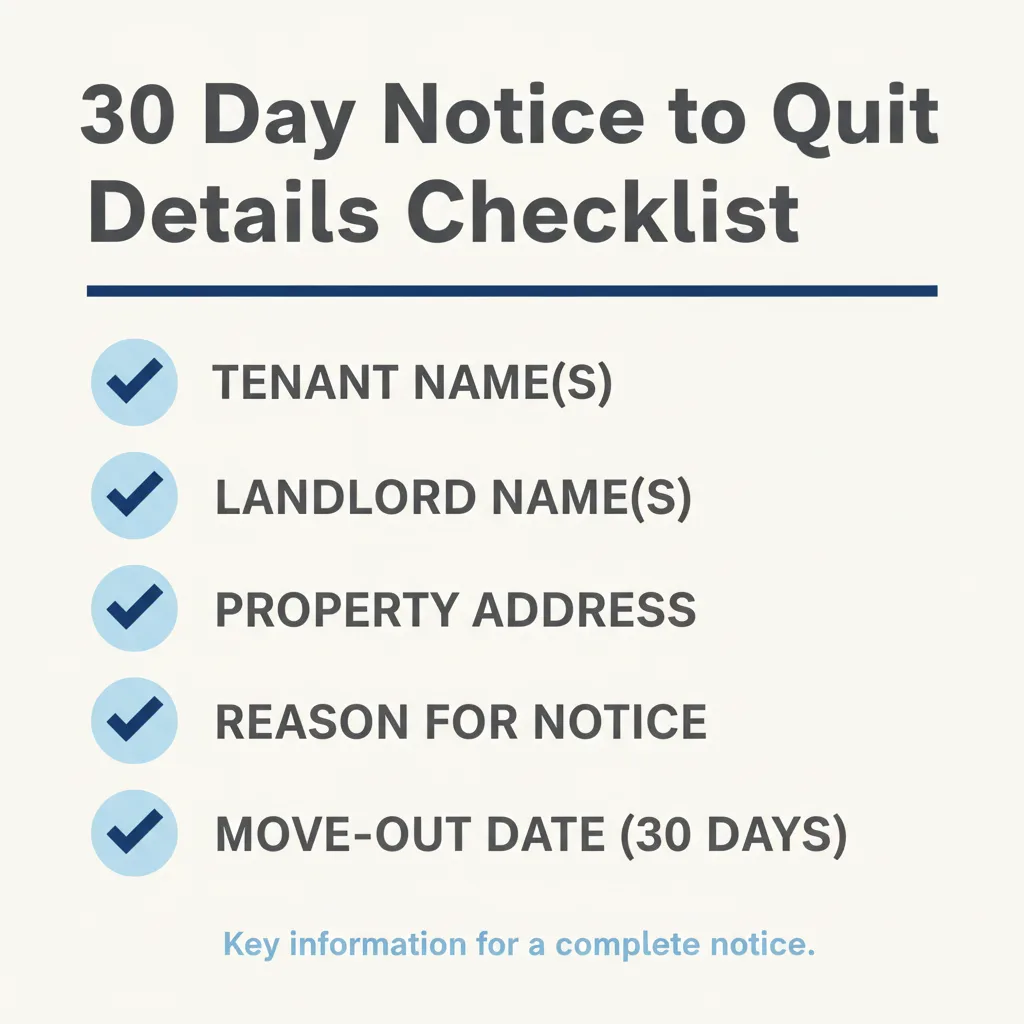
For a 30 Day Notice to Quit to be legally effective, it must contain specific information to clearly inform the tenant of the landlord's intentions and the required actions. While exact requirements can vary by jurisdiction, standard elements generally include:
- Landlord's Name and Contact Information - Identification of the party issuing the notice.
- Tenant's Name and Contact Information - Identification of the party receiving the notice.
- Property Address - The full street address of the rental unit being vacated.
- Date of Notice - The date the notice is written and, ideally, sent or served.
- Effective Termination Date - The specific date by which the tenant must vacate the premises, typically 30 days from the date of service, though calculation rules can vary.
- Statement of Tenancy Termination - A clear and unambiguous statement that the tenancy is being terminated.
Frequently Asked Questions
Sources
- Types of eviction notices landlords | California Courts | Self Help Guide - Provides information on 30-day and 60-day notices to quit in California, including requirements and exceptions.
- Landlord / Tenant / Unlawful Detainer | Superior Court of California | County of Glenn - Details the use of 30-day notices to quit in California for terminating indefinite-term tenancies.
- Find out how to start the eviction process | Mass.gov - Explains the use of 30-day notices to quit in Massachusetts for ending month-to-month tenancies.
- Tenants' guide to eviction | Mass.gov - Describes the 30-day notice to quit as a legal document initiating the eviction process in Massachusetts.
- Virginia's Eviction Process » Henrico County, Virginia - Outlines the use of 30-day notices to quit in Virginia for contractual issues.
- 4-922 - [Thirty-day notice] [sixty-day notice] to quit - New Mexico Courts - Provides the official form for a 30-day notice to quit in New Mexico for mobile home park tenancies.
Not the form you're looking for?
Try our legal document generator to create a custom document
Disclaimer: The templates available on this website are provided for general informational purposes only and do not constitute legal advice. They are not intended to be, and should not be interpreted as, compliant with any specific legal, regulatory, or privacy requirements. These templates are not a replacement for professional legal guidance and should not be relied upon for any particular matter or circumstance. Users are strongly encouraged to seek advice from a qualified attorney licensed in their jurisdiction before using, modifying, or relying on any template.
All templates are provided on an "as is," "with all faults," and "as available" basis. The provider disclaims any and all warranties of any kind, whether express, implied, statutory, or otherwise, including without limitation warranties of merchantability, fitness for a particular purpose, title, or non-infringement.
LegalTemplates.com makes no guarantees or representations regarding the accuracy, completeness, expected outcomes, or reliability of the materials contained in these templates or any materials referenced or linked from them.