Domestic Partnership Agreement
A Domestic Partnership Agreement is a legal document outlining the rights, responsibilities, and financial arrangements between two individuals in an unmarried, committed relationship.
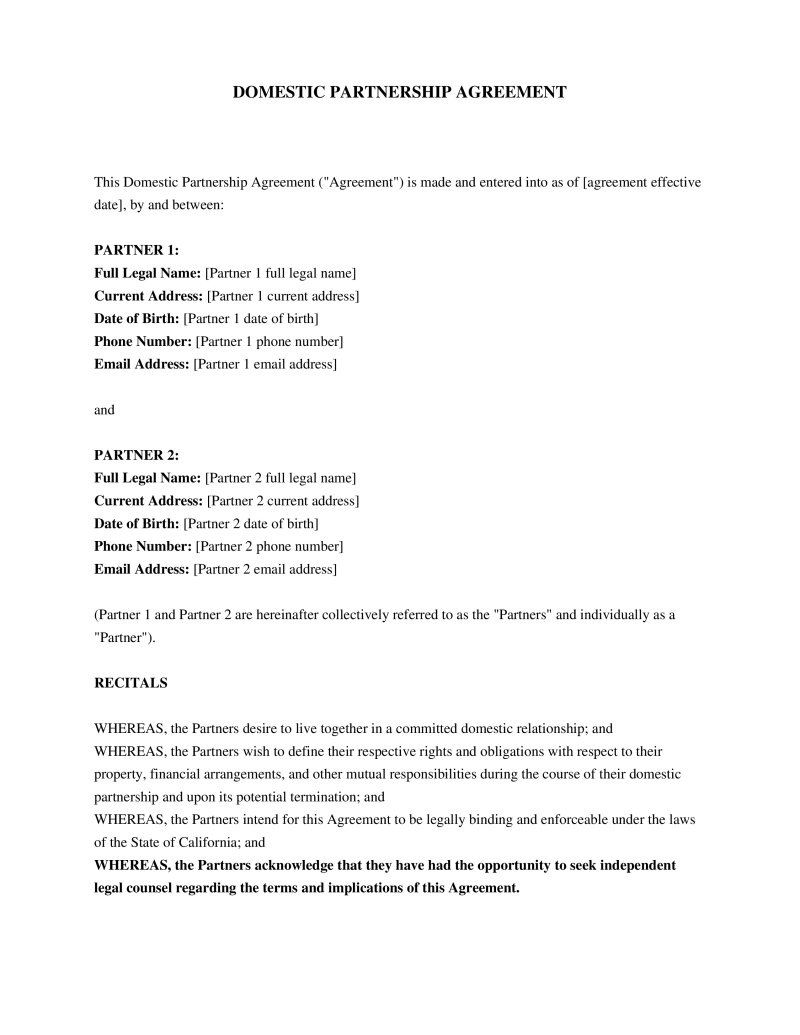
Property Ownership Structure
Choose how jointly acquired property will be owned.
Table of Contents
What is a Domestic Partnership Agreement?
A Domestic Partnership Agreement is a legally recognized relationship between two individuals who live together and share a domestic life but are not married. It serves to formalize aspects of their relationship, often providing some rights and benefits that may be similar to those afforded to married couples, depending on the jurisdiction. This type of agreement is typically utilized by couples, both same-sex and heterosexual, who choose not to enter into a traditional marriage but desire legal recognition and certain protections for their partnership.
Nature and Purpose of Domestic Partnerships
Domestic partnerships emerged as a way for couples, particularly same-sex couples before widespread marriage equality, to gain legal recognition and access to benefits that were traditionally reserved for married spouses. While the landscape of marriage equality has changed, domestic partnerships remain relevant for couples who prefer not to marry for personal, financial, or other reasons. These partnerships often signify a committed relationship where partners share mutual residence and provide mutual support to one another.
The specific rights and obligations granted by a domestic partnership vary significantly by jurisdiction. Some municipalities and employers offer domestic partnership benefits, while some states provide broader legal recognition. Nevada, for instance, defines a domestic partnership as a civil contract that grants partners the same rights and obligations as other civil contracts, highlighting its legal weight within that state.
Requirements for Forming a Domestic Partnership
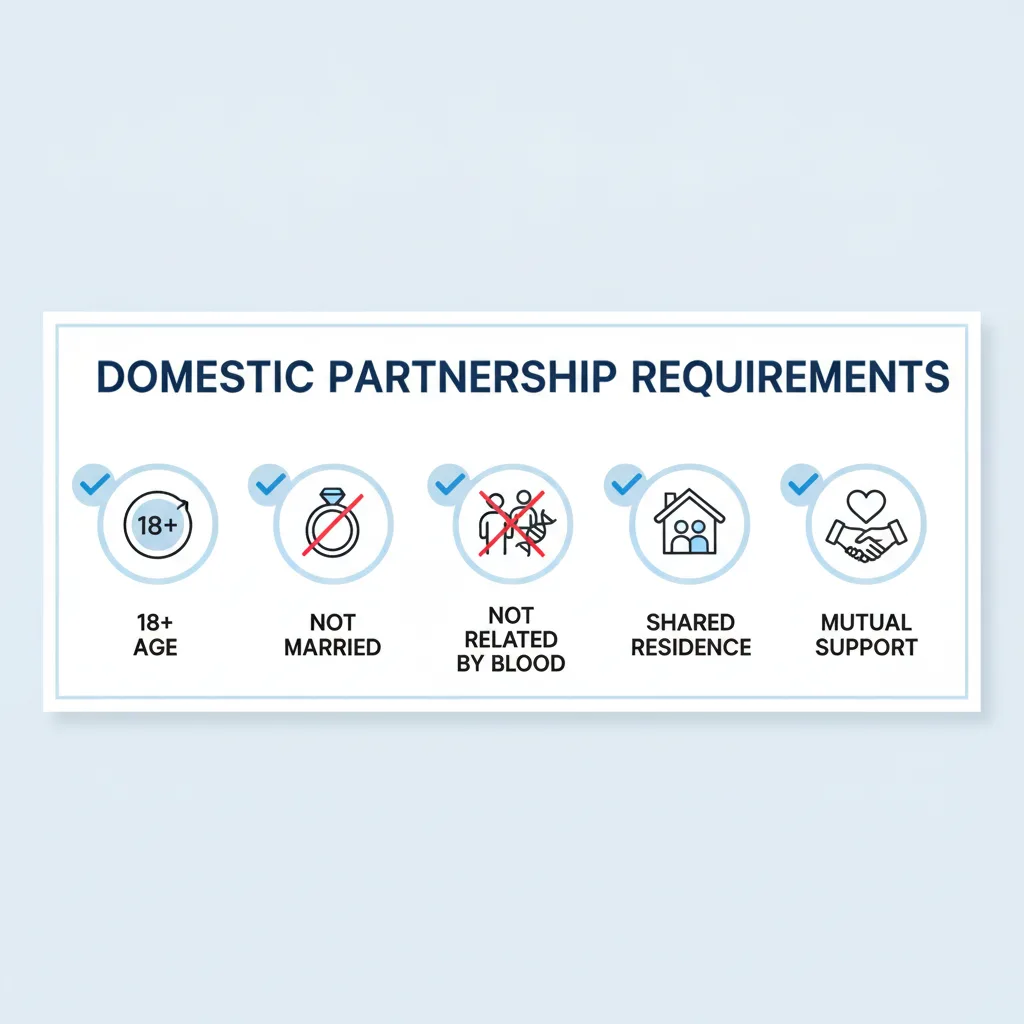
To establish a domestic partnership, individuals typically must meet specific criteria, which can vary by the governmental entity or employer offering the partnership recognition. Common requirements often include:
- Age Requirement - Both partners must be at least 18 years old (City of Tampa; District of Columbia Department of Health; Nevada Secretary of State; U.S. Office of Personnel Management).
- Marital Status - Neither partner can be currently married to another person or be a member of another domestic partnership (City of Tampa; U.S. Office of Personnel Management; Los Angeles Fire and Police Pensions).
- Blood Relation - Partners must not be related by blood in a way that would prohibit legal marriage (City of Tampa; U.S. Office of Personnel Management; Los Angeles Fire and Police Pensions).
- Mutual Residence - The partners must share a common residence (City of Tampa; District of Columbia Department of Health; Los Angeles Fire and Police Pensions).
- Mutual Support - Partners are often required to be in a committed relationship and responsible for each other's common welfare, providing mutual support (City of Tampa; Los Angeles Fire and Police Pensions).
- Declaration Form - A formal declaration or application form, such as a Declaration of Domestic Partnership, must typically be filed with the relevant authority (District of Columbia Department of Health; Nevada Secretary of State).
Benefits and Legal Recognition
The benefits and legal recognition associated with domestic partnerships are highly dependent on the jurisdiction or organization providing the recognition. While federal law now recognizes same-sex marriage, domestic partnerships continue to offer certain advantages at local and employer levels. These may include access to health insurance, retirement benefits, and other spousal-equivalent benefits.
Examples of recognition and benefits include:
- Local Government Recognition - Cities like Tampa, Florida, and the District of Columbia offer domestic partnership registration, which can provide local benefits and legal standing (City of Tampa; District of Columbia Department of Health).
- Employer Benefits - Many private and public employers, such as the Los Angeles Fire and Police Pensions (LAFPP) and the U.S. Office of Personnel Management (OPM), extend benefits like health insurance, retirement, and survivorship benefits to qualified domestic partners (U.S. Office of Personnel Management; Los Angeles Fire and Police Pensions). For LAFPP members, qualified domestic partners receive the same survivorship benefits as qualified surviving spouses.
- State-Level Legal Status - Some states, like Nevada, provide a broader legal framework, recognizing domestic partnerships as civil contracts that confer various rights and obligations akin to marriage within state law (Nevada Secretary of State).
Comparison with Marriage
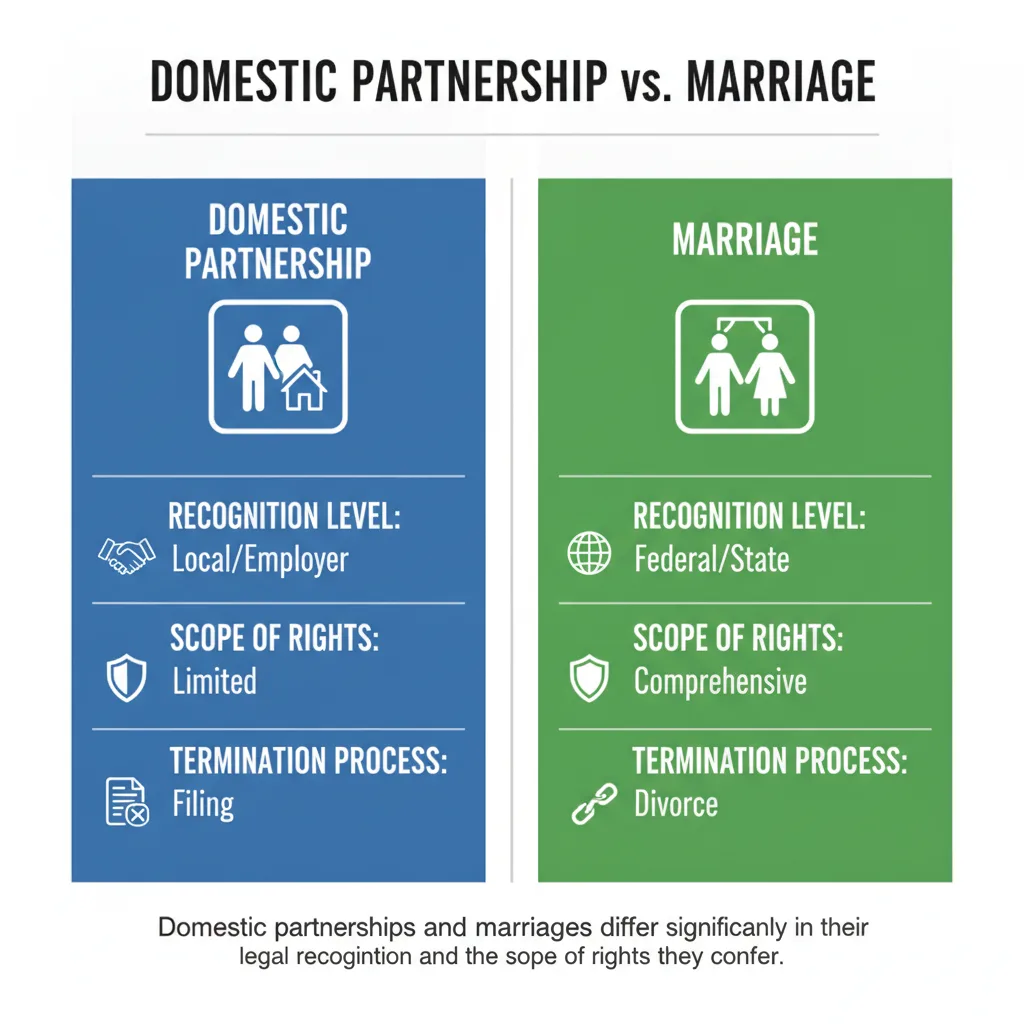
While domestic partnerships offer some similar benefits and legal recognition, they are distinct from marriage. Marriage is a federally recognized union that provides a comprehensive set of rights, obligations, and protections across all states and at the federal level. Domestic partnerships, in contrast, typically derive their recognition from specific state, local, or employer policies. This means that rights and benefits associated with a domestic partnership may not transfer across state lines or be recognized by all federal agencies unless explicitly stated.
The scope of legal protections for domestic partners is generally narrower than that for married couples. For instance, while some employers may offer equivalent benefits, domestic partners may not automatically receive the same tax benefits, inheritance rights, or decision-making authority in medical emergencies that married spouses do, unless specifically granted by a separate agreement or local statute.
Termination of a Domestic Partnership
Just as domestic partnerships are formally established, they typically require a formal process for termination. The method for ending a domestic partnership usually mirrors the process for its creation, involving official documentation and filings with the registering authority. Jurisdictions that offer domestic partnership registration often have a defined procedure for dissolution.
For example, in Washington, D.C., and Nevada, a Declaration of Termination of Domestic Partnership must be filed to formally end the partnership (District of Columbia Department of Health; Nevada Secretary of State). This formal termination ensures that the legal status of the partnership is officially dissolved, which is important for ending shared benefits, obligations, and any associated legal presumptions.
Frequently Asked Questions
Sources
- Domestic Partnership Registration | City of Tampa - Provides definitions and requirements for domestic partnerships in Tampa, Florida.
- Domestic Partnership | District of Columbia Department of Health - Details the registration and termination process for domestic partnerships in Washington, D.C.
- Domestic Partnerships | Nevada Secretary of State - Provides information on domestic partnership filings in Nevada, including definitions and filing procedures.
- Domestic Partnerships | Los Angeles Fire and Police Pensions (LAFPP) - Explains the definition and benefits of domestic partnerships for LAFPP members.
- Same-Sex Domestic Partner Benefits | U.S. Office of Personnel Management (OPM) - Provides the federal definition of a domestic partner for benefits purposes.
Not the form you're looking for?
Try our legal document generator to create a custom document
Disclaimer: The templates available on this website are provided for general informational purposes only and do not constitute legal advice. They are not intended to be, and should not be interpreted as, compliant with any specific legal, regulatory, or privacy requirements. These templates are not a replacement for professional legal guidance and should not be relied upon for any particular matter or circumstance. Users are strongly encouraged to seek advice from a qualified attorney licensed in their jurisdiction before using, modifying, or relying on any template.
All templates are provided on an "as is," "with all faults," and "as available" basis. The provider disclaims any and all warranties of any kind, whether express, implied, statutory, or otherwise, including without limitation warranties of merchantability, fitness for a particular purpose, title, or non-infringement.
LegalTemplates.com makes no guarantees or representations regarding the accuracy, completeness, expected outcomes, or reliability of the materials contained in these templates or any materials referenced or linked from them.