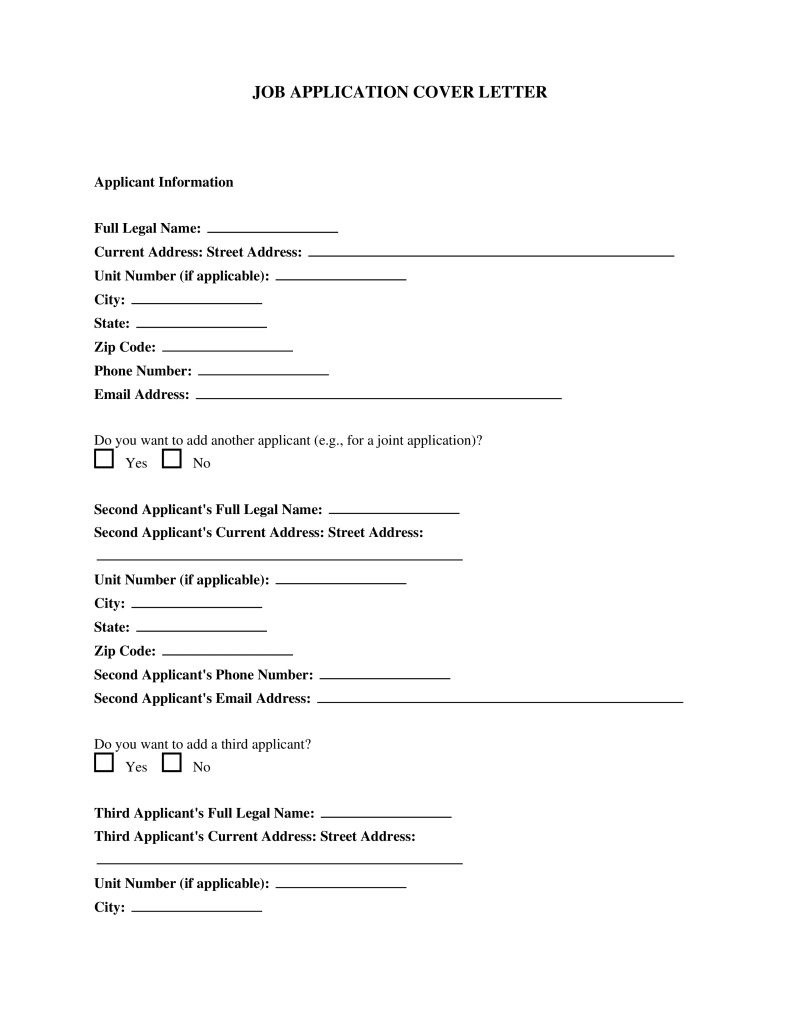
Cover Letter for Job
A Cover Letter for Job is a formal written communication accompanying a resume, intended to express an applicant's interest in a specific employment position and highlight relevant qualifications.
Job Industry
Select the industry most relevant to the position. This helps tailor your cover letter to industry standards.
Describe the industry if not listed above.
Table of Contents
What Is a Cover Letter For Job Template?
A Cover Letter for Job template is a pre-structured document designed to help job seekers compose a compelling introductory letter to accompany their resume. It provides a foundational framework, ensuring that all critical components, from contact information to a persuasive closing, are included. Teams, particularly those in career services, recruitment agencies, or even internal HR departments, utilize these templates to standardize advice, streamline the application process for candidates, and maintain consistency in professional communication standards.
What Is Included
Understanding the core components of a cover letter template is crucial for crafting a document that effectively communicates your suitability for a role. Each section serves a specific purpose, contributing to a professional and persuasive presentation of your qualifications.
- Your Contact Information - Essential for the hiring manager to know who is applying and how to reach you. This includes your name, phone number, email, and often a LinkedIn profile URL or personal website.
- Date - Provides a clear timestamp for when the letter was written, which can be important for tracking applications or understanding the timeline of your job search.
- Hiring Manager or Recipient's Contact Information - Demonstrates your attention to detail and research efforts by addressing the letter to a specific individual or department, including their title, company name, and address.
- Salutation - A professional greeting that establishes the tone of the letter. Addressing a specific person ("Dear Mr./Ms. [Last Name]") is always preferred over generic greetings.
- Opening Paragraph - Hook the reader immediately by stating the position you're applying for, where you saw the advertisement, and a brief, compelling reason why you are interested and a strong fit.
- Body Paragraphs (2-3) - This is where you connect your skills, experiences, and achievements directly to the job description requirements. Use specific examples, quantifiable results, and showcase how you can add value to the company, avoiding merely repeating your resume.
- Closing Paragraph - Reiterate your enthusiasm for the role and the company, express confidence in your qualifications, and include a clear call to action, such as requesting an interview or next steps.
- Professional Closing - A polite and standard sign-off, such as "Sincerely," or "Regards," followed by your typed name.
- Signature - Your handwritten signature above your typed name, adding a personal and professional touch to a physical letter, or left blank for digital submissions where your typed name suffices.
- Enclosure (Optional) - A brief note indicating that other documents, such as your resume, are included with the letter.
Who Should Use This Template?
This template is a versatile tool, but its utility shines brightest for specific use cases and applicant profiles. Understanding when it's most effective – and when an alternative approach might be better – can significantly impact your application success.
Best For
- Early Career Professionals and Recent Graduates - Individuals with limited work history can leverage the template to structure their academic achievements, internships, and transferable skills in a compelling narrative, demonstrating their potential.
- Career Changers - Those transitioning to a new industry or role can use the template to articulate how their existing skills and experiences are relevant to the new field, bridging the gap between their past and desired future.
- Applicants Targeting Specific Roles - When applying for a well-defined position with a clear job description, the template helps organize thoughts to directly address the required qualifications and showcase a tailored fit.
- Individuals Seeking a Structured Approach - Job seekers who benefit from a clear outline to ensure they don't miss any critical information and maintain a professional tone throughout their application.
- High-Volume Applicants Needing Efficiency - While customization is key, a template provides a quick starting point, allowing applicants to efficiently adapt the core structure and content for multiple applications.
Not Ideal For
- Highly Informal Applications - Roles or industries where a cover letter might be explicitly discouraged or where a portfolio or direct communication is the sole expected introductory method (though these are rare).
- Applicants Who Prefer Freeform Expression - Individuals who might feel constrained by a template and prefer a completely open canvas for highly creative or unconventional applications, typically in niche creative fields.
- Situations Requiring Extreme Brevity - Some application systems might have strict character limits or only accept very short messages, making a full cover letter template cumbersome.
- Internal Promotions Where the Relationship is Already Established - While a formal letter can still be beneficial, a template might feel overly formal if you're applying for an internal promotion and have a very close, established working relationship with the hiring manager.
Comparing General Purpose vs. Highly Targeted Cover Letters
While the core anatomy of a cover letter remains consistent, the level of customization defines its effectiveness. A General Purpose Cover Letter might use a template with minor adjustments, suitable for mass applications where you're casting a wide net. It focuses on broader skills and experiences relevant to a category of roles. In contrast, a Highly Targeted Cover Letter uses the template as a foundation but involves extensive research into the company and role. Every paragraph is meticulously crafted to echo the job description's language, highlight specific achievements relevant to that company's challenges, and name-drop relevant projects or values. The targeted approach requires more effort but significantly increases your chances of standing out for competitive positions, demonstrating genuine interest and a deep understanding of the employer's needs.
Quick Start Guide
Leveraging a Cover Letter for Job template effectively involves more than just filling in blanks. Follow these tactical steps to transform a generic template into a powerful personal statement.
- Research the Company and Role Thoroughly: Before writing a single word, delve into the company's mission, values, recent projects, and culture. Analyze the job description for keywords, required skills, and responsibilities. This deep understanding will inform every aspect of your letter, making it highly relevant.
- Identify 2-3 Key Strengths Aligned with the Job: Based on your research, pinpoint the most crucial skills or experiences you possess that directly address the job's core requirements. These will form the backbone of your body paragraphs and should be unique selling points.
- Customize the Recipient Information and Salutation: Always strive to address a specific hiring manager by name. Use LinkedIn or the company website to find the correct contact. If a name isn't available, use a title like "Hiring Manager" or "Head of [Department Name]," avoiding generic greetings like "To Whom It May Concern."
- Craft a Compelling Opening Paragraph: Beyond stating the role, immediately articulate your enthusiasm and briefly mention one key reason you're an exceptional fit. For instance, "My 5+ years of experience in scaling SaaS platforms, combined with my passion for [Company X]'s innovative approach to [Industry Challenge], make me an ideal candidate for the Senior Product Manager role."
- Develop Targeted Body Paragraphs with STAR Examples: For each of your 2-3 key strengths, dedicate a paragraph. Use the STAR method (Situation, Task, Action, Result) to provide concrete examples of how you've applied that skill and achieved measurable outcomes. Quantify your achievements whenever possible (e.g., "increased sales by 15%," "reduced project completion time by 20%").
- Write a Strong Call to Action and Professional Closing: In your final paragraph, reiterate your interest and express eagerness for an interview to discuss your qualifications further. Conclude with a professional closing like "Sincerely" or "Best regards," followed by your full name.
- Proofread Meticulously and Get a Second Opinion: Errors in spelling or grammar can undermine your professionalism. Read your letter aloud, use grammar checking tools, and ask a trusted friend or mentor to review it for clarity, conciseness, and impact.
- Save as a PDF with a Professional Filename: Always submit your cover letter as a PDF to preserve formatting. Name the file professionally, such as "YourName_CoverLetter_JobTitle.pdf" to ensure it's easily identifiable by recruiters.
Frequently Asked Questions
Not the form you're looking for?
Try our legal document generator to create a custom document
Disclaimer: The templates available on this website are provided for general informational purposes only and do not constitute legal advice. They are not intended to be, and should not be interpreted as, compliant with any specific legal, regulatory, or privacy requirements. These templates are not a replacement for professional legal guidance and should not be relied upon for any particular matter or circumstance. Users are strongly encouraged to seek advice from a qualified attorney licensed in their jurisdiction before using, modifying, or relying on any template.
All templates are provided on an "as is," "with all faults," and "as available" basis. The provider disclaims any and all warranties of any kind, whether express, implied, statutory, or otherwise, including without limitation warranties of merchantability, fitness for a particular purpose, title, or non-infringement.
LegalTemplates.com makes no guarantees or representations regarding the accuracy, completeness, expected outcomes, or reliability of the materials contained in these templates or any materials referenced or linked from them.