Affidavit of Support
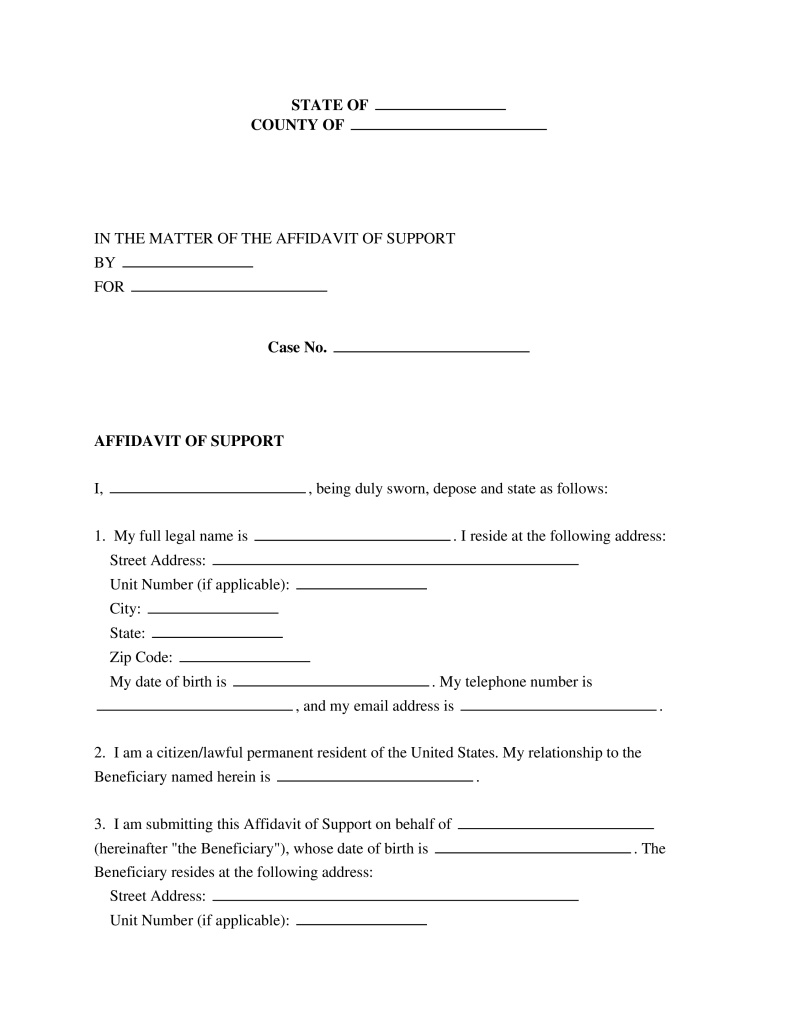
An Affidavit of Support is a sworn statement affirming a sponsor's financial capacity to support an immigrant, preventing them from becoming a public charge.
Sponsor Is Individual Or Entity
Select 'Individual' if the sponsor is a person, or 'Business/Entity' if the sponsor is an organization or company.
Table of Contents
What is an Affidavit of Support?
An Affidavit of Support, formally known as Form I-864, is a legally binding contract an individual signs to accept financial responsibility for another person, typically a relative, who is immigrating to the United States. Its primary purpose is to demonstrate to the U.S. government that the immigrant will not become a “public charge” – someone who relies on government assistance for their primary support. This document is crucial for many family-based immigration petitions and certain employment-based petitions, ensuring the immigrant has adequate financial backing upon their arrival and settlement in the U.S.
Purpose and Scope of an Affidavit of Support
The Affidavit of Support plays a critical role in U.S. immigration law by addressing the public charge inadmissibility ground, as outlined in the Immigration and Nationality Act (INA). By signing this document, the sponsor commits to providing financial support to the intending immigrant, preventing them from needing means-tested public benefits. This commitment is not merely a statement of intent; it creates a legally enforceable obligation that can be enforced by the sponsored immigrant, by any federal, state, or local government agency that provides means-tested public benefits, or by the private entities that administer such programs.
The scope of the financial obligation is broad, covering a wide array of public benefits. The sponsor's responsibility generally lasts until the sponsored immigrant becomes a U.S. citizen, works 40 qualifying quarters under the Social Security Act, departs the United States permanently, or dies. The Affidavit of Support is a foundational element in demonstrating an immigrant's financial self-sufficiency, reducing the potential burden on public resources, and facilitating their integration into American society with assured financial backing.
Sponsor Eligibility and Requirements
To serve as a sponsor for an Affidavit of Support, an individual must meet specific legal and financial criteria established by U.S. immigration law. These requirements ensure that the sponsor has the capability and commitment to fulfill the financial obligations associated with the document. Failure to meet any of these criteria can result in the denial of the immigrant visa or adjustment of status application.
Key eligibility criteria for a sponsor include:
- Age and Citizenship/Residency - The sponsor must be at least 18 years of age and a U.S. citizen or lawful permanent resident (green card holder).
- Domicile in the U.S. - The sponsor must reside in the United States, its territories, or possessions. If living abroad, they must demonstrate an intention to re-establish domicile in the U.S. on or before the date the sponsored immigrant obtains permanent residence.
- Income Requirements - The sponsor must demonstrate an annual income at or above 125% of the federal poverty guidelines for their household size. For sponsors who are active-duty members of the U.S. armed forces petitioning for their spouse or minor child, the income threshold is 100% of the federal poverty guidelines.
- Household Size Calculation - The sponsor's household size includes themselves, their dependents, any individuals they have previously sponsored on an Affidavit of Support, and the intending immigrant(s).
- Assets as Alternative - If the sponsor's income alone does not meet the 125% threshold, they may use assets (such as savings, stocks, bonds, or real estate) to supplement their income. The value of these assets must generally be at least five times the difference between the sponsor's income and the poverty guideline, or three times for spouses and children of U.S. citizens.
If the primary sponsor cannot meet the income requirements, a joint sponsor may be permitted. A joint sponsor must independently meet all the same eligibility criteria, including the income threshold, and assumes the same legal obligations as the primary sponsor. Multiple joint sponsors are permitted if each takes responsibility for at least one sponsored immigrant and meets the income requirement for their own household size plus the number of immigrants they are sponsoring.
Financial Obligations and Enforceability
The act of signing an Affidavit of Support creates a significant and long-lasting financial obligation for the sponsor. This commitment is legally binding and is designed to protect both the sponsored immigrant and the U.S. government from potential financial burdens. Understanding the nature and duration of these obligations is crucial for anyone considering becoming a sponsor.
The sponsor's financial responsibilities entail:
- Financial Support - The sponsor agrees to provide the sponsored immigrant with any necessary financial support to maintain them at an income level at or above 125% of the federal poverty guidelines.
- Reimbursement to Government Agencies - If the sponsored immigrant receives any means-tested public benefits, the government agency providing those benefits can seek reimbursement from the sponsor. This includes cash assistance for income maintenance, Supplemental Security Income (SSI), Temporary Assistance for Needy Families (TANF), Medicaid, and the State Children's Health Insurance Program (SCHIP).
- Legal Enforceability by Beneficiary - The sponsored immigrant themselves has the right to sue the sponsor in court to enforce the Affidavit of Support and obtain the promised financial support.
- Duration of Obligation - The financial responsibility generally continues until the sponsored immigrant becomes a U.S. citizen, works 40 qualifying quarters under the Social Security Act (approximately 10 years of work), permanently departs the United States, or dies. Divorce does not terminate the sponsorship obligation.
The enforcement mechanism for an Affidavit of Support is robust. Government agencies typically send demand letters to sponsors for reimbursement of benefits provided. If a sponsor fails to respond or repay, the agency may initiate legal proceedings. Similarly, sponsored immigrants can pursue civil action in federal or state court to compel the sponsor to provide support. The legally binding nature of this document underscores the seriousness of the commitment undertaken by the sponsor.
How to Complete an Affidavit of Support
Completing an Affidavit of Support, Form I-864, requires careful attention to detail and thorough documentation. The process involves several key steps to ensure all requirements are met and the application is processed smoothly by U.S. Citizenship and Immigration Services (USCIS) or the Department of State (DOS).
- Obtain the Correct Form and Instructions - Download the latest version of Form I-864 from the USCIS website. Carefully read the instructions provided with the form, as they contain critical information on eligibility, required documentation, and proper completion. The instructions are frequently updated, so using the current version is essential.
- Gather Necessary Documentation - Collect all supporting documents before beginning to fill out the form. This typically includes proof of U.S. citizenship or lawful permanent residency, federal income tax returns for the most recent three tax years (including W-2s and 1099s), current employment letters or pay stubs, and proof of assets if relying on them. Documents for all household members, such as birth certificates or marriage certificates, may also be required to verify household size.
- Complete All Sections of Form I-864 Accurately - Fill out every section of the form completely and truthfully. Provide your full legal name, address, date of birth, and Social Security number. Clearly list the immigrant(s) you are sponsoring. Ensure all financial information, including income and assets, is accurately reported and consistent with your tax documents. If you are using a joint sponsor, they will also need to complete their own Form I-864 and provide their supporting documentation.
- Sign the Form and Have it Notarized (If Required) - The Affidavit of Support must be signed by the sponsor(s) under penalty of perjury. While notarization is generally not required for Form I-864 itself when submitted to USCIS or DOS, some specific circumstances or consular offices may request it. Always check the instructions or consult with the relevant agency if there is any doubt.
- Assemble and Submit the Complete Package - Organize the completed Form I-864 and all supporting documents as specified in the instructions. This usually means attaching copies of tax returns, proof of income, and evidence of U.S. citizenship/LPR status. Submit the package to the National Visa Center (NVC) for consular processing cases or to USCIS for adjustment of status cases, along with the immigrant's main application. Retain a complete copy of the submitted packet for your records.
Legal Framework and Penalties
The Affidavit of Support is deeply rooted in federal immigration law, primarily the Immigration and Nationality Act (INA), which provides the legal basis for its requirements and enforceability. Non-compliance with the obligations outlined in an Affidavit of Support can lead to significant legal and financial consequences for the sponsor.
Federal Statutes Governing the Affidavit of Support
The primary federal laws and regulations governing the Affidavit of Support include:
- Immigration and Nationality Act (INA) Section 212(a)(4) - Defines the "public charge" ground of inadmissibility, stating that an immigrant who is likely to become a public charge is inadmissible to the United States (8 U.S.C. § 1182(a)(4)).
- Immigration and Nationality Act (INA) Section 213A - Establishes the legally enforceable Affidavit of Support requirement for most family-based immigrants and certain employment-based immigrants. This section details sponsor eligibility, financial obligations, and the duration of support (8 U.S.C. § 1183a).
- Code of Federal Regulations (CFR) Title 8, Part 213a - Provides detailed regulatory guidance on the requirements for the Affidavit of Support, including definitions, procedures for filing, income requirements, and termination of obligations (8 CFR § 213a.1 et seq.).
Penalties for Non-Compliance
Failure to uphold the commitments made in an Affidavit of Support can result in severe repercussions for the sponsor:
- Reimbursement of Public Benefits - If the sponsored immigrant receives means-tested public benefits, the government agency that provided those benefits can demand reimbursement from the sponsor. This demand is legally enforceable, and agencies frequently pursue collection aggressively.
- Civil Lawsuits - The sponsored immigrant themselves can file a civil lawsuit against the sponsor in federal or state court to compel the sponsor to provide the financial support promised in the Affidavit of Support. Courts can order the sponsor to pay the difference between the immigrant's income and 125% of the poverty guidelines.
- Impact on Future Immigration Petitions - A sponsor who has failed to honor their obligations under a previous Affidavit of Support may find it difficult or impossible to sponsor other immigrants in the future. Their past non-compliance can be a factor in determining their suitability as a sponsor.
- Credit and Financial Consequences - Judgments against a sponsor for unpaid reimbursement or support can negatively impact their credit score, affect their ability to secure loans, and potentially lead to wage garnishment or asset seizure.
These penalties underscore the serious and long-term nature of the financial commitment made when signing an Affidavit of Support, emphasizing that it is a binding legal contract with significant consequences for any breach.
Frequently Asked Questions
Affidavit of Support Example
Not the form you're looking for?
Try our legal document generator to create a custom document
Disclaimer: The templates available on this website are provided for general informational purposes only and do not constitute legal advice. They are not intended to be, and should not be interpreted as, compliant with any specific legal, regulatory, or privacy requirements. These templates are not a replacement for professional legal guidance and should not be relied upon for any particular matter or circumstance. Users are strongly encouraged to seek advice from a qualified attorney licensed in their jurisdiction before using, modifying, or relying on any template.
All templates are provided on an "as is," "with all faults," and "as available" basis. The provider disclaims any and all warranties of any kind, whether express, implied, statutory, or otherwise, including without limitation warranties of merchantability, fitness for a particular purpose, title, or non-infringement.
LegalTemplates.com makes no guarantees or representations regarding the accuracy, completeness, expected outcomes, or reliability of the materials contained in these templates or any materials referenced or linked from them.