Notarized Child Travel Consent Form
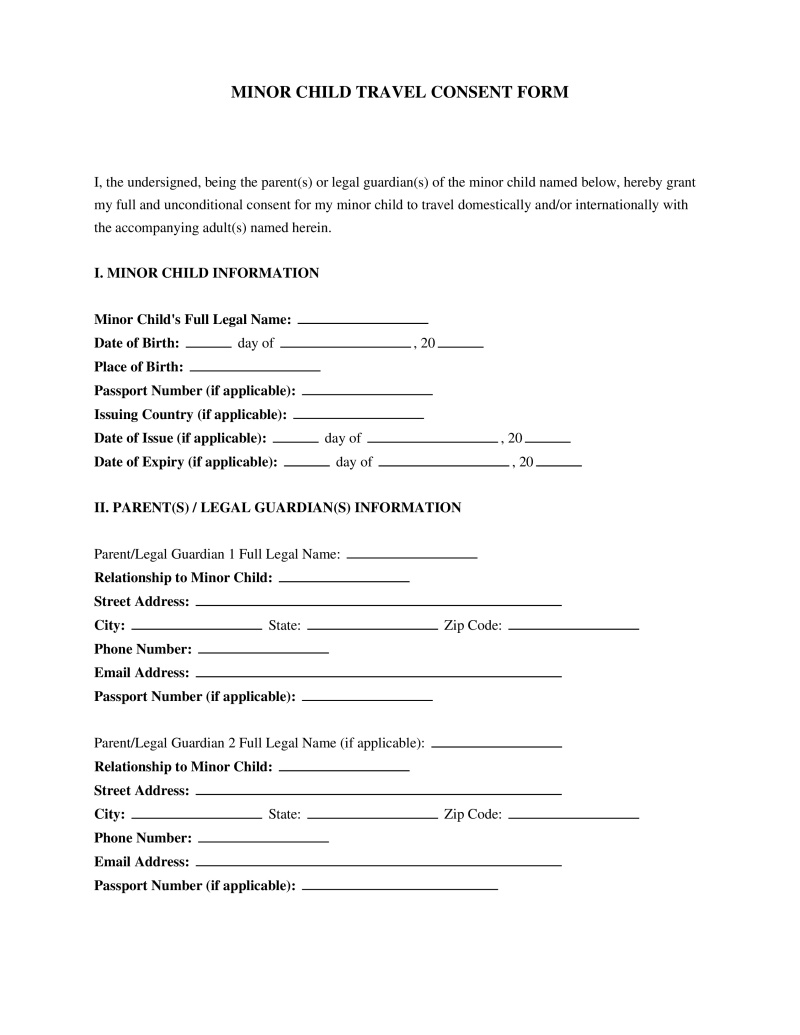
A Notarized Child Travel Consent Form is a legal instrument affirming parental or guardian permission for a minor to travel, often internationally, with an adult or independently, with notarization verifying authenticity.
Travel Type
Select whether the travel is within the same country or to a foreign country.
Table of Contents
What is a Notarized Child Travel Consent Form?
A Notarized Child Travel Consent Form is a legal document used when a minor child travels internationally or domestically without both parents or legal guardians present. It grants permission from the non-traveling parent(s) or guardian(s) for the child to travel with another adult, such as a single parent, grandparent, or other chaperone. The primary purpose of this form is to prevent international child abduction and to ensure that border officials, airline personnel, and other authorities can verify that the child has permission to travel. It provides an essential layer of protection for the child and legal assurance for the accompanying adult.
Legal Requirements and Validity
The legal validity and specific requirements for a Notarized Child Travel Consent Form can vary significantly based on the country of origin, the destination country, and the specific circumstances of travel. Generally, for the form to be considered valid, it must clearly demonstrate the informed consent of all non-traveling parents or legal guardians. The notarization process adds a layer of authentication, confirming the identity of the signatory and the voluntary nature of their signature. Without proper notarization, many authorities, especially international border control, may not accept the document as legitimate.
Key aspects that contribute to the legal validity of such a form typically include:
- Clear Parental Consent - Explicit permission from all parents or legal guardians not accompanying the child, affirming their agreement for the child's travel.
- Notarization - The signature(s) of the consenting parent(s) or guardian(s) must be witnessed and certified by a Notary Public, who verifies their identity and voluntary signing.
- Specific Travel Details - Inclusion of precise information about the travel itinerary, including departure and arrival dates, destinations, and the name of the accompanying adult.
- Absence of Duress - The consent must be given freely and without any form of coercion or undue influence.
- Compliance with Custody Orders - The consent must not contradict any existing court orders regarding child custody, visitation rights, or travel restrictions.
Applicable Federal and International Laws
While no single federal law mandates a Notarized Child Travel Consent Form for all domestic travel, several federal and international legal frameworks underscore its importance, particularly for international journeys. These laws aim to combat child abduction and ensure the welfare of minors crossing borders.
Relevant legal considerations include:
- International Parental Kidnapping Crime Act (IPKCA) - Makes it a federal crime to remove a child from the United States or retain a child outside the United States with intent to obstruct parental rights (18 U.S.C. § 1204). This act highlights the importance of documented consent to prevent such criminal acts.
- Hague Convention on the Civil Aspects of International Child Abduction - An international treaty that provides a mechanism for the prompt return of children who have been wrongfully removed from or retained outside their country of habitual residence (22 U.S.C. § 9001 et seq.). While not directly requiring a consent form, it emphasizes the need for clear parental authorization for international travel.
- U.S. Customs and Border Protection (CBP) Recommendations - Although not a statutory requirement, CBP strongly recommends that minors traveling without both parents carry a consent letter from the non-traveling parent(s). This recommendation helps prevent delays and extensive questioning at ports of entry.
- Passport Regulations - U.S. passport applications for minors generally require the consent of both parents or legal guardians. If one parent is unavailable, specific forms (e.g., DS-3053 Statement of Consent) or court orders are required, reinforcing the principle of joint parental consent for international travel.
Penalties for non-compliance with international travel regulations, particularly those related to child travel, can be severe. Individuals attempting to travel with a minor without proper consent or documentation may face:
- Travel Delays or Denial of Entry/Exit - Border officials can refuse passage for the child and accompanying adult until proper documentation is presented.
- Investigation for Child Abduction - Suspicion of parental kidnapping can lead to immediate investigation by law enforcement agencies, including the FBI.
- Criminal Charges - In cases where a child is removed without legal consent, federal charges under IPKCA or state charges related to child abduction may be filed, leading to significant fines and imprisonment.
- Custody Disputes and Legal Action - The non-traveling parent may initiate legal proceedings for violation of custody orders or parental rights.
Rights and Obligations of Parties Involved
The Notarized Child Travel Consent Form delineates the specific rights and obligations of all parties associated with the minor's travel, ensuring legal clarity and protection.
The primary parties involved and their respective considerations include:
- Consenting Parent(s) or Legal Guardian(s) - They have the right to grant or deny permission for their child's travel and to specify the conditions of that travel. Their obligation is to provide clear, informed consent, ensuring the document is accurate and legally binding. They must understand the travel itinerary, the identity of the accompanying adult, and the purpose of the trip.
- Accompanying Adult (Traveling Parent or Chaperone) - This individual has the right to travel with the minor as authorized by the consent form. Their primary obligation is to ensure the child's safety and well-being throughout the journey and to adhere strictly to the terms outlined in the consent form. They must also be prepared to present the form and any other required travel documents to authorities upon request.
- The Minor Child - While not a signatory, the child has the right to safe and lawful travel. Their welfare is the central concern of the consent form. In some jurisdictions, older minors may have input into travel decisions, though ultimate legal consent rests with the parents or guardians.
- Notary Public - The Notary Public's obligation is to verify the identity of the signatory(s) and witness their signature, ensuring it is made voluntarily. They do not attest to the truthfulness of the document's content, only the authenticity of the signature.
How to Complete a Notarized Child Travel Consent Form
Completing a Notarized Child Travel Consent Form involves several crucial steps to ensure its accuracy and legal validity.
- Gather Necessary Information - Collect all pertinent details for the child, the accompanying adult, and the non-traveling parent(s) or guardian(s). This includes full legal names, dates of birth, passport numbers (if applicable), addresses, and contact information. Ensure you have the exact travel dates, destinations, and the purpose of the trip.
- Draft the Consent Letter - Prepare a clear and comprehensive letter stating that the non-traveling parent(s) or guardian(s) grant permission for the child to travel. The letter should explicitly name the child, the accompanying adult, the itinerary, and emergency contact information. It should also include a statement authorizing medical treatment in case of an emergency, if desired.
- Sign Before a Notary Public - The non-traveling parent(s) or guardian(s) must sign the completed consent form in the presence of a Notary Public. The notary will verify their identity using government-issued identification (e.g., driver's license, passport) and witness the signature, then affix their seal and signature to the document. Do not sign the document beforehand.
- Obtain Additional Documentation - Depending on the destination and specific circumstances, it may be prudent to include copies of the child's birth certificate, relevant court orders (e.g., custody agreements), and passport identification pages for all parties. These supplementary documents can provide further proof of parental relationship and legal authority.
Required Elements of a Valid Notarized Child Travel Consent Form
For a Notarized Child Travel Consent Form to be considered valid and effective by border officials, airlines, and other authorities, it must contain specific information. Omissions can lead to significant travel delays or denial of entry.
- Child's Full Legal Name and Date of Birth - Essential for identifying the minor.
- Child's Passport Information - If applicable, including passport number, issue date, and expiry date.
- Accompanying Adult's Full Legal Name and Date of Birth - Clearly identifies the person authorized to travel with the child.
- Accompanying Adult's Passport Information - If applicable, including passport number, issue date, and expiry date.
- Contact Information for Accompanying Adult - Phone number and address.
- Consenting Parent(s)/Guardian(s) Full Legal Name(s) and Contact Information - Phone number(s) and address(es) for verification.
- Consenting Parent(s)/Guardian(s) Passport Information - If applicable, or other government-issued ID details used for notarization.
- Specific Travel Itinerary - Detailed dates of departure and return, specific destinations (cities, countries), and the purpose of the trip.
- Emergency Contact Information - Phone numbers and names for both traveling and non-traveling parents/guardians.
- Statement of Consent for Medical Treatment (Optional but Recommended) - Authorizing the accompanying adult to seek medical care for the child if necessary.
- Signature(s) of Consenting Parent(s)/Guardian(s) - Must be original signatures.
- Date of Signature - When the document was signed.
- Notary Public's Seal and Signature - Official authentication of the signatory's identity and voluntary signature.
International Travel Considerations
Traveling internationally with a minor, especially without both parents, introduces additional layers of scrutiny and specific requirements that vary by country. U.S. Customs and Border Protection (CBP) advises that a Notarized Child Travel Consent Form is a prudent measure to avoid issues at borders. Many countries have their own specific entry requirements for minors, which may include unique forms or translated documents.
Key considerations for international travel include:
- Country-Specific Requirements - Research the entry and exit requirements for minors in all destination countries, as some nations have very strict rules, including specific language translations or particular types of consent forms.
- Airline Policies - Airlines may have their own internal policies regarding minors traveling alone or with one parent, often requiring additional documentation beyond what border agencies demand.
- U.S. Customs and Border Protection (CBP) Recommendations - CBP strongly recommends carrying a consent letter from any parent or guardian not accompanying the child. This letter should include the non-traveling parent's contact information.
- Court Orders - If a child is subject to a custody order, divorce decree, or other legal document, a copy of that order should always accompany the consent form. This is especially critical if the order specifies travel restrictions or requires specific parental permissions.
- Emergency Medical Authorization - It is highly advisable to include a clause in the consent form, or a separate notarized document, authorizing the accompanying adult to make medical decisions for the child in an emergency.
Frequently Asked Questions
Not the form you're looking for?
Try our legal document generator to create a custom document
Disclaimer: The templates available on this website are provided for general informational purposes only and do not constitute legal advice. They are not intended to be, and should not be interpreted as, compliant with any specific legal, regulatory, or privacy requirements. These templates are not a replacement for professional legal guidance and should not be relied upon for any particular matter or circumstance. Users are strongly encouraged to seek advice from a qualified attorney licensed in their jurisdiction before using, modifying, or relying on any template.
All templates are provided on an "as is," "with all faults," and "as available" basis. The provider disclaims any and all warranties of any kind, whether express, implied, statutory, or otherwise, including without limitation warranties of merchantability, fitness for a particular purpose, title, or non-infringement.
LegalTemplates.com makes no guarantees or representations regarding the accuracy, completeness, expected outcomes, or reliability of the materials contained in these templates or any materials referenced or linked from them.