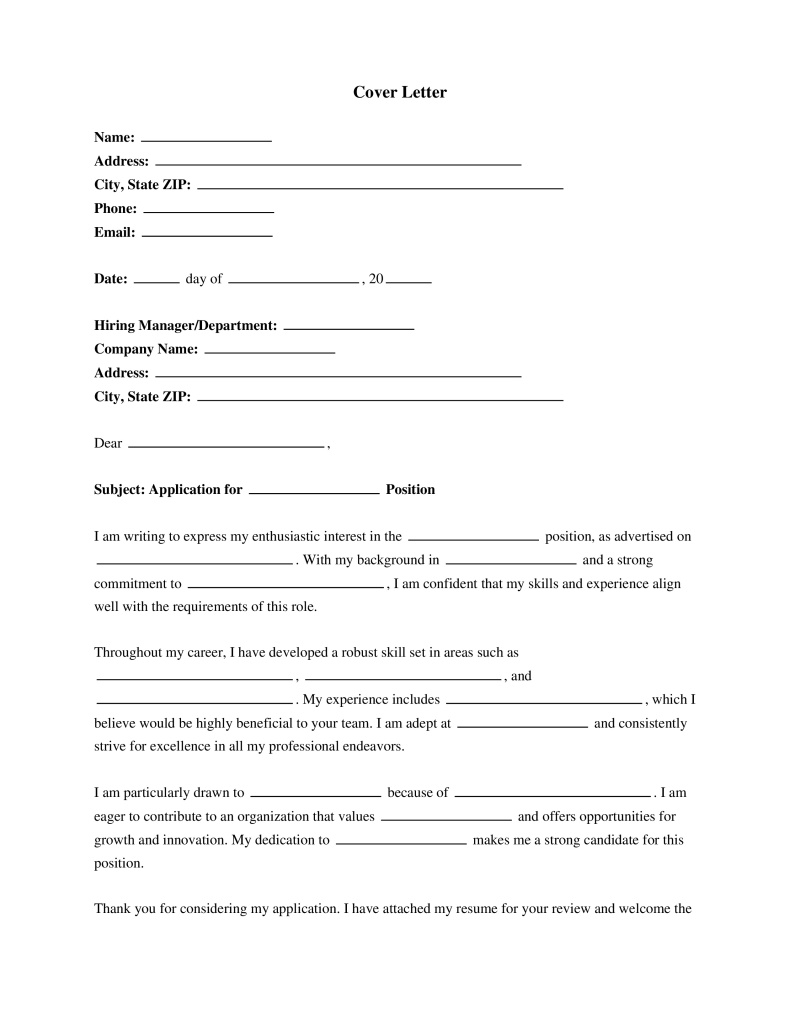
Cover Letter
A Cover Letter is a formal written communication, often accompanying a resume or curriculum vitae, that serves to introduce an applicant and express interest in a specific position or opportunity.
Cover Letter Tone
Choose the style that best fits your target employer and industry.
If you selected 'Other', describe the tone you want for your cover letter.
Table of Contents
What Is a Cover Letter Template?
A cover letter template is a pre-designed, structured document that provides a framework for job applicants to introduce themselves, highlight their qualifications, and express genuine interest in a specific role or company. Teams and individual job seekers utilize these templates to streamline the application process, maintain a professional and consistent brand, and ensure all critical information is included without starting from scratch. It acts as a foundational guide, allowing users to focus on tailoring their message rather than formatting.
What Is Included
A well-constructed cover letter template includes several key sections, each serving a distinct purpose in presenting a professional and compelling case for your candidacy:
- Your Contact Information - This section, typically placed at the top, includes your full name, phone number, email address, and LinkedIn profile URL. It's crucial for recruiters to quickly identify and contact you.
- Date - The date on which you are writing the letter. This is a standard professional courtesy and helps track your application timeline.
- Hiring Manager/Company Contact Information - This includes the name, title, company, and address of the hiring manager or the department you are applying to. Researching and addressing the letter to a specific individual demonstrates diligence and personalization.
- Salutation - A formal greeting, ideally addressing the hiring manager by name (e.g., "Dear Mr./Ms. [Last Name]" or "Dear [Full Name]"). A personalized salutation is far more impactful than a generic one.
- Opening Paragraph - This vital paragraph immediately states the position you are applying for, where you saw the advertisement, and a brief, compelling reason why you are interested and a strong fit. Its purpose is to grab the reader's attention and encourage them to continue reading.
- Body Paragraph(s) - This is the core of your cover letter, typically comprising one to two paragraphs. Here, you connect your most relevant skills, experiences, and achievements directly to the requirements outlined in the job description. Use specific examples and quantify your accomplishments whenever possible to demonstrate impact.
- Closing Paragraph - In this paragraph, you reiterate your enthusiasm for the role and the company, express confidence in your ability to contribute, and include a clear call to action, such as expressing your availability for an interview.
- Professional Closing - A formal sign-off, such as "Sincerely," "Regards," or "Best regards," followed by your typed full name. This maintains a professional tone.
Who Should Use This Template?
Understanding when a cover letter template is most effective, and when it might be less suitable, helps optimize your job application strategy.
Best For
- Individual Job Seekers in Established Industries - Applicants targeting corporate, healthcare, finance, education, or government roles where traditional application methods and professional formality are highly valued.
- Career Changers and Those with Gaps - Individuals looking to transition into a new field or explain employment gaps can use the cover letter to articulate transferable skills, explain their career trajectory, and demonstrate their commitment to a new path more effectively than a resume alone.
- Applicants Needing Efficiency and Consistency - Job seekers applying to multiple positions can leverage a template to quickly customize and generate professional letters, ensuring a consistent level of quality across all applications while saving significant time.
- Candidates Targeting Specific Roles - When a job description emphasizes particular soft skills, company culture fit, or unique project experience, a cover letter provides the space to elaborate on these aspects in a narrative format that complements the resume.
- Those Who Struggle with Starting from Scratch - A template provides a clear structure and prompts, making it easier for individuals who find it challenging to organize their thoughts or begin writing a formal document.
Not Ideal For
- Highly Niche Creative Roles - For certain design, art, or highly conceptual roles, a traditional cover letter might be less impactful than a direct link to a portfolio or a highly visual, non-standard submission that showcases creativity directly.
- Informal Networking or Direct Messaging - When reaching out to contacts for informational interviews or casual networking, a brief, personalized email or LinkedIn message is often more appropriate and effective than a formal cover letter.
- Internal Applications in Agile Teams - Within small, highly collaborative teams where internal promotions or role changes are common, a direct conversation with a manager or a brief, informal email might suffice, rendering a formal cover letter unnecessary.
- Roles Explicitly Stating "No Cover Letter Required" - While a brief, tailored cover letter can sometimes still be beneficial, some companies explicitly request applicants to omit them. Ignoring this instruction could reflect poorly on the applicant's ability to follow directions.
Quick Start Guide
Leveraging a cover letter template effectively requires more than just filling in the blanks. Follow these tactical steps to create a compelling and tailored application:
- Choose a Template Style Aligned with the Role and Industry: Consider whether a traditional, conservative layout (e.g., for finance, law, government) or a more modern, slightly creative design (e.g., for tech, marketing, non-profits) is appropriate. A lightweight, minimalist template might suit fast-paced startups, while a detailed version with more space for narrative is better for roles requiring extensive explanation of complex projects.
- Thoroughly Analyze the Job Description: Before writing, deconstruct the job posting. Identify keywords, essential skills, required experience, and the company's values. These will be your guide for tailoring the content of your cover letter.
- Customize Contact Information and Salutation: Update your personal contact details accurately. Research the hiring manager's name and title. If you cannot find a specific name, use a professional but general salutation like "Dear Hiring Manager" or "Dear [Department] Team."
- Craft a Powerful Opening Paragraph: Start strong by clearly stating the position you're applying for and immediately connect your interest to a key requirement or the company's mission. This paragraph is crucial for capturing the reader's attention and encouraging them to read on.
- Showcase Relevant Skills with Quantifiable Achievements: In the body paragraphs, don't just list skills. Instead, provide concrete examples of how you've applied those skills and the positive outcomes you achieved. Quantify your successes with numbers, percentages, or specific results whenever possible to demonstrate impact.
- Articulate Your Fit and Enthusiasm: Dedicate a section to explaining why you are genuinely interested in this specific company and this specific role. Reference company projects, values, or recent achievements to show you've done your research and are enthusiastic about contributing.
- Proofread Meticulously and Save Correctly: Before sending, proofread your cover letter multiple times for any grammatical errors, typos, or inconsistencies. Reading it aloud can help catch mistakes. Save your final document as a PDF unless instructed otherwise, to preserve its formatting across different systems.
- Ensure Consistent Branding with Your Resume: If submitting a resume alongside your cover letter, ensure there's a visual consistency in fonts, colors (if any), and header styles. This creates a cohesive and professional application package.
Frequently Asked Questions
Not the form you're looking for?
Try our legal document generator to create a custom document
Disclaimer: The templates available on this website are provided for general informational purposes only and do not constitute legal advice. They are not intended to be, and should not be interpreted as, compliant with any specific legal, regulatory, or privacy requirements. These templates are not a replacement for professional legal guidance and should not be relied upon for any particular matter or circumstance. Users are strongly encouraged to seek advice from a qualified attorney licensed in their jurisdiction before using, modifying, or relying on any template.
All templates are provided on an "as is," "with all faults," and "as available" basis. The provider disclaims any and all warranties of any kind, whether express, implied, statutory, or otherwise, including without limitation warranties of merchantability, fitness for a particular purpose, title, or non-infringement.
LegalTemplates.com makes no guarantees or representations regarding the accuracy, completeness, expected outcomes, or reliability of the materials contained in these templates or any materials referenced or linked from them.