Aircraft (Airplane) Bill of Sale Form
An Aircraft Bill of Sale Form is a legal document that evidences the transfer of ownership of an airplane from seller to buyer.
Aircraft Category
Select the primary category that best describes the aircraft.
Enter the aircraft category if 'Other' was selected.
Table of Contents
What is an Aircraft (Airplane) Bill of Sale Form?
An Aircraft (Airplane) Bill of Sale Form is a legal document that formally records the transfer of ownership of an aircraft from a seller to a buyer. This crucial instrument serves as proof of purchase and is essential for establishing legal title to the aircraft. It is primarily used by individuals, corporations, and other entities involved in the buying and selling of airplanes, helicopters, and other types of aircraft. The document facilitates the change of ownership records with federal aviation authorities, ensuring that the new owner is properly registered and recognized.
Legal Requirements and Validity
For an aircraft bill of sale to be legally valid and effective, particularly for purposes of federal registration, it must adhere to specific requirements. While the Federal Aviation Administration (FAA) provides a standardized form (AC Form 8050-2), parties can also use their own custom forms, provided they meet the minimum informational criteria. Proper execution of this document is paramount for ensuring a clear chain of title and avoiding future disputes regarding ownership.
Key aspects contributing to the legal validity of an aircraft bill of sale include:
- Identification of Parties - The full legal names and addresses of both the seller (grantor) and the buyer (grantee) must be clearly stated on the document.
- Aircraft Identification - The aircraft must be uniquely identified by its N-number (registration number), make, model, and serial number. This ensures there is no ambiguity about which specific aircraft is being transferred.
- Consideration - The purchase price or other valuable consideration exchanged for the aircraft must be specified. This confirms that a legitimate transaction has occurred.
- Date of Sale - The precise date on which the ownership transfer takes place is a critical element for determining the effective date of the sale and for FAA registration timelines.
- Seller's Signature - The signature of the seller is mandatory to signify their intent to transfer ownership. In some cases, a corporate officer or authorized agent may sign on behalf of an entity.
- Delivery of Possession - While not explicitly part of the form, the physical transfer of the aircraft and its related documents (logbooks, airworthiness certificates) is an essential component of the overall transaction.
Rights and Obligations of Parties Involved
The aircraft bill of sale delineates the rights and obligations of both the seller and the buyer, creating a legally binding agreement between them. Understanding these responsibilities helps ensure a smooth and compliant transaction.
The seller typically assumes several key obligations:
- Clear Title Delivery - The seller is generally obligated to deliver clear title to the aircraft, meaning it is free from undisclosed liens, encumbrances, or other claims that would impair the buyer's ownership.
- Aircraft as Described - The aircraft must be delivered in the condition represented during the sale process, particularly if any warranties (express or implied) are made.
- Provision of Documentation - The seller must provide all necessary documentation, including the executed aircraft bill of sale, aircraft logbooks, airworthiness certificates, and any other relevant maintenance or operational records.
- Disclosure of Known Defects - While many aircraft are sold "as-is," sellers typically have an obligation to disclose known material defects that could affect the aircraft's airworthiness or value, especially if they are not readily apparent.
The buyer also undertakes specific responsibilities and gains certain rights:
- Payment of Purchase Price - The buyer is obligated to pay the agreed-upon purchase price according to the terms specified in the sale agreement.
- Due Diligence - Buyers have the right and responsibility to conduct thorough pre-purchase inspections and due diligence on the aircraft and its records before completing the purchase.
- FAA Registration - Upon acquiring the aircraft, the buyer is responsible for promptly filing the aircraft bill of sale with the FAA Aircraft Registry in Oklahoma City to officially transfer ownership and register the aircraft in their name.
- Assumption of Risk - Once ownership is transferred, the buyer generally assumes the risks associated with the aircraft, particularly in an "as-is" sale.
How to Complete an Aircraft (Airplane) Bill of Sale Form
Completing an Aircraft Bill of Sale Form, such as the FAA's AC Form 8050-2, requires careful attention to detail to ensure accuracy and compliance with federal regulations. The process involves several key steps to accurately reflect the transaction and facilitate the transfer of ownership.
- Gather Aircraft Identification Details - Begin by accurately collecting all identifying information for the aircraft. This includes the unique N-number (registration number), the aircraft's make (manufacturer), model designation, and the complete serial number. These details are crucial for the FAA to correctly identify the specific aircraft being transferred and ensure proper recordation.
- Identify Seller and Buyer Information - Enter the full legal name and current mailing address for both the seller(s) and the buyer(s). For corporate entities, include the full legal name of the corporation and its principal address. Ensuring this information is precise prevents ambiguity regarding the parties involved in the transaction.
- Specify the Purchase Price and Date of Sale - Clearly state the total monetary amount or other valuable consideration exchanged for the aircraft. The bill of sale should also include the exact date on which the transaction occurred, which is vital for establishing the effective date of ownership transfer and subsequent FAA filing deadlines.
- Include Terms and Conditions (if applicable) - While the standard FAA form is concise, if using a custom form, include any specific terms or conditions agreed upon, such as an "as-is" clause that explicitly states the buyer is purchasing the aircraft in its current condition without warranties. This protects the seller from future claims regarding the aircraft's state.
- Execute Signatures of the Seller(s) - The seller(s) must sign the aircraft bill of sale. If there are multiple sellers or if the seller is a corporation, all necessary parties or an authorized corporate officer must sign. The signature confirms the seller's intent to convey title and is a fundamental requirement for the document's validity.
- Consider Notarization (Recommended) - Although the FAA does not strictly require notarization for its standard bill of sale form for registration purposes, it is highly recommended. Notarization adds an extra layer of legal authenticity, verifying the identity of the signatory and the date of signature, which can be beneficial in resolving potential disputes or for lender requirements.
- File with the FAA Aircraft Registry - After completion, the original executed aircraft bill of sale must be sent to the FAA Aircraft Registry in Oklahoma City, Oklahoma. This crucial step officially records the change of ownership and allows the buyer to register the aircraft in their name, typically within 20 days of the purchase date.
Required Elements of a Valid Aircraft (Airplane) Bill of Sale Form
To ensure an aircraft bill of sale is legally sound and accepted by the Federal Aviation Administration for registration purposes, it must contain several essential elements:
- Aircraft N-Number - The unique registration number assigned by the FAA, critical for identifying the specific aircraft.
- Aircraft Make and Model - The manufacturer and specific model designation of the aircraft (e.g., Cessna 172, Piper PA-28).
- Aircraft Serial Number - The unique serial number assigned by the manufacturer, which further distinguishes the aircraft.
- Full Legal Name and Address of Seller - Complete identifying information for the current owner transferring the aircraft.
- Full Legal Name and Address of Buyer - Complete identifying information for the new owner acquiring the aircraft.
- Date of Sale - The specific calendar date on which the ownership transfer officially occurred.
- Purchase Price (Consideration) - The agreed-upon monetary amount or other value exchanged for the aircraft.
- Seller's Signature - The legally binding signature of the seller, or an authorized representative, confirming the transfer of ownership.
Applicable Federal and State Laws
The sale and transfer of aircraft ownership are subject to a complex interplay of federal and, to a lesser extent, state laws. Federal regulations primarily govern aircraft registration and title, while state laws often address contractual aspects and taxation.
Several federal laws govern the registration and transfer of aircraft:
- Federal Aviation Act of 1958 (as amended) - This foundational act establishes the Federal Aviation Administration (FAA) and grants it broad authority over civil aviation, including the registration of aircraft (49 U.S.C. § 44101 et seq.).
- Aircraft Registration Requirements - Detailed regulations outlining the specific information and procedures required for registering an aircraft with the FAA Civil Aircraft Register (14 CFR Part 47).
- Aircraft Recordation System - Governs the recording of ownership interests, security interests, and other encumbrances against aircraft with the FAA Aircraft Registry, establishing a system of notice for potential creditors and buyers (49 U.S.C. § 44107).
- International Registry for Mobile Assets (Cape Town Convention) - For certain categories of aircraft, particularly larger, more valuable assets, transactions may also be subject to the international regime for the registration of interests in mobile equipment, which helps secure creditors' rights globally.
State-specific regulations also play a role in certain aspects of aircraft sales:
- Uniform Commercial Code (UCC) Article 2, Sales - This model law, adopted in various forms by all U.S. states, governs the sale of goods, including general contract principles, warranties, and remedies for breach of contract, which can apply to aircraft sales unless superseded by federal aviation law (UCC § 2-101 et seq.).
- State Notary Public Laws - These laws dictate the requirements for the notarization of legal documents, which, while not always federally mandated for an aircraft bill of sale, may be required by lenders or for other state-specific purposes (varies by state statute).
- State Sales and Use Tax Laws - Most states impose sales or use tax on the purchase of aircraft, requiring buyers to pay a percentage of the purchase price to the state, with specific exemptions sometimes available (varies by state statute).
Penalties for non-compliance with these laws can be significant. Failure to properly file an aircraft bill of sale with the FAA can result in the inability to legally operate the aircraft, difficulty in proving ownership, complications with obtaining financing or insurance, and potential fines. Additionally, failure to comply with state tax laws can lead to penalties, interest charges, and legal action by state authorities.
Frequently Asked Questions
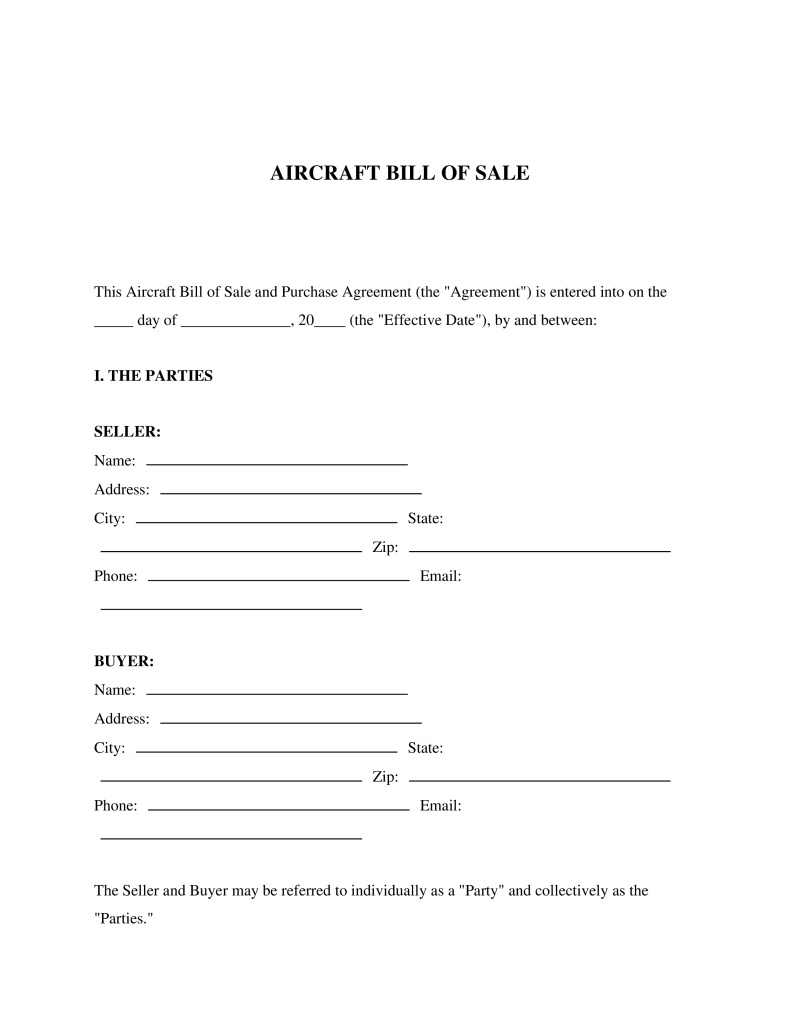
Aircraft Bill of Sale Sampe
Not the form you're looking for?
Try our legal document generator to create a custom document
Disclaimer: The templates available on this website are provided for general informational purposes only and do not constitute legal advice. They are not intended to be, and should not be interpreted as, compliant with any specific legal, regulatory, or privacy requirements. These templates are not a replacement for professional legal guidance and should not be relied upon for any particular matter or circumstance. Users are strongly encouraged to seek advice from a qualified attorney licensed in their jurisdiction before using, modifying, or relying on any template.
All templates are provided on an "as is," "with all faults," and "as available" basis. The provider disclaims any and all warranties of any kind, whether express, implied, statutory, or otherwise, including without limitation warranties of merchantability, fitness for a particular purpose, title, or non-infringement.
LegalTemplates.com makes no guarantees or representations regarding the accuracy, completeness, expected outcomes, or reliability of the materials contained in these templates or any materials referenced or linked from them.