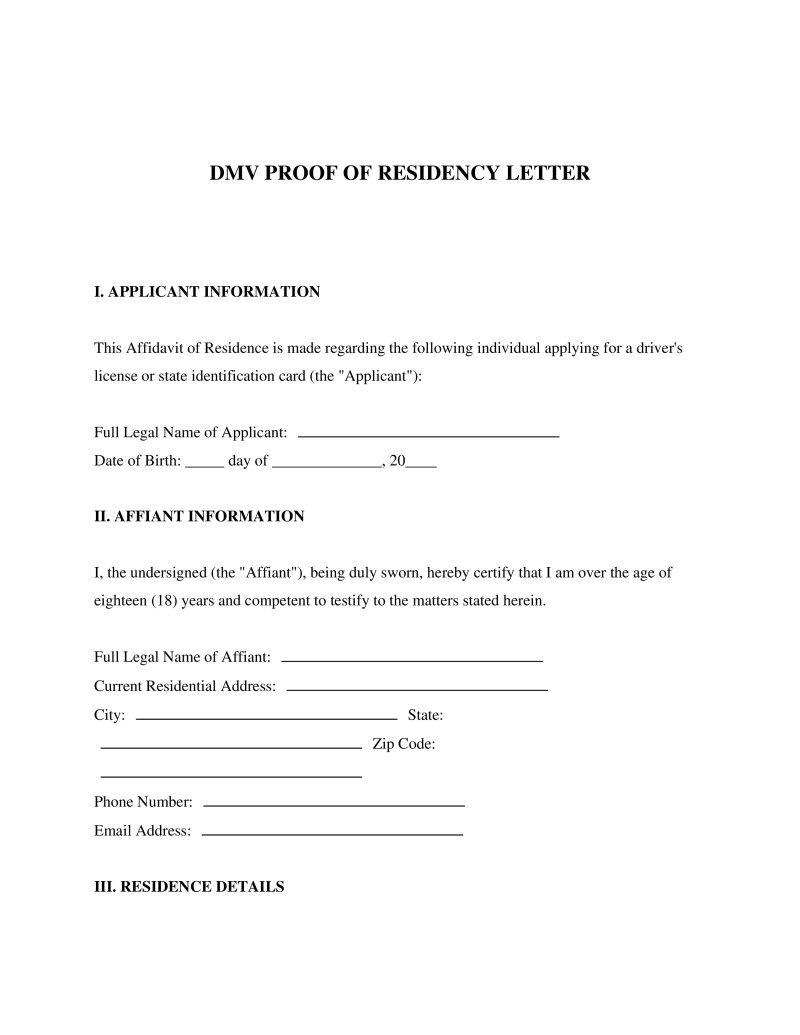
DMV Proof of Residency (Address) Letter
A DMV Proof of Residency Letter verifies an individual's address, often required for obtaining or renewing a driver's license or ID card.
Applicant Is Self Or Other
Select 'Yes' if you are the individual applying for a DMV document. Select 'No' if you are completing this letter on behalf of someone else.
Table of Contents
What is a DMV Proof of Residency (Address) Letter?
A DMV Proof of Residency Letter is a formal document used to verify an individual's physical address for various Department of Motor Vehicles (DMV) services, such as obtaining a driver's license, state identification card, or registering a vehicle. This letter serves as a crucial piece of evidence, particularly when an applicant may not have traditional proofs of residency, like utility bills or rental agreements, in their name. Its primary purpose is to establish that an individual physically resides at a specific address within a state, fulfilling a fundamental requirement for legal identification and vehicle operations.
Legal Requirements
Key requirements for a valid DMV Proof of Residency Letter typically include:
- Issuer Credibility - The letter must be issued by a verifiable third party, such as a landlord, property manager, employer, school administrator, shelter official, or government agency.
- Applicant Identification - The letter must clearly state the full legal name of the applicant as it appears on their other identification documents.
- Physical Address Confirmation - It must explicitly confirm that the applicant resides at the specified physical residential address within the state. Post office boxes are generally not acceptable as primary residential addresses.
- Date of Issuance - The letter must include the date it was written, and most DMVs require that it be dated within a specific recent timeframe, often 30 to 90 days prior to the application date.
- Issuer's Information - The letter must provide the full name, title, physical address, and contact telephone number of the person or entity issuing the letter.
- Issuer's Relationship to Applicant - It should clearly state the nature of the relationship between the issuer and the applicant (e.g., landlord-tenant, employer-employee, school-student).
- Original Signature - The letter generally requires an original, wet signature from the issuer. Facsimile or photocopied signatures are often not accepted.
- Notarization - Some states or specific circumstances may require the letter to be notarized, adding an additional layer of verification to the issuer's signature.
Failure to adhere to these stipulations can result in the rejection of the letter by the DMV, delaying the processing of the applicant's driver's license, ID card, or vehicle registration.
Rights and Obligations of Parties Involved
Applicant's Rights and Obligations:
- Right to Apply - Individuals have the right to apply for state-issued identification and driving privileges, provided they meet all statutory requirements, including proof of residency.
- Right to Privacy - Applicants have a right to the privacy of their personal information submitted to the DMV, subject to applicable federal and state privacy laws.
- Obligation to Provide Accurate Information - Applicants are legally obligated to provide truthful and accurate information regarding their residency. Submitting false information can lead to severe penalties, including fines, imprisonment, and denial or revocation of driving privileges.
- Obligation to Present Valid Documentation - It is the applicant's responsibility to ensure that all submitted documents, including the proof of residency letter, meet the DMV's specific requirements for validity and recency.
DMV's Rights and Obligations:
- Right to Request Proof - The DMV has the right to demand sufficient proof of residency to ensure compliance with state laws and federal mandates, such as the REAL ID Act.
- Right to Verify Information - The DMV is authorized to verify the authenticity of all submitted documents and the information contained within them, including contacting the issuer of a residency letter.
- Obligation to Process Applications Fairly - The DMV is obligated to process all applications for licenses, ID cards, and registrations in a fair, consistent, and non-discriminatory manner, adhering to established legal procedures.
- Obligation to Protect Data - The DMV has an obligation to protect the personal information it collects from applicants, in accordance with state and federal data privacy laws.
Letter Issuer's Rights and Obligations:
- Right to Refuse - An individual or entity is generally not legally obligated to write a proof of residency letter if they are uncomfortable vouching for someone's residency or if the individual does not genuinely reside at the address.
- Obligation to Provide Accurate Information - If a letter is issued, the issuer has a moral and potentially legal obligation to provide truthful and accurate information. Providing false information knowingly can expose the issuer to legal consequences.
- Obligation to Respond to Verification - The issuer may be contacted by the DMV to verify the contents of the letter. Cooperating with such inquiries helps ensure the integrity of the process.
How to Complete
- Identify the Appropriate Issuer - Determine who can legitimately vouch for your residency. This could be a landlord, property manager, employer, school administrator, director of a homeless shelter, or a government agency. The issuer must have direct knowledge of your residency at the specified address. Ensure they are willing and able to provide accurate information.
- Gather Necessary Information - Collect all pertinent details required for the letter. This includes your full legal name, the complete physical residential address, and the approximate dates you have resided or will reside there. Also, gather the full legal name, title, organization name (if applicable), physical address, and a verifiable contact phone number for the person who will be writing and signing the letter.
- Draft the Letter's Content - Begin the letter with a professional salutation to the "Department of Motor Vehicles" or "To Whom It May Concern." Clearly state that the purpose of the letter is to confirm the residency of the applicant. Include the applicant's full name and explicitly state that they reside at the specified address. It is beneficial to mention the duration or specific dates of residency if known.
- Include Issuer's Credentials and Contact Information - The letter must clearly identify the issuer. This includes their full legal name, their official title (e.g., "Landlord," "Employer," "Shelter Director"), the name of their organization (if applicable), their complete mailing address, and a reliable contact telephone number where they can be reached for verification. This information is critical for the DMV to authenticate the letter.
- Sign and Date the Letter - The issuer must sign the letter with an original, "wet" signature. Digital or photocopied signatures are often not accepted. The letter must also be dated on the day it is signed. Ensure the date is recent, as DMVs typically require residency proofs to be no older than 30-90 days.
- Consider Notarization (If Required) - Check your state's specific DMV requirements to determine if notarization is mandatory for a proof of residency letter. If so, the issuer must sign the letter in the presence of a notary public, who will then affix their seal and signature, further authenticating the document. Notarization adds an extra layer of legal verification.
- Submit with Other Required Documents - Once completed and, if necessary, notarized, the DMV Proof of Residency Letter should be submitted to the DMV along with all other identification, eligibility, and application documents required for your specific service (e.g., driver's license application, vehicle registration). Keep a copy for your records.
Required Elements of a Valid DMV Proof of Residency (Address) Letter
For a DMV Proof of Residency Letter to be accepted by state authorities, it must contain several critical pieces of information. These elements ensure the document's authenticity and provide the necessary verifiable details to confirm an applicant's address.
- Applicant's Full Legal Name - The complete name of the individual seeking DMV services, matching other identification.
- Applicant's Physical Residential Address - The full street address, city, state, and ZIP code where the applicant currently resides. P.O. boxes are typically not accepted.
- Date the Letter was Issued - The exact date on which the letter was written and signed. DMVs often have strict recency requirements (e.g., within 30-90 days).
- Full Legal Name of the Issuer/Verifier - The complete name of the person or entity providing the residency verification.
- Issuer's Relationship to the Applicant - A clear statement defining how the issuer knows the applicant's residency (e.g., landlord, employer, family member if permitted, shelter administrator).
- Issuer's Verifiable Contact Information - This includes the issuer's mailing address, telephone number, and potentially an email address, allowing the DMV to contact them for verification.
- Original Signature of the Issuer - A handwritten, non-reproduced signature of the person issuing the letter.
- Explicit Statement of Residency - A clear and unambiguous sentence confirming that the applicant resides at the stated address.
- Notary Public's Seal and Signature - If required by the specific state's DMV, the letter must bear the official seal and signature of a notary public, confirming the issuer's identity and signature.
Federal and State Laws Governing Residency Verification
The requirements for proving residency, particularly for official identification documents, are shaped by both federal mandates and specific state statutes. These laws aim to standardize identification processes and prevent identity fraud.
Federal Regulatory Context
Several federal laws and initiatives influence how states manage residency verification for DMV services:
- REAL ID Act of 2005 - Establishes minimum security standards for state-issued driver's licenses and identification cards and prohibits federal agencies from accepting, for certain purposes, licenses and identification cards from states that do not meet the Act's minimum standards (Public Law 109-13). This act is a primary driver for stringent residency verification requirements, as it mandates states to confirm an applicant's identity and lawful status, which includes proving a physical address.
- Privacy Act of 1974 - Governs the collection, maintenance, use, and dissemination of personally identifiable information by federal agencies (5 U.S.C. § 552a). While primarily for federal agencies, its principles often influence state data handling practices, including how DMVs manage applicant information.
- Identity Theft and Assumption Deterrence Act of 1998 - Makes it a federal crime to knowingly transfer or use, without lawful authority, a means of identification of another person with the intent to commit, or to aid or abet, any unlawful activity that constitutes a violation of federal law, or that constitutes a felony under any applicable state or local law (18 U.S.C. § 1028). This act underscores the seriousness of identity fraud, which robust residency verification helps to prevent.
State-Specific Residency Statutes and Penalties
Each state enacts its own statutes and administrative codes to detail the specific acceptable proofs of residency and the consequences for non-compliance or fraudulent submissions. These state laws often build upon federal guidelines.
- State Vehicle Codes and Administrative Regulations - Most states have comprehensive vehicle codes or administrative rule sets that explicitly list acceptable documents for proving residency for driver's licenses, ID cards, and vehicle registrations (e.g., California Vehicle Code § 12800.5 outlines residency requirements, and New York Vehicle and Traffic Law § 502 details application procedures including proof of residency). These regulations typically specify the types of documents, their recency, and any notarization requirements.
- Perjury and False Statement Statutes - State laws widely criminalize the act of making false statements or committing perjury on official government documents or under oath (e.g., Cal. Penal Code § 118 for perjury; Texas Penal Code § 37.02 for perjury). Submitting a fraudulent DMV Proof of Residency Letter or any other false information to the DMV can lead to severe penalties.
- Penalties for Fraudulent Submissions - Individuals who knowingly submit false or fraudulent residency documents to the DMV face significant legal repercussions. These penalties can include:
- Fines - Substantial monetary fines, often ranging from hundreds to thousands of dollars.
- Imprisonment - Jail time, particularly for repeat offenses or severe cases of fraud, classified as misdemeanors or felonies depending on state law.
- License/ID Denial or Revocation - Immediate denial of the application or revocation of any existing driver's license or state identification card.
- Driving Privileges Suspension - Suspension of driving privileges for a specified period.
- Felony Charges - In cases involving organized fraud or multiple false identities, individuals may face felony charges with prolonged prison sentences.
- Uniform Residential Landlord and Tenant Act (URLTA) - While not directly governing DMV proof of residency, URLTA (adopted in modified forms by many states) outlines the rights and responsibilities of landlords and tenants, which can indirectly affect the issuance of residency letters by landlords. For instance, a landlord's obligation to maintain accurate tenant records can support the veracity of a residency letter.
Frequently Asked Questions
Not the form you're looking for?
Try our legal document generator to create a custom document
Disclaimer: The templates available on this website are provided for general informational purposes only and do not constitute legal advice. They are not intended to be, and should not be interpreted as, compliant with any specific legal, regulatory, or privacy requirements. These templates are not a replacement for professional legal guidance and should not be relied upon for any particular matter or circumstance. Users are strongly encouraged to seek advice from a qualified attorney licensed in their jurisdiction before using, modifying, or relying on any template.
All templates are provided on an "as is," "with all faults," and "as available" basis. The provider disclaims any and all warranties of any kind, whether express, implied, statutory, or otherwise, including without limitation warranties of merchantability, fitness for a particular purpose, title, or non-infringement.
LegalTemplates.com makes no guarantees or representations regarding the accuracy, completeness, expected outcomes, or reliability of the materials contained in these templates or any materials referenced or linked from them.