ATV Bill of Sale
An ATV Bill of Sale is a legal document that records the sale and transfer of ownership of an all-terrain vehicle.
Atv Condition
Select the current condition of the ATV at the time of sale.
Include details about wear, damage, repairs, or modifications.
Table of Contents
What is an ATV Bill of Sale?
An ATV Bill of Sale is a legally binding document that records the transfer of ownership of an All-Terrain Vehicle (ATV) from a seller to a buyer. This document serves as a formal agreement, detailing the transaction particulars and providing proof of purchase. It is primarily used to establish legal ownership, facilitate vehicle registration with state authorities, and protect both parties by documenting the terms of the sale.
Legal Significance and Purpose
The ATV Bill of Sale holds significant legal weight beyond a simple receipt. It is a critical instrument for establishing clear ownership and can be essential for various administrative and legal processes. Without a properly executed bill of sale, a buyer may encounter difficulties registering the ATV, obtaining insurance, or proving ownership in case of theft or dispute. For the seller, it provides documented proof that the ATV has been sold, thereby transferring liability and future responsibilities.
Key purposes of an ATV Bill of Sale include:
- Proof of Ownership - Serves as the primary legal document demonstrating that the buyer has acquired legal title to the ATV.
- Liability Transfer - Formalizes the date and time of sale, transferring responsibility for the ATV from the seller to the buyer. This is crucial for accident liability, fines, or other incidents occurring post-sale.
- Registration and Titling - Many states require an ATV Bill of Sale to complete the registration process, obtain a new title, or transfer an existing title into the buyer's name.
- Sales Tax Calculation - Provides the official purchase price, which is used by state revenue departments to calculate applicable sales taxes.
- Dispute Resolution - In the event of a dispute between the buyer and seller regarding the ATV's condition, price, or terms of sale, the bill of sale acts as a written record of the agreement.
- Lien Release Documentation - If the ATV had a lien, the bill of sale can complement a lien release document by confirming the full payment and transfer of unencumbered ownership.
Required Elements of a Valid ATV Bill of Sale
For an ATV Bill of Sale to be considered legally valid and effective, it must contain several essential pieces of information. The inclusion of these details ensures clarity, prevents misunderstandings, and provides a comprehensive record of the transaction. Omitting critical elements can invalidate the document or lead to legal complications.
- Date of Sale - The exact calendar date on which the ownership transfer occurs.
- Buyer's Information - Full legal name, current address, and contact information of the person or entity purchasing the ATV.
- Seller's Information - Full legal name, current address, and contact information of the person or entity selling the ATV.
- ATV Description - Comprehensive details about the ATV being sold, including its make, model, year, Vehicle Identification Number (VIN), engine size, color, and odometer reading (if applicable).
- Purchase Price - The agreed-upon monetary amount for the ATV, clearly stated in both numerical and written form, along with the currency.
- Payment Method - Specification of how the payment was made (e.g., cash, check, money order, bank transfer).
- Condition of Sale - A statement indicating whether the ATV is sold "as-is" or with a warranty. An "as-is" clause typically means the buyer accepts the ATV in its current condition with no guarantees from the seller.
- Signatures of Parties - Original signatures of both the buyer and the seller, affirming their agreement to the terms outlined in the bill of sale.
- Witness Signatures (Optional but Recommended) - Signatures of one or more impartial witnesses to the transaction, which can add an extra layer of authenticity and legal weight.
- Notary Acknowledgment (Optional but Recommended) - A notary public's seal and signature, verifying the identities of the signing parties. This is required in some jurisdictions for title transfers.
How to Complete an ATV Bill of Sale
Completing an ATV Bill of Sale involves several straightforward steps to ensure all necessary information is accurately recorded and the document is legally sound. Following this process carefully helps protect both the buyer and the seller.
- Gather Necessary Information - Before beginning, collect all relevant details for both the buyer and seller, including full legal names, addresses, and contact numbers. Obtain the ATV's complete information, such as its make, model, year, VIN, engine size, and any current odometer reading. Having this information readily available streamlines the document preparation.
- Fill in the ATV Details - Accurately transcribe all identifying information about the ATV onto the bill of sale form. The Vehicle Identification Number (VIN) is particularly crucial as it uniquely identifies the specific ATV and must match any existing title or registration documents. Double-check all entries for accuracy to prevent future discrepancies.
- Specify the Purchase Price and Payment Terms - Clearly state the agreed-upon sale price in both numerical and written format to avoid any ambiguity. Indicate the method of payment, whether it is cash, a cashier's check, or another form of tender. If there are any specific payment terms, such as a deposit or installment plan, these should also be detailed.
- Include "As-Is" Clause or Warranty Information - Most private ATV sales are "as-is," meaning the buyer accepts the vehicle in its current condition without any implied or express warranties from the seller. If this is the case, ensure an "as-is" clause is explicitly stated. If any warranty is offered, its terms and duration must be clearly outlined.
- Execute Signatures and Dating - Both the buyer and the seller must sign and date the ATV Bill of Sale. This act formally acknowledges their agreement to the terms of the transaction. It is advisable to sign in the presence of each other to confirm identities and witness the execution of the document.
- Consider Witness or Notary Acknowledgment - While not always legally mandated, having one or more impartial witnesses sign the bill of sale can strengthen its validity. For added legal security, especially in states requiring it for title transfer, consider having the document notarized by a public notary. The notary's seal confirms the identities of the signers.
- Distribute Copies - After the document is fully executed, ensure that both the buyer and the seller receive an original signed copy of the ATV Bill of Sale. The buyer will need their copy for registration and titling purposes, while the seller will retain their copy as proof of sale and transfer of liability.
Rights and Obligations of Parties
The ATV Bill of Sale delineates the specific rights and obligations of both the buyer and the seller, ensuring a fair and transparent transaction. Understanding these roles is essential for a smooth transfer of ownership and to prevent future legal disputes.
- Seller's Obligations - The seller is generally obligated to provide a clear title to the ATV, free of any undisclosed liens or encumbrances. They must accurately represent the ATV's condition and history to the best of their knowledge, avoiding fraudulent misrepresentations. Upon sale, the seller is responsible for delivering the ATV and any associated keys or accessories to the buyer.
- Seller's Rights - The seller has the right to receive the agreed-upon purchase price for the ATV. They also have the right to transfer legal ownership and liability of the ATV to the buyer upon completion of the sale, as documented by the bill of sale.
- Buyer's Obligations - The buyer is obligated to pay the agreed-upon purchase price for the ATV according to the specified payment terms. Following the purchase, the buyer is responsible for registering the ATV in their name with the appropriate state authorities and fulfilling any applicable sales tax requirements.
- Buyer's Rights - The buyer has the right to receive the ATV in the condition as represented by the seller and as stated in the bill of sale, especially if an "as-is" clause is not present or if fraud is involved. They are entitled to a clear title that allows them to register the ATV in their name. The buyer also gains full legal ownership and possession of the ATV upon completion of the sale.
Applicable Laws and Regulations
The sale and transfer of ATVs are governed by a combination of state and, to a lesser extent, federal laws. These regulations are in place to protect consumers, ensure proper titling, and facilitate tax collection.
Federal Laws and Uniform Acts
While no specific federal statute directly governs the private sale of an ATV, the principles of contract law and sales of goods are broadly informed by uniform acts adopted at the state level.
- Uniform Commercial Code (UCC) Article 2 - Sales - This uniform act, adopted by all U.S. states in some form, governs the sale of goods, including ATVs. It establishes rules for contract formation, warranties, and remedies for breach of contract (UCC § 2-101 et seq.).
State Laws and Requirements
State laws are the primary regulatory framework for ATV sales, registration, and titling. These laws vary significantly from state to state.
- Vehicle Titling and Registration Laws - Most states require ATVs to be titled and registered, especially if they are operated on public lands or roads. These laws dictate the process for transferring titles, deadlines for registration, and the documents required, including an ATV Bill of Sale (e.g., California Vehicle Code § 38010 et seq. for Off-Highway Vehicles).
- Sales Tax Laws - States impose sales tax on the purchase of ATVs, and the bill of sale serves as evidence of the purchase price for tax calculation. Buyers are typically responsible for remitting sales tax to the state Department of Revenue or equivalent agency (e.g., Texas Tax Code § 152.001 et seq. for Motor Vehicle Sales Tax).
- Consumer Protection Laws - While primarily applicable to licensed dealerships, state consumer protection statutes can apply to private ATV sales in cases of fraud, misrepresentation, or hidden defects that materially affect the vehicle's value or safety. These laws aim to prevent deceptive trade practices (e.g., Florida Deceptive and Unfair Trade Practices Act, Fla. Stat. § 501.201 et seq.).
- Fraud Statutes - State criminal and civil fraud statutes can be invoked if a seller intentionally misrepresents the condition, history, or ownership of an ATV in the bill of sale or during the sale process, leading to financial harm for the buyer (e.g., New York Penal Law § 190.65 for Grand Larceny by False Pretenses).
- Lien Perfection and Release Laws - If an ATV is subject to a lien, state laws govern how that lien is recorded and how it must be released upon full payment to ensure a clear title transfer to the new owner (e.g., Uniform Certificate of Title Act, adopted in various forms by states).
Penalties for non-compliance with these laws can range from civil fines for failure to register or pay taxes to more severe criminal charges for fraud or selling a stolen vehicle. Buyers who fail to register an ATV within the prescribed timeframe may incur late fees. Sellers who fail to disclose known defects or provide a clear title may face civil lawsuits for damages.
Frequently Asked Questions
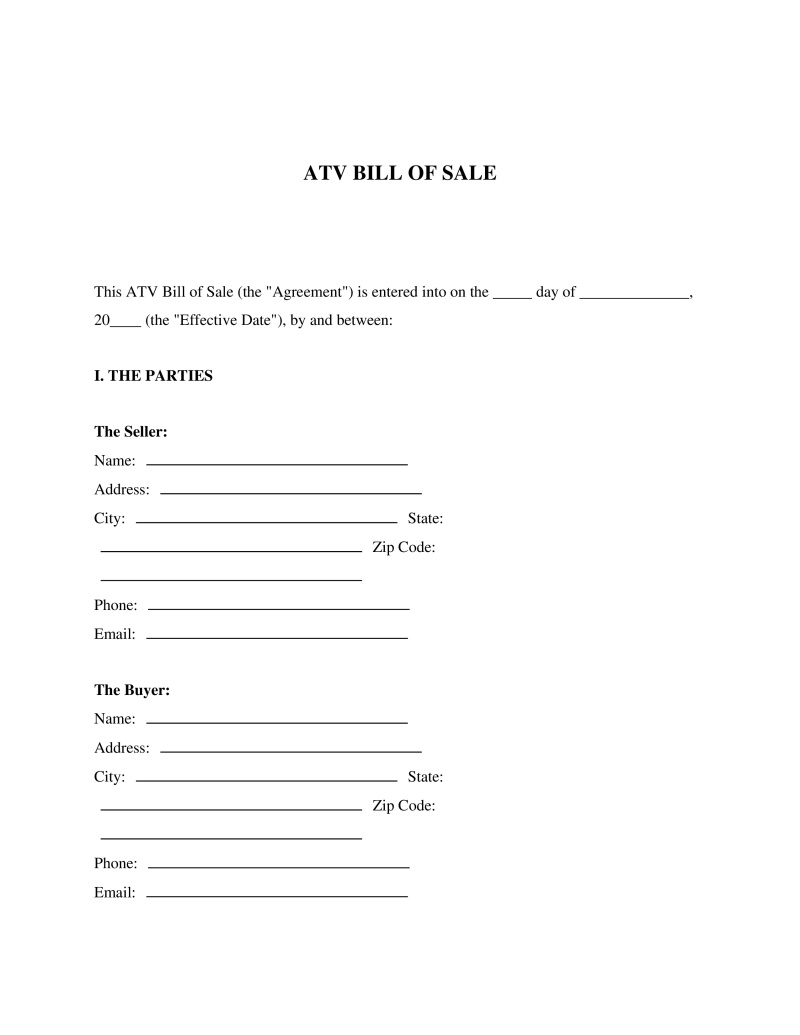
ATV Bill of Sale Sample
Already have a Bill of Sale?
Get it reviewed free — checked against your state's laws in about a minute.
Not the form you're looking for?
Try our legal document generator to create a custom document
Disclaimer: The templates available on this website are provided for general informational purposes only and do not constitute legal advice. They are not intended to be, and should not be interpreted as, compliant with any specific legal, regulatory, or privacy requirements. These templates are not a replacement for professional legal guidance and should not be relied upon for any particular matter or circumstance. Users are strongly encouraged to seek advice from a qualified attorney licensed in their jurisdiction before using, modifying, or relying on any template.
All templates are provided on an "as is," "with all faults," and "as available" basis. The provider disclaims any and all warranties of any kind, whether express, implied, statutory, or otherwise, including without limitation warranties of merchantability, fitness for a particular purpose, title, or non-infringement.
LegalTemplates.com makes no guarantees or representations regarding the accuracy, completeness, expected outcomes, or reliability of the materials contained in these templates or any materials referenced or linked from them.